
Autonomous IT Operations Market Report Scope and Overview:
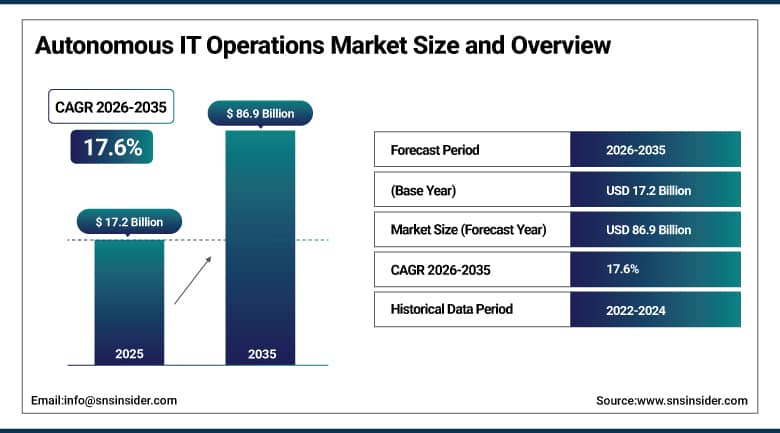
The Autonomous IT Operations Market was valued at USD 17.2 Billion in 2025 and is projected to reach USD 86.9 Billion by 2035, registering a CAGR of 17.6% from 2026 to 2035.
The autonomous IT operations market growth is being driven by the rising complexity of hybrid and multi-cloud IT environments, which is generating volumes of operational data that traditional, rules-based monitoring tools can no longer process fast enough to prevent service disruption. Growing enterprise adoption of machine learning and generative AI for automated anomaly detection, root cause analysis, and self-healing incident remediation is expanding the addressable use case beyond passive monitoring toward genuinely autonomous operational decision-making. Additional momentum is coming from rising IT talent shortages that are pushing organizations toward platforms capable of reducing manual intervention, alongside growing vendor investment in causal and generative AI models purpose-built for IT operations workflows.
Dynatrace expanded the causal and generative AI capabilities within its Davis AI engine in 2025 extending automated root cause determination and proactive remediation guidance across increasingly complex hybrid-cloud customer environments.
To Get More Information On Autonomous IT Operations Market - Request Free Sample Report
Autonomous IT Operations Market Trends
-
Growing integration of generative AI assistants into IT operations platforms continues accelerating root-cause analysis and remediation workflows.
-
Rising enterprise migration from on-premises monitoring toward cloud-native autonomous operations platforms continues reshaping deployment preferences.
-
Expanding vendor consolidation through acquisitions of specialized observability and automation start-ups continues broadening platform capabilities.
-
Increasing adoption among mid-sized enterprises continues widening the market beyond its traditional large-enterprise customer base.
-
Growing use of AI agents for autonomous incident remediation continues reducing average incident resolution times across enterprise IT environments.
U.S. Autonomous IT Operations Market Outlook
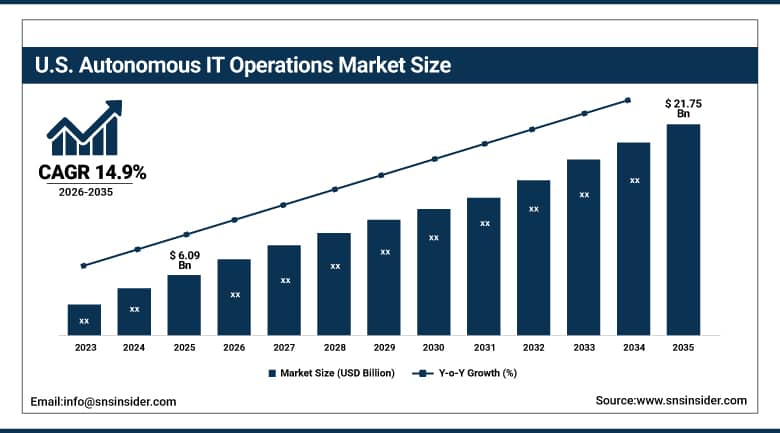
The U.S. Autonomous IT Operations Market was valued at approximately USD 6.09 Billion in 2025 and is projected to reach approximately USD 21.75 Billion by 2035, registering a CAGR of approximately 14.9% from 2026 to 2035.
The U.S. market is underpinned by a dense concentration of hyperscale cloud providers, enterprise software vendors, and large-scale IT environments that generate the operational data volumes autonomous platforms are specifically designed to manage. Growing federal-agency modernization initiatives, alongside sustained enterprise capital investment in AI-driven observability tools, continue to support strong domestic demand. A concentration of established monitoring and observability vendors headquartered domestically, combined with continued venture investment in newer AI-native operations start-ups, is keeping the United States the largest and most competitive market for autonomous IT operations platforms globally.
ServiceNow expanded its AI Agent Orchestrator capability within its IT Operations Management suite in 2025, enabling coordinated autonomous incident triage and remediation across interconnected enterprise IT workflows.
Autonomous IT Operations Market Segment Analysis
-
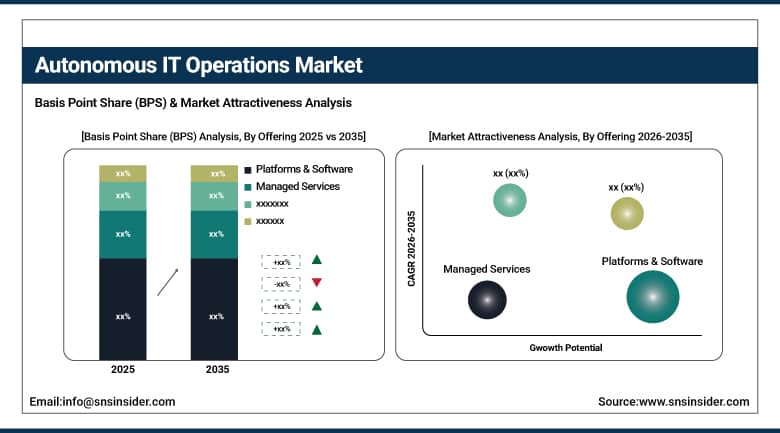
By Offering, Platforms & Software segment dominated the market in 2025 with 67% share; Managed Services segment is the fastest growing segment.
-
By Deployment Mode, On-Premises segment dominated the market in 2025 with 55% share; Cloud segment is the fastest growing segment.
-
By Application, Application Performance Management segment dominated the market in 2025 with 42% share; Root Cause Analysis & Anomaly Detection segment is the fastest growing segment.
-
By End-Use Industry, IT & Telecom segment dominated the market in 2025 with 30% share; BFSI segment is the fastest growing segment.
By Offering, Platforms & Software Lead, Managed Services Grow Fastest
The Platforms & Software segment accounted for the largest revenue share in 2025 owing to continuous investment from companies in platform licenses of observability and automation software, which can help ingest and correlate data generated in an increasingly distributed IT ecosystem. There has been continuous improvement in platform functionalities by vendors from anomalies detections to automatic fixing, eliminating the necessity of third-party integrations and platform licensing becoming the largest revenue generator in the whole industry.
Managed services is expected to witness the fastest growth as the increased demand for such services from mid-sized firms who do not have internal capabilities to manage their autonomous IT platforms independently. Many managed service providers are offering platform licenses with tuning, management of models, and overseeing incident response, helping such firms overcome the initial adoption challenge for autonomous IT platforms.
By Deployment Mode, On-Premises Retains Lead, Cloud Advances Fastest
The On-Premises segment held the largest deployment share reflecting continued reliance among large enterprises, particularly within regulated industries such as banking and government, on maintaining direct infrastructure control over sensitive operational data. Long procurement and compliance review cycles within these organizations have kept on-premises deployment the dominant model even as cloud-native alternatives continue expanding elsewhere in the market.
The Cloud segment is registering the fastest growth, supported by accelerating enterprise migration toward cloud-native and hybrid IT architectures that autonomous operations platforms are increasingly designed to monitor natively. Cloud deployment offers faster implementation timelines and easier access to vendor-managed AI model updates, both of which are proving particularly attractive to mid-sized enterprises adopting autonomous IT operations platforms for the first time.
By Application, Application Performance Management Leads, Root Cause Analysis Grows Fastest
The Application Performance Management segment led the market by application, reflecting its position as the most established and widely deployed use case within autonomous IT operations, spanning transaction tracing, latency monitoring and user-experience analytics across enterprise application environments. Long-standing vendor investment in this category has produced mature, broadly adopted tooling that continues to anchor overall category revenue.
The Root Cause Analysis & Anomaly Detection segment is expanding at the fastest pace, driven by growing enterprise demand for platforms capable of automatically correlating disparate signals across complex distributed systems to identify the true source of an incident rather than simply flagging symptoms. Advances in causal and generative AI are meaningfully improving the accuracy of automated root-cause determination accelerating adoption of this increasingly central autonomous operations capability.
By End-Use Industry, IT & Telecom Dominates, BFSI Expands Fastest
The IT & Telecom segment accounted for the largest end-use industry share, owing to the unique nature of the sector, being characterized by a very big and extensive infrastructure and the early adoption of automation tools. Telecommunications companies have invested heavily in such platforms owing to the nature of their network infrastructure.
The BFSI segment represents the fastest-growing end-use industry as it is influenced by the fact that financial institutions have become more concerned about downtime and the need to be resilient and available. The increase in investments towards autonomous IT operations platforms is aimed at meeting the needs of banks and other financial institutions.
Regional Insights
|
Region |
Major Country |
Share within Region, 2025 (%) |
|
North America |
United States |
86.00% |
|
Europe |
Germany |
21.50% |
|
Asia Pacific |
China |
30.80% |
|
Middle East and Africa |
UAE |
26.20% |
|
Latin America |
Brazil |
35.40% |
North America Autonomous IT Operations Market Insights
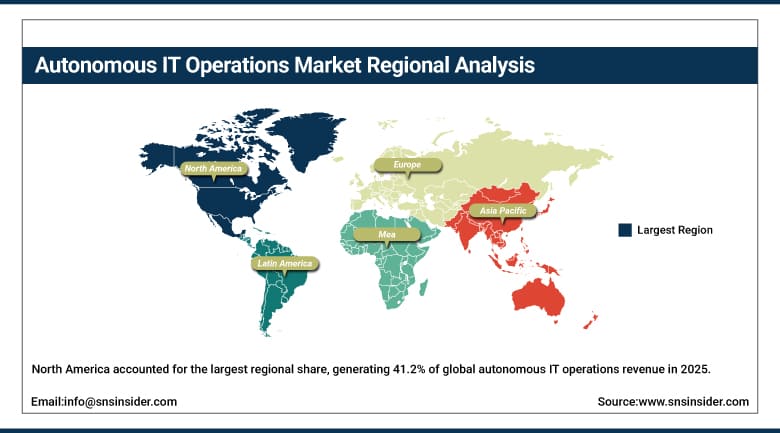
North America accounted for the largest regional share, generating 41.2% of global autonomous IT operations revenue in 2025. This leading status could be attributed to the abundance of hyperscale cloud players and enterprise software vendors in the region, coupled with early investments made by enterprises in AI-powered observability and automation solutions. The presence of robust enterprise IT budgets as well as complex and distributed infrastructures, continued to drive demand within the region.
The United States represented approximately 86.00% of North American revenue, driven by extensive hyperscale cloud infrastructure, a dense concentration of leading observability and automation vendors and sustained enterprise capital investment in AI-driven IT operations tooling. Canada contributed a smaller but steady share through growing enterprise and public-sector adoption, together keeping North America the largest addressable market for autonomous IT operations vendors.
Get Customized Report as Per Your Business Requirement - Enquiry Now
Europe Autonomous IT Operations Market Insights
Europe held a meaningful share of global revenue, supported by growing enterprise digital transformation initiatives and rising regulatory expectations around operational resilience across regulated industries including banking and telecommunications. Regional data residency and privacy requirements have shaped deployment preferences, with several enterprises favoring hybrid or on-premises configurations for sensitive operational data.
Germany accounted for approximately 21.50% of European revenue driven by a strong concentration of large industrial and financial services enterprises undergoing IT modernization. The UK and France contributed substantial additional demand and continued regional investment in cloud infrastructure is expected to support steady growth in autonomous IT operations adoption through the forecast period.
Asia Pacific Autonomous IT Operations Market Insights
Asia Pacific is projected to register the fastest regional growth, with a CAGR of 23.4% from 2026 to 2035. This expansion is being driven by rapid cloud infrastructure buildout, accelerating digital transformation across the region's largest economies, and growing enterprise investment in AI-driven IT automation as organizations scale increasingly complex hybrid-cloud environments.
China represented the largest share of regional revenue, supported by substantial domestic investment in cloud infrastructure and enterprise AI adoption across its large technology and telecommunications sector. India contributed meaningful additional demand given its rapidly expanding IT services industry, while Japan's advanced enterprise technology adoption continues to support steady regional platform investment.
MEA and Latin America Autonomous IT Operations Market Insights
The Middle East and Africa and Latin America together represent a comparatively smaller share of global revenue, though growth across both regions has remained steady, supported by expanding cloud infrastructure investment and growing enterprise digital transformation initiatives. In markets where enterprise IT modernization is still accelerating, autonomous operations platforms are increasingly viewed as a way to manage growing infrastructure complexity without proportionally expanding IT operations headcount.
The UAE led demand within Middle East and Africa, supported by substantial government and private-sector investment in cloud and digital infrastructure under national technology strategies. Saudi Arabia contributed further regional demand through its own digital transformation initiatives. Brazil accounted for the largest share within Latin America, where growing enterprise cloud adoption has continued to support demand for automated IT operations tooling.
Growth Drivers: Rising IT Complexity and Generative AI Integration
Growth is being driven by the rising complexity of hybrid and multi-cloud IT environments, which is generating operational data volumes that traditional rules-based monitoring tools can no longer process quickly enough to prevent service disruption. Growing enterprise adoption of machine learning and generative AI for automated anomaly detection, root cause analysis, and remediation is expanding the addressable use case well beyond passive monitoring toward genuinely autonomous operational decision-making.
Persistent IT talent shortages are further reinforcing this driver, as organizations increasingly turn to autonomous platforms capable of reducing the manual intervention that traditional IT operations teams can no longer keep pace with given the scale of modern infrastructure. Continued vendor investment in causal and generative AI models purpose-built for IT operations workflows is meaningfully improving remediation accuracy, reinforcing enterprise confidence in expanding autonomous decision-making authority.
Restraints: Integration Complexity and Trust in Autonomous Remediation
Integrating autonomous operations platforms across legacy and modern IT environments simultaneously remains a meaningful restraint, as many large enterprises operate a mix of infrastructure generations that autonomous platforms must be specifically configured to monitor and act upon reliably. This integration complexity can extend implementation timelines and increase the total cost of deployment relative to simpler, narrower monitoring tools.
Organizational reluctance to grant autonomous systems authority to take remediation action without human approval represents a further restraint, particularly within regulated industries where an incorrect automated action could itself trigger a compliance or service-availability incident. Building sufficient operational trust for enterprises to expand autonomous remediation scope beyond monitoring and recommendation remains an ongoing adoption hurdle for many vendors.
Opportunities: Mid-Market Expansion and AI Agent Orchestration
Expanding adoption among mid-sized enterprises represents a substantial growth opportunity as vendors increasingly package autonomous IT operations capability into more accessible, lower-complexity offerings suited to organizations without dedicated observability engineering teams. Vendors that successfully simplify deployment and reduce the specialized expertise required for effective use are well positioned to capture this expanding customer base.
A further opportunity lies in orchestrating multiple specialized AI agents across the broader IT operations workflow from detection through diagnosis to remediation, rather than automating each step in isolation. Vendors that successfully coordinate these capabilities into a genuinely autonomous, end-to-end operational loop stand to capture meaningful share as enterprises look to extend automation beyond today's largely advisory or semi-automated deployments.
Recent Developments:
-
2025: Dynatrace expanded the causal and generative AI capabilities within its Davis AI engine, extending automated root cause determination and proactive remediation guidance across increasingly complex hybrid-cloud customer environments.
-
2025: ServiceNow expanded its AI Agent Orchestrator capability within its IT Operations Management suite, enabling coordinated autonomous incident triage and remediation across interconnected enterprise IT workflows.
-
2026: Datadog extended the capabilities of its Bits AI assistant to support autonomous root-cause investigation across distributed cloud environments, aiming to shorten the path from anomaly detection to resolution.
Autonomous IT Operations Market key players are:
-
IBM Corporation
-
BMC Software, Inc.
-
Dynatrace, Inc.
-
Datadog, Inc.
-
New Relic, Inc.
-
ServiceNow, Inc.
-
Cisco Systems, Inc.
-
Open Text Corporation
-
Amazon Web Services, Inc.
-
Microsoft Corporation
-
Google LLC
-
HCL Technologies Limited
-
Dell Technologies Inc.
-
PagerDuty, Inc.
-
Zenoss, Inc.
-
eG Innovations, Inc.
-
Sumo Logic, Inc.
-
ScienceLogic, Inc.
Autonomous IT Operations Market Report Scope:
| Report Attributes | Details |
|---|---|
| Market Size in 2025 | USD 17.2 Billion |
| Market Size by 2035 | USD 86.9 Billion |
| CAGR | CAGR of 17.6% From 2026 to 2035 |
| Base Year | 2025 |
| Forecast Period | 2026-2035 |
| Historical Data | 2022-2024 |
| Report Scope & Coverage | Market Size, Segments Analysis, Competitive Landscape, Regional Analysis, DROC & SWOT Analysis, Forecast Outlook |
| Key Segments | • By Offering (Platforms & Software, Managed Services, Professional Services) • By Deployment Mode (On-Premises, Cloud, Hybrid) • By Application (Application Performance Management, Root Cause Analysis & Anomaly Detection, IT Service Management & Incident Automation, Network & Infrastructure Monitoring, Others) • By End-Use Industry (IT & Telecom, BFSI, Healthcare, Retail & E-commerce, Manufacturing, Others) |
| Regional Analysis/Coverage | North America (US, Canada), Europe (Germany, UK, France, Italy, Spain, Russia, Poland, Rest of Europe), Asia Pacific (China, India, Japan, South Korea, Australia, ASEAN Countries, Rest of Asia Pacific), Middle East & Africa (UAE, Saudi Arabia, Qatar, South Africa, Rest of Middle East & Africa), Latin America (Brazil, Argentina, Mexico, Colombia, Rest of Latin America). |
| Company Profiles | IBM Corporation, BMC Software, Inc., Dynatrace, Inc., Datadog, Inc., New Relic, Inc., ServiceNow, Inc., Elastic N.V., Cisco Systems, Inc., OpenText Corporation, Amazon Web Services, Inc., Microsoft Corporation, Google LLC, HCL Technologies Limited, Dell Technologies Inc., PagerDuty, Inc., LogicMonitor, Inc., Zenoss, Inc., eG Innovations, Inc., Sumo Logic, Inc., ScienceLogic, Inc. |

Frequently Asked Questions
Key players include IBM, BMC, Dynatrace, Datadog, New Relic, ServiceNow, Elastic, Cisco, AWS, Microsoft, Google, HCL, Dell, PagerDuty, LogicMonitor, Zenoss, eG Innovations, Sumo Logic, and ScienceLogic.
Key opportunities include expanding adoption among mid-sized enterprises and orchestrating multiple AI agents for end-to-end autonomous incident remediation across complex IT workflows.
Rising hybrid-cloud complexity, generative AI integration for automated anomaly detection and remediation, and persistent IT talent shortages are driving market growth significantly.
The Platforms & Software segment dominated the Autonomous IT Operations Market, accounting for approximately 67% market share in 2025.
North America dominated with a 41.2% share in 2025, driven by hyperscale cloud providers and early enterprise investment in AI-powered observability solutions.
