
Autonomous BVLOS Drone Market Report Scope & Overview:
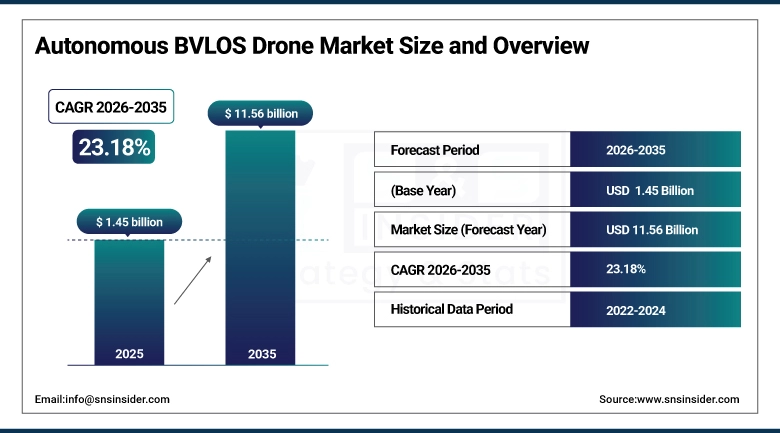
The Autonomous BVLOS Drone Market size is valued at USD 1.45 Billion in 2025 and is projected to reach USD 11.56 Billion by 2035, growing at a CAGR of 23.18% during the forecast period 2026–2035.
The market research report on the Autonomous BVLOS Drone Market analyzes key industry trends, autonomy advancements, regulatory developments, and application expansion across commercial and defense sectors. The increasing adoption of AI-enabled autonomous flight systems, rising demand for long-range unmanned surveillance and inspection solutions, growing integration of BVLOS drones in logistics and delivery networks, and expanding defense modernization programs are driving strong market growth from 2026 to 2035.
Usage of BVLOS-enabled autonomous drone operations is estimated to surpass 2.8 Billion mission deployments in 2025.
Market Size and Forecast:
-
Market Size in 2025: USD 1.45 Billion
-
Market Size by 2035: USD 11.56 Billion
-
CAGR: 23.18% from 2026 to 2035
-
Base Year: 2025
-
Forecast Period: 2026–2035
-
Historical Data: 2022–2024
To Get more information on Autonomous BVLOS Drone Market - Request Free Sample Report
Autonomous BVLOS Drone Market Trends:
-
Rising adoption of AI-enabled autonomous flight systems is accelerating fully automated BVLOS operations across commercial, defense, and industrial applications.
-
Expanding demand for long-range drone missions in logistics, delivery, and infrastructure inspection is driving rapid BVLOS deployment globally.
-
Increasing integration of drones into defense modernization programs and unmanned surveillance systems is significantly boosting market adoption.
-
Growing use of BVLOS drones in critical infrastructure monitoring (energy pipelines, utilities, telecom networks) is improving operational efficiency and reducing manual inspection costs.
-
Rapid advancements in 5G, satellite communication, and hybrid connectivity systems are enabling reliable real-time BVLOS operations over extended distances.
-
Rising adoption of drone-as-a-service (DaaS) and autonomous fleet-based business models is transforming enterprise-level drone deployment strategies.
-
Expansion of precision agriculture, smart city projects, and industrial automation is increasing multi-sector utilization of autonomous BVLOS drones.
U.S. Autonomous BVLOS Drone Market Insights:
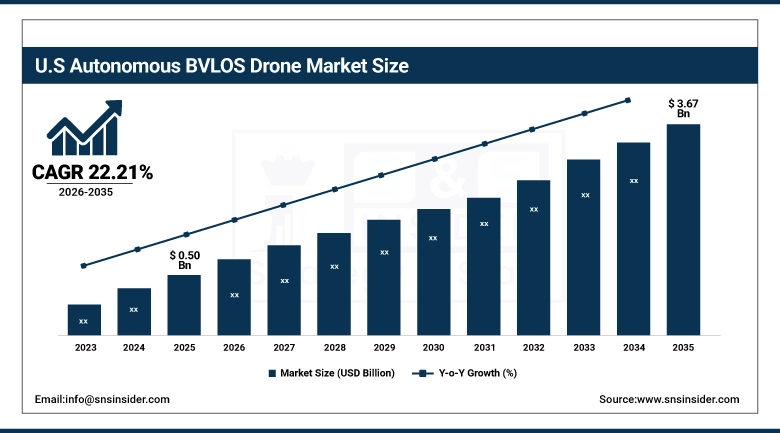
The U.S. Autonomous BVLOS Drone Market is projected to grow from USD 0.50 Billion in 2025 to USD 3.67 Billion by 2035, at a CAGR of 22.21%. Some of the drivers that will propel the industry's growth forward would be the widespread use of AI-powered autonomous drones in the military and commercial sector, the growing need for long-distance BVLOS missions in logistical and infrastructural inspections, and the constant improvement in communication technology like 5G, satellites, and detect-and-avoid systems making BVLOS flights much safer.
Autonomous BVLOS Drone Market Growth Drivers:
-
Rising demand for autonomous BVLOS drone systems across defense, logistics, and infrastructure inspection sectors is driving strong market expansion globally.
The rising demand for the use of UAVs for long-haul autonomous flights, real-time surveillance, and automatic data gathering is cited to be one of the key drivers contributing to the expansion of the autonomous BVLOS drones market. With the fast-paced adoption of artificial intelligence in flight management systems and detect-and-avoid capabilities, along with the implementation of satellite and 5G communications networks for drones, the need for better efficiency and safety arises.
More than 50% of defense surveillance and critical infrastructure inspection operations in 2025 are estimated to be supported by BVLOS-capable autonomous drone systems.
Autonomous BVLOS Drone Market Restraints:
-
High development and operational costs associated with autonomous BVLOS drone systems remain a key restraint for the Autonomous BVLOS Drone Market.
There are some barriers that small and medium businesses will likely have to overcome when implementing BVLOS flights, such as the expensive nature of AI-driven autonomous flight systems, detect and avoid solutions, satellite, and 5G communications technology, and certification. Moreover, the aviation safety rules, airspace approvals, and BVLOS implementation will make the deployment process longer and more costly. The constant software updates, cybersecurity measures, and calibration of sensors will add additional costs during the life cycle of BVLOS flights.
Autonomous BVLOS Drone Market Opportunities:
-
Rapid expansion of autonomous logistics networks and unmanned aerial delivery ecosystems presents a significant growth opportunity for the Autonomous BVLOS Drone Market.
BVLOS drones for last mile deliveries, critical emergency transport, and crucial supply chains have opened up a range of business opportunities. The government and commercial organizations are making serious investments in drone corridors, smart air mobility, and fleet management platforms that support large scale operations. Innovations in AI-based route planning, autonomous air traffic management, and real-time flight data analysis are also supporting operational capabilities.
Nearly 45% of emerging smart logistics and critical delivery programs globally are expected to integrate BVLOS-capable autonomous drone systems by 2025–2026.
Autonomous BVLOS Drone Market Segmentation Analysis:
-
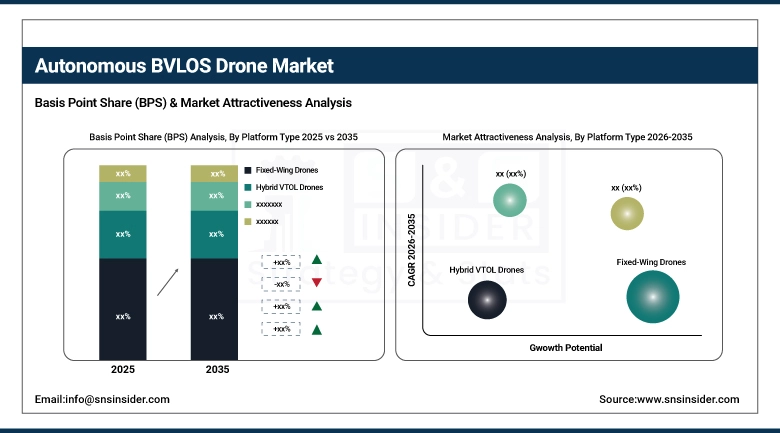
Fixed-Wing Drones Dominate the largest market share of 42.55% in 2025, while Hybrid VTOL Drones are expected to grow at the fastest CAGR of 26.46% during 2026–2035.
-
Infrastructure Inspection (Energy, Utilities, Telecom) Dominate the largest market share of 25.45% in 2025, while Infrastructure Inspection is also expected to grow at the fastest CAGR of 24.48% during 2026–2035.
-
Semi-Autonomous BVLOS Drones Dominate the largest market share of 62.85% in 2025, while Fully Autonomous BVLOS Drones (AI-enabled systems) are expected to grow at the fastest CAGR of 27.41% during 2026–2035.
-
Medium Range BVLOS (20–100 km) Dominate the largest market share of 40.21% in 2025, while Long Range BVLOS (100+ km) are expected to grow at the fastest CAGR of 24.15% during 2026–2035.
-
Defense & Military Dominate the largest market share of 34.51% in 2025, while Commercial Enterprises are expected to grow at the fastest CAGR of 23.35% during 2026–2035.
By Platform Type, Fixed-Wing Drones Dominate While Hybrid VTOL Drones Grow Rapidly:
Fixed-Wing Drones held the maximum market share as a result of the high endurance capacity, long-range flight ability, and applicability of such drones for long BVLOS flights during surveillance, mapping, and inspections.
The Hybrid VTOL Drones category will experience rapid growth because of the high demand for takeoff and landing flexibility and capability for long-range BVLOS flights. The growing use of Hybrid VTOL Drones in logistics, defense, and challenging urban mission scenarios has been facilitated by their runway-less flight capabilities.
By Application, Infrastructure Inspection Dominates While Also Growing Rapidly:
The Infrastructure Inspection (Energy, Utilities, Telecom) segment occupied the dominating position among other segments due to high demand for constant monitoring of oil and gas pipelines, electricity transmission lines, telecommunication tower sites, and industrial infrastructure. The growing need for affordable, efficient, and automated infrastructure inspection in inaccessible regions will continue to dominate the industrial sector.
The Infrastructure Inspection segment will record the fastest growth rate among all segments due to the rapid use of BVLOS drone technology for preventive maintenance and real-time monitoring of industrial infrastructure assets. The integration of artificial intelligence technology is also driving its growth.
By Autonomy Level, Semi-Autonomous BVLOS Drones Dominate While Fully Autonomous BVLOS Drones Grow Rapidly:
The Semi-autonomous BVLOS Drones segment accounted for the largest market share as the technology was being deployed widely in the early stages and was familiar to regulators. It was used in defense surveillance, industrial inspections, and commercial operations that need some human intervention for safe execution and adherence to regulatory standards.
The Fully Autonomous BVLOS Drones is fastest growing segment due to advances in the field of artificial intelligence and autonomous decision-making capabilities. Investments made into automation and advanced flight control technologies have been contributing significantly towards the growth of this segment.
By Range / Flight Endurance, Medium Range BVLOS Dominates While Long Range BVLOS Grows Rapidly:
The Medium Range BVLOS category remains dominant because of its most efficient combination of effectiveness, feasibility, and adaptability for various industrial, surveillance, and military tasks. Such a range segment will remain popular among customers as a tool for performing missions of moderate distance and high stability of operation and communications control.
Long Range BVLOS segment is the fastest-growing due to the increasing demands for more advanced drones capable of covering larger distances. The progress in satellite communication technologies, artificial intelligence-driven route optimization, and higher efficiency will make these drones operate with higher autonomy and safety at longer ranges.
By End-User, Defense & Military Dominates While Commercial Enterprises Grow Rapidly:
The Defense & Military segment dominates the market because of the heavy use of BVLOS drones in Intelligence Surveillance Reconnaissance (ISR). The continued investment by governments in unmanned aerial systems further strengthens the dominance of this industry.
Commercial Enterprises segment is the fastest-growing because of the integration of BVLOS drones in logistics and enterprise data services, infrastructure inspection, and energy management. An increased use of drone-as-a-service model contributes towards the growth of the industry.
Autonomous BVLOS Drone Market Regional Analysis:
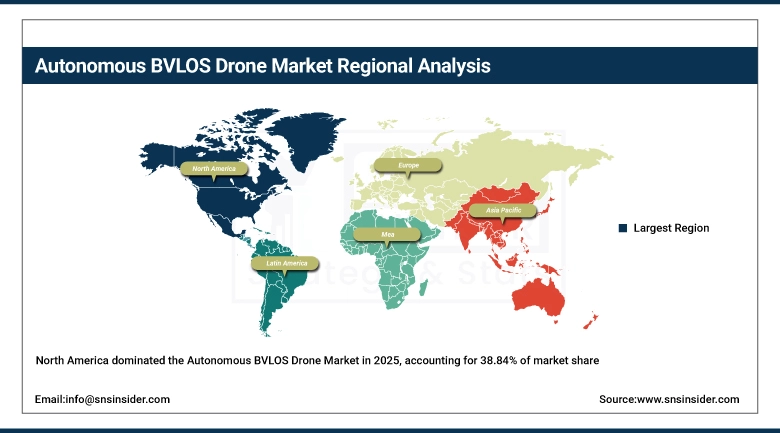
The North America Autonomous BVLOS Drone Market dominates, holding the 38.84% share in 2025, backed by advanced aerospace ecosystems, extensive programs for modernizing the defense capabilities of countries and early regulation in the approval of BVLOS in the United States and Canada. High usage rates of autonomous drones in infrastructure inspections, energy pipeline inspections, public safety, and logistics operations are contributing to regional dominance. The high presence of leading players in the market, significant funding from venture capital, and integration of drones in enterprise operations further contribute to dominance. Developments in autonomous flight technology, detect and avoid technologies, and satellite communication networks are helping in BVLOS drone deployment at scale.
Get Customized Report as per Your Business Requirement - Enquiry Now
U.S. Autonomous BVLOS Drone Market Insights:
The U.S. Autonomous BVLOS Drone Market holds dominant share in the region owing to high defense spending, growing regulatory initiatives for BVLOS flights by FAA, and increasing adoption in commercial sectors like logistics, energy inspections, and security surveillance. Adoption of fully autonomous drones in military intelligence operations, border monitoring and security, and infrastructural inspection and security operations are contributing majorly to its growth. Increasing investments from technology players in AI-based autonomous flight, drone fleet management, and aerial analytics technologies are further contributing to market growth.
Asia-Pacific Autonomous BVLOS Drone Market Insights:
The Asia-Pacific Autonomous BVLOS Drone Market is the fastest-growing region, projected to expand at a CAGR of 24.24% during 2026–2035. It is fueled by the fast growth of smart city infrastructures, heavy industrialization, and the adoption of drones for automation processes in logistics, agriculture, and surveillance applications. Nations including China, India, Japan, and South Korea are extensively investing in drone autonomy ecosystems for safety purposes, infrastructure developments, and delivery networks. The increased integration of artificial intelligence (AI)-driven navigational solutions, the rapid deployment of 5G networks, and governmental backing for unmanned aerial vehicles are boosting market growth in the region.
China Autonomous BVLOS Drone Market Insights:
The China Autonomous BVLOS Drone Market is witnessing tremendous growth owing to the extensive implementation of drone technology in industrial automation systems, surveillance systems, and smart city infrastructure developments. The presence of strong manufacturing capabilities within the nation for UAV systems and the fast progress in autonomous flight technologies driven by AI innovations is further boosting uptake.
Europe Autonomous BVLOS Drone Market Insights:
Europe Autonomous BVLOS Drone Market is being fueled by stringent aviation safety regulations, controlled airspace management, and robust industrial automation ecosystem. Countries like Germany, France, and the UK are using BVLOS drones in applications related to inspection of infrastructure, monitoring of renewable energy sources, and public safety surveillance among others. High emphasis on regulatory compliance, cybersecurity, and environmental sustainability is favoring uptake of advanced and safer autonomous flight platforms. Growth in smart mobility platforms, industrial automation, and development of cross-border drone corridors is further helping to drive growth within the Europe market.
Germany Autonomous BVLOS Drone Market Insights:
Germany is among major countries in Europe that adopt advanced autonomous BVLOS drones because of its strong industrial presence in areas of automotive manufacture, engineering, and power infrastructure. Applications for BVLOS drones include industrial inspection, logistics, and precise mapping. High investments in technologies associated with Industry 4.0 and automation are helping drive growth within the industry. Advanced aerospace engineering skills and regulatory compliance within the industry are adding to market growth potential.
Latin America Autonomous BVLOS Drone Market Insights:
The Latin America Autonomous BVLOS Drone Market is growing owing to increased utilization in agricultural surveys, mining, and infrastructure inspections in countries such as Brazil, Mexico, and Chile. The rising need for efficient remote monitoring of large areas through aerial surveys is resulting in higher utilization of BVLOS drones for various industrial applications. Increased availability of digital networks in addition to progressive developments in regulatory policies concerning drone operations is driving adoption within the region. Rising investments in agricultural applications and smart resource management solutions is also fueling demand for autonomous BVLOS drone technology.
Middle East & Africa Autonomous BVLOS Drone Market Insights:
The Middle East & Africa Autonomous BVLOS Drone Market is witnessing steady growth because of increased utilization in oil & gas industry infrastructure inspection, smart cities, and security applications. The region comprises countries such as the UAE, Saudi Arabia, and South Africa where investments are being made towards advanced drone technologies. Growth of smart infrastructure projects coupled with emphasis on digital transformation is propelling the growth of drones within the region. Increased utilization in border security applications and desert environment monitoring is further boosting market growth within the region.
Autonomous BVLOS Drone Market Competitive Landscape:
Skydio is one of the leading firms in the Autonomous BVLOS Drone Market that stands out for its highly advanced autonomous flight technology powered by artificial intelligence. It has a significant presence due to its proficiency in terms of obstacle avoidance, navigation, and remote operation services. The firm has a critical part to play in the provision of fully autonomous BVLOS services in both military, public safety, and corporate inspections. The firm’s focus on computer vision, AI, and drone autonomy platforms has led to its being an important innovation company within the UAS sector.
-
In September 2025, Skydio expanded its autonomous flight software suite with enhanced BVLOS mission planning capabilities, enabling longer-range operations with improved real-time obstacle detection and reduced operator intervention across defense and enterprise drone deployments.
Zipline is one of the world’s leading companies in terms of autonomous BVLOS drones for delivery purposes, having earned recognition through the commercial use of extensive logistics networks with drones that have a long range. The firm is one of the first companies to utilize the power of fully autonomous drones for logistical needs such as medical delivery, humanitarian aid, and retail delivery. What makes Zipline stand out is its capability to conduct many BVLOS flights with the precision of landing and automated dispatch, becoming one of the best logistics companies using drones worldwide.
-
In August 2025, Zipline launched its next-generation autonomous delivery platform featuring extended BVLOS range capabilities and improved AI-based fleet coordination, enabling faster delivery cycles for healthcare and commercial logistics networks across multiple regions.
Wing (Alphabet) is one of the best autonomous drone delivery companies owned by Alphabet Inc., providing services in the realm of scalable BVLOS technology in the last-mile deliveries sector. The company specializes in the integration of autonomous drones in urban and suburban logistics supply chains and the quick and efficient delivery of consumer products, meals, and medical supplies. The competitive advantage that Wing has over other autonomous drone delivery companies is attributed to its cutting-edge air traffic management, autonomous navigation systems, and real-time delivery optimization capabilities.
-
In July 2025, Wing (Alphabet) upgraded its autonomous delivery system with improved BVLOS flight routing algorithms and expanded operational zones, allowing higher delivery volumes and enhanced integration with urban air mobility infrastructure across key pilot markets.
Autonomous BVLOS Drone Market Key Players:
Some of the Autonomous BVLOS Drone Market Companies are:
-
Skydio
-
Zipline
-
Wing (Alphabet Inc.)
-
DJI
-
AeroVironment Inc.
-
General Atomics Aeronautical Systems Inc.
-
Lockheed Martin Corporation
-
Northrop Grumman Corporation
-
The Boeing Company
-
Airbus SE
-
Thales Group
-
BAE Systems plc
-
Elbit Systems Ltd.
-
Leonardo S.p.A.
-
Anduril Industries Inc.
-
Shield AI Inc.
-
Parrot Drones SAS
-
ideaForge Technology Ltd.
-
Quantum-Systems GmbH
-
Matternet Inc.
| Report Attributes | Details |
|---|---|
| Market Size in 2025 | USD 1.45 Billion |
| Market Size by 2035 | USD 11.56 Billion |
| CAGR | CAGR of 23.18% From 2026 to 2035 |
| Base Year | 2025 |
| Forecast Period | 2026-2035 |
| Historical Data | 2022-2024 |
| Report Scope & Coverage | Market Size, Segments Analysis, Competitive Landscape, Regional Analysis, DROC & SWOT Analysis, Forecast Outlook |
| Key Segments | • By Platform Type (Fixed-Wing Drones, Rotary-Wing (Multirotor) Drones, Hybrid VTOL Drones, Others) • By Application (Infrastructure Inspection (Energy, Utilities, Telecom), Logistics & Delivery, Surveillance & Security, Defense & Military Operations, Agriculture & Precision Farming, Mapping & Surveying, Others) • By Autonomy Level (Semi-Autonomous BVLOS Drones, Fully Autonomous BVLOS Drones (AI-enabled systems)) • By Range / Flight Endurance (Medium Range BVLOS (20–100 km), Short Range BVLOS (5–20 km), Long Range BVLOS (100+ km), Others) • By End-User (Defense & Military, Commercial Enterprises, Government & Public Safety Agencies, Industrial Operators (Oil & Gas, Mining, Utilities), Others) |
| Regional Analysis/Coverage | North America (US, Canada), Europe (Germany, UK, France, Italy, Spain, Russia, Poland, Rest of Europe), Asia Pacific (China, India, Japan, South Korea, Australia, ASEAN Countries, Rest of Asia Pacific), Middle East & Africa (UAE, Saudi Arabia, Qatar, South Africa, Rest of Middle East & Africa), Latin America (Brazil, Argentina, Mexico, Colombia, Rest of Latin America). |
| Company Profiles | Skydio, Zipline, Wing (Alphabet), DJI, AeroVironment, General Atomics Aeronautical Systems, Lockheed Martin, Northrop Grumman, Boeing, Airbus, Thales Group, BAE Systems, Elbit Systems, Leonardo S.p.A., Anduril Industries, Shield AI, Parrot Drones, ideaForge Technology, Quantum-Systems GmbH, Matternet |
Frequently Asked Questions
North America dominated with a 38.84% share in 2025, while Asia-Pacific is the fastest-growing region, expected to expand at a CAGR of 24.24% during 2026–2035.
Fixed-Wing Drones dominated with a 42.55% share in 2025, while Hybrid VTOL Drones are projected to grow at the fastest CAGR of 26.46% during 2026–2035.
Growth is driven by increasing adoption of AI-enabled autonomous flight systems for long-range operations, rising demand for BVLOS drones in defense surveillance, logistics.
The market is valued at USD 1.45 Billion in 2025 and is projected to reach USD 11.56 Billion by 2035.
The Autonomous BVLOS Drone Market is projected to grow at a CAGR of 23.18% during 2026–2035.
