
Zonal Autonomous Control Market Report Scope & Overview:
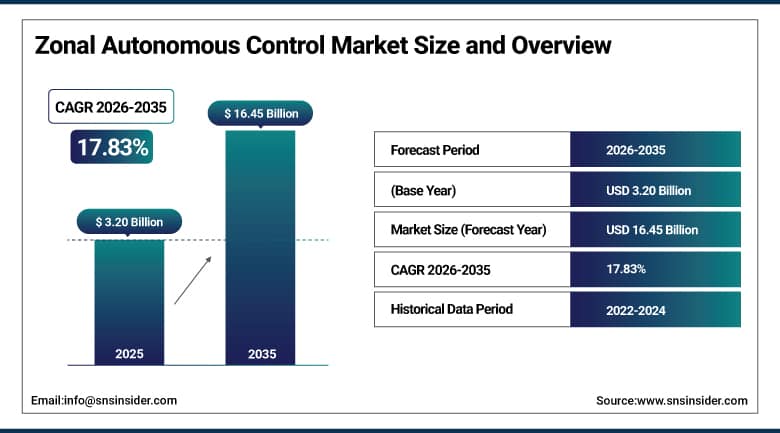
The Zonal Autonomous Control Market size was valued at USD 3.20 Billion in 2025 and is projected to reach USD 16.45 Billion by 2035, expanding at a CAGR of 17.83% during 2026–2035.
Zonal autonomous control market is expanding on account of increasing requirements for smart grid management, growing deployment of renewable energy sources, and the need to ensure improved power distribution reliability. More and more utilities are resorting to zonal autonomous control solutions to handle their energy grids, improve distributed energy resources management, and increase operational efficiency. Growth in the deployment of smart grids, increasing usage of electric cars, and development of decentralized power production, among others, are some factors that are contributing towards the rapid implementation of zonal control solutions. Moreover, developments in edge computing, real-time monitoring, and automated grid management solutions are helping utilities in enhancing resilience and cutting down the instances of blackouts.
At the World Utilities Congress in Abu Dhabi, in 2025, Schneider Electric unveiled its new One Digital Grid Platform, which has been developed using Microsoft Azure and incorporates ADMS, DERMS, and zonal autonomous control with AI analytics for predicting grid behavior and autonomous switching of energy zones.
Market Size and Forecast
-
Market Size in 2026E: USD 3.76 Billion
-
Market Size by 2035: 16.45 Billion
-
CAGR: 17.83% from 2026 to 2035
-
Fastest Growing Region: Asia Pacific
-
Largest Region: North America
To Get More Information On Zonal Autonomous Control Market - Request Free Sample Report
Zonal Autonomous Control Market Trends
-
Rising integration of renewable energy sources and distributed energy resources is increasing demand for autonomous control solutions that improve grid stability and operational efficiency.
-
Growing adoption of smart grids and digital utility infrastructure is accelerating the deployment of AI-enabled zonal control systems for real-time monitoring and automated decision-making.
-
Increasing investments in edge computing, IoT sensors, and advanced grid analytics are driving the integration of intelligent control platforms across power distribution networks.
-
Expansion of electric vehicle charging infrastructure and decentralized energy generation is creating demand for flexible zonal management solutions to balance localized power loads.
-
Strategic collaborations among utilities, technology providers, and energy solution companies are supporting the development of AI-driven, resilient, and energy-efficient autonomous grid control systems.
U.S. Zonal Autonomous Control Market Size Outlook
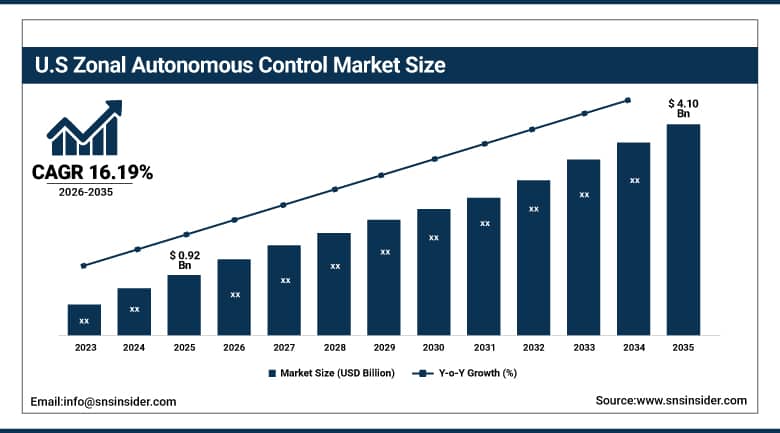
The U.S. Zonal Autonomous Control Market was valued at USD 0.92 Billion in 2025 and is projected to reach USD 4.10 Billion by 2035, registering a CAGR of 16.19% during 2026–2035.
The U.S. Zonal Autonomous Control Market is growing owing to the increasing adoption of distributed energy resources, rising investments in smart grid modernisation, and increasing demand for automated power network management solutions. Utilities across the nation are using advanced control technologies to increase grid reliability and operational efficiency as well as to manage complex flows of energy from renewables, electric vehicles and distributed generation systems. The use of artificial intelligence-enabled analytics, edge computing, IoT-enabled monitoring, and self-healing grid technology also drives the market growth. The push for clean energy and grid resilience also presents opportunities for utilities to pursue autonomous control solutions.
In 2025, GE Vernova introduced GridBeats, a software-defined automation solution with a dedicated module for Zonal Autonomous Control. The solution allows utilities to divide their electricity networks into self-managed zones able to detect faults, isolate faults and automatically perform self-healing restoration processes. This makes the grid more resilient and less dependent on human intervention.
Zonal Autonomous Control Market Segment Analysis
-
By Solution Type, Grid Automation Systems dominated the Zonal Autonomous Control Market with a 42.60% share in 2025, while Edge Intelligence & Edge Control Systems is the fastest-growing solution type segment with a CAGR of 20.09% from 2026–2035.
-
By Application, Substation Monitoring & Operations dominated the Zonal Autonomous Control Market with a 34.80% share in 2025, while Edge Management is the fastest-growing application segment with a CAGR of 20.26% from 2026–2035.
-
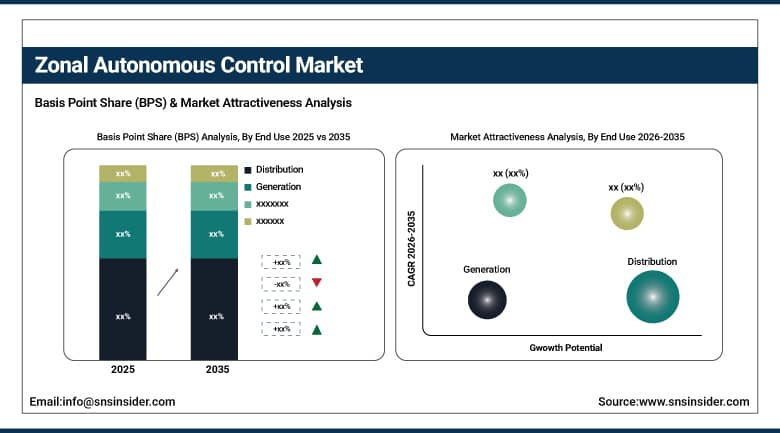
By End Use, Distribution dominated the Zonal Autonomous Control Market with a 32.40% share in 2025, while Distribution is also the fastest-growing end-use segment with a CAGR of 18.70% from 2026–2035.
By End Use, Distribution dominated the Zonal Autonomous Control Market, while Distribution is expected to register the fastest CAGR during the forecast period 2026–2035.
The Distribution segment dominated the Zonal Autonomous Control Market with a revenue share of 32.40% in 2025. The segment is dominated by the increasing demand for reliable electricity distribution, increasing complexity of local energy networks and increasing integration of distributed energy resources. Zonal autonomous control solutions can provide distribution utilities with the means to improve grid visibility, optimise power flows, reduce outage duration, and facilitate automated fault isolation and restoration. Autonomous control technologies are increasingly being deployed in distribution applications thanks to the deployment of smart distribution networks, renewable energy systems and electric vehicle charging infrastructure.
The Distribution segment is expected to grow at the fastest CAGR of 18.70% during the forecast period of 2026-2035. Growth is driven by growing investments in distribution grid modernisation, increasing adoption of smart grid technologies and the need for flexible energy management solutions. Distribution networks are becoming more complex with the bi-directional power flows from renewable energy sources and increasing consumer level energy generation. The adoption of AI-based monitoring, automated switching and self-healing grid capabilities is expected to create significant growth opportunities for zonal autonomous control solutions in distribution systems.
By Solution Type, Grid Automation Systems dominated the Zonal Autonomous Control Market, while Edge Intelligence & Edge Control Systems is expected to register the fastest CAGR during the forecast period 2026–2035.
The Grid Automation Systems segment dominated the Zonal Autonomous Control Market with a revenue share of 42.60% in 2025. The segment is dominated by the increasing investments in the smart grid modernisation, increasing demand for the automated power distribution management and the rising demand for improved grid reliability and operational efficiency. Grid automation systems enable utilities to monitor, control and optimise the delivery of electricity using sophisticated sensors, automated switching and real-time data analytics. New trends such as the integration of renewable energy resources, distributed energy resources, and electric vehicle charging infrastructure are forcing utilities to deploy advanced grid automation solutions to improve the flexibility and resiliency of the grid.
The Edge Intelligence & Edge Control Systems segment is projected to grow at the fastest CAGR of 20.09% during the forecast period, 2026-2035. “Growth in this segment is driven by the growing deployment of edge computing technologies, AI-enabled grid management, and real-time decision-making capabilities. Edge intelligence solutions can locally process grid data leading to faster fault detection, autonomous control actions and improved energy management. The growing deployment of distributed energy resources, smart metres and IoT-enabled grid devices further increases the necessity for edge-based autonomous control systems.
By Application, Substation Monitoring & Operations dominated the Zonal Autonomous Control Market, while Edge Management is expected to register the fastest CAGR during the forecast period 2026–2035.
The Substation Monitoring & Operations segment dominated the Zonal Autonomous Control Market with a revenue share of 34.80% in 2025. The segment dominance is driven by increasing demand for real-time monitoring and automation and improved reliability of substations. Advanced analysis and automation technologies enable autonomous control systems in zones to help utilities optimise substation performance, identify potential problems and better manage power flows. Rising investments in smart substations, the digitalisation of grid infrastructures and the transformation of old electrical grids are driving the development of autonomous monitoring and operational solutions.
The Edge Management segment is expected to rise with the fastest CAGR of 20.26% in the forecast period 2026-2035. The rapid growth will be spurred by growing demand for decentralised grid control, real-time data processing and decision making. Edge management systems could provide benefits for utilities to process the information near the grid assets to increase response time and operational effectiveness. The growth of renewables, distributed generation and grid-connected equipment will fuel the development of edge management solutions.
Regional Analysis
|
Region |
Major Country |
Share within Region, 2025 (%) |
|---|---|---|
|
North America |
United States |
83.71% |
|
Europe |
Germany |
28.40% |
|
Asia Pacific |
China |
36.90% |
|
Middle East & Africa |
UAE |
25.10% |
|
Latin America |
Brazil |
46.27% |
North America Zonal Autonomous Control Market Insights
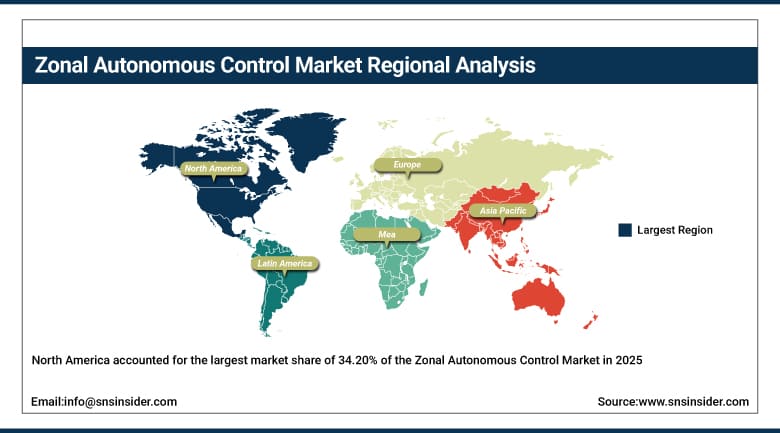
North America accounted for the largest market share of 34.20% of the Zonal Autonomous Control Market in 2025 owing to large investments in grid modernisation through smart grids, utility infrastructure development, and automation technologies. In this region, power grid networks have been built, renewable energy sources have been installed, and there is growing demand for grid management systems. The rise of artificial intelligence, edge computing, IoT sensors and integration of distributed energy resources is prompting utilities in this region to use autonomous control systems to better manage the grid.
The United States is the largest contributor to the North America Zonal Autonomous Control Market, accounting for 83.71% of the regional market share in 2025, which can be attributed to the huge investments in the digitalisation of grid network, installation of renewable energy and utility automation platforms. Increasing self-healing grid network initiatives and expanding smart grid infrastructure in this country are driving the implementation of zonal autonomous controls in this region.
Get Customized Report as Per Your Business Requirement - Enquiry Now
Europe Zonal Autonomous Control Market Insights
The Zonal Autonomous Control Market share in Europe was substantial in 2025 due to rising investments in energy transition, smart grid development and digitalisation of utilities. The region’s focus is on improving grid flexibility, integrating renewable energy sources, and improving electricity network reliability using state-of-the-art automation solutions. In Europe, the development of AI-based monitoring solutions, distributed energy management systems and autonomous grids has been growing as part of meeting the energy efficiency and sustainability targets.
Germany is one of the major drivers of the Zonal Autonomous Control Market growth in Europe as a result of advanced industrial base, strong adoption of renewable energy, and constant investments in smart grid technologies. Besides Germany, other countries such as UK, France and Netherlands also support market growth through digitalisation of utilities and electricity networks.
Asia Pacific Zonal Autonomous Control Market Insights
The Asia Pacific region is expected to be the fastest growing regional market during the forecast period, registering a CAGR of 19.37% between 2026 and 2035. Rapid urbanisation, growing electricity demand, penetration of renewable energy and large scale investments in smart grid infrastructure are driving regional growth. Countries in the region are embracing advanced automation, AI-powered energy management and digital monitoring solutions to improve grid reliability and efficiently manage the growing complexity of power.
China is a major contributor to the Asia Pacific Zonal Autonomous Control Market owing to huge investments in power infrastructure, integration of renewable energy and digital grid transformation. China, Japan, South Korea and India are rolling out autonomous grid solutions as the demand for efficient electricity distribution, edge-based control systems and real-time grid monitoring grows. Regional market growth is likely to be further augmented by the rising adoption of electric vehicles, distributed energy resources and smart utility technologies.
Middle East & Africa and Latin America Zonal Autonomous Control Market Insights
The Middle East & Africa and Latin America Zonal Autonomous Control market is witnessing steady growth due to large investments in electricity infrastructure modernisation, renewable energy projects and digital transformation. And utilities in those areas are installing automation systems to make the electricity grid more reliable, meet rising demand for electricity and improve efficiency. With the progress of smart cities, renewable energy and monitoring technologies, autonomous control technologies are feasible in these areas.
In Latin America, Brazil remains a key player with investments in energy infrastructure, renewable power generation projects and grid infrastructure modernisation projects. Middle East & Africa including UAE, Saudi Arabia is booming in digital energy transformation, smart grid deployment and utility management systems. As intelligent control systems continue to be adopted, these areas will continue to grow.
Market Dynamics
Growth Drivers: Rising smart grid modernization and increasing adoption of autonomous energy management solutions driving market growth
The Zonal Autonomous Control Market is anticipated to witness strong growth owing to increasing demand for intelligent grid management, integration of renewable energy and requirement of reliable power distribution network. Zonal autonomous control solutions allow utilities to divide the power grid into multiple zones for real-time monitoring, decision-making, fault detection, and self-healing. The emergence of smart grid technology, renewable energy sources, electric vehicle charging stations and the digital utility transformation is pushing utilities to deploy more advanced autonomous control technologies.
Emergence of artificial intelligence, IoT sensors, edge computing, and advanced analytics is also enhancing the capabilities of autonomous control systems. AI platforms allow predictive maintenance, localised grid optimisation and automated switching so utilities can easily manage complex energy flows. Investment in renewable energy integration, grid automation and next generation distribution networks is increasing, offering autonomous control solutions ample growth opportunities.
Restraints: High implementation costs and complex grid integration limiting market expansion
Deployment expenses involved in setting up an advanced grid automation infrastructure is one of the major hurdles that are limiting the growth of the Zonal Autonomous Control Market. The deployment of the system needs huge investment on account of sensors, communication, software platform, and digital grids. Need for expert technical skills, system upgradation and integration with current utility network system can make the whole process complicated.
There might be other issues of cybersecurity risk, grid technology interoperability, and regulations which could limit the growth of the market. In order to make sure that there is secure communication, data management, and proper interface of legacy infrastructure with the autonomous control systems, utilities have to take care of several things. The complexities involved in changing from traditional grid systems to automated control systems and continuous development of technology may act as a hurdle to the market.
Opportunities: Expansion of renewable energy integration and AI-powered grid automation creating new growth avenues
The increasing adoption of renewable energy resources, distributed energy resources and decentralised power generation is creating huge opportunities for the Zonal Autonomous Control Market. As electricity networks become ever more complex utilities are looking for sophisticated solutions for flexible energy management, automated load balancing and efficient integration of solar, wind and energy storage systems. The increasing adoption of smart cities, electric vehicles and digital utility platforms is likely to drive demand for autonomous grid control technologies.
Rising investment in power infrastructure modernisation and renewable energy projects are likely to provide strong growth opportunities for emerging markets in Asia Pacific, Latin America and Middle East & Africa. But combining AI-driven analytics, edge intelligence and real-time monitoring platforms with zonal self-governing control systems is expected to boost grid reliability and operational efficiency. The growing thrust on self-healing networks, energy resilience, and sustainable power management during the forecast period is expected to drive the deployment of advanced autonomous control solutions across the globe.
Recent Developments:
-
2025: Itron launched IntelliFLEX at DISTRIBUTECH 2025, a distributed-intelligence-enabled DERMS platform for edge grid control. The solution enables autonomous load balancing and coordination of rooftop solar, BESS, and EV chargers through smart meters and local transformers.
-
2026: Governments and utilities expanded investments in zonal autonomous control infrastructure driven by EU REPowerEU and GCC Vision 2030 initiatives. The programs promote interoperable standards such as IEC 61850 and IEEE 2030.5 for advanced grid automation.
-
2026: GE Vernova introduced AI-driven software suites and its “Reimagining the Grid Edge” framework at Orchestrate 2026. The solution enables localized AI-based zone management, allowing faster fault detection, isolation, and restoration across distribution networks.
-
2025: Schneider Electric launched its One Digital Grid Platform at Enlit Europe in Spain. Built on Microsoft Azure, the platform integrates ADMS, DERMS, and AI-powered zonal autonomous control for automated switching and improved grid management.
Zonal Autonomous Control Companies are:
-
Siemens AG
-
General Electric (GE Vernova)
-
ABB Ltd.
-
Eaton Corporation plc
-
Honeywell International Inc.
-
Itron Inc.
-
Landis+Gyr Group AG
-
Emerson Electric Co.
-
Rockwell Automation Inc.
-
Cisco Systems Inc.
-
IBM Corporation
-
Microsoft Corporation
-
Oracle Corporation
-
AutoGrid Systems Inc.
-
Open Systems International (OSI) Inc.
-
Schweitzer Engineering Laboratories (SEL)
-
GridPoint Inc.
-
Tesla Energy
Zonal Autonomous Control Market Report Scope:
| Report Attributes | Details |
|---|---|
| Market Size in 2025 | USD 3.20 Billion |
| Market Size by 2035 | USD 16.45 Billion |
| CAGR | CAGR of 17.83% From 2026 to 2035 |
| Base Year | 2025 |
| Forecast Period | 2026-2035 |
| Historical Data | 2022-2024 |
| Report Scope & Coverage | Market Size, Segments Analysis, Competitive Landscape, Regional Analysis, DROC & SWOT Analysis, Forecast Outlook |
| Key Segments | • By Switching Technology (MEMS-based Switching, Electro-Optic Switching, Thermo-Optic Switching, Liquid-Crystal-Based Switching, Acousto-Optic Switching, and Others) • By Port Count (1×2, 1×4, 1×8, and 1×16 and Above) • By Application (Circuit Switching, Multiplexing, Cross-Connects, Signal Monitoring, Protection Switching, and Others) • By End-User Industry (IT & Telecom, Manufacturing, Healthcare, Aerospace & Defense, Data Centers, Energy & Utilities, and Others) |
| Regional Analysis/Coverage | North America (US, Canada), Europe (Germany, UK, France, Italy, Spain, Russia, Poland, Rest of Europe), Asia Pacific (China, India, Japan, South Korea, Australia, ASEAN Countries, Rest of Asia Pacific), Middle East & Africa (UAE, Saudi Arabia, Qatar, South Africa, Rest of Middle East & Africa), Latin America (Brazil, Argentina, Mexico, Colombia, Rest of Latin America). |
| Company Profiles | Schneider Electric, Siemens AG, General Electric (GE Vernova), ABB Ltd., Hitachi Energy, Eaton Corporation plc, Honeywell International Inc., Itron Inc., Landis+Gyr Group AG, Emerson Electric Co., Rockwell Automation Inc., Cisco Systems Inc., IBM Corporation, Microsoft Corporation, Oracle Corporation, AutoGrid Systems Inc., Open Systems International (OSI) Inc., Schweitzer Engineering Laboratories (SEL), GridPoint Inc., Tesla Energy |

Frequently Asked Questions
The Zonal Autonomous Control Market was valued at USD 3.20 Billion in 2025.
The Distribution segment is expected to register the fastest CAGR of 18.70% from 2026–2035.
The Zonal Autonomous Control Market is expected to grow at a CAGR of 17.83% from 2026 to 2035.
North America dominated the Zonal Autonomous Control Market in 2025, accounting for approximately 34.20% market share.
