
Autonomous Networks Market Report Scope & Overview:
The Autonomous Networks Market was valued at USD 8.28 Billion in 2025 and is expected to reach USD 52.36 Billion by 2035, growing at a CAGR of 20.27% from 2026–2035.
The growth of the global autonomous networks market is driven by the increasing adoption of 5G networks, rising network complexity, growing demand for real-time network optimization, and the need to reduce operational costs through automation. Telecom operators and enterprises are increasingly adopting autonomous network technologies to enable self-configuring, self-optimizing, and self-healing network operations across complex environments, including 5G, cloud, and edge computing infrastructures.
The adoption of autonomous networks is accelerating as organizations seek to improve network performance, enhance service reliability, reduce manual intervention, and manage rapidly increasing data traffic. Technologies such as Artificial Intelligence (AI), Artificial Intelligence for IT Operations (AIOps), Software-Defined Networking (SDN), Network Function Virtualization (NFV), and Intent-Based Networking (IBN) are helping enterprises and telecom providers achieve intelligent network management and zero-touch automation.
In 2026, major telecom and technology providers continued expanding their autonomous networking capabilities by integrating AI-driven automation, predictive analytics, closed-loop control, and intelligent orchestration features into their network platforms. These advancements enable organizations to achieve faster fault detection, automated network optimization, improved resource utilization, and enhanced reliability across increasingly complex communication infrastructures.
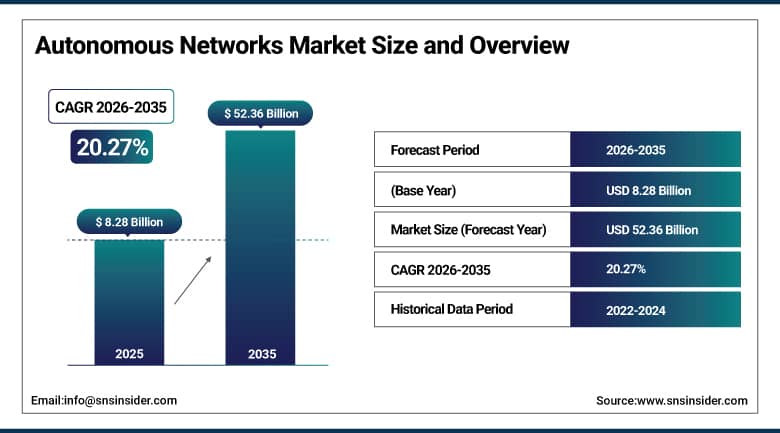
To Get More Information On Autonomous Networks Market - Request Free Sample Report
Autonomous Networks Market Trends:
-
Rising demand for automated network management, 5G deployment, and operational efficiency is driving the growth of the autonomous networks market across telecom operators, enterprises, and cloud service providers.
-
Increasing adoption of AI, AIOps, Software-Defined Networking (SDN), Network Function Virtualization (NFV), and cloud-native network environments is accelerating the deployment of autonomous network solutions worldwide.
-
Autonomous networks enable faster fault detection, automated configuration, real-time optimization, predictive maintenance, reduced manual intervention, and improved scalability of network operations.
-
Advancements in AI-driven automation, self-healing networks, intent-based networking, intelligent orchestration, and closed-loop automation technologies are driving innovation in the autonomous networks market.
-
Growing adoption across telecommunications, cloud providers, BFSI, healthcare, manufacturing, government, and enterprise sectors is supporting sustained market growth.
U.S. Autonomous Networks Market Outlook:
The U.S. Autonomous Networks Market was valued at USD 7.26 Billion in 2025 and is expected to reach around USD 45.24 Billion by 2035, growing at a CAGR of 20.10% from 2026–2035.
The increasing adoption of 5G networks, cloud computing, and hybrid IT architectures, along with the rising demand for efficient network management, is contributing to the growth of the autonomous networks market in the US. Companies across various sectors, including IT & telecom, BFSI, healthcare, government, and enterprises, are adopting autonomous network solutions powered by Artificial Intelligence (AI), AIOps, Software-Defined Networking (SDN), and intelligent network orchestration to improve operational efficiency and reliability.
Moreover, advancements in AI-driven automation, predictive analytics, self-healing networks, intent-based networking, and closed-loop automation are accelerating the growth of the autonomous networks market in the US. Increasing investments from telecom operators, cloud service providers, and technology companies in intelligent network management platforms are further supporting market expansion.
In 2026, leading technology providers continued enhancing their autonomous networking platforms with advanced AI capabilities, automated network optimization, intelligent monitoring, and zero-touch management features. These innovations help enterprises streamline network operations, reduce manual intervention, improve scalability, and manage increasingly complex 5G, cloud, and edge computing environments.
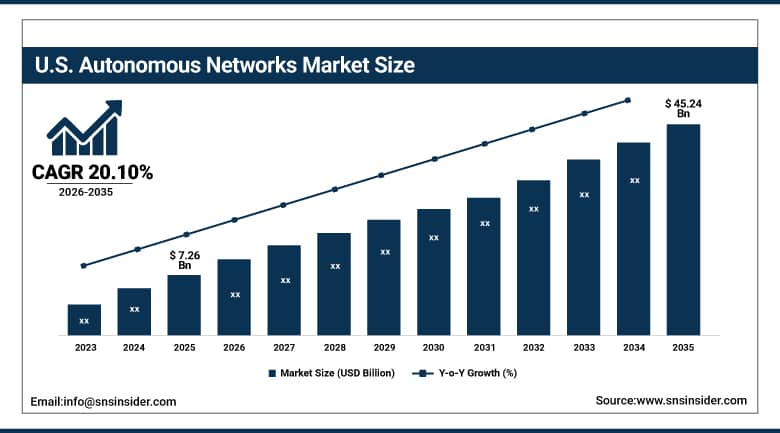
Autonomous Networks Market Segment Analysis:
-
By component, solutions dominated the autonomous networks market with a 68.00% share in 2025, while services are projected to be the fastest-growing segment, increasing its share 22.48% by 2035.
-
By solution, AI Networking dominated the autonomous networks market with a 30.00% share in 2025, while Intent-Based Networking (IBN) is projected to be the fastest-growing segment, increasing its share 24.06% by 2035.
-
By autonomy level, Level 2 Partial Automation dominated the autonomous networks market with a 42.00% share in 2025, while Level 4 High Autonomy is projected to be the fastest-growing segment, increasing its share 29.75% by 2035.
-
By network type, Hybrid Networks dominated the autonomous networks market with a 45.00% share in 2025, while Virtual Networks are projected to be the fastest-growing segment, increasing its share 24.39% by 2035.
-
By end user, Telecom Operators dominated the autonomous networks market with a 55.00% share in 2025, while Cloud Providers are projected to be the fastest-growing segment, increasing its share from 25.5% by 2035.
By component, solutions dominated the autonomous networks market, while services are expected to grow fastest
In 2025, the solutions segment held the largest revenue share in the autonomous networks market due to the increasing adoption of AI-driven automation platforms, network orchestration tools, AIOps solutions, and intelligent network management systems. Organizations are increasingly deploying autonomous network solutions to automate network monitoring, optimization, configuration, and fault management processes. Additionally, the growing demand for improved network efficiency, reduced manual intervention, and enhanced scalability is supporting the growth of the solutions segment.
Conversely, the services segment is expected to register the fastest growth during the forecast period due to the rising need for consulting, implementation, integration, and managed services. Organizations require specialized expertise to deploy and manage autonomous network environments across complex 5G, cloud, and edge infrastructures.
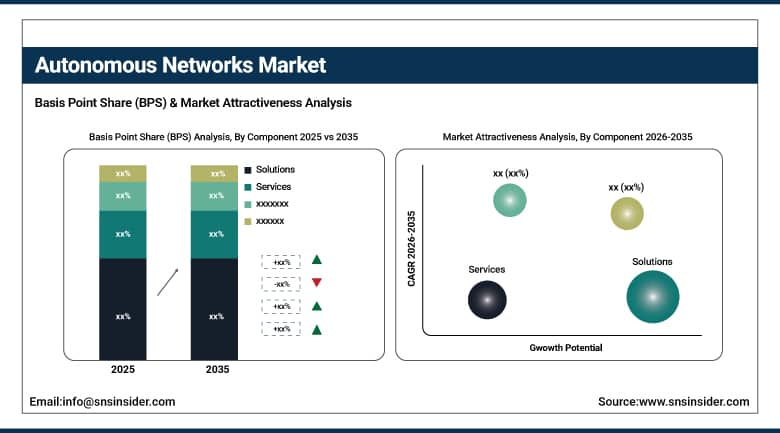
By solution, AI Networking dominated the autonomous networks market, while Intent-Based Networking (IBN) is expected to grow fastest
AI Networking accounted for the largest market share in 2025 due to the increasing adoption of artificial intelligence and machine learning technologies for network optimization, predictive analytics, automated decision-making, and real-time performance management. Telecom operators and enterprises are leveraging AI networking solutions to improve network reliability, efficiency, and operational automation.
Intent-Based Networking (IBN) is expected to witness the highest growth rate during the forecast period due to the rising demand for self-configuring, policy-driven, and zero-touch network operations. IBN enables networks to automatically align with business objectives by translating high-level requirements into automated network configurations.
By network type, Hybrid Networks dominated the autonomous networks market, while Virtual Networks are expected to grow fastest
Hybrid Networks accounted for the largest market share in 2025 due to the continued coexistence of traditional physical infrastructure and modern cloud-based network environments. Enterprises and telecom operators are adopting hybrid architectures to support gradual digital transformation while maintaining existing network investments.
Virtual Networks are expected to experience the fastest growth during the forecast period due to the increasing adoption of Software-Defined Networking (SDN), Network Function Virtualization (NFV), cloud-native infrastructure, and 5G core networks. Virtualized environments enable greater flexibility, scalability, and automated network management.
By end user, Telecom Operators dominated the autonomous networks market, while Cloud Providers are expected to grow fastest
Telecom Operators accounted for the largest market share in 2025 due to increasing investments in 5G deployment, network modernization, and AI-based automation to manage complex communication infrastructures. Autonomous networks help telecom operators improve service quality, reduce operational costs, and enhance network performance.
Cloud Providers are expected to register the fastest growth during the forecast period due to the expansion of hyperscale data centres, edge computing, and cloud-native network environments. The increasing need for automated management of distributed infrastructure is driving the adoption of autonomous network solutions among cloud service providers.
Regional Insights:
|
Region |
Major Country |
Share within Region, 2025(%) |
|---|---|---|
|
North America |
United States |
90.10% |
|
Europe |
Germany |
26.50% |
|
Asia Pacific |
China |
41.50% |
|
Middle East & Africa |
Saudi Arabia |
31.00% |
|
Latin America |
Brazil |
45.00% |
North America Autonomous Networks Market Insights
North America accounted for 38.50% of the global autonomous networks market share in 2025. The growth of the regional market is attributed to the early adoption of AI-driven network automation, advanced 5G infrastructure, cloud-native technologies, and increasing demand for efficient network management. Organizations across IT & telecom, BFSI, healthcare, government, and enterprise sectors are adopting autonomous networking solutions, including AI networking, AIOps, intent-based networking, and automated network monitoring platforms. In 2025, the United States accounted for 90.10% of the North America autonomous networks market.
The regional market growth is driven by increasing investments in 5G standalone networks, cloud infrastructure, edge computing, AI-based automation, and self-healing network technologies. Furthermore, the presence of leading telecom operators, cloud providers, and technology companies is accelerating the adoption of autonomous network solutions across the United States and North America.
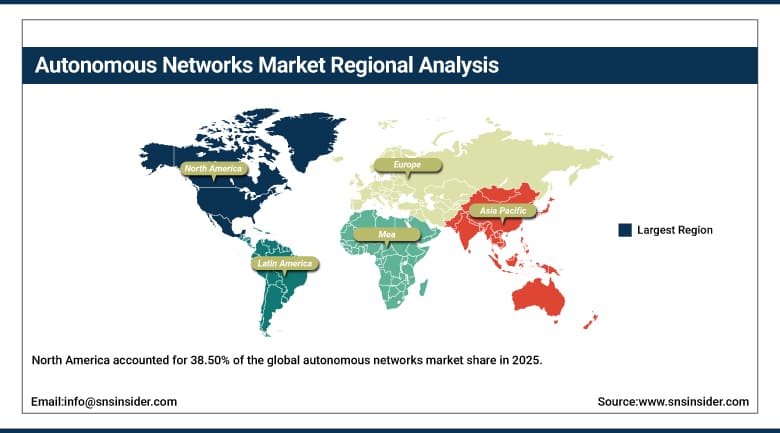
Get Customized Report as Per Your Business Requirement - Enquiry Now
Europe Autonomous Networks Market Insights
The autonomous networks market in Europe is expanding due to increasing digital transformation initiatives, adoption of 5G networks, cloud computing, and the growing need for automated network operations. Germany accounted for 26.50% of the Europe autonomous networks market in 2025, supported by its strong industrial ecosystem, advanced telecom infrastructure, and increasing adoption of AI-based automation technologies.
The regional market is driven by the rising deployment of AI networking, intent-based networking, software-defined networking (SDN), and network automation solutions. Additionally, growing investments in secure digital infrastructure, cloud-native technologies, and intelligent network management platforms are supporting market growth across Europe.
Asia Pacific Autonomous Networks Market Insights
The Asia Pacific region is expected to witness significant growth in the autonomous networks market due to rapid 5G deployment, expanding cloud infrastructure, increasing digitalization, and rising investments in AI-driven network automation. China accounted for 41.50% of the Asia Pacific autonomous networks market in 2025, driven by large-scale telecom infrastructure development, strong technology capabilities, government-led digital initiatives, and widespread adoption of advanced networking technologies.
The regional market growth is supported by increasing adoption of AI networking, AIOps, network virtualization, edge computing, and automated network management solutions. Countries such as Japan, South Korea, and India are also investing heavily in next-generation telecom infrastructure and intelligent network technologies.
Middle East & Africa and Latin America Autonomous Networks Market Insights
The autonomous networks market in the Middle East & Africa is witnessing steady growth due to increasing digital transformation initiatives, 5G expansion, cloud adoption, and modernization of telecom infrastructure. Saudi Arabia accounted for 31.00% of the Middle East & Africa autonomous networks market in 2025, supported by Vision 2030 initiatives, investments in digital infrastructure, and the adoption of AI-based automation technologies.
The Latin America autonomous networks market is experiencing gradual growth due to increasing cloud adoption, enterprise digitalization, telecom modernization, and rising demand for efficient network management solutions. Brazil accounted for 45.00% of the Latin America autonomous networks market in 2025, driven by expanding 5G networks, increasing enterprise automation adoption, and investments in digital infrastructure.
Growth Driver: Rising adoption of cloud computing and increasing demand for automated network management accelerating autonomous networks market growth
The increasing deployment of cloud computing, hybrid cloud environments, 5G networks, and digital transformation initiatives is expected to drive the growth of the autonomous networks market. Enterprises and telecom operators across industries such as IT & telecom, BFSI, healthcare, manufacturing, government, and large enterprises are adopting autonomous network solutions to enable automated network provisioning, configuration, monitoring, optimization, and fault management.
The growing adoption of AI networking, AIOps, intent-based networking, software-defined networking (SDN), and network function virtualization (NFV) is contributing to market expansion. Additionally, rising investments in AI-driven automation, self-healing networks, predictive analytics, edge computing, and intelligent network orchestration are expected to accelerate the adoption of autonomous network technologies.
Restraints: High implementation complexity and integration challenges may restrain autonomous networks market growth
High deployment costs, complex integration requirements, and the need for specialized expertise may limit the growth of the autonomous networks market. Organizations often face challenges while integrating autonomous network solutions with existing legacy infrastructure, multi-vendor environments, and complex hybrid cloud architectures.
Furthermore, concerns related to cybersecurity, data privacy, interoperability issues, and the lack of standardized frameworks for autonomous network deployment may slow adoption among enterprises. Continuous technology upgrades and the requirement for skilled professionals to manage AI-driven network operations also create challenges for widespread implementation.
Opportunities: Growing adoption of AI-driven automation and expansion of cloud-native infrastructure
The autonomous networks market presents significant growth opportunities due to increasing demand for AI-powered automation, cloud-native architectures, and intelligent network management solutions. Technologies such as AI networking, AIOps, intent-based networking, network virtualization, and closed-loop automation are enabling organizations to build scalable, efficient, and self-optimizing network environments.
Moreover, the rising adoption of 5G standalone networks, edge computing, private networks, and multi-cloud environments is creating new opportunities for autonomous network solutions. Continuous advancements in artificial intelligence, machine learning, predictive analytics, and self-healing technologies are expected to further accelerate the adoption of autonomous networks across telecom operators, cloud providers, and enterprises.
Recent Developments:
-
2026: Google expanded its cloud infrastructure automation capabilities by integrating AI-driven automation, intelligent resource management, and automated monitoring features to help businesses optimize cloud operations and improve infrastructure efficiency.
-
2026: Adobe enhanced its cloud-based ecosystem by incorporating automated management capabilities and intelligent workflows to improve operational efficiency across its cloud platforms.
-
2025: Microsoft strengthened its infrastructure automation capabilities by integrating AI-driven management, cloud automation, and intelligent monitoring features across its enterprise and cloud platforms.
-
2025: Technology companies continued advancing infrastructure automation solutions through the development of AI-driven operations, automated monitoring, predictive analytics, and intelligent infrastructure management capabilities.
Autonomous Networks Market Key Players:
-
Huawei Technologies Co., Ltd.
-
Telefonaktiebolaget LM Ericsson
-
Nokia Corporation
-
Juniper Networks, Inc.
-
ZTE Corporation
-
NEC Corporation
-
Samsung Electronics
-
Arista Networks, Inc.
-
Ciena Corporation
-
IBM Corporation
-
Microsoft Corporation
-
Amazon Web Services
-
Google LLC
-
Oracle Corporation
-
Hewlett Packard Enterprise
-
Broadcom Inc.
-
VMware
-
ServiceNow.
Autonomous Networks Market Report Scope:
| Report Attributes | Details |
|---|---|
| Market Size in 2025 | USD 8.28 Billion |
| Market Size by 2035 | USD 52.36 Billion |
| CAGR | CAGR of 20.27% From 2026 to 2035 |
| Base Year | 2025 |
| Forecast Period | 2026-2035 |
| Historical Data | 2022-2024 |
| Report Scope & Coverage | Market Size, Segments Analysis, Competitive Landscape, Regional Analysis, DROC & SWOT Analysis, Forecast Outlook |
| Key Segments | • By component (Solutions, Services) • By solution (AI Networking, Artificial Intelligence for IT Operations (AIOps), Network Management Tools, Software-Defined Networking (SDN), Intent-Based Networking (IBN)) • By autonomy level (Level 1 Assisted Operations, Level 2 Partial Automation, Level 3 Conditional Autonomy, Level 4 High Autonomy) • By network type (Physical Networks, Virtual Networks, Hybrid Networks) • By end user (Telecom Operators, Cloud Providers, Large Enterprises, Government & Defense) |
| Regional Analysis/Coverage | North America (US, Canada, Mexico), Europe (Eastern Europe [Poland, Romania, Hungary, Turkey, Rest of Eastern Europe] Western Europe] Germany, France, UK, Italy, Spain, Netherlands, Switzerland, Austria, Rest of Western Europe]), Asia Pacific (China, India, Japan, South Korea, Vietnam, Singapore, Australia, Rest of Asia Pacific), Middle East & Africa (Middle East [UAE, Egypt, Saudi Arabia, Qatar, Rest of Middle East], Africa [Nigeria, South Africa, Rest of Africa], Latin America (Brazil, Argentina, Colombia, Rest of Latin America) |
| Company Profiles | Huawei Technologies Co., Ltd.; Telefonaktiebolaget LM Ericsson; Nokia Corporation; Cisco Systems, Inc.; Juniper Networks, Inc.; ZTE Corporation; NEC Corporation; Samsung Electronics; Arista Networks, Inc.; Ciena Corporation; IBM Corporation; Microsoft Corporation; Amazon Web Services, Inc.; Google LLC; Oracle Corporation; Dell Technologies Inc.; Hewlett Packard Enterprise; Broadcom Inc.; VMware, Inc.; ServiceNow, Inc. |
Frequently Asked Questions
The autonomous networks market is expected to grow at a CAGR of 20.27% from 2026 to 2035.
The autonomous networks market was valued at USD 8.28 billion in 2025.
The market is driven by increasing adoption of 5G networks, cloud computing, AI-driven automation, network complexity, and demand for efficient network management.
The solutions segment dominated the autonomous networks market in 2025 with a 68.00% share.
North America dominated the autonomous networks market in 2025 with a 38.50% share.
