
Autonomous Drug Discovery Market Report Scope & Overview:
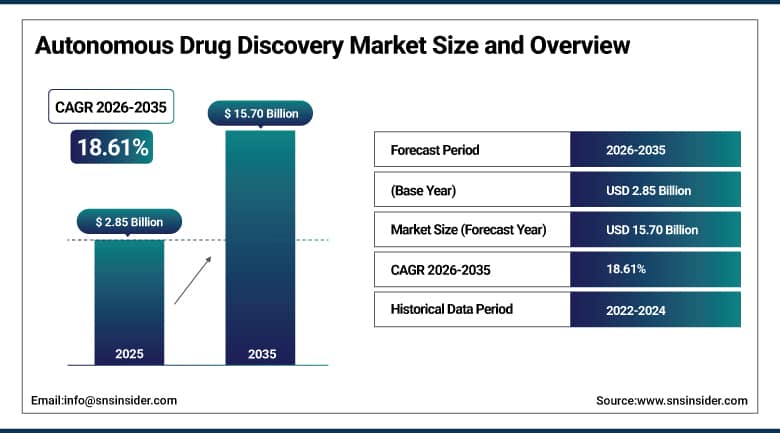
The Autonomous Drug Discovery Market was valued at USD 2.85 Billion in 2025 and is projected to reach USD 15.70 Billion by 2035, expanding at a CAGR of 18.61% during the forecast period 2026–2035.
An autonomously intelligent drug discovery ecosystem is currently revolutionizing pharmaceutical research, as AI, robotic lab automation, cloud computing and computational biology are being seamlessly integrated in a single drug discovery pathway. In contrast to conventional AI-supported drug discovery processes, autonomous systems will constantly design experiments, perform laboratory actions, analyze biology datasets and optimize molecules and experimental plans with little to no human input.
Increased pressure on researchers to reduce drug development timeframes, raise prediction outcomes and lower research cost, and expedite personalized medicine development efforts has led to a substantial increase in the investment across the autonomous discovery ecosystem by research institutions, biotechnologies and pharmaceutical companies. On the technological side, with continuously evolving market, adoption of generative AI, self-learning ML algorithms, digital twin simulations, lab automation robots and cloud-native computational platforms enable self-learning closed-loop discovery. In May 2025 Recursion Pharmaceuticals extended its AI capabilities, by integrating it further on large biology dataset and ML infrastructure, thereby accelerating therapeutic discovery programs.
To Get More Information On Autonomous Drug Discovery Market - Request Free Sample Report
Autonomous Drug Discovery Market Trends
-
Increasing deployment of autonomous AI platforms across pharmaceutical research laboratories.
-
Growing adoption of generative AI for novel molecule design and optimization.
-
Rising investment in robotic laboratory automation for closed-loop experimentation.
-
Expansion of cloud-native computational infrastructure supporting large-scale biological data analysis.
-
Increasing collaborations between pharmaceutical companies and AI technology developers for accelerated drug discovery.
The U.S. Autonomous Drug Discovery Market Size Outlook
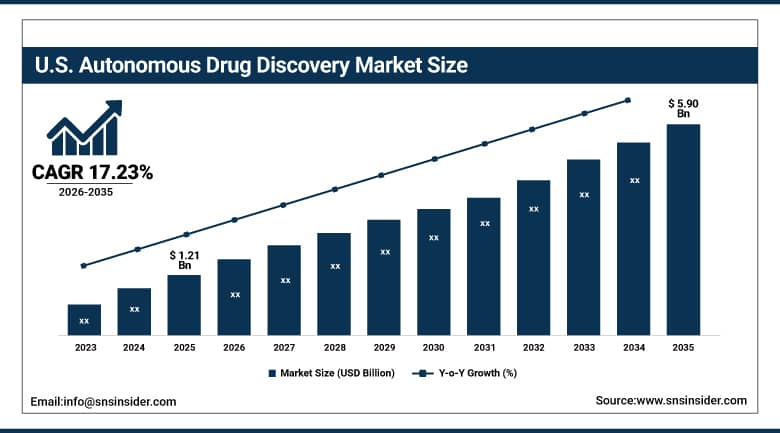
The U.S. Autonomous Drug Discovery Market was valued at USD 1.21 billion in 2025 and is expected to reach approximately USD 5.90 billion by 2035, expanding at a CAGR of 17.23% during 2026–2035.
The United States still represents a dominant force within North America for the autonomous drug discovery market, driven by a mature pharmaceutical infrastructure, a robust biotechnology innovation pipeline, substantial levels of venture capital investment and the use of AI in nearly every corner of the biomedical research landscape. Pharmaceutical majors, biotechnology organizations, leading medical centers and technology companies are all making increasing investments in autonomous discovery solutions capable of integrating ML, robotic experimentation, cloud computing and multi-omics analysis into end-to-end drug discovery processes.
Continued advancements in generative AI foundation models, laboratory automation/robotics and digital biology platforms, alongside in silico automated experimental verification are now promoting faster rates of deployment throughout the United States. Pharmaceutical entities are also increasing investment in autonomous labs capable of shortening timelines, and improving selection of candidates, while also lowering the cost of research. In January 2026 Insilico Medicine declared it will further strengthen its AI-powered drug discovery partnerships, hoping to speed up drug candidate pipelines utilizing both generative AI and automated design capabilities.
Autonomous Drug Discovery Market Segmentation Analysis
-
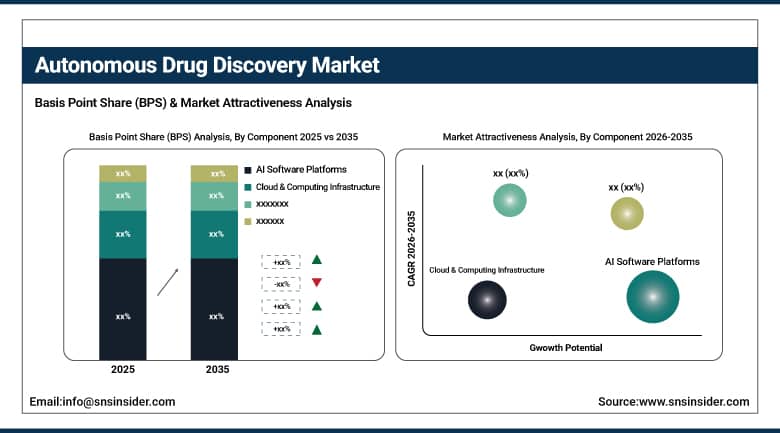
By Component, AI software platforms dominated the market with 36.00% share in 2025, while cloud & computing infrastructure is projected to witness the fastest growth with a CAGR of 19.94% during the forecast period.
-
By Technology, machine learning dominated the market with 28.00% share in 2025, while generative AI is projected to witness the fastest growth with a CAGR of 24.41% during the forecast period.
-
By Application, target identification dominated the market with 24.00% share in 2025, while lead discovery & optimization is projected to witness the fastest growth with a CAGR of 19.72% during the forecast period.
-
By End User, pharmaceutical companies dominated the market with 44.00% share in 2025, while biotechnology companies are projected to witness the fastest growth with a CAGR of 19.83% during the forecast period.
By Component, AI software platforms dominated, while cloud & computing infrastructure grows fastest.
At 36.00% in 2025, AI software platforms represent the dominant section fueling an autonomous drug discovery workflow. By integrating machine learning and biological data analytics, molecular modeling, predictive simulation, and workflow orchestration, such platforms generate efficient workflow tools for higher research throughputs. In March 2026, NVIDIA announced partnerships with pharmaceutical and biotechnology companies that use the scaled hardware and accelerated data processing capabilities provided by accelerated computing and platform development.
Cloud & computing infrastructure is anticipated to experience the quickest CAGR of 19.94% between 2026 and 2035, with rapidly growing computational requirements for autonomously discovering pharmaceutical drugs in part driving growth. Increased use of multimodal biological data, extensive genetic analysis, digitally native drugs and organs, generation of molecules, and sophisticated AI models necessitate an autonomous exploration to manage an overwhelming dataset of medical information in the best method. In 2025, Microsoft made strides to introduce an extensive set of life science-focused healthcare services and digital technologies with powerful cloud infrastructure to enable accelerated biomedical research and an autonomous process to the development of drugs.
By Technology, machine learning dominated, while generative AI grows fastest.
Machine learning had the biggest market share of 28.00%, in 2025 given its usage throughout the predictive drug discovery processes, identification of biomarkers, prediction of molecular properties, target prioritization, and biological data interpretation processes. Years of validated ML models have helped pharma companies generate multiple tools for high-throughput screening, compound ranking, toxicity prediction, clinical candidate optimization and etc., with enhanced reliability. The platform is the operating technology for autonomous discovery systems, which can learn from new experimental results and enhance the predictive capability at various pharmaceutical development stages. In 2025, Recursion Pharmaceuticals maintained expansion on ML-enabled biological mapping capabilities to accelerate therapeutic discovery for oncology, neuroscience and rare diseases.
Generative AI held the largest projected growth rate CAGR of 24.41% throughout the entire forecast period, as pharma companies is embracing large foundation models to not only design novel molecules structures but also generate optimized drug candidates, predict protein interactions, and facilitate medicinal chemistry workflow, etc. This enables the autonomous design and modification of chemical entities coupled with evaluation on biological activity and manufacturability beyond just predictive AI systems.
By Application, target identification dominated, while lead discovery & optimization grows fastest.
Target identification held a 24.00% market share of the autonomous drug discovery market in 2025 because identifying biologically relevant therapeutic targets has historically been the most challenging and complex phase of the drug discovery process and autonomous platforms apply AI, multi-omics analyses, biological network integration and machine learning to efficiently and rapidly discover diseases associated targets. Pharma continued its investments in in-silico target discovery due to improvements to pipeline quality, reduction in the occurrence of late stage drug failure and the drive towards precision medicine platforms. By 2025, the NIH was supporting a range of in-silico, AI related Biomedical Research initiatives aiming to enhance computational target identification and translational medicine platform performance.
The lead discovery and optimization market is predicted to witness the greatest CAGR of 19.72% in the 2026-2035 period with Autonomous Laboratories increasingly automating the processes of molecule design, compound optimization, biological validation, and iterative experimental learning with AI-based platforms and experimental automation for the analysis of large numbers of molecules. By 2026 Schrdinger, Inc. continued to enhance its computational drug discovery platform through integration of the latest AI capabilities for enhanced molecule optimization and accelerated lead identification pipelines.
Regional Analysis
|
Region |
Major Country |
Share within Region, 2025 (%) |
|---|---|---|
|
North America |
United States |
94.00% |
|
Europe |
Germany |
27.00% |
|
Asia Pacific |
China |
22.00% |
|
Middle East & Africa |
UAE |
3.00% |
|
Latin America |
Brazil |
2.00% |
North America Autonomous Drug Discovery Market Insights
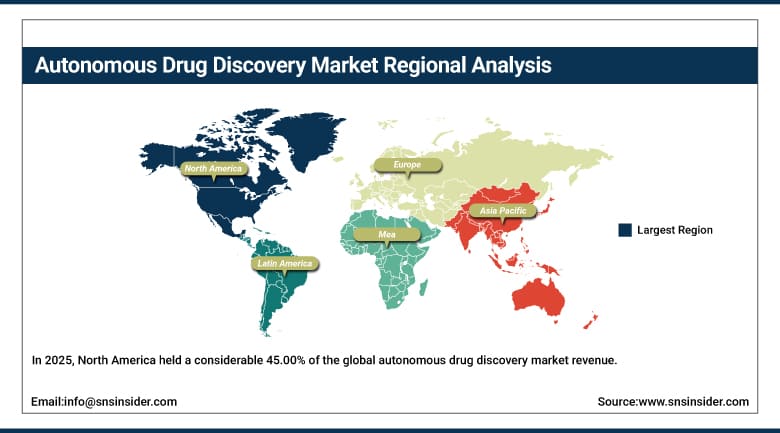
In 2025, North America held a considerable 45.00% of the global autonomous drug discovery market revenue. Fueled by the abundant presence of top multinational pharmaceutical corporations, progressive biotechnology landscape, leading academic research establishments, and major capital allocations to R&D activities utilizing AI, this region maintained a significant grip on market leadership. Over time, North America will experience increased operational deployment of autonomous lab systems incorporating AI software, robotic mechanisms, cloud-computing platforms, high-throughput research, into comprehensive drug development processes.
Increased collaboration between big pharmaceutical companies and leading software vendors, cloud infrastructure providers, research and academic institutions, will lead to further efficiency improvement, coupled with accelerated drug discovery pipeline speed.
Enhanced backing by various government entities for biomedical endeavors, proliferation of precision medicine-related ventures, and significant funding into computational biology are expected to further enhance its market leadership through 2032. As of May 2026, Recursion Pharmaceuticals fortified its drug discovering capacity with AI-powered, leveraging amplified large biological dataset analysis as well as computational analysis capacities for quicker therapeutic candidate development in North America.
Get Customized Report as Per Your Business Requirement - Enquiry Now
Europe Autonomous Drug Discovery Market Insights
One of the more cutting edge autonomous drug discovery markets is Europe, which can draw on its well established pharmaceutical manufacturing base and heavy funding for biomedical research, coupled with the widespread application of AI technologies to the life sciences. Many of the leading nations including Germany, United Kingdom, France, Switzerland, and the Netherlands continue to heavily invest in areas like computational biology, digital labs, and AI powered drug innovation. A key positive aspect for the region includes a wide range of partnerships formed between biotechnology organizations, research universities, healthcare organizations, and technology suppliers all involved in developing faster ways for novel therapeutics to be discovered.
Asia Pacific Autonomous Drug Discovery Market Insights
Asia-Pacific is anticipated to witness the most significant CAGR of 22.35 % throughout the predicted period of 2026-2035 due to an increase in pharmaceutical manufacturing capabilities and government funding for R&D related to pharmaceuticals and biotechnology, rising investment in artificial intelligence in healthcare-related research, and technological developments in the industry. Countries such as China, Japan, Singapore, South Korea, and India are significantly increasing their smart healthcare infrastructure and bolstering the adoption of artificial intelligence in biomedical innovation through nation research programs and government-public organizations. In 2025, the development of its first fully autonomous AI-enabled lab in Asia Pacific made XtalPi able to execute experiments with robotics integrated with a supercomputer platform.
Middle East & Africa and Latin America Autonomous Drug Discovery Market Insights
In the Middle East & Africa, market growth is steadily progressing on account of enhanced national biotech strategies as well as more supportive healthcare research systems and digitally transformed pharma industries, led by regional players in countries such as the UAE, Saudi Arabia, and South Africa that are driving utilization of the AI/cloud/precision medicine platforms through dedicated life science innovation-driving programs and increased research partnerships with major global players.
In Latin America, organic market growth is being fostered as pharmaceutical research investment expands while start-up firms increase and research labs in Argentina, Chile, Brazil, and Mexico update more quickly – supported by academic and commercial use of the latest AI, cloud-based research technologies, and digitization. In 2025, increased government focus led by initiatives like by AD Department of Health the expansion of strategic public/private alliances to drive growth in the AI adoption and advanced life sciences arena throughout the region.
Market Dynamics
Growth Drivers: Rising prevalence of autonomous AI platforms for faster drug discovery and shortened research cycles.
The increase in demands for enhanced productivity in drug discovery research with reduced cost and time span of pharmaceutical development acts as a key factor towards driving the Autonomous Drug Discovery Market. The process of discovery of new therapeutic candidates takes more than a decade time and significant expenditure for researchers before commercialization. Autonomous platforms can deliver significant improvements by bringing together the power of AI, ML, automated robotic laboratories, cloud computing, as well as computation biotechnology to create continuous cycles of design experiment and optimize, analyses biological data and molecular candidate to achieve the research with less number of experiments with minimal human intervention.
The rise in use of autonomous AI drug discovery solutions is prominently seen in areas such as oncology, immunology, rare diseases, and precision medicine. In January 2026; Insilico Medicine announced that it will strengthen its partnership with additional research and expanded capabilities in autonomous molecular design and generative AI to hasten drug candidate pipelines targeting more diseases.
Restraints: Cost of high implementation and seamless integration of an autonomous laboratory ecosystem.
Despite excellent commercial opportunity, the adoption of autonomous drug discovery platforms has been limited due to the heavy cost of the necessary advanced computer power, robotic laboratory systems, AI software platforms, and high powered cloud computing systems to effectively implement the technology. Operational complexity is also high, because the entire autonomous drug discovery ecosystem needs to be integrated, including lab automation, bio-databases, experimental instruments, data management, and regulatory requirements.
A number of data quality, transparency of models, cyber security risks, and validity of findings resulting from AI have also continued to deter rapid enterprise-wide adoption within the highly regulated environment of the pharmaceutical industry. Schrdinger, Inc. Remained successful in enhancing enterprise deployment of its and its partner's integrated computational platforms, which helps reduce the barrier of adoption for AI drug discovery technology for pharmaceutical R&D organizations.
Opportunities: Growth of generative AI, autonomous labs, and multi-modal biology foundation models.
The continued rapid progress in fields such as generative artificial intelligence, multi-modal biology foundation models, lab robotics and digital experimental platforms provide strong long term growth opportunities for the Autonomous Drug Discovery Market. These next generation systems continue to improve at generating new molecules, predicting interactions and determining therapeutic attributes, and completing experiments autonomously (closed-loop learning) to feed back into generation and prediction cycles.
Increased partnerships and establishment of a full ecosystem of AI companies, semiconductor companies, cloud services and biotech start-ups will be a key characteristic going forward, fueling autonomous discovery to drive the pharmaceutical industry. The growth of biologics development and the research into rare diseases coupled with a greater focus on precision medicine will be key commercial markets during the forecast period.
Recent Developments
-
2026: Recursion Pharmaceuticals expanded its AI-driven drug discovery infrastructure by integrating larger biological datasets and enhanced machine learning capabilities to accelerate therapeutic discovery and translational research.
-
2026: Insilico Medicine strengthened its generative AI-enabled drug discovery collaborations, expanding autonomous molecular design and AI-powered pharmaceutical research programs across multiple therapeutic areas.
-
2025: Schrödinger, Inc. enhanced its computational drug discovery platform with advanced AI capabilities supporting molecular simulation, lead optimization, and autonomous medicinal chemistry workflows.
-
2026: NVIDIA expanded healthcare and life sciences AI initiatives through accelerated computing technologies designed to support autonomous drug discovery, digital biology, and foundation model development.
Autonomous Drug Discovery Market Key Players are:
-
Insilico Medicine
-
Atomwise, Inc.
-
XtalPi Holdings Limited
-
Generate:Biomedicines
-
Absci Corporation
-
Owkin, Inc.
-
Valo Health, Inc.
-
SandboxAQ
-
Relay Therapeutics, Inc.
-
Isomorphic Labs
-
Genesis Therapeutics, Inc.
-
Microsoft Corporation
-
NVIDIA Corporation
-
Google LLC
-
Amazon Web Services, Inc.
-
IBM Corporation
-
Pfizer Inc.
Autonomous Drug Discovery Market Report Scope:
| Report Attributes | Details |
|---|---|
| Market Size in 2025 | USD 2.85 Billion |
| Market Size by 2035 | USD 15.70 Billion |
| CAGR | CAGR of 18.61% From 2026 to 2035 |
| Base Year | 2025 |
| Forecast Period | 2026-2035 |
| Historical Data | 2022-2024 |
| Report Scope & Coverage | Market Size, Segments Analysis, Competitive Landscape, Regional Analysis, DROC & SWOT Analysis, Forecast Outlook |
| Key Segments | • By Component (AI Software Platforms, Autonomous Laboratory Hardware, Cloud & Computing Infrastructure, Professional & Integration Services, Others) • By Technology (Machine Learning, Deep Learning, Generative AI, Robotic Laboratory Automation, Others) • By Application (Target Identification, Lead Discovery & Optimization, ADMET Prediction, Drug Repurposing, Others) • By End User (Pharmaceutical Companies, Biotechnology Companies, Contract Research Organizations, Academic & Research Institutes, Others) |
| Regional Analysis/Coverage | North America (US, Canada), Europe (Germany, UK, France, Italy, Spain, Russia, Poland, Rest of Europe), Asia Pacific (China, India, Japan, South Korea, Australia, ASEAN Countries, Rest of Asia Pacific), Middle East & Africa (UAE, Saudi Arabia, Qatar, South Africa, Rest of Middle East & Africa), Latin America (Brazil, Argentina, Mexico, Colombia, Rest of Latin America). |
| Company Profiles | Recursion Pharmaceuticals, Insilico Medicine, Schrödinger, Inc., BenevolentAI, Atomwise, Inc., XtalPi Holdings Limited, Generate:Biomedicines, Absci Corporation, Owkin, Inc., Valo Health, Inc., SandboxAQ, Relay Therapeutics, Inc., Isomorphic Labs, Genesis Therapeutics, Inc., Microsoft Corporation, NVIDIA Corporation, Google LLC, Amazon Web Services, Inc., IBM Corporation, Pfizer Inc. |
Frequently Asked Questions
The Autonomous Drug Discovery Market was valued at USD 2.85 Billion in 2025.
The market is projected to reach USD 15.70 Billion by 2035.
The market is anticipated to expand at a CAGR of 18.60% during the forecast period.
North America dominated the global Autonomous Drug Discovery Market in 2025, accounting for 45.00% of total revenue.
AI Software Platforms accounted for the largest revenue share of 36.00% in 2025.
