
Bitcoin ATM Machine Market Report Scope & Overview:
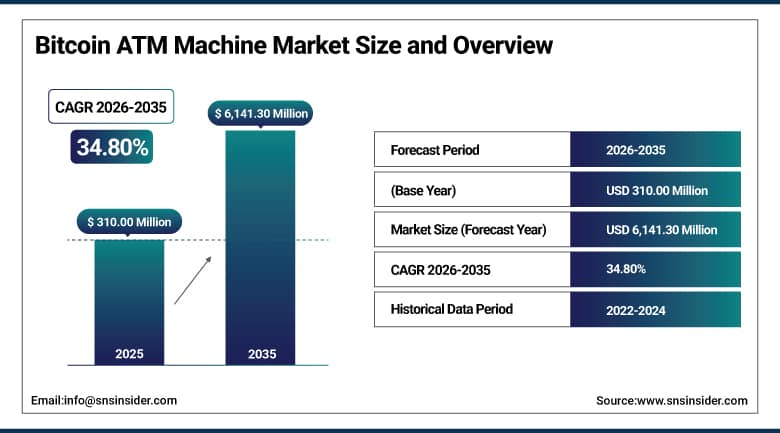
The Bitcoin ATM Machine Market was valued at USD 310.00 Million in 2025 and is estimated at USD 417.88 Million in 2026. The market is projected to reach USD 6,141.30 Million by 2035, advancing at a CAGR of 34.80% from 2026 to 2035. A Bitcoin ATM is a self-service kiosk that lets customers buy digital assets with cash or cards, and in some models sell them for cash, with fees charged on each transaction. Growth rests on wider crypto ownership and new machine types, but consumer protection rules are reshaping the installed base.
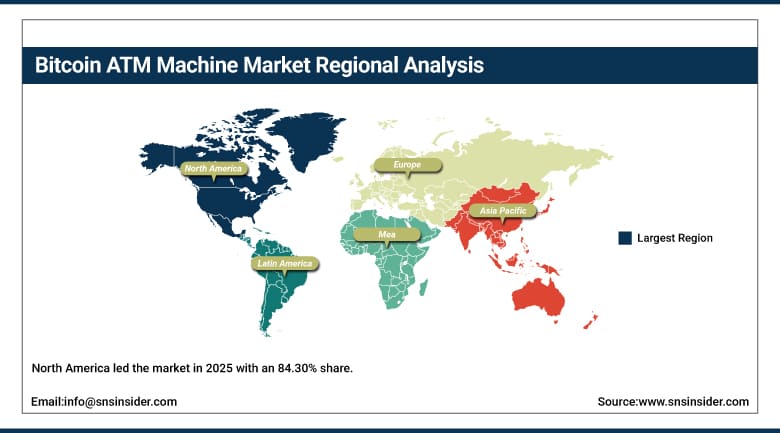
In 2025, North America emerged as the biggest regional market, owing to an impressive share of 84.30%. The majority of the world’s machines can be found in the US, as well as Canada, which has its significant network of machines, situated in convenience stores, petrol stations, and malls. Europe is positioned in second place with its low-placed market affected by anti-money-laundering law, while Asia-Pacific becomes the fastest-increasing region, which is led by Australia. Latin America and the Middle East with Africa appear to be really small at this point, but they are attracting some first operators’ attention.
To Get More Information On Bitcoin ATM Machine Market - Request Free Sample Report
Key Report Takeaways
-
By type, one-way machines held a 78.60% share in 2025, while two-way machines are the fastest growing.
-
By component, hardware held a 64.90% share in 2025, while software is the fastest growing.
-
By cryptocurrency, Bitcoin held a 49.80% share in 2025, while Ethereum is the fastest growing.
-
By deployment location, restaurants and hospitality held a 36.00% share in 2025, while commercial spaces are the fastest growing.
-
By region, North America held an 84.30% share in 2025, while Asia Pacific is the fastest growing.
Market Trends and Insights
Operators are adding identity checks, transaction limits, and warnings at every machine. Compliance has become a core product feature, and platforms that automate screening and reporting are gaining value.
The installed base is consolidating. Industry trackers show the number of machines worldwide falling from about 39,000 at the end of 2025 to about 27,400 by late September 2026 as bans, caps, and exits took effect.
Machines are becoming more varied. Cashless models, two-way machines that pay out cash, and units that support stablecoins and several coins are replacing simple buy-only Bitcoin kiosks.
Drivers Impact Analysis
|
Driver |
(~) Percentage Point Impact on Market CAGR |
Geographic Relevance |
Impact Timeline |
|---|---|---|---|
|
Unbanked and Cash-Preferring Customers |
+11.80% |
North America, Latin America |
Short term (2 years or less) |
|
Retail Network Expansion and Partnerships |
+9.50% |
North America, Asia Pacific |
Medium term (2 to 4 years) |
|
Multi-Coin and Stablecoin Support |
+7.60% |
Global |
Medium term (2 to 4 years) |
|
Two-Way and Cashless Machine Innovation |
+6.20% |
North America, Europe, Asia Pacific |
Medium term (2 to 4 years) |
|
Mainstream Crypto Adoption and Price Cycles |
+4.70% |
Global |
Short term (2 years or less) |
|
Compliance Technology and Licensed Operators |
+3.20% |
North America, Europe, Asia Pacific |
Long term (4 years or more) |
Unbanked and Cash-Preferring Customers
Many adults prefer cash, lack easy access to exchanges, or have no bank account, and a kiosk offers a quick path from physical cash to digital assets. Immigrants sending funds abroad, people without bank cards, and users who value privacy represent core customers. Machines located in convenience stores and gas stations are open late hours and need no app download, which lowers the barrier to a first purchase. Transaction fees at kiosks are higher than online exchanges, yet convenience keeps volumes steady among these users.
Retail Network Expansion and Partnerships
Operators sign location agreements with convenience stores, grocery chains, tobacco shops, malls, and fuel stations, paying hosts a share of fees or a fixed rent. These partnerships give retailers extra foot traffic and give operators low-cost access to dense customer flows. Expansion into airports, transport hubs, and commercial buildings is under way, and white-label arrangements allow smaller brands to run machines supplied by larger operators, which lowers entry cost and spreads the network into new neighborhoods and countries. Hosts also benefit from added customer visits.
Multi-Coin and Stablecoin Support
Machines that support Bitcoin alone are giving way to units that also sell Ethereum, Litecoin, and dollar-linked stablecoins. Industry trackers count several thousand machines that now offer more than one coin. Stablecoin support is particularly useful for customers who want a stable store of value or cross-border transfers, and a wider menu increases the number of reasons to visit a kiosk. Operators also earn fees on each additional asset, which raises revenue per machine and encourages upgrades of older hardware.
Two-Way and Cashless Machine Innovation
Two-way machines allow customers to sell digital assets for cash as well as buy them, and cashless models accept cards or bank transfers while limiting physical cash handling. Manufacturers are releasing devices with better identity verification, camera analytics, and remote management. These features attract larger operators and help satisfy regulators, and they open the market to merchants who want to offer crypto services without carrying large cash balances. Software subscriptions for monitoring and compliance add recurring revenue for vendors. Remote updates reduce service costs.
Mainstream Crypto Adoption and Price Cycles
Higher digital asset prices, the launch of exchange-traded products, and clearer attitudes among large financial firms bring new customers to crypto in general, and some of them choose kiosks for their first purchase. Transaction volumes at kiosks usually rise when prices rise and media attention grows. Over a full cycle, rising awareness and acceptance among merchants and payment companies expand the pool of potential users, even though kiosk revenue moves with price swings. Social media interest also lifts curiosity among younger customers.
Compliance Technology and Licensed Operators
Operators who can demonstrate effective identity verification, transaction oversight, and customer support fare better under the rules. Suppliers of screening solutions, blockchain analytics tools, and KYC applications are developing tools suited to kiosk networks, while compliant operators are expanding their market share (as non-compliant dealers are exiting the market). Regulations increase costs in the short run; however, they also foster public confidence and create stable opportunities for ethically compliant businesses fulfilling the local licensing and reporting standards. Banking institutions and payment providers are more willing to work with operators demonstrating proper control and integration practices, thus strengthening the standing of compliant operators.
Restraints Impact Analysis
|
Driver |
(~) Percentage Point Impact on Market CAGR |
Geographic Relevance |
Impact Timeline |
|---|---|---|---|
|
Fraud Concerns and State and National Bans |
-4.20% |
North America, Asia Pacific |
Short term (2 years or less) |
|
Transaction Caps, Refund Mandates, and Compliance Cost |
-2.30% |
North America, Europe, Asia Pacific |
Medium term (2 to 4 years) |
|
Operator Concentration and Financial Fragility |
-1.00% |
North America |
Medium term (2 to 4 years) |
|
Banking Access and Cyber Risk |
-0.70% |
Global |
Long term (4 years or more) |
Fraud Concerns and State and National Bans
Scammers have used kiosks to take cash from victims, particularly older adults, and attorneys general, police, and consumer groups have pushed for tighter rules. In April 2026, Tennessee enacted a law that makes it a misdemeanor to operate or host a crypto kiosk, effective three months later, and other states have passed bans or moratoria. Hosts such as retailers are removing machines to avoid risk. Each ban cuts the installed base and discourages investment by operators in the affected area.
Transaction Caps, Refund Mandates, and Compliance Cost
Many jurisdictions limit the amount a customer can send in a day, require written warnings, and oblige operators to refund victims who report fraud within a set period. In April 2026, Wisconsin enacted a daily cap of USD 1,000 together with a 30-day reimbursement requirement. Australia limits cash deposits at crypto machines to AUD 5,000 per transaction. Lower limits reduce revenue per machine, and licensing, insurance, and audit costs fall hardest on smaller operators. Smaller operators feel this burden most strongly.
Operator Concentration and Financial Fragility
The industry is extremely concentrated, with ten biggest companies owning approximately 78.20% of the machines in March of 2026 according to market analysis reports. There are very low profit margins after expenses for rental, cash transport, and compliance, while drop in crypto values can lead to a decrease in business volume. The absence of huge corporations may lead to the loss of many machines at once. At the moment big lending organizations and people leasing the machines also pay attention to aforementioned risks.
Banking Access and Cyber Risk
Operators depend on banks and payment processors to hold cash and settle transactions, and many financial institutions limit services to crypto businesses to manage their own risk. Machines also face theft, tampering, and software attacks, and a single security incident can damage a brand. Vendors must invest in secure hardware and updates, and these costs weigh on smaller operators and manufacturers with limited resources. Insurers also charge higher premiums for cash-handling equipment, and landlords may ask for additional safeguards, which adds to operating costs for every site.
Bitcoin ATM Machine Market Segment Analysis
By Type, One-Way Machines Dominate Bitcoin ATM Machine Market; Two-Way Machines to Register Fastest Growth.
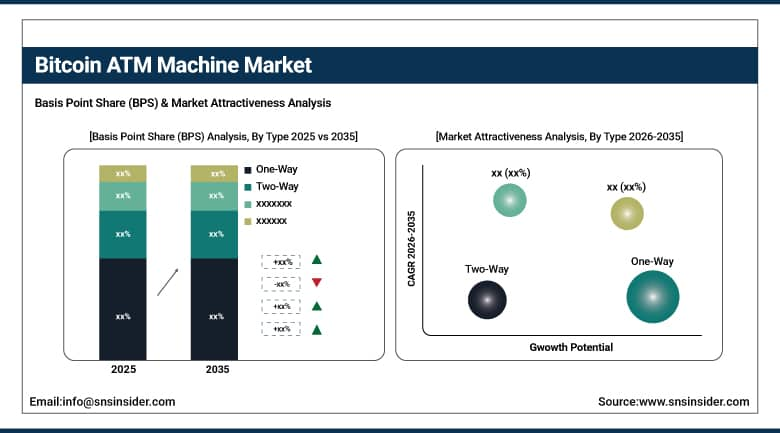
One-way machines hold the largest share of the market, at 78.60% in 2025. They let customers buy digital assets with cash but do not pay cash out, which keeps the hardware simple and limits the cash that operators must manage. Industry trackers show roughly nine in ten installed units are buy-only, and operators prefer them for low upkeep. Established manufacturers supply them in volume to operators that value reliability, easy servicing, and predictable cash handling across large fleets.
Two-way machines are expected to expand fastest, at a CAGR of 41.80% from 2026 to 2035. They allow users to sell as well as buy, which attracts customers who want to cash out and raises transaction counts. Their higher cost and compliance burden are offset by better utilization. Operators in some regions are converting existing kiosks to support selling, and manufacturers are releasing models with cash dispensing and bill recycling that reduce service visits, so the mix will shift.
By Component, Hardware Dominates Bitcoin ATM Machine Market; Software to Register Fastest Growth.
The hardware sector is the top sector with 64.90% of the market share in 2025. Each unit consists of a cabinet, touch screen, bill acceptor, printer, cameras, and secure computing, and operators buy or lease thousands of them. Spare parts and field service are also sold by manufacturers. Hardware sales are the primary source of income for suppliers, even though new installations are decreasing. Manufacturers compete on the basis of reliability, security, and service networks; consequently, operators tend to use only one supplier because this makes spare parts more straightforward.
Software is forecast to grow at a CAGR of 38.20% from 2026 to 2035. Identity verification, transaction monitoring, remote fleet management, pricing tools, and reporting systems are becoming essential under new rules. Subscriptions provide recurring revenue and help operators prove compliance. Vendors also offer analytics for pricing and fraud detection, which helps operators respond quickly to suspicious patterns, and as rules tighten, software spending is expected to rise faster than spending on new machines because every installed unit needs them.
By Cryptocurrency, Bitcoin Dominates Bitcoin ATM Machine Market; Ethereum to Register Fastest Growth.
Bitcoin has a market share of 49.80% in 2025. The kiosks are widely thought to be associated with Bitcoin, as extensive liquidity makes it a preferred choice by customers and almost all kiosks support Bitcoin. The name itself has made it a number one choice of customers. Large transaction sizes and the availability of effective pricing and compliance software have made the kiosks work efficiently. However, with the headquarters' operations, other cryptocurrencies are also increasing their share.
Ethereum is projected to grow at a CAGR of 39.30% from 2026 to 2035. It is supported on a rising share of machines, and its use in decentralized applications and stablecoin transfers draws new users. Operators add it to widen the menu and raise revenue per machine. Gas fees and network speed matter to buyers, so operators price it with a margin that reflects those costs, while stablecoins on the same network add a second reason to use the asset.
By Deployment Location, Restaurants and Hospitality Dominates Bitcoin ATM Machine Market; Commercial Spaces to Register Fastest Growth.
Restaurant and hospitality segments are the biggest areas for deployment, with a 36.00% share estimated in 2025. The convenience stores, petrol stations, and food outlets have long working hours, attract many customers to their premises, and provide rental income. Operators like the convenience stores, petrol stations, and food outlets as they offer good visibility and rent and sign contracts with national chains for a longer period of time.
Commercial spaces are the fastest-growing location type, with a projected CAGR of 40.30% from 2026 to 2035. Malls, office buildings, airports, and large retail centers offer secure indoor sites and higher spending customers. Hosts value controlled access and security staff. Operators are negotiating placements in shopping centers and corporate buildings to reach customers who are less price sensitive, and these sites typically have stricter security and compliance expectations, which favors established operators with strong monitoring tools and customer service policies.
Geography Analysis
|
Region |
Major Country |
Share within Region, 2025 (%) |
|---|---|---|
|
North America |
United States |
88.50% |
|
Europe |
Poland |
24.00% |
|
Asia Pacific |
Australia |
62.00% |
|
Middle East & Africa |
United Arab Emirates |
36.00% |
|
Latin America |
Mexico |
38.00% |
North America Bitcoin ATM Machine Market
North America led the market in 2025 with an 84.30% share. The United States market was valued at USD 231.28 Million in 2025 and is projected to grow at a CAGR of 33.60% from 2026 to 2035. The country hosts the large majority of machines, which are concentrated in convenience stores and gas stations in the South and Midwest. Canada adds a sizeable network, while Mexico, which is part of Latin America, is a small but growing market. Dense networks serve large metropolitan areas.
Regulation is the key aspect that distinguishes this situation. As of 2023, more than thirty states have introduced laws regarding kiosks, covering areas such as licensing, caps, warnings, and refunds. In May 2026 Minnesota adopted a preliminary law stating that all kiosks must be turned off by the end of the third quarter of the year. Companies are adapting by avoiding restrictive states and choosing to focus their attention on states with clear regulations. The federal government is considering the introduction of a national limit on daily transaction and refund rights for customers, although no law has been introduced at the federal level by the time this study was written.
Get Customized Report as Per Your Business Requirement - Enquiry Now
Asia Pacific Bitcoin ATM Machine Market
The Asia Pacific region is expected to witness a CAGR of 41.20% from 2026 to 2035 and accounted for a share of 6.20% in 2025. Australia has the highest number of operating networks, with other smaller hubs in countries such as New Zealand, Hong Kong, Singapore, and Japan. A growing interest in crypto among young consumers and the migrant population contributes toy the region's growth. Despite difficulties in the regulatory landscape, there are local players and some international brands targeting migrant workers and tourists in large cities.
The financial crime and transaction agency of Australia has put a cap on the cash usage of crypto ATMs and has taken action against the operators. In July 2026, the New Zealand government abandoned its plans for an outright ban and instead opted for regulations that will minimize the online transactions. In this regard, operators are making sure they comply and there will be an increase in investments in countries that have embraced the licensing. Licensing models in Singapore and Hong Kong favor big players while Japan and South Korea have strict regulations concerning cash transactions.
Europe Bitcoin ATM Machine Market
Europe comes in second, with 7.10% of the market by 2025. Number of devices there is small as compared to North America; machines are used all over Spain, Poland, Austria, Italy and other countries. Operators need to be registered as virtual asset service providers, conduct identity verification, and comply with travel rule requirements which impede anonymous cash transactions and add to the cost of operations. Tourists serve as clients in southern Europe; Poland and the Czech Republic are home to the manufacturers and small operators producing machines for regional clients across Central Europe.
The anti-money-laundering regulation that applies from July 2027 will introduce uniform customer due diligence rules, a cap on large cash payments, and a single supervisory authority. Manufacturers based in Central Europe supply machines worldwide and are adding features for compliance with the markets in crypto-assets regime. Supervisors in several member states already require registration and tough identity rules, and some banks refuse to serve operators, so the number of active machines is small and growth depends on firms able to meet compliance demands at scale.
Latin America Bitcoin ATM Machine Market
Latin America is a very small region, led by Mexico and followed by Colombia, Argentina, and Brazil. Remittance flows, currency instability, and high inflation make digital assets attractive to households, and some operators from North America have opened service centers in large cities. Machine counts are modest, but interest in stablecoins is strong. Operators from North America are present in Mexico City and other large cities, and cash-heavy economies, informal labor markets, and remittance flows from the United States offer a natural base for kiosk services.
Regulations are still evolving, and a number of countries are working on legislation for providers of virtual assets. All operators are struggling against lack of bank services, problems with security and restrictions on currency. The cooperation with local supermarket chains might enable the enlargement of scope in the future. Payment companies and banks are careful while dealing with crypto companies, and the cost of importing machines is very high because of tariffs and currency fluctuations as well. Security is an issue for cash kiosks in some cities, so operator takes into account the presence of guards and cameras, as well as good relations with landlords to avoid the risk of theft.
Middle East & Africa Bitcoin ATM Machine Market
The Middle East & Africa region holds the smallest share, at 1.10% in 2025. The United Arab Emirates is the main market, supported by licensing frameworks for virtual assets in Dubai and Abu Dhabi, while South Africa and Nigeria show strong consumer interest in crypto. Machine counts are small. Global exchanges and payment companies have set up regional hubs in the Gulf, which creates a supportive environment even though few cash kiosks are operating so far, and expatriate workers who send money home form a clear target customer group.
Tourism, expatriate populations, and remittance corridors support early demand, and regulators in the Gulf are building clear licensing rules that may attract global operators. In Africa, mobile money competes with kiosks, and limited banking links and currency controls slow expansion. Security and cash logistics add costs, so operators are likely to enter selectively through partnerships with local retailers and exchanges, and early machines are expected in airports, large malls, and hotel lobbies where foot traffic and oversight are strongest during the early years of adoption.
Competitive Landscape
The Bitcoin ATM Machine Market has a highly consolidated structure. A handful of large operators such as Bitcoin Depot, CoinFlip, and Athena Bitcoin control most of the installed base, followed by regional networks such as Rockitcoin, Bitstop, and Margo. Machine makers such as General Bytes and Byte Federal supply hardware and software. Competition rests on location quality, fees, compliance record, customer support, and the ability to secure banking services.
Operators follow several strategic lines. Large networks are tightening identity checks and caps, expanding into new countries, and signing national retail agreements, while smaller companies focus on regional service and white-label arrangements. Consolidation is likely as weaker operators exit.
Bitcoin ATM Machine Market Industry Leaders
1. Bitcoin Depot
2. CoinFlip
3. Athena Bitcoin
4. Rockitcoin
5. Bitstop: Operator and brand of kiosks with a focus on user experience and compliance.
Companies Covered in this Report
-
Bitcoin Depot
-
CoinFlip
-
Athena Bitcoin
-
Rockitcoin
-
Bitstop
-
Margo
-
Byte Federal
-
General Bytes
-
Cryptolink
-
Genesis Coin
Recent Industry Developments
-
December 2025: CoinFlip opened a crypto service center in Mexico City.
-
January 2026: General Bytes reported progress on its BATM7 cashless machine and on compliance with the markets in crypto-assets and digital operational resilience rules.
-
February 2026: Bitcoin Depot introduced identity checks at every transaction on its machines.
-
February 2026: Byte Federal launched ByteConnect, a merchant payment gateway, through its Australian arm.
-
May 2026: Bitcoin Depot filed for Chapter 11 bankruptcy protection in the United States.
-
August 2026: Cryptolink had its Australian registration suspended for three months, taking 96 machines offline.
Scope and Research Methodology
This study covers the Bitcoin ATM Machine Market, which includes kiosks that sell digital assets for cash or cards, and the hardware, software, and transaction fees associated with them. The base year is 2025, the forecast period is 2026 to 2035, and all values are expressed in USD. The market is segmented by type, component, cryptocurrency, deployment location, and region. Exchange platforms, online brokers, and point-of-sale crypto payments are excluded, and only kiosk revenue is counted. Revenue from machine sales, leasing, spare parts, and service is included alongside transaction fees, while fiat deposits themselves are not counted as market revenue. Public company disclosures are used wherever available.
The research program combines secondary and primary research. Secondary research draws on company annual reports, investor presentations and filings, regulator and government databases, trade association data, product documentation, and peer-reviewed and industry publications. Primary research consists of structured interviews and surveys with executives, product and business heads, procurement leaders, and end-user stakeholders across the value chain, including machine makers, operators, retail hosts, compliance vendors, and payment providers. These conversations are used to validate assumptions, adoption rates, and pricing. Interviews cover several regions so that purchasing practices and price levels reflect local conditions.
Market engineering follows a bottom-up build from operator revenue and installed machine data, which is cross-checked top-down against crypto transaction volumes and consumer spending. Triangulation across these views confirms segment and regional estimates. Regional figures are built from machine counts, fee levels, and regulatory status, then adjusted for pricing and enforcement. Forecasts consider adoption by location, regulation, technology change, and macroeconomic conditions, and every dataset passes an analyst quality review before it is published. The study also reports sensitivity to key assumptions, and results are refreshed whenever significant events change the competitive or regulatory picture. Scenario analysis tests demand under stricter caps and weaker crypto prices.
Bitcoin ATM Machine Market Report Scope:
| Report Attributes | Details |
|---|---|
| Market Size in 2025 | USD 310.00 Million |
| Market Size by 2035 | USD 6,141.30 Million |
| CAGR | CAGR of 34.80% From 2026 to 2035 |
| Base Year | 2025 |
| Forecast Period | 2026-2035 |
| Historical Data | 2022-2024 |
| Report Scope & Coverage | Market Size, Segments Analysis, Competitive Landscape, Regional Analysis, DROC & SWOT Analysis, Forecast Outlook |
| Key Segments | • By Type (One-Way and Two-Way) • By Component (Hardware and Software) • By Cryptocurrency (Bitcoin, Ethereum, Litecoin, and Others) • By Deployment Location (Restaurants and Hospitality, Commercial Spaces, Transportation Hubs, and Others) |
| Regional Analysis/Coverage | North America (US, Canada), Europe (Germany, UK, France, Italy, Spain, Russia, Poland, Rest of Europe), Asia Pacific (China, India, Japan, South Korea, Australia, ASEAN Countries, Rest of Asia Pacific), Middle East & Africa (UAE, Saudi Arabia, Qatar, South Africa, Rest of Middle East & Africa), Latin America (Brazil, Argentina, Mexico, Colombia, Rest of Latin America). |
| Company Profiles | Bitcoin Depot, CoinFlip, Athena Bitcoin, Rockitcoin, Bitstop, Margo, Byte Federal, General Bytes, Cryptolink, Genesis Coin |

Frequently Asked Questions
The market was valued at USD 310.00 Million in 2025 and is estimated at USD 417.88 Million in 2026. It is projected to reach USD 6,141.30 Million by 2035.
The market is projected to grow at a CAGR of 34.80% from 2026 to 2035, supported by cash-preferring customers, retail expansion, and new machine types, partly offset by regulation.
North America leads, with an 84.30% share in 2025, while Asia Pacific is the fastest-growing region, with a CAGR of 41.20% from 2026 to 2035, from a small base.
Bitcoin Depot, CoinFlip, Athena Bitcoin, Rockitcoin, and Bitstop are among the major players, with Margo, Byte Federal, and General Bytes also active.
One-way machines, hardware, Bitcoin, and restaurants and hospitality lead their respective axes. Two-way machines, software, Ethereum, and commercial spaces grow fastest.
