
Cannabis Vaporizer Market Report Scope & Overview:
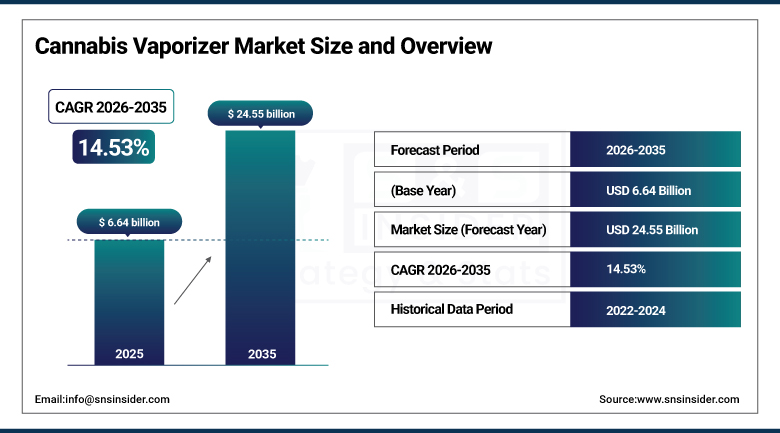
The Cannabis Vaporizer Market was valued at USD 6.64 billion in 2025 and is expected to reach USD 24.55 billion by 2035, growing at a CAGR of 14.53% from 2026-2035.
The Cannabis vaporizers may be the biggest winners from one of the biggest shifts in consumer products regulation in the last two decades. With cannabis legalization marching ever further across North America, Europe and now steadily into Latin America and Asia Pacific, the vaporizer has proven the preferred method of consumption for an increasingly health-conscious and mature cannabis consuming demographic. It is logical because it works like this: when you vaporize cannabis materials the temperature becomes hot enough to release cannabinoids and terpenes in vapor form but below combustion temperatures that yield the carcinogens and irritants present in cigarette smoke. That harm reduction profile is clinically meaningful for medical cannabis patients and in formal prescriptions in some jurisdictions. It creates consistency with health values for recreational consumers who may not define as one who smokes. Hardware innovation portable devices with smartphone app connectivity, degree-precision temperature and cartridge-based concentrate formats have collectively failed the market to basically create a consumer electronics category that enlarges the total addressable consumer populace well beyond the typical cannabis smoker demographic.
As detailed in the CDC's National Centre for Health Statistics, the prevalence of smoking among U.S. adults fell to 11.6% in 2022, the lowest level recorded, while the adoption of alternative nicotine and cannabinoid delivery devices increased, representing a broader cultural trend toward smokeless consumption methods that drives cannabis vaporizer demand. Cannabis use among U.S. adults in 2023 reached 18.7% — the highest level ever recorded by SAMHSA's National Survey on Drug Use and Health.
To Get more information on Cannabis Vaporizer Market - Request Free Sample Report
Cannabis Vaporizer Market Trends
-
Premium portable vaporizers with precision temperature control, OLED displays, and smartphone app integration are creating a consumer electronics-grade product experience that commands significant price premiums over basic vape pens.
-
Induction heating technology is gaining commercial traction for its even heating, reduced risk of hot spots, and cleaner vapor production profile compared to conduction heating alternatives.
-
Concentrate cartridge vaporizers — pre-filled oil cartridges designed for proprietary pens — are growing rapidly as brands leverage the cartridge format to build recurring revenue consumer relationships similar to printer ink cartridge models.
-
Microdosing-focused vaporizer designs with precise dose control are appealing to medical cannabis patients who require consistent, reproducible cannabinoid intake for symptom management.
-
Cannabis vaporizer brands are increasingly partnering with cannabis cultivators and extraction companies to create vertically integrated branded product experiences from genetics through hardware.
-
Expansion of cannabis lounges and social consumption venues in legalized jurisdictions is creating in-venue vaporizer demand for tabletop devices that deliver consistent, high-quality experiences in social settings.
-
Regulatory agency science on vaporization safety relative to smoking is progressively building the evidence base that supports medical prescribing of vaporization as the recommended cannabis delivery method over smoking.
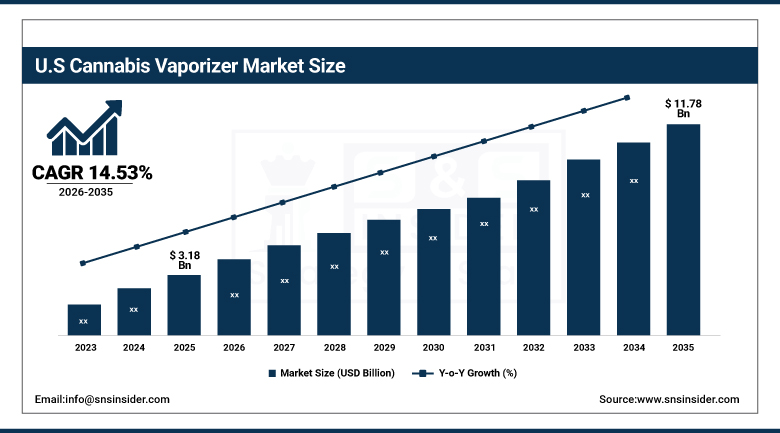
U.S. Cannabis Vaporizer Market was valued at USD 3.18 billion in 2025 and is expected to reach USD 11.78 billion by 2035, growing at a CAGR of 14.53% from 2026-2035.
the USA has for the most part been the biggest natural cannabis vaporizer marketplace on earth, bolstered by the world biggest lawful cannabis retail advertise and the world's most evolved cannabis equipment item biological system. California, Colorado, Illinois, Washington, Michigan, and Massachusetts – containing thousands of licensed dispensaries and mature buyers who have purchased vaporizers for ages – make up the largest-volume state markets. The U.S. market has also created the highest class of product innovation: international icons focused on hardware have launched here in the U.S. where their optics and top-shelf hardware sold here sells internationally by purely coincidence, as direct international cannabis hardware sales over U.S.-based retail outlets are prohibited. The commercial landscape for cannabis businesses, including manufacturers of vaporizers, would radically change if federal rescheduling happens and actually takes place especially would occur if the DEA proposal in 2024 to take cannabis out of Schedule I altogether and into Schedule II.)
Under state-level authorities, the U.S. Cannabis Regulatory Agency requires child-resistant packaging, and safety testing of vape pens with devices sold through licensed dispensaries. The DEA's proposed new scheduling for cannabis would be up to Schedule III, which would lighten federal compliance burdens for cannabis businesses and could speed up the banking access that is currently a choke point for cannabis hardware manufacturers.
Cannabis Vaporizer Market Segment Analysis
-
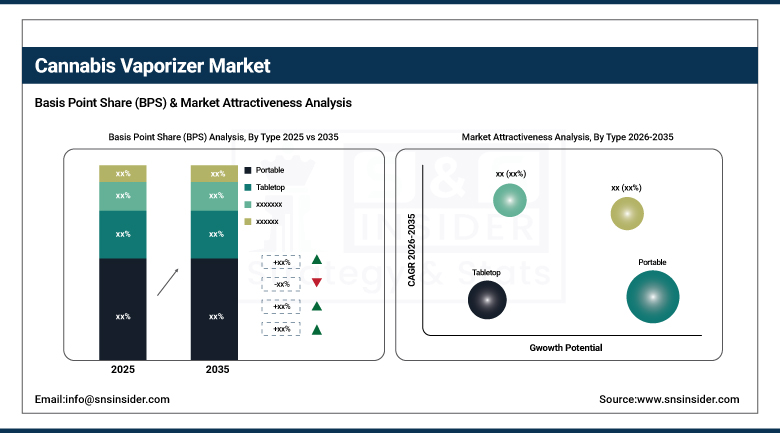
By Type, Portable segment dominated with 69.6% share in 2025; Tabletop fastest growing (CAGR).
-
By Ingredient, Dry Herb segment dominated with 44.8% share in 2025; Hybrid fastest growing (CAGR).
-
By Heating Method, Conduction dominated with 43.2% share in 2025; Induction fastest growing (CAGR).
-
By Power Source, Battery-powered dominated with 64.7% share in 2025; Non-battery fastest growing (CAGR).
-
By Distribution, Online dominated with 56.4% share in 2025; Offline fastest growing (CAGR).
By Type, Portable segment dominates the Cannabis Vaporizer Market, Tabletop expected to grow fastest
portable cannabis vaporizers controlled about 69.6% of the market in 2024, a share amplified by growing demand from consumers in search of portable, simple-to-use, and discreet devices that facilitate an end-use that many consumers prefer to make a flexible aspect of their daily lives rather than a stationary home ritual (i.e., when & where available). Portable devices appeal to millennials and on-the-go consumers because they are wireless, easily used outside the home, and do not dominate the table like larger, more complex devices can. Recent advances in technology improved battery designs, fast-heating elements, and compact form factors have turned portable vaporizers into legitimately performant systems of vapor quality instead of just convenient systems that historically had to sacrifice portability for performance.
Table Top Vaporizers are expected to grow at the fastest CAGR during the forecast period due to the high quality of vapor extracted from tabletop devices, the larger temperature control capabilities of tabletop vaporizers, and the better user experience for consumers who prioritize quality over mobility. Tabletop devices are extremely popular among enthusiast and medical users who want a premium, home-based experience, where potency, taste and efficiency are key. Widespread social vaping behavior and cannabis lounges in already legalized states and countries which are public venues designated for cannabis consumption is growing the demand for tabletop vaporizers as fixtures that assure consumers optimal, same-quality consistent experiences.
By Ingredient, Dry Herb segment dominates the Cannabis Vaporizer Market, Hybrid expected to grow fastest
In 2024, dry herb vaporizers contributed approximately 44.8% of the total Cannabis Vaporizer Market as traditional cannabis consumers preferred the natural flavour profile and whole-spectrum cannabinoid and terpene content that unprocessed plant material provides. Unlike concentrates and oils, dry herb vaporizers are able to vaporize the flower of the plant directly based only on the heat source, allowing the natural chemistry of the plant to remain intact without all of the extraction and formulation steps needed to create concentrates or oils. They earned their popularity partly because they are efficient vaporization is able to extract much more cannabinoids per gram than combustion does and in part because consumers prefer to consume the whole plant to processed extracts. As ever more new, exotic premium cannabis flower varieties (terpene profiles and cannabinoid ratios) gain exposure in the marketplace, demand for dry herb vaporizers has continued to grow amongst connoisseur consumers who opt for their hardware based on which machines preserve the individual attributes of the flower they search for.
Hybrid vaporizers are likely to account for the fastest ingredient CAGR through 2035, being able to vaporize both dry herbs as well as concentrates in a single device, tapping into a rising consumer segment looking for flexibility across product formats. Of course, as consumers continue to refine their cannabis experience, navigating the different types of concentrates wax, shatter, live resin, distillate in addition to traditional flower, hybrid devices unlock the opportunity for consumers to explore the whole spectrum without having to buy multiple devices dedicated to each type. Companies are working to the other extreme and creating new ways to build hybrid devices to provide the best performance on both formats, thereby minimizing the performance compromises typically found with lower cost hybrid hardware, resulting in premium pricing, but with true dual-mode capability.
By Heating Method, Conduction dominates the Cannabis Vaporizer Market, Induction expected to grow fastest
In 2024, conduction vaporizers would hold around 43.2% of the market as they are easy to use, affordable and can reach temperature instantly. Conduction heating — when the cannabis material is in direct contact with the heated surface — is easier to engineer, cheaper to manufacture, and morequick to heat from cold than its convection or induction counterparts. Conduction devices are an entry point into vaporization for beginners and casual users focused more on accessibility and cost than most vapor quality. Such ultra-cheap portable conduction devices for as little as the USD 50-150 price bracket, which are now widely available have really democratized vaporizer access since it makes hardware-based cannabis consumption within the price range for cannabis consumers who may not have the budget for rolling papers or a pipe.
Induction vaporizers are then anticipated to rise at the fastest heating method CAGR through 2035 as their revolutionary technology affords meaningfully superior performance on the very metrics that the cannabis hardware market is trending toward: heating efficiency, temperature accuracy, and vapor purity. Induction heating is based on electromagnetic fields that heat ferromagnetic susceptor materials inside the cannabis material, rather than by conduction; in other words, induction does not heat hot spots that lead to degraded vapor quality and more waste of the cannabis material created by conduction systems. For induction to take hold, there need to be health-conscious consumers willing to accept why vaporization is better, either out of stigma around smoking combustible materials or, on the other end of the scale, outright sacrifice but without their sacrificing palatability-be it taste, appearance or any number of other criteria-willing to accept then effect demonstrated via the sound science behind induction's evidence based improvement of lither consistent low-temp vaporization..
By Distribution, Online segment dominates the Cannabis Vaporizer Market, Offline fastest growing
he online sales channels accounted for the largest share of around 56.4% in the Cannabis Vaporizer Market on the basis of revenue owing to the growing trend of e-commerce which is convenient, provides multiple brands for comparison and enables purchasing in discreet. Cannabis users are drawn to online platforms for their ability to compare prices across dispensaries, the wealth of user reviews, and access to the complete range of products that no single dispensary or local shop can stock. The increasing penetration of digital marketing & social media promotion had bolstered online sales, especially from the younger generation who learns about new vaping products through creator content and social channels of brands.
The offline sales channels are expected to register the fastest distribution CAGR over the forecast period through 2035. Meanwhile, consumers are realizing the value of in-store experiences, where knowledgeable budtenders can offer personalized product recommendations, conduct product demonstrations, and allow hands-on evaluation of hardware quality which no online channel can fully deliver. With legalization driving cannabis retail into the mainstream, the in-store purchase experience wins acceptance from consumers who get to know, and trust, the retail environment in which they buy and gain a relationship that drives repeated purchases.
Cannabis Vaporizer Market Regional Analysis
|
Region |
Major Country |
Share within Region (%) |
|---|---|---|
|
North America |
United States |
88% |
|
Europe |
Germany |
30% |
|
Asia Pacific |
Australia |
45% |
|
Middle East & Africa |
South Africa |
40% |
|
Latin America |
Mexico |
42% |
North America Cannabis Vaporizer Market Insights
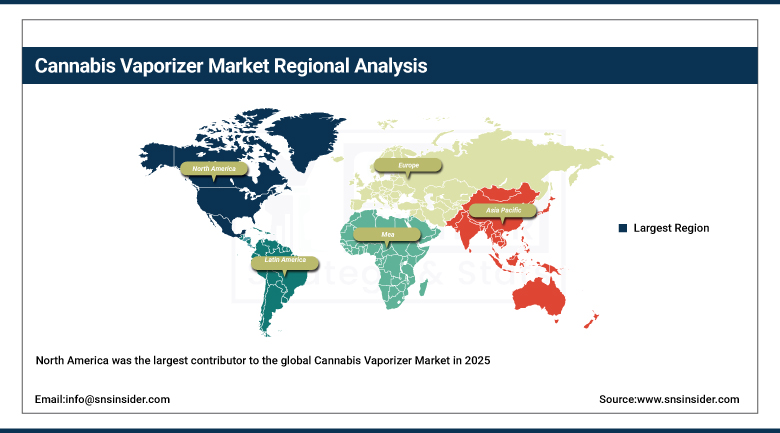
North America was the largest contributor to the global Cannabis Vaporizer Market in 2025 with the largest revenue share owing to the maturity of legal cannabis markets in the United States and Canada, and a well-developed licensed retail infrastructure and the most advanced cannabis hardware product ecosystem in the world. The federal legalization of cannabis in Canada back into 2018 has established a national market infrastructure with protocols for product safety and an increasing number of licensed retailers who stock vaporizer hardware as a core product category. The U.S. legal market is currently ~40 states medical and 24 recreational which creates a giant but fragmented national market in which new hardware brands compete for consumer loyalty by product and brand quality over distribution coverage as in many other industries.
According to MJBizDaily, total U.S. cannabis retail sales topped around USD 28 billion in 2023, with vaporizer hardware being one of the fastest-growing product categories at retail. Canada's licensing framework in cannabis has created a national distribution infrastructure for legal vaporizer hardware, with more than 1,000 licensed retail stores to date and continuing to grow.
Get Customized Report as per Your Business Requirement - Enquiry Now
Europe Cannabis Vaporizer Market Insights
The Europe are seeing rapid growth in cannabis vaporizers strong growth in the broader cannabis market will help propel the vaporizer segment Cosmic Insight Cannabis vaporizers are also seeing strong growth in Europe, which will likely be the highest growth regional market worldwide with rapid cannabis legalization across EU member states and the UK. Germany's legalisation of cannabis-infused foods in April 2024 the largest cannabis market in Europe — signalled a key turning point in European cannabis policy set to ripple down progressively throughout the remaining EU member states . Even already-established medical cannabis programs in Germany, Italy, France, the Netherlands and the UK are generating captive vaporizer demand, in that patients being prescribed cannabis in accordance with the legislation in those jurisdictions' programs are being assigned to use a vaporization route. Because of the way that the recreational model is built on top of the medical frameworks found across Europe, hardware will eventually move from just targeting medical to the customer side of the retail market.
Asia Pacific Cannabis Vaporizer Market Insights
Cannabis legalization across regional jurisdictions in Asia Pacific is progressing in a slow yet steady manner. With probably the most mature regulated medicinal cannabis program in the region, Australia has successfully established a formal medical cannabis market, wherein vaporizers are prescribed as palatable patient delivery devices, and contributing to steady demand from registered medical cannabis patients. The partial legalization of cannabis in Thailand produced a new commercial landscape attracting the attention to both tourism and domestic consumption. With New Zealand's medical cannabis program, the regulatory framework is being rolled out, while discussions continue in South Korea and Japan on medical cannabis policy that grows a legal market presence in the region.
When analysing data, medicinal cannabis prescriptions have grown over 2,000% according to Australia's Therapeutic Goods Administration (TGA), vapouriser hardware are no longer a medical product needing prescription; meaning, they are able to be prescribed as an approved delivery method of inhaled cannabis medicines under the Special Access Scheme. In 2022, Thailand's Food and Drug Administration stripped cannabis of its list of narcotic substances, resulting in the most deregulated cannabis economy of any nation in the region.
Middle East & Africa and Latin America Cannabis Vaporizer Market Insights
These are both early stage but rapidly maturing cannabis vaporizer markets with commercially viable development primarily facilitated by medical cannabis programs. A gray market is slowly heading towards formalization following confirmation from South Africa's highest court that citizens can grow their own marijuana and smoke it in private. Regulatory delays have hampered Mexico's march toward cannabis legalization topping China and the United States to become the world's third-largest population-wise potential cannabis market but the country remains on course toward a legal framework that would create a sizable cannabis vaporizer market. Established Cultivation Markets with Expanding Medical Export Opportunities: Colombia and Jamaica and the Brazil evolution of ANVISA drug formulation guidelines and distribution channel analysis from full medical cannabis to recent medicine in patients approaches.
Cannabis Vaporizer Market Growth Drivers:
Global cannabis legalization expansion and health-conscious consumer shift to smoke-free consumption driving vaporizer market growth
The growth of global cannabis vaporizers market is itself a long term trend driven by two different speed forces lined up moving in the same direction. The structural force is legalization: every jurisdiction that legalizes cannabis for medical or recreational use provides an available, and legal, means for hardware commerce a means that the underground market stifles. The behavioural driver is the health consciousness shift as cannabis users have access to legally produced products and trained retail staff to provide end-to-end knowledge they systematically select vaporization over combustion when presented with an alternative and the ability to make an informed choice. The two forces feed into each other: legalization provides the retail context where vaporizer education and demonstration occurs, and health-conscious purchasing behavior creates the economic justification for dispensaries and brands to invest in producing quality vaporizer hardware and merchandise that makes the educational dialogue economically viable.
The WHO Framework Convention on Tobacco Control guidance on harm reduction has also shaped the regulation-governance globl thinking about alternatives to combusted cannabis consumption. Similarly, NIDA research into this area far outweighs the competition, which suggests that combustion produces many more respiratory irritants than vaporization, and provides the health evidence base that supports the medical prescribing of vaporization, as the preferred delivery method for cannabis.
Cannabis Vaporizer Market Restraints:
Regulatory inconsistencies across jurisdictions and lingering health concerns limiting cannabis vaporizer market expansion globally
The cannabis vaporizer market exist in this uniquely fragmented regulatory environment in which cannabis products, nicotine vaping products, and consumer electronics regulations manifest and coexist in ways that vary dramatically from jurisdiction to jurisdiction. Something that is legal in one state for sale in a California dispensary, legal in the UK as a tobacco vaporizer substitute, and entirely illegal in Singapore or Indonesia, creates compliance, marketing, and distribution strategies for global brands that are impossible to standardize. Long-term consumer confusion over vaping safety from the U.S. 2019-2020 EVALI outbreak that was more than 90% due to vitamin E acetate in illicit market THC cartridges than regulated commercial products continues to necessitate active communication from brands and regulators. 0:34 Product quality control issues with respect to illegal and gray trade leaves a reputational overhang on the legitimate industry.
Cannabis Vaporizer Market Opportunities:
Premium product customization and expanding medical cannabis adoption creating significant cannabis vaporizer growth opportunities
The cannabis vaporizer market's potential for the premium tier of the cannabis vaporizer market as product sophistication grows, and the willingness to spend on quality hardware increases with category maturity. Devices in the USD 200-500+ range that provide accurate temperature control, smart connectivity, compatible accessories, and materials are taking a bigger portion of hardware revenues as consumers begin to treat their vaporizer as a higher-consideration consumer electronics purchase instead of a disposable item. PAX (loyalty program) and Puffco (Peak Pro ecosystem) are raising consumer switches and Storz & Bickel lineages are pushing low-threshold medical devices brands create relationships around product quality, design and build-up community which lasts through hardware frame updates and complementary accessory revenue. The growing medical cannabis population offers a unique market: Patients who take cannabis to alleviate symptoms consume more often, prefer consistent management of their symptoms, and are willing to pay a premium for accurate, medical-grade hardware than recreational users.
Recent Developments:
-
2026: PAX Labs launched the PAX Era Pro 2 cartridge vaporizer with expanded Bluetooth connectivity to a redesigned app featuring lab-tested strain-specific dosing recommendations and session tracking, targeting medical cannabis patients seeking data-driven consumption management and recreational consumers who value optimized experiences based on cannabis product chemistry profiles.
-
2025: Storz & Bickel expanded its MIGHTY+ vaporizer product line with a new medical variant specifically designed for clinical cannabis prescription programs in Germany under the Cannabis Act, featuring tamper-evident packaging, dose tracking capability, and TÜV Rheinland medical device certification that allows the device to be prescribed under Germany's cannabis medicine reimbursement framework.
-
2025: Puffco launched the Peak Pro Studio Edition tabletop concentrate vaporizer with integrated real-time vapor temperature monitoring through an upgraded atomizer with embedded temperature sensors, providing users with precise temperature-confirmed vapor production data through app connectivity and enabling reproducible consumption sessions for medical accuracy requirements.
Cannabis Vaporizer Market Key Players
Some of the Cannabis Vaporizer Market Companies
-
PAX Labs Inc.
-
Storz & Bickel GmbH
-
Puffco
-
DaVinci Vaporizer
-
Grenco Science
-
Firefly Vapor
-
AirVape
-
Arizer Co.
-
XMax
-
POTV
-
Dynavap LLC
-
Boundless Technology
-
Pulsar Vaporizers
-
Kandypens
-
Dr. Dabber Inc.
-
Bloom Vape
-
Select
-
Calyx Peaks Inc.
-
Ooze Life Inc.
-
Vessel Brand Inc.
Cannabis Vaporizer Market Report Scope:
| Report Attributes | Details |
|---|---|
| Market Size in 2025 | USD 6.64 Billion |
| Market Size by 2035 | USD 24.55 Billion |
| CAGR | CAGR of 14.53% From 2026 to 2035 |
| Base Year | 2025 |
| Forecast Period | 2026-2035 |
| Historical Data | 2022-2024 |
| Report Scope & Coverage | Market Size, Segments Analysis, Competitive Landscape, Regional Analysis, DROC & SWOT Analysis, Forecast Outlook |
| Key Segments | • By Type (Tabletop, Portable) • By Ingredient (Dry Herb Vaporizers, Oil, Hybrid) • By Heating Method (Conduction, Convection, Induction) • By Power Source (Battery, Without Battery) • By Distribution (Online, Offline) |
| Regional Analysis/Coverage | North America (US, Canada), Europe (Germany, UK, France, Italy, Spain, Russia, Poland, Rest of Europe), Asia Pacific (China, India, Japan, South Korea, Australia, ASEAN Countries, Rest of Asia Pacific), Middle East & Africa (UAE, Saudi Arabia, Qatar, South Africa, Rest of Middle East & Africa), Latin America (Brazil, Argentina, Mexico, Colombia, Rest of Latin America). |
| Company Profiles | Pax Labs, Curaleaf, Stiiizy, OrganiGram Holdings Inc., Little Green Pharma, Qnovia, MIIST Therapeutics, Greentank, Cornbread Hemp, Beam, HOLISTIK Wellness, Medterra, CBDistillery, Foria, Martha Stewart CBD. |
Frequently Asked Questions
North America dominated the Cannabis Vaporizer Market in 2025.
The Induction segment is expected to register the fastest CAGR in the Cannabis Vaporizer Market through 2035.
The Portable segment dominated with approximately 69.6% share in 2025.
The Cannabis Vaporizer Market was valued at USD 6.64 billion in 2025.
The Cannabis Vaporizer Market is expected to grow at a CAGR of 14.53% from 2026 to 2035.
