
Cell Therapy Manufacturing Automation Market Report Scope & Overview:
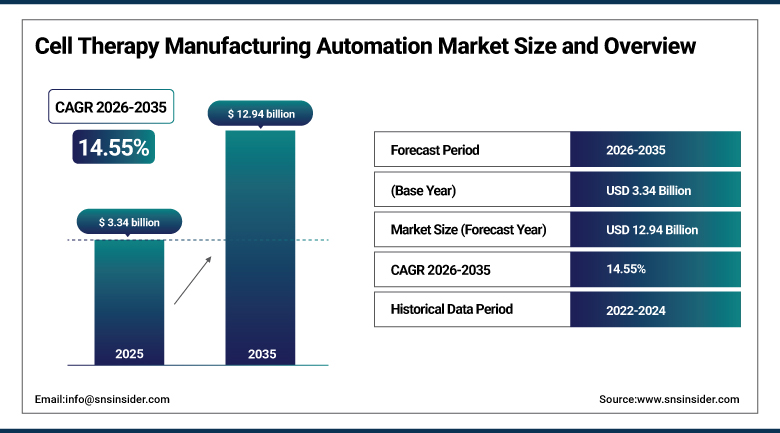
The Cell Therapy Manufacturing Automation Market was valued at USD 3.34 billion in 2025 and is expected to reach USD 12.94 billion by 2035, growing at a CAGR of 14.55% from 2026-2035.
The Cell Therapy Manufacturing Automation Market is witnessing strong growth due to increasing demand for scalable, standardized, and efficient cell therapy production. The complexity involved in cell-based manufacturing processes is making automation increasingly necessary in cell processing, culturing, medium management, quality control, and filling. Automation can help in minimizing human interventions, contamination risks, process variations, and cost of production. Moreover, the increased number of clinical trials and commercial products related to cell therapies is creating the need for a more adaptable manufacturing platform. Innovations in closed-system processing, robotics, digital monitoring, and quality control automation are also contributing to the use of automation in cell therapy manufacturing processes.
FDA reported that CBER had approved close to 50 cell and gene therapies over the previous decade, demonstrating the expanding clinical and commercial base requiring advanced manufacturing capabilities.
To Get more information Cell Therapy Manufacturing Automation Market - Request Free Sample Report
Cell Therapy Manufacturing Automation Market Trends
-
Rising demand for cell therapies is driving automation adoption to improve manufacturing scalability, consistency, quality, and production efficiency.
-
Increasing commercialization of CAR-T and other advanced cell therapies is expanding demand for automated and standardized manufacturing workflows.
-
Growing need to reduce manual handling and contamination risks is encouraging adoption of closed and automated cell processing systems.
-
Advancements in robotics, artificial intelligence, and process control technologies are improving manufacturing precision, monitoring, reproducibility, and operational efficiency.
-
Increasing investments in cell therapy manufacturing facilities are accelerating deployment of automated equipment, software, and integrated production platforms.
U.S. Cell Therapy Manufacturing Automation Market Outlook
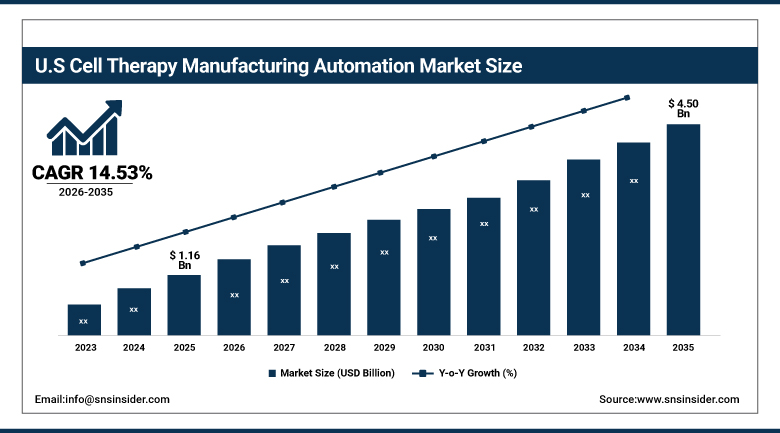
U.S. Cell Therapy Manufacturing Automation Market was valued at USD 1.16 billion in 2025 and is expected to reach USD 4.50 billion by 2035, growing at a CAGR of 14.53% from 2026-2035.
The U.S. Cell Therapy Manufacturing Automation Market is witnessing strong growth due to increasing demand for scalable, standardized, and efficient cell therapy production. As more and more clinical trials of cell therapies and commercial initiatives become available, there arises a need for automated systems that can increase manufacturing consistency, reduce human involvement and eliminate contamination as well as variations in the process. More and more investments in cell therapy manufacturing capabilities in the U.S. are also helping to drive this trend. Moreover, advancements in closed-system manufacturing, robotic technology, automated cell culturing, digital monitoring, and quality control have been increasing the efficiency of the manufacturing process.
A published automated manufacturing study demonstrated production of approximately 1.5 × 10¹⁰ T cells after 12 days of expansion without affecting other product attributes
Cell Therapy Manufacturing Automation Market Segment Analysis
-
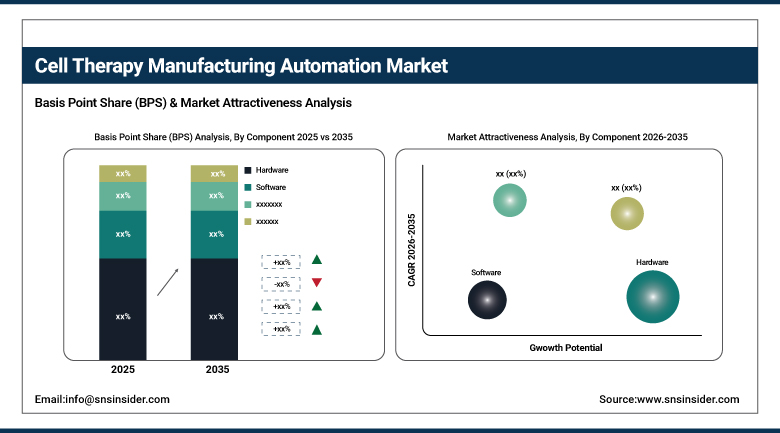
By Component, Hardware dominates the Cell Therapy Manufacturing Automation Market with 48% share in 2025; Software is expected to grow at the fastest CAGR of 15.62% from 2026–2035.
-
By Process, Upstream Processing dominates the Cell Therapy Manufacturing Automation Market with 26% share in 2025; Quality Control is expected to grow at the fastest CAGR of 16.23% from 2026–2035.
-
By Application, Clinical dominates the Cell Therapy Manufacturing Automation Market with 43% share in 2025; Commercial is expected to grow at the fastest CAGR of 15.37% from 2026–2035.
-
By Cell Type, T-Cells dominate the Cell Therapy Manufacturing Automation Market with 43% share in 2025; Natural Killer (NK) Cells are expected to grow at the fastest CAGR of 16.32% from 2026–2035.
-
By End User, Pharmaceutical & Biotechnology Companies dominate the Cell Therapy Manufacturing Automation Market with 51% share in 2025; Contract Manufacturing Organizations (CMOs) are expected to grow at the fastest CAGR of 16.60% from 2026–2035.
By Component, Hardware dominates the cell therapy manufacturing automation market, Software grows fastest.
Hardware segment dominated the Cell Therapy Manufacturing Automation Market with the highest revenue share of about 48% in 2025 because of the rising need for automated bioreactors, cell processing systems, fillers, and material handling systems. The equipment helps to reduce human interaction, chances of contamination, and variation in processes. Cell therapies and automation also help in the increase in hardware usage.
Software segment is expected to grow at the fastest CAGR of 15.62% from 2026-2035 Due to rising demands for digital process control, real-time monitoring, data management, workflow automation, and manufacturing analytics. Software improves process transparency, traceability, and quality management within complicated cell therapy processes. Increasing levels of digitization, regulations, and smart manufacturing platforms are anticipated to drive software adoption worldwide.
By Process, Upstream Processing dominates the cell therapy manufacturing automation market, Quality Control grows fastest.
Upstream Processing segment dominated the Cell Therapy Manufacturing Automation Market with the highest revenue share of about 26% in 2025 Due to increasing demands on controlled cell proliferation, culture, media handling, and process reproducibility. Automation allows for monitoring and control of key upstream processes and decreases contamination and variability of operators. Increasing demand for production of cell therapies and scalable manufacturing processes adds to its adoption worldwide.
Quality Control segment is expected to grow at the fastest CAGR of 16.23% from 2026-2035 as a result of increasing regulations, the necessity for product consistency, and requirement of quality monitoring in real time during cell therapy manufacturing. Automated quality control ensures testing efficiency, traceability, and batch release process. Commercialization and increasing complexities associated with cell therapies are predicted to drive global acceptance of automated quality control systems.
By Application, Clinical dominates the cell therapy manufacturing automation market, Commercial grows fastest.
Clinical segment dominated the Cell Therapy Manufacturing Automation Market with the highest revenue share of about 43% in 2025 Because of the growing need for cell therapy clinical trials that require a controlled manufacturing process. Automation will assist researchers in managing complicated processes and ensuring accuracy. The increasing number of clinical trials and investments in advanced therapy will further enhance the use of automation worldwide.
Commercial segment is expected to grow at the fastest CAGR of 15.37% from 2026-2035 Because of the commercialization of cell therapies that have been approved as well as the requirement of scaling up the manufacturing process so as to be standardized and cost-effective. The use of automation will lead to increase in production rate, quality, and decrease in manual intervention.
By Cell Type, T-Cells dominate the cell therapy manufacturing automation market, Natural Killer (NK) Cells grow fastest.
T-Cells segment dominated the Cell Therapy Manufacturing Automation Market with the highest revenue share of about 43% in 2025 because of the extensive development and application of T-cell therapy especially CAR-T therapies. T-cells manufacturing requires intricate process like proliferation, activation, modification and harvest; automation can greatly improve this process. Increasing applications in oncology and commercial production also adds more reasons for the automation requirement.
Natural Killer (NK) Cells segment is expected to grow at the fastest CAGR of 16.32% from 2026-2035 Due to increased scientific research on NK cell-based immunotherapies and their possible use in scalable and off-the-shelf treatment options. The benefits of automation include consistency in cell expansion, processing, and quality assurance while decreasing manufacturing variance. Increased clinical research, cancer immunology research, and investment in NK cells will drive adoption.
By End User, Pharmaceutical & Biotechnology Companies dominate the cell therapy manufacturing automation market, Contract Manufacturing Organizations (CMOs) grow fastest.
Pharmaceutical & Biotechnology Companies segment dominated the Cell Therapy Manufacturing Automation Market with the highest revenue share of about 51% in 2025 owing to heavy investments in the area of cell therapy R&D, manufacturing, and commercialization. Such firms need automatic machinery for increased scalability and quality control. The rise in cell therapy pipeline and manufacturing investments makes the use of such machinery more common worldwide.
Contract Manufacturing Organizations (CMOs) segment is expected to grow at the fastest CAGR of 16.60% from 2026-2035 Due to increasing outsource activities in cell therapy development and manufacturing. CMOs have specialized facilities, automation, and regulatory know-how that can help developers scale up production efficiently. Increasing pipelines of therapies, small manufacturing capacity of developers, and the need for flexible production services are likely to boost the use of CMOs.
Regional Analysis
|
Region |
Major Country |
Share within Region, 2025 (%) |
|---|---|---|
|
North America |
United States |
91.0% |
|
Europe |
Germany |
24.0% |
|
Asia Pacific |
China |
42.0% |
|
Middle East & Africa |
UAE |
18.0% |
|
Latin America |
Brazil |
35.0% |
North America Cell Therapy Manufacturing Automation Market Insights
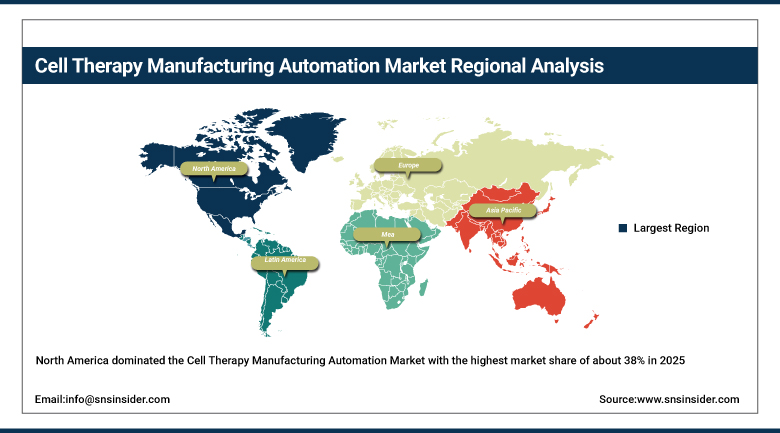
North America dominated the Cell Therapy Manufacturing Automation Market with the highest market share of about 38% in 2025, driven by cell therapy manufacturing infrastructure, well-established biotechnology and pharmaceutical industry, and high demands for scaleable manufacturing. Increasing adoption of automated bioprocessing, stringent quality standards, clinical pipeline development, and investment in advanced manufacturing technologies is further enhancing regional market dominance.
The U.S. Cell Therapy Manufacturing Automation Market accounted for a market share of 91.0%, backed by an advanced cell therapy infrastructure, pharmaceutical industry, biotechnology industry, and a robust pipeline of clinical and commercial therapies. Growing adoption of bioprocess automation, stringent quality standards, and investments in scalable manufacturing technologies are boosting demand, while the presence of well-established research facilities is aiding market growth in the region.
Get Customized Report as per Your Business Requirement - Enquiry Now
Europe Cell Therapy Manufacturing Automation Market Insights
Europe Cell Therapy Manufacturing Automation Market is witnessing steady growth, backed up by growing research on cell therapy, more clinical trials, and enhanced drug manufacturing facilities. Increasing requirement for standardization, scalability, and contamination-free drug production is driving the use of automation. Advanced bioprocessing technology, quality control, personalized medicines, as well as favorable regulatory environment and research in biotechnology, are supporting market growth in the region.
The Germany Cell Therapy Manufacturing Automation Market accounted for a market share of 24.0%, This is because of the rise of pharmaceutical manufacturing, research in biotechnology, and the development of cell therapy. The need for standardized, scalable, and contamination-free processes is boosting the adoption of automation. With bioprocessing technology investments, quality control, personalized medicine, and manufacturing infrastructure, cell therapy manufacturing automation adoption in Germany is being further bolstered.
Asia Pacific Cell Therapy Manufacturing Automation Market Insights
Asia Pacific is expected to grow at the fastest CAGR of about 16.28% from 2026–2035, backed by increasing research on cell therapies, increased clinical trials, and investments in biotechnology manufacturing. Improved health care facilities, scalability of production, automation, and government support for advanced therapies are also contributing to the growth in the region, especially in China, Japan, South Korea, and India.
The China Cell Therapy Manufacturing Automation Market accounted for a market share of 42.0%, backed by growing research into cell therapy, clinical trials, and significant biotechnology investment. Increasing demand for scalable and standard manufacturing is making way for automation technology. Government support of advanced therapies, growth in pharmaceutical manufacturing capacity, investments in bioprocessing technology, and commercialization of cell-based therapies are contributing to China’s market strength.
Middle East & Africa and Latin America Cell Therapy Manufacturing Automation Market Insights
The Middle East & Africa and Latin America Cell Therapy Manufacturing Automation Market is growing at a slow pace, owing to the growing investment in biotechnology, rising clinical studies, and healthcare infrastructure. The rising demand for automated production of cell therapies is offering many opportunities in the region. The government policies, collaborations between international pharmaceutical companies, technology transfer, and advanced healthcare and bioprocessing infrastructure are further driving regional market growth.
The UAE Cell Therapy Manufacturing Automation Market accounted for a market share of 18.0%, facilitated by greater healthcare spending, biotechnology innovation, and rising demand for cell therapies. Automation is being encouraged through increased needs for consistent manufacturing processes. Modernization of healthcare led by the government, collaborative efforts between international biotech firms, specialized research facilities, and greater focus on advanced bioprocessing and personalized medicine have all contributed to the advancement of cell therapy manufacturing automation in the UAE.
Market Dynamics
Growth Drivers: Growing cell therapy pipelines and commercialization are accelerating demand for automated manufacturing systems across therapy production facilities globally
The rapid expansion of cell therapy pipelines is significantly driving demand for manufacturing automation solutions. The rise in CAR-T, stem cell, natural killer cells, and other forms of cutting-edge cellular therapies is driving demands for more scalable, reproducible, and efficient manufacturing methods. Conventional manufacturing of cellular therapies typically includes many manual steps including cell harvesting, activation, proliferation, washing, formulation, and filling. Automation will allow standardization of these steps while also adding process control, decreasing the risk of variability and contamination, and ensuring consistent quality. The rise in clinical trials and commercializing of cell therapy products is also driving the need for increased manufacturing. For these reasons, pharmaceutical and biotechnology companies are developing automation platforms to facilitate efficient cell therapy production.
Restraints: High capital investment and complex system integration can limit automation adoption among smaller cell therapy manufacturers
High capital requirements remain a significant challenge for the Cell Therapy Manufacturing Automation Market. It is possible that cell processing platforms, bioreactors, robotic technology, monitoring equipment, software, and other necessary infrastructure can cost quite a lot of money. There is a possibility that it will be necessary to adapt the company’s existing facility for the use of these technologies. Combining equipment from various suppliers into one automation platform can add more complications to the process. Small biotechnology companies and early-stage therapy developers lack funding and are unsure about their manufacturing quantities and therefore cannot invest a significant amount of money in automation equipment. The need for highly skilled operators to use and maintain these systems can lead some manufacturers to avoid automation and rely on manual operations.
Opportunities: Rapid commercialization of cell therapies creates significant opportunities for scalable automated manufacturing platforms and technologies
The increasing commercialization of cell therapies is creating substantial opportunities for automation technology providers. With therapeutics progressing beyond clinical trials to the stage of manufacturing, system solutions that provide higher throughput with quality control and reduced variability will be required by drug manufacturers. Automatic systems have been found to facilitate the process of isolation, activation, expansion, harvesting, formulation, filling, and other steps in a controlled environment. With the use of closed and automatic systems, contamination problems can be minimized, as well as enhancing the safety of operators. The development of modular platforms may enable drug manufacturers to ramp up production based on the demand for therapies without retooling their existing facilities entirely. With increased funding in the construction of cell therapy plants and dedicated manufacturing organizations, the demand is likely to increase even more.
Recent Developments:
-
2026 : Cellares expanded automated cell therapy manufacturing through collaborations applying its Cell Shuttle® and Cell Q™ platforms to T-cell, Treg, and gene-edited stem-cell therapies, supporting scalable cGMP production and automated quality control.
-
2026 : Cellares raised $257 million in Series D financing to industrialize automated cell therapy manufacturing, supporting global Smart Factory expansion and commercial-scale production capabilities for advanced cell therapies.
-
2026 : Cellares expanded its global Smart Factory network with a European headquarters in the Netherlands, creating regional automated manufacturing capacity while maintaining standardized production processes across international facilities.
-
2026 : Cellares and TScan Therapeutics agreed to evaluate automated manufacturing and quality-control processes for TSC-101 using Cell Shuttle® and Cell Q™, targeting scalable and cost-efficient TCR-T production.
Cell Therapy Manufacturing Automation Market key players are:
-
Thermo Fisher Scientific Inc.
-
Danaher Corporation (Cytiva)
-
Sartorius AG
-
Lonza Group AG
-
Merck KGaA
-
FUJIFILM Corporation
-
Corning Incorporated
-
Miltenyi Biotec
-
Terumo Corporation
-
Beckman Coulter Life Sciences
-
WuXi AppTec Co., Ltd.
-
Catalent, Inc.
-
Cellares Corporation
-
Resilience Corporation
-
Minaris Regenerative Medicine
-
Oxford Biomedica plc
-
Ori Biotech Ltd.
-
Repligen Corporation
-
Fresenius Kabi AG
-
Bio-Rad Laboratories, Inc.
Cell Therapy Manufacturing Automation Market Report Scope:
| Report Attributes | Details |
|---|---|
| Market Size in 2025 | USD 3.34 Billion |
| Market Size by 2035 | USD 12.94 Billion |
| CAGR | CAGR of 14.55% From 2026 to 2035 |
| Base Year | 2025 |
| Forecast Period | 2026-2035 |
| Historical Data | 2022-2024 |
| Report Scope & Coverage | Market Size, Segments Analysis, Competitive Landscape, Regional Analysis, DROC & SWOT Analysis, Forecast Outlook |
| Key Segments | • By Component (Hardware, Software, Services) • By Process (Upstream Processing, Downstream Processing, Fill-Finish, Quality Control, Other Processes) • By Application (Research, Clinical, Commercial) • By Cell Type (T-Cells, Stem Cells, Natural Killer (NK) Cells, Other Cell Types) • By End-User (Pharmaceutical & Biotechnology Companies, Research Institutes, Contract Manufacturing Organizations (CMOs), Other End-Users) |
| Regional Analysis/Coverage | North America (US, Canada), Europe (Germany, UK, France, Italy, Spain, Russia, Poland, Rest of Europe), Asia Pacific (China, India, Japan, South Korea, Australia, ASEAN Countries, Rest of Asia Pacific), Middle East & Africa (UAE, Saudi Arabia, Qatar, South Africa, Rest of Middle East & Africa), Latin America (Brazil, Argentina, Mexico, Colombia, Rest of Latin America). |
| Company Profiles | Thermo Fisher Scientific Inc., Danaher Corporation (Cytiva), Sartorius AG, Lonza Group AG, Merck KGaA, FUJIFILM Corporation, Corning Incorporated, Miltenyi Biotec, Terumo Corporation, Beckman Coulter Life Sciences, WuXi AppTec Co., Ltd., Catalent, Inc., Cellares Corporation, Resilience Corporation, Minaris Regenerative Medicine, Oxford Biomedica plc, Ori Biotech Ltd., Repligen Corporation, Fresenius Kabi AG, and Bio-Rad Laboratories, Inc. |

Frequently Asked Questions
The Cell Therapy Manufacturing Automation Market is expected to grow at a CAGR of 14.55% from 2026 to 2035.
The Cell Therapy Manufacturing Automation Market was valued at USD 3.34 billion in 2025.
The major growth factor is growing demand for gene and cell therapies, driving adoption of automation to achieve scalable, standardized, cost-effective, and high-quality manufacturing while reducing contamination and manual errors.
The Hardware segment dominated the Cell Therapy Manufacturing Automation Market in 2025.
North America dominated the Cell Therapy Manufacturing Automation Market in 2025.
