
Cell Therapy Logistics Market Report Scope & Overview:
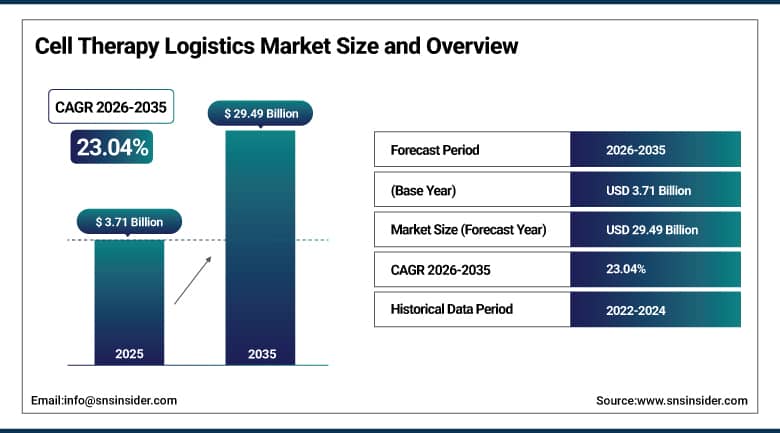
The Cell Therapy Logistics Market was valued at USD 3.71 Billion in 2025 and is projected to reach USD 29.49 Billion by 2035, expanding at a CAGR of 23.04% during the forecast period 2026–2035.
The Cell therapy logistics are quickly emerging as the most important enabling sector in advanced therapeutics as more autologous and allogeneic cell therapies are coming to the market all over the world. Cell therapy logistics require strict chain of identity and chain of custody protocols, cryopreservation, live tracking of shipment and extremely high level coordination of time sensitive distribution to maintain the efficacy of the products as they reach patients. Regulatory approvals for CAR-T therapies, growing investments in regenerative medicine, increasing investments, and expanding global manufacturing infrastructure are driving demand for logistics specialists capable of shipping hyper-sensitive biological materials across complex global supply chains.
AI fueled logistics optimization, cloud based logistics orchestration software, live RFID tracking, IoT devices, a block chain enabled chain of custody and automated curio storage are driving operational transparency. The FDA's current support for accelerating advanced cell therapy commercialization with regulatory recommendations around chain of identity, chain of custody and manufacturing quality systems for individualized therapies is enhancing the need for specialized logistics.
To Get More Information On Cell Therapy Logistics Market - Request Free Sample Report
Cell Therapy Logistics Market Trends:
-
Increasing deployment of AI-enabled logistics visibility and predictive shipment monitoring.
-
Rising adoption of cryogenic transportation supporting commercial CAR-T therapies.
-
Growing implementation of RFID, IoT sensors, and real-time cold-chain monitoring.
-
Expansion of cloud-based chain-of-identity and chain-of-custody management platforms.
-
Increasing investments in GMP-compliant cryogenic storage and specialized logistics infrastructure.
U.S. Cell Therapy Logistics Market Size Outlook:
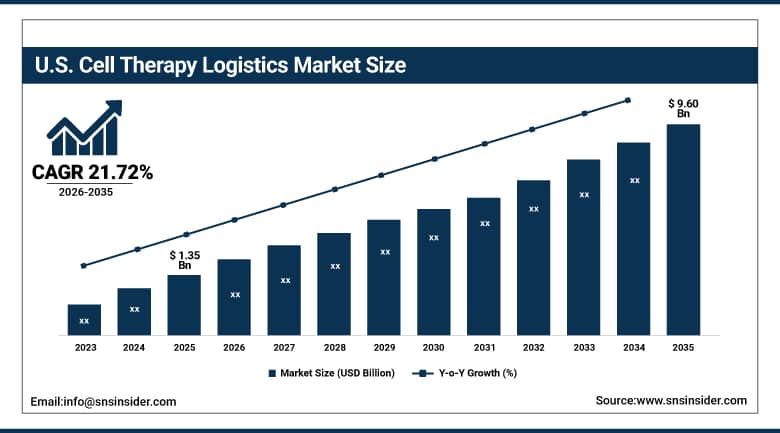
The U.S. Cell Therapy Logistics Market was valued at USD 1.35 billion in 2025 and is expected to reach approximately USD 9.60 billion by 2035, expanding at a CAGR of 21.72% during 2026–2035.
The United States currently maintains the lead in cell therapy logistics across North America due to its early adoption of commercial CAR-T therapies, well-developed biopharmaceutical ecosystem, superior cold-chain capacity and increasing number of specialized treatment centers. Rising number of regulatory approvals, growing clinical trials, commercial manufacturing capacity expansion are leading to growing demand for validated cryogenic shipments, real-time shipments tracking, specialized packaging and seamless chain-of-custody chain. Providers and therapy developers are largely focusing on investment in cloud-based logistics platform that can manage patient scheduling, manufacturing dates and product delivery within stringent time frames for sensitive treatments so as to maintain overall efficiency of cell therapy supply chain.
A continued stream of innovation is helping the U.S. To strengthen its leadership. Logistics providers are now equipping artificial intelligence, predictive analytics, RFID-based monitoring systems, IoT environmental sensors and automated cryogenic storage systems to increase visibility while simultaneously reduce the risk of product loss. Cryoport Systems expanded its integrated temperature-controlled logistics capabilities of cell and gene therapies, including dedicated cryogenic transportation and end-to-end supply chain management services in the U.S.
Cell Therapy Logistics Market Segmentation Analysis:
-
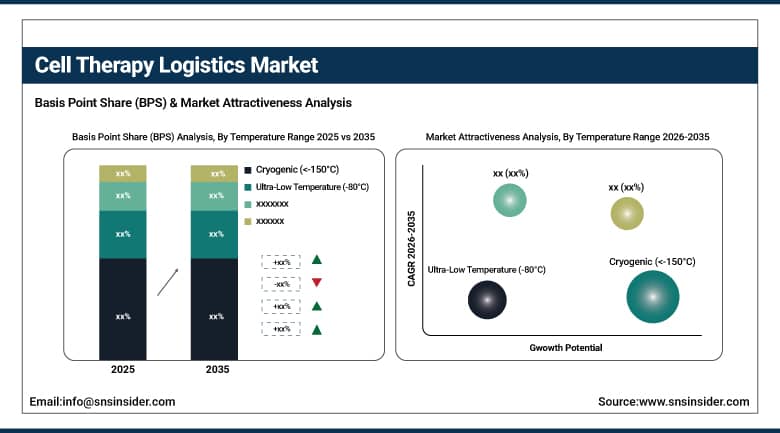
By Temperature Range, cryogenic (<-150°C) dominated the market with 39.00% share in 2025, while ultra-low temperature (-80°C) is projected to witness the fastest growth with 28.29% CAGR during the forecast period.
-
By Service, transportation & distribution dominated the market with 36.00% share in 2025, while supply chain management software is projected to witness the fastest growth with 25.46% CAGR during the forecast period.
-
By Therapy Type, autologous cell therapy dominated the market with 63.00% share in 2025, while allogeneic cell therapy is projected to witness the fastest growth with 30.54% CAGR during the forecast period.
-
By End User, biopharmaceutical companies dominated the market with 42.00% share in 2025, while CDMOs & CMOs are projected to witness the fastest growth with 29.12% CAGR during the forecast period.
By Temperature Range, cryogenic (<-150°c) dominated, while ultra-low temperature (-80°c) grows fastest.
Cryogenic (-<150C) logistics will dominate the market with a 39.00% market share by 2025 as the sector is pivotal for ensuring cell viability from point of collection to manufacturing, storage and final point of delivery to patients. Several autologous therapies commercially approved today requires cryo-preservation with liquid nitrogen vapors for preservation of the biological product for long distances delivery and storage. CSafe further boosted their state-of-the-art cryogenic shipping systems to accommodate commercial transport of temperature-sensitive cell and gene therapies with certified ultra-cold protection.
Ultra-low temperature (-80C) logistics is predicted to grow at the maximum CAGR of 28.29% during the forecast period due to increasing use in the nascent allogeneic therapies, biologics, and in decentralized manufacturing systems. Enhanced dry-ice shipping technologies along with advanced thermal packaging and smart monitoring systems facilitate robust delivery across wide distribution channels. UPS Healthcare boosted their cold-chain logistics infrastructure by increasing temperature-controlled solutions to accommodate the growing cell therapy and biologics globally.
By Service, transportation & distribution dominated, while supply chain management software grows fastest.
Transportation & distribution was identified as the most significant service segment of the cell therapy logistics market in 2025, accounting for 36.00% of the market’s revenue. The intrinsic time-sensitive, high-stakes and patient-specific nature of advanced cell therapies drives this dominance. Autologous therapies, for example, necessitate meticulous co-ordination between patient collection, manufacturing facilities, and hospitals, with immutable maintenance of the chain of custody and an unaltered temperature. This domain is anticipated to grow with the advancing commercialization of CAR-T therapies; expansion of a worldwide treatment network; and a burgeoning reliance on qualified, validated cryo-logistics experts.
Supply chain management software is predicted to realize essentially the most spectacular compound annual growth rate, at 25.46%, between 2026 and 2035. Over the ensuing decade, an escalating embrace of digitation and cloud-based systems which allow advanced analytics; predictive modeling, RFID, environmental controls (IoT) and digital chain of identification information will be used to increase shipper’s logistical workflow transparency and minimize operational risks. In January 2022 Bio Life Options bolstered their e-Logistics supply chain Management software capabilities, and their flagship evo supply Chain Administration platform capabilities, will permit further productiveness gains within digital awareness; chain of product documentation, shipment-watching; and overall complex treatment transport security.
By Therapy Type, autologous cell therapy dominated, while allogeneic cell therapy grows fastest.
Autologous cell therapy accounted for 63.00% share of the global cell therapy logistics market in 2025. Currently marketed CAR-T therapies are individual patient-derived cells requiring precise, coordinated logistics in their execution. Every consignment involves rigorous chain-of-identity confirmation, individualized scheduling, qualified cryogenic logistics and constant tracking from the collection of patient cells to manufacturing and reinfusion. Kite, further increased its commercial execution capabilities of CAR-T therapies by reinforcing their manufacturing facilities and coordinated logistics to provide personalized cancer therapy.
Allogeneic cell therapy is expected to register the highest CAGR of 30.54% in the forecasts period from 2026 to 2035. A number of developers are actively progressing towards ready-to-use off-the-shelf allogeneic cell therapies to achieve larger commercialization. Allogeneic Cell Therapy enables batch manufacturing, optimized warehousing, increased distribution and consequently the emergence of new logistical challenges across the distribution hubs and treatment networks. Allogeneic therapeutics continues developing number of allogeneic CAR-T clinical programs which aims at optimizing manufacturing efficiency and broader patient access to allogeneic therapies via uniform distribution..
Regional Analysis:
|
Region |
Major Country |
Share within Region, 2025 (%) |
|---|---|---|
|
North America |
United States |
93.00% |
|
Europe |
Germany |
28.00% |
|
Asia Pacific |
China |
26.00% |
|
Middle East & Africa |
UAE |
4.00% |
|
Latin America |
Brazil |
3.00% |
North America Cell Therapy Logistics Market Insights
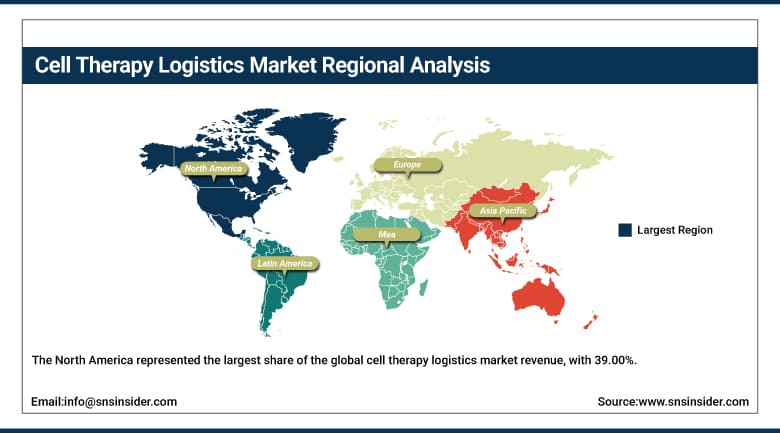
The North America represented the largest share of the global cell therapy logistics market revenue, with 39.00%. In this segment, the region dominated through the highly advanced therapy ecosystem. Strong commercial adoption and presence of CAR-T and robust cold-chain logistics infrastructure contribute to the largest share for this region. The US holds the larger regional revenue with considerable biopharmaceutical manufacturing capacity. The increase in the number of treatment specialists, wider existence of the GMP-certified cryogenic facilities and increasing trend toward investment on the supply chain for personalized medicine fuel the market growth.
The continuous approvals for cell therapies and robust clinical trials supported by wide adoption of digital logistics technologies like- AI powered shipment tracking, RFID based traceability, IoT enabled environmental sensors and cloud based chain of custody play an important role in enhancing the reliability and scalability. Cryoport augmented its global supply chain network by enhancing its tailored cry logistics support for the commercial cell & gene therapy distribution in North America.
Get Customized Report as Per Your Business Requirement - Enquiry Now
Europe Cell Therapy Logistics Market Insights
Europe benefiting from a well-established regulatory environment, rise in AMTP commercial manufacturing and increased investment in international cold chain. Several European countries like Germany, U.K., France, Switzerland, Belgium, and the Netherlands continue expanding their role as leading players in Europe for regenerative and advanced therapies by increasing the number of clinical trials, manufacturing capacities and supply-chain expertise in this complex field. Growing demand for approved regenerative medicine products and storage, as well as the use of digitally-tracked supply-chains make it increasingly necessary for companies across the region to develop sophisticated shipment capabilities, cryogenic storage, and real-time monitoring services.
DHL Health Logistics extends dedicated, life science logistics services through Europe to enhance capacity for temperature-controlled transportation and advanced therapy supply chains.
Asia Pacific Cell Therapy Logistics Market Insights
The Asia Pacific region is anticipated to see the quickest CAGR development of 24.82%, backed by the fast growth of regenerative medication research, rising financial investments in state-of-the-art therapy manufacturing, as well as escalating industrialization of cell-based therapies in China, Japan, South Korea, India, Singapore, and also Australia. Governments in the area keep on endorsing biotechnology invention via funding chances, quickly approved regulatory pathways, and investments in life sciences systems. The boost in GMP-licensed manufacturing centers, growing cryogenic storage space ability, as well as increasing clinical test tasks are fueling greater demand for dedicated logistics remedies that safeguard product stability via complex regional supply chain networks.
Middle East & Africa and Latin America Cell Therapy Logistics Market Insights
The Middle East and Africa market continue to grow as the governments invest more funding into biotechnology infrastructure, precision medicine program, and a heightened focus into advanced healthcare capabilities. The U.A.E., Saudi Arabia and South Africa continue to invest more into dedicated treatment centers, GMP certified labs, and temperature controlled infrastructure capable of handling regenerative medicine. Increased partnerships between global biopharmaceutical organizations and local health organizations increase accessibility of advanced therapies in the region and stimulate more use of validated cryogenic shipping, digital supply chain management, and real-time shipment tracking solutions.
Latin America sees increased demand for specialized cell therapy logistics as it continues to develop specialized biotechnologies and increase access to global clinical trials, especially within Brazil, Mexico, Argentina, and Chile. Due to government funding into cold-chain infrastructure and increased health care access, along with increased cooperation with multinational biopharmaceutical organization's there is a rise in commercialization of advanced therapies. Demand is increasing within these territories for digital logistics solutions, specialized packaging, and integrated cryogenic transportation solutions along the cold chain. World Courier continued to strengthen its global specialty logistics network while increasing temperature-controlled transportation and end-to-end supply chain solutions for advanced therapies in international emerging markets.
Growth Drivers: Exponential increase in demand for customized cell therapy logistics owing to the speedy commercialization of cell therapies.
The accelerated growth of Cell Therapy Logistics Market can be attributed primarily to the increasing commercialization of various advanced cell therapies. Increased number of regulatory approvals for CAR T therapies, stem cell therapies, and other regenerative medicine products are extensively augmenting the volume of patient-specific shipments that need specialized delivery and storage solutions. Unlike generic drugs, living cell products require reliable chain-of-identity, chain-of-custody, validation of cryogenic storage conditions, and monitoring of shipments during storage and transport processes from manufacturing through to treatment.
The increasing trend of distributed manufacturing and growth of specialized treatment centers are increasingly elevating logistics complexity and sustaining the demand for well-qualified logistics providers. Growing strategic partnerships between biopharmaceutical companies, CDMOs, healthcare providers, and the leading logistics companies to offer innovative automated cryogenic storage, real-time, on-demand temperature and location monitoring coupled with predictive shipment data tracking, coupled with cloud based logistics orchestration and digital documentation infrastructure is ensuring reduced risks during transport, while helping the cell therapies reach its destinations.
Restraints: High cost of operation, rigorous regulatory compliance for cell therapy logistics.
While the commercial expansion of this market has remained solid for the Cell Therapy Logistics Market, it presents numerous operational challenges with specialized high value cold-chain infrastructure required to handle the product properly and safely from the origin to the destination, it needs specially trained employees for this purpose. The cold-chain needs specially validated cryogenic shippers, validated MP-compliant warehouses, qualified specialized transport vendors, environmental monitoring from point of origin to point of destination and exhaustive documentation requirements in addition to product traceability during shipment and handling throughout the supply chain for strict regulations during all logistics processes.
A minor shipment delay; temperature excursion, misidentification, lack of chain custody; may render product irreparable and cause delay in patients' treatments, hence complicated as compare to the delivery of conventional pharmaceutical products. Regulatory bodies are reinforcing data integrity, audit trailing, electronic documents as well as quality management systems throughout global logistics organizations.
Opportunities: AI digital logistics platforms and increased allogeneic cell therapy adoption.
Greater incorporation of AI, cloud-based, cloud computing, IoT monitored, documented with block chain, and analyzed predictive mechanisms will produce huge growth possibilities in Cell Therapy Logistics Market. Digital supply chain platforms that allow real-time visibility of shipment, automated deviations and notifications, predictive routing optimization, and full chain-of-identity documentation are more vital than ever as commercial therapy units continue to rise. These improve logistics dependability while minimizing operations and the risk associated with product loss or delays. RFID based smart packing, automated inventory systems, and interconnected cryo storages allow for increasing service quality from logistics partners while supporting intricate international treatment networks.
A second large area of growth comes from ever improving allogeneic cell therapies that allow greater production at a massive, commercial scale and a more widespread clinical distribution than patient specific autologous cell therapies. Bio Life Solutions continued to grow its evo cloud-based supply chain platform, adding capabilities to improve its customer’s management of their digital chain-of-custody, shipment visibility, and operational reporting of advances therapies logistically.
Recent Developments:
-
2026: Cryoport expanded its global Bio Services and cryogenic logistics capabilities to support increasing commercial cell and gene therapy programs with integrated temperature-controlled supply chain solutions.
-
2025: Bio Life Solutions sold its evo cold chain business in early 2026 rather than enhancing for strengthening digital shipment visibility, chain-of-identity documentation, and logistics orchestration for advanced therapies.
-
2025: UPS Healthcare expanded temperature-controlled logistics services and specialized cold-chain infrastructure supporting commercial distribution of advanced biologics and cell therapies across key global markets.
-
2025: DHL Health Logistics strengthened its life sciences logistics network by expanding specialized cold-chain transportation and launched major regional pharma infrastructure in April 2025, for advanced therapies and biologics.
Cell Therapy Logistics Market Key Players are:
-
Cryoport Systems
-
QuickSTAT
-
UPS Healthcare
-
FedEx Custom Critical
-
BioLife Solutions, Inc.
-
CSafe
-
Cold Chain Technologies
-
Envirotainer
-
Kuehne+Nagel International AG
-
SkyCell AG
-
Thermo Fisher Scientific Inc.
-
Air Canada Cargo
-
American Airlines Cargo
-
DB Schenker
-
CEVA Logistics
-
Yusen Logistics Co., Ltd.
-
Biocair International Ltd.
Cell Therapy Logistics Market Report Scope:
| Report Attributes | Details |
|---|---|
| Market Size in 2025 | USD 3.71 Billion |
| Market Size by 2035 | USD 29.49 Billion |
| CAGR | CAGR of 23.04% From 2026 to 2035 |
| Base Year | 2025 |
| Forecast Period | 2026-2035 |
| Historical Data | 2022-2024 |
| Report Scope & Coverage | Market Size, Segments Analysis, Competitive Landscape, Regional Analysis, DROC & SWOT Analysis, Forecast Outlook |
| Key Segments | • By Service (Transportation & Distribution, Cryogenic Storage & Warehousing, Packaging & Cold Chain Solutions, Supply Chain Management Software, Others) • By Temperature Range (Cryogenic (<-150°C), Ultra-Low Temperature (-80°C), Refrigerated (2–8°C), Ambient Controlled) • By Therapy Type (Autologous Cell Therapy, Allogeneic Cell Therapy) • By End User (Biopharmaceutical Companies, CDMOs & CMOs, Hospitals & Treatment Centers, Clinical Research Organizations, Others) |
| Regional Analysis/Coverage | North America (US, Canada), Europe (Germany, UK, France, Italy, Spain, Russia, Poland, Rest of Europe), Asia Pacific (China, India, Japan, South Korea, Australia, ASEAN Countries, Rest of Asia Pacific), Middle East & Africa (UAE, Saudi Arabia, Qatar, South Africa, Rest of Middle East & Africa), Latin America (Brazil, Argentina, Mexico, Colombia, Rest of Latin America). |
| Company Profiles | Cryoport Systems, World Courier, Marken, DHL Health Logistics, QuickSTAT, UPS Healthcare, FedEx Custom Critical, BioLife Solutions, Inc., CSafe, Cold Chain Technologies, Envirotainer, Kuehne+Nagel International AG, SkyCell AG, Thermo Fisher Scientific Inc., Air Canada Cargo, American Airlines Cargo, DB Schenker, CEVA Logistics, Yusen Logistics Co., Ltd., Biocair International Ltd. |
Frequently Asked Questions
The Cell Therapy Logistics Market was valued at USD 3.71 Billion in 2025.
The market is projected to reach USD 29.49 Billion by 2035.
The Cell Therapy Logistics Market is anticipated to expand at a CAGR of 23.04% during the forecast period.
North America dominated the global Cell Therapy Logistics Market in 2025, accounting for 39.00% of total market revenue.
The Transportation & Distribution segment accounted for the largest revenue share of 36.00% in 2025.
