
Cell Therapy Potency Assays Market Report Scope & Overview:
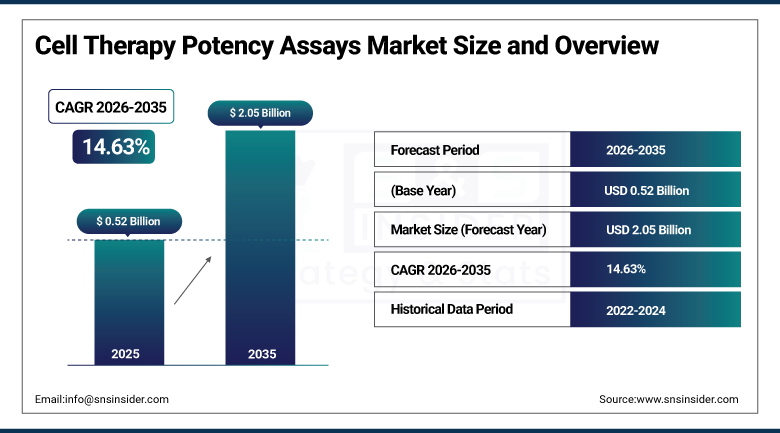
The Cell Therapy Potency Assays Market was valued at USD 0.52 Billion in 2025 and is expected to reach USD 2.05 Billion by 2035, growing at a CAGR of 14.63% from 2026 to 2035.
The Cell Therapy Potency Assays market growth is being fueled by the fast-paced expansion of the cell therapy pipeline worldwide, increasing regulatory demands for lot release data on potency, and moving toward a more matrix approach for the potency assurance of CAR-T cells, stem cells, and other advanced cell therapies. The potency assay represents a critical quality attribute throughout cell therapy product development, from IND enabling to commercial BLA filing, and regulators demand proof of quantitative data on the maintenance of the mechanism of action, biological function, and activity of the cell products.
Charles River Laboratories and Lonza both expanded their cell-based potency and bioassay testing capacity in 2026 to meet rising CAR-T and stem cell therapy developer demand for GMP-compliant, matrix-based potency assurance testing amid tightening FDA and EMA lot-release requirements for advanced therapy medicinal products.
To Get more information On Cell Therapy Potency Assays Market - Request Free Sample Report
Cell Therapy Potency Assays Market Trends:
-
Rising adoption of automated, high-throughput cell-based potency assay platforms is streamlining GMP lot-release testing for CAR-T and stem cell therapy manufacturers.
-
Growing regulatory emphasis under the FDA's potency assurance framework is accelerating demand for multi-attribute, matrix-based potency testing strategies.
-
Increasing outsourcing of potency assay development and validation to specialized CDMOs and CROs is expanding the contract testing services segment.
-
Expanding use of reporter gene and flow cytometry-based assays is improving assay reproducibility across allogeneic and autologous cell therapy pipelines.
-
Rising volume of cell therapy clinical trials and BLA filings worldwide is driving sustained investment in scalable, standardized potency assay infrastructure.
U.S. Cell Therapy Potency Assays Market Outlook:
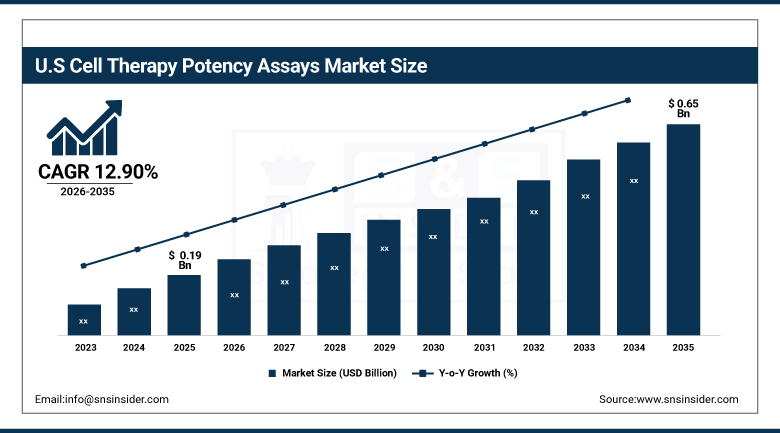
The U.S. Cell Therapy Potency Assays Market was valued at USD 0.19 Billion in 2025 and is projected to reach USD 0.65 Billion by 2035, growing at a CAGR of 12.90% during 2026–2035.
This United States's leading position is additionally emphasized due to a high density of developers of CAR-T and stem cell therapy, an advanced FDA regulatory process which more and more often needs matrix-based potency testing data to be provided in order to submit BLA applications, and a robust network of contract testing labs and CDMOs which provide bioassay testing in accordance with the GMP standards. The growing number of facilities which produce cell therapies domestically, more active participation in clinical trials at academic medical centers, and biotech investments in automated potency testing platforms also contribute to demand growth in this area.
In 2026, Charles River Laboratories launched a new automated cell-based potency assay platform at its Massachusetts cell and gene therapy testing facility, combining cytotoxicity and cytokine-release readouts to accelerate IND-enabling studies for U.S. CAR-T and stem cell therapy developers.
Cell Therapy Potency Assays Market Segment Analysis:
-
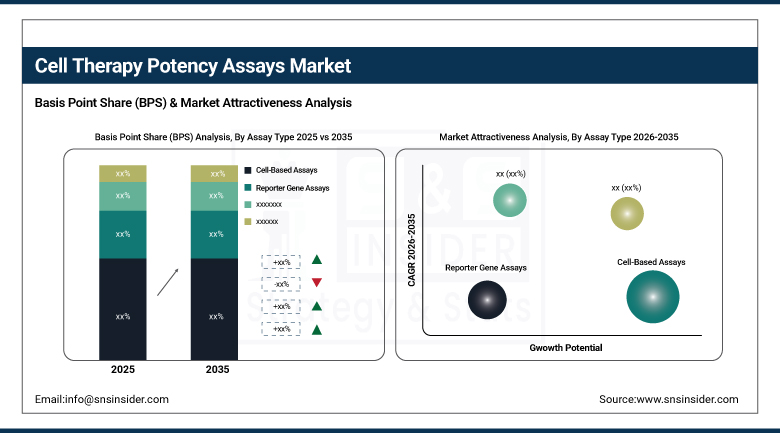
By Assay Type, Cell-Based Assays dominated the Cell Therapy Potency Assays Market with a 44.20% share in 2025, while Reporter Gene Assays is the fastest-growing assay type segment with a CAGR of 17.40% from 2026–2035.
-
By Product & Service, Services dominated the Cell Therapy Potency Assays Market with a 51.80% share in 2025, while Kits & Reagents is the fastest-growing product & service segment with a CAGR of 16.60% from 2026–2035.
-
By Cell Therapy Type, CAR-T Cell Therapy dominated the Cell Therapy Potency Assays Market with a 39.40% share in 2025, while TIL & NK Cell Therapy is the fastest-growing cell therapy type segment with a CAGR of 18.10% from 2026–2035.
-
By End User, Pharmaceutical & Biotechnology Companies dominated the Cell Therapy Potency Assays Market with a 46.70% share in 2025, while CDMOs & CROs is the fastest-growing end user segment with a CAGR of 17.60% from 2026–2035.
By Assay Type, Cell-Based Assays led while Reporter Gene Assays is the fastest-growing segment.
Cell-Based Assays held the largest share of the Cell Therapy Potency Assays Market in 2025, owing to its being a preferred choice owing to the fact that it measures the biological activity of a living cellular product in terms of cytotoxicity, proliferation, and cytokine production, which is close to the actual mechanism of action of CAR-T and stem cell therapies among others. Regulatory agencies continue to favor cell-based readouts for lot-release and stability testing because they capture biologically relevant activity that purely molecular or biochemical methods cannot replicate, and their compatibility with automated imaging and flow cytometry platforms has made them the default choice across both clinical-stage and commercial cell therapy manufacturing programs pursuing BLA approval.
The Reporter Gene Assays segment is expected to register the fastest CAGR during the forecast period 2026–2035. Growing developer preference for reporter gene formats stems from their superior reproducibility, shorter turnaround times, and ability to generate quantitative, dose-responsive potency data that satisfies increasingly stringent FDA and EMA expectations for matrix-based potency assurance. As more cell therapy developers transition from early feasibility assays toward validated, ICH Q2-aligned release methods ahead of pivotal trials and commercial launch, reporter gene platforms are being adopted at an accelerating pace across CDMOs, CROs, and in-house analytical development laboratories supporting the expanding global cell therapy pipeline.
By Product & Service, Services led while Kits & Reagents is the fastest-growing segment.
The Services segment dominated the product & service segment in the Cell Therapy Potency Assays Market in 2025 due to the need for outsourced solutions for the development of cell therapy potency assays and transfer to Good Manufacturing Practices (GMP)-validated bioassay methods by young biotechnology firms as well as matured cell therapy companies that require the help of Contract Development and Manufacturing Organizations (CDMOs) and Contract Research Organizations (CROs). Such services enable these companies to leverage existing bioassay laboratories, highly experienced analytical scientists, and validated bioassays without investing in expensive infrastructure since each test is specific to the product.
The Kits & Reagents segment is projected to grow at the fastest CAGR during the forecast period 2026–2035. Rising in-house adoption of standardized, ready-to-use potency assay kits is being driven by manufacturers seeking to reduce assay development timelines and improve inter-laboratory reproducibility across multi-site clinical and commercial manufacturing networks. There are more suppliers entering the market with pre-qualified reporter gene and cytotoxicity kits suitable for a particular form of cell therapy that makes it easier to build up the required technical capacity to carry out the appropriate test for potency.
By Cell Therapy Type, CAR-T Cell Therapy led while TIL & NK Cell Therapy is the fastest-growing segment.
The CAR-T Cell Therapy was the largest contributor to the global Cell Therapy Potency Assay Market due to the highest number of commercially available and late-stage clinical CAR-T cell therapy products that need to be tested for multiple attributes of potency. The autologous manufacturing process of CAR-T cells along with FDA's stringent lot release tests on a per-patient basis has made the process of developing potency assays an important one for CAR-T cell therapy manufacturers and their testing contractors.
The TIL & NK Cell Therapy segment is anticipated to register the fastest CAGR during the forecast period 2026–2035. Rapid clinical pipeline expansion for tumor-infiltrating lymphocyte and natural killer cell therapies is driving strong demand for newly developed, modality-specific potency assays capable of capturing the distinct killing mechanisms and activation profiles of these emerging cell types. As more TIL and NK cell therapy candidates progress from early trials toward pivotal studies, developers are investing heavily in assay development partnerships to establish validated, regulatory-ready potency methods ahead of anticipated approvals.
By End User, Pharmaceutical & Biotechnology Companies led while CDMOs & CROs is the fastest-growing segment.
The Pharmaceutical & Biotechnology Companies was leading end user in the Cell Therapy Potency Assays Market, holding the highest share in terms of revenue in 2025 owing to the development of cell therapies predominantly in large pharmaceutical firms and biotechnology companies which have in-house teams focused on developing potency assays for their cell therapy development. The focus of these companies on their own assay platforms specifically suited to their cell therapies makes these companies the leading demand generators for potency assays in the market.
The CDMOs & CROs segment is expected to witness the fastest CAGR during the forecast period 2026–2035. Growing numbers of emerging biotech companies without in-house analytical infrastructure are increasingly turning to contract development and manufacturing organizations and contract research organizations for end-to-end potency assay development, validation, and routine lot-release testing services. This shift is being reinforced by the rising complexity and cost of establishing compliant in-house bioassay capability, prompting even mid-sized and larger developers to supplement internal capacity with specialized outsourced testing partnerships.
Regional Analysis:
|
Region |
Major Country |
Share within Region, 2025 (%) |
|---|---|---|
|
North America |
United States |
86.00% |
|
Europe |
Germany |
25.40% |
|
Asia Pacific |
China |
36.80% |
|
Middle East & Africa |
UAE |
26.40% |
|
Latin America |
Brazil |
35.60% |
North America Cell Therapy Potency Assays Market Insights
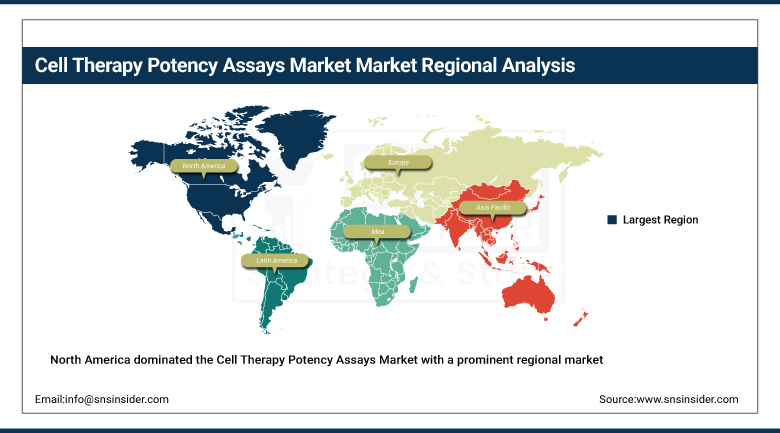
North America dominated the Cell Therapy Potency Assays Market with a prominent regional market share of 42.50% in 2025, owing to the availability of a large number of FDA-approved CAR-T cells and stem cells therapy in North America, along with the presence of a highly developed FDA regulation system that increasingly requires matrix-based potency data for the lot release of such products. There is also a well-developed network of contract testing laboratories for potency assays and cell therapy CDMOs in North America.
The US was the leading country within the North America Cell Therapy Potency Assays Market in 2025 with a market share of 86.00% of the regional market, driven by the largest base of FDA-approved cell therapy products, extensive domestic CAR-T and stem cell manufacturing capacity, and a well-established network of contract testing laboratories offering GMP-compliant bioassay services. Canada is contributing to regional growth through its expanding academic cell therapy research base and growing domestic biomanufacturing investment supporting early-stage analytical development activity.
Get Customized Report as per Your Business Requirement - Enquiry Now
Europe Cell Therapy Potency Assays Market Insights
Europe represented an significant share in the Cell Therapy Potency Assays Market in 2025 due to the harmonized European Medicines Agency (EMA) regulatory environment of advanced therapy medicinal products in the region, presence of a developed cluster of biopharmaceutical companies, and increased national investments in cell and gene therapies manufacturing facilities. Rising numbers of academic and hospital-led cell therapy trials across the region continue to generate steady demand for specialized potency assay development and validation services among both established contract laboratories and emerging analytical service providers.
Germany is one of the leading markets in Europe owing to its strong biopharmaceutical manufacturing base and presence of major contract testing and analytical service providers supporting both domestic and international cell therapy developers. Other countries such as the United Kingdom, France, and Spain, home to active cell therapy clinical trial networks and academic medical centers, are also contributing to regional market growth through expanding investment in advanced therapy analytical infrastructure.
Asia Pacific Cell Therapy Potency Assays Market Insights
The Asia Pacific Cell Therapy Potency Assays Market is expected to register the fastest growth rate during the forecast period 2026–2035, at a CAGR of 17.20%. Market growth is being driven by rapidly expanding domestic cell therapy development activity, growing government investment in biomanufacturing infrastructure, and increasing numbers of CAR-T and stem cell therapy candidates advancing through clinical trials across the region's major and emerging pharmaceutical markets pursuing accelerated regulatory approval pathways.
China is one of the primary growth drivers in the Asia Pacific Cell Therapy Potency Assays Market, owing to its large and rapidly expanding domestic cell therapy pipeline and growing base of contract testing laboratories supporting both local and international developers. Japan and South Korea, both home to established regenerative medicine regulatory pathways and active academic-industry collaboration networks, are also contributing to regional growth through expanding cell therapy clinical trial and analytical development activity.
Middle East & Africa and Latin America Cell Therapy Potency Assays Market Insights
Middle East & Africa and Latin American regions are gradually expanding cell therapy potency assay adoption as regional clinical trial activity and biomanufacturing investment grow, supported by increasing government focus on establishing regenerative medicine regulatory frameworks and growing academic medical center participation in international cell therapy trials across both regions.
Brazil is set to be a prominent Latin American market, supported by its growing academic cell therapy research base and expanding clinical trial collaborations with international sponsors requiring localized potency testing support. There is the UAE and Saudi Arabia that are making investments in sophisticated regenerative medicine technology and bio-manufacturing plants, leading to an increase in the demand for cell therapy analysis and potency testing in the ME&A region.
Market Dynamics:
Growth Drivers: Expanding cell therapy pipeline and tightening regulatory potency requirements driving market growth
One of the main drivers of the Cell Therapy Potency Assays Market is the fast growth of the cell therapy pipeline at the global level and the increased demands from the regulatory perspective through guidelines such as FDA potency assurance for cellular and gene therapy products. Regulators increasingly expect developers to demonstrate a validated, matrix-based potency strategy that links assay results to a product's clinical mechanism of action, replacing the earlier single-test approach with a more comprehensive analytical framework spanning cytotoxicity, cytokine secretion, and identity testing across every stage of clinical development and commercial manufacturing.
Growing numbers of CAR-T, stem cell, and TIL and NK cell therapy candidates advancing toward pivotal trials and BLA submission are generating sustained demand for both in-house and outsourced potency assay development capability. Rising biotechnology investment in automated, reproducible testing platforms, expanding contract testing laboratory capacity, and continued innovation in reporter gene and cell-based assay formats are further supporting demand growth across the forecast period, as cell therapy developers seek faster, more reliable pathways to regulatory-compliant lot-release testing.
Restraints: Assay standardization challenges and high development costs limiting market expansion
One of the most significant restraints facing the Cell Therapy Potency Assays Market is the inherent difficulty of standardizing assays for living, donor-variable cellular products whose mechanism of action often involves multiple biological functions, including engraftment, differentiation, and immunomodulation. Unlike conventional small-molecule or protein-based biologics, cell therapies frequently lack a single, well-defined potency-indicating attribute, which requires developers to design and validate product-specific assay matrices that are time-consuming, resource-intensive, and difficult to transfer consistently across multiple testing sites and laboratories.
Furthermore, the cost involved in the development, validation, and qualification of cell-based potency tests using ICH Q2 harmonized criteria, along with a lack of trained analytical scientists skilled in the evaluation of advanced therapies, has made it difficult for small biotech companies with limited R&D budget. Inconsistency of regulatory authorities concerning acceptable approaches of ensuring product potency is another challenge facing developers of advanced therapies, who need approval from multiple international markets.
Opportunities: Expansion of outsourced testing services and next-generation assay technologies creating new growth avenues
The growing preference among emerging cell therapy developers for outsourcing potency assay development and validation to specialized CDMOs and CROs presents a substantial growth opportunity within the Cell Therapy Potency Assays Market. As more biotech companies advance early-stage cell therapy candidates without established in-house analytical infrastructure, demand for turnkey potency assay development, method transfer, and routine GMP release testing services is expected to expand significantly across both established and emerging cell therapy hubs worldwide.
There is considerable opportunity in the development of next-generation, automated potency assay technologies, including high-throughput imaging platforms and standardized reporter gene kits, that reduce assay development timelines while improving inter-laboratory reproducibility. The continued expansion of cell therapy manufacturing and clinical trial activity across Asia Pacific and Latin America, supported by growing government investment in regenerative medicine regulatory frameworks, will further drive demand for accessible, scalable potency testing solutions in these emerging markets.
Recent Developments:
-
2025: Sartorius expanded its Incucyte live-cell imaging portfolio with a dedicated potency assay module enabling real-time, label-free measurement of cell-killing kinetics for autologous and allogeneic cell therapy products.
-
2026: Lonza expanded its Walkersville, Maryland bioassay testing laboratory, adding new reporter gene assay and flow cytometry-based testing capacity to support growing client demand for GMP-compliant lot-release potency testing.
-
2026: WuXi Advanced Therapies launched a dedicated potency assay development service line combining custom reporter gene assay design with cytokine secretion profiling for cell and gene therapy developers advancing toward BLA filing.
Cell Therapy Potency Assays Market key players are:
-
Sartorius AG
-
WuXi AppTec Co., Ltd.
-
Eurofins Scientific SE
-
Pharmaron Beijing Co., Ltd.
-
Danaher Corporation (Cytiva)
-
Bio-Techne Corporation
-
Revvity, Inc.
-
Promega Corporation
-
SGS SA
-
Intertek Group plc
-
Catalent, Inc.
-
Avantor, Inc.
-
Merck KGaA
-
Miltenyi Biotec B.V. & Co. KG
-
National Resilience, Inc.
-
ACROBiosystems
-
Cellistic (a Fujifilm company)
Cell Therapy Potency Assays Market Report Scope:
| Report Attributes | Details |
|---|---|
| Market Size in 2025 | USD 0.52 Billion |
| Market Size by 2035 | USD 2.05 Billion |
| CAGR | CAGR of 14.63% From 2026 to 2035 |
| Base Year | 2025 |
| Forecast Period | 2026-2035 |
| Historical Data | 2022-2024 |
| Report Scope & Coverage | Market Size, Segments Analysis, Competitive Landscape, Regional Analysis, DROC & SWOT Analysis, Forecast Outlook |
| Key Segments | • By Assay Type (Cell-Based Assays, Reporter Gene Assays, Binding & Immunoassays, Molecular & Biochemical Assays) • By Product & Service (Kits & Reagents, Instruments, Services) • By Cell Therapy Type (CAR-T Cell Therapy, Stem Cell Therapy, TIL & NK Cell Therapy, Dendritic Cell & Other Cell Therapies) • By End User (Pharmaceutical & Biotechnology Companies, CDMOs & CROs, Academic & Research Institutes) |
| Regional Analysis/Coverage | North America (US, Canada), Europe (Germany, France, UK, Italy, Spain, Russia, Poland, Rest of Europe]), Asia Pacific (China, India, Japan, South Korea, Australia, ASEAN Countries, Rest of Asia Pacific), Latin America (Brazil, Argentina, Mexico, Colombia, Rest of Latin America), Middle East & Africa (UAE, Saudi Arabia, Qatar, South Africa, Rest of Middle East & Africa) |
| Company Profiles | Charles River Laboratories International, Inc., Lonza Group AG, Thermo Fisher Scientific Inc., Sartorius AG, WuXi AppTec Co., Ltd., Eurofins Scientific SE, Pharmaron Beijing Co., Ltd., Danaher Corporation (Cytiva), Bio-Techne Corporation, Revvity, Inc., Promega Corporation, SGS SA, Intertek Group plc, Catalent, Inc., Avantor, Inc., Merck KGaA, Miltenyi Biotec B.V. & Co. KG, National Resilience, Inc., ACROBiosystems, Cellistic (a Fujifilm company) |

Frequently Asked Questions
Key Players include Charles River Laboratories International, Inc., Lonza Group AG, Thermo Fisher Scientific Inc., Sartorius AG, and WuXi AppTec Co., Ltd., among others.
Key opportunities include rising cell therapy pipelines, outsourced assay development, automated testing, reporter gene technologies, and demand for GMP-compliant potency testing.
The market is driven by the rapid expansion of the global cell therapy pipeline, tightening FDA and EMA potency assurance requirements, and rising outsourcing of assay development to CDMOs and CROs.
The Services segment dominated the Cell Therapy Potency Assays Market in 2025, accounting for approximately 51.80% market share.
The North America region dominated the Cell Therapy Potency Assays Market in 2025 with a 42.50% share, driven by its dense concentration of commercially approved cell therapies and advanced FDA regulatory framework.
