
Cellular GNSS Combo Module Market Report Scope & Overview:
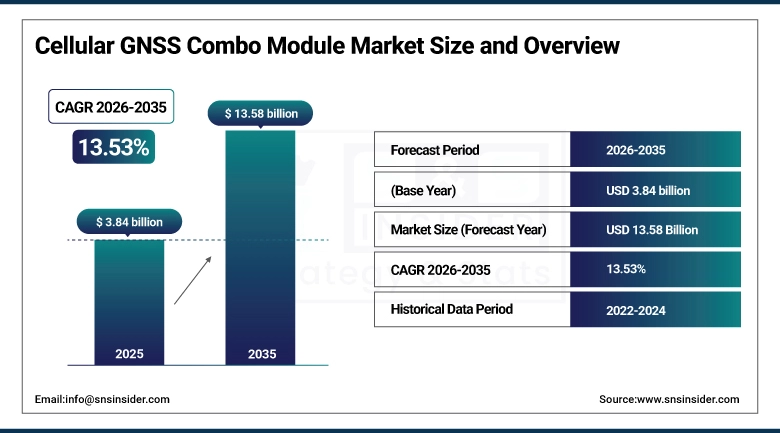
The Cellular GNSS Combo Module Market was valued at USD 3.84 billion in 2025 and is expected to reach USD 13.58 billion by 2035, growing at a CAGR of 13.53% from 2026-2035.
The Cellular GNSS Combo Module market is witnessing robust growth due to the growing use of connected cars, IoT-powered devices, and real-time asset tracking applications in the automotive industry, as well as other sectors such as industrial and logistics. The development of 4G/LTE, along with the deployment of 5G, helps to improve connectivity and location tracking capabilities. The increased need for fleet management, intelligent transportation systems, and navigation systems drives growth even more.
According to industry estimates, global IoT connections reached approximately 18.8 billion in 2024, with continued expansion expected across smart mobility and tracking ecosystems. Around 4 billion of these connections (nearly 22%) are supported by cellular connectivity, directly driving demand for cellular GNSS combo modules used in positioning-enabled devices.
In parallel, Qualcomm has advanced integration trends by embedding GNSS capabilities into next-generation connectivity platforms, including the introduction of quad-band GNSS (L1/L2/L5/L6) integrated with 5G modem systems, significantly enhancing positioning accuracy for connected devices and vehicles.
To Get more information on Cellular GNSS Combo Module Market - Request Free Sample Report
Cellular GNSS Combo Module Market Trends
-
Rising adoption of connected devices, IoT applications, and smart mobility solutions is driving the cellular GNSS combo module market.
-
Growing demand for accurate positioning, navigation, and real-time connectivity in automotive, logistics, and consumer electronics is boosting market growth.
-
Expansion of fleet management, asset tracking, and telematics applications is fueling deployment.
-
Increasing focus on seamless integration of cellular communication with high-precision GNSS positioning is shaping adoption trends.
-
Advancements in multi-constellation GNSS, low-power chipsets, and 5G-enabled modules are enhancing accuracy and efficiency.
-
Rising demand for compact, energy-efficient, and cost-effective connectivity solutions is supporting market expansion.
-
Collaborations between chipset manufacturers, automotive OEMs, and IoT solution providers are accelerating innovation and global adoption.
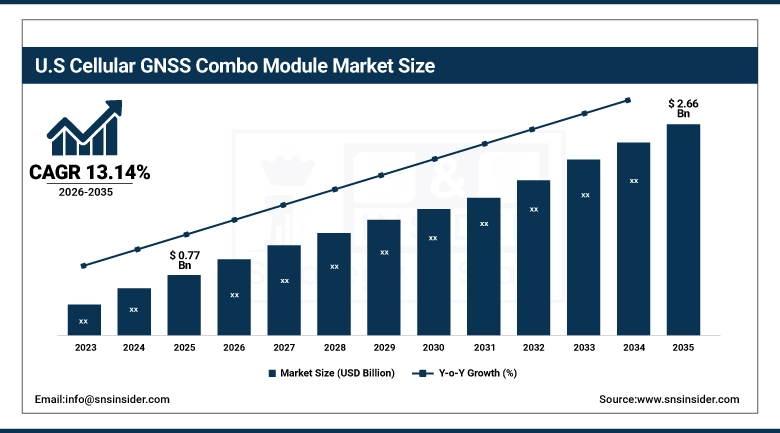
U.S. Cellular GNSS Combo Module Market was valued at USD 0.77 billion in 2025 and is expected to reach USD 2.66 billion by 2035, growing at a CAGR of 13.14% from 2026-2035.
The U.S. Cellular GNSS Combo Module Market is experiencing robust growth driven by widespread adoption of connected cars, sophisticated fleet management systems, and the growing IoT ecosystem. The presence of a strong 5G network, along with the growing need for location-based services and automation, is fueling growth.
Cellular GNSS Combo Module Market Growth Drivers:
-
Rising demand for connected vehicles, IoT devices, and real-time positioning solutions in navigation and telematics ecosystems worldwide expansion trends
Increasing growth in mobility ecosystems requires greater need for precise location and connectivity for connected mobility platforms. GNSS and cellular combo modules facilitate accurate tracking and navigation. As a result, they become a necessity in advanced transport systems such as smart transport systems and logistics solutions. With the growing trend towards the implementation of Internet of Things-based devices and machine-to-machine communication, more sectors implement such technologies. Enhanced connectivity and lower latency improve operational efficiency. The increasing use of smart mobility and cloud-based tracking solutions contributes to faster adoption of these products in numerous applications.
Cellular GNSS Combo Module Market Restraints:
-
Supply chain disruptions and dependency on semiconductor availability impacting production stability and delaying large-scale deployment across global markets ecosystem
The global shortage of semiconductors and disruption of supply chains has a considerable effect on the manufacturing and punctual delivery of modern GNSS cellular modules. Being reliant on the production process that requires the use of certain chipsets and electronics makes it difficult for producers to provide a stable manufacturing process. The lack of availability of the necessary raw materials and logistics issues add up to delays in the launch of new products. This is problematic for manufacturers since they will have difficulty with managing their inventory. This will hinder the adoption of such products by businesses and organizations worldwide.
Cellular GNSS Combo Module Market Opportunities:
-
Rising 5G IoT ecosystem expansion and edge computing integration enabling advanced positioning services and real-time connectivity solutions adoption growth
The increasing usage of IoT ecosystems that utilize 5G technology is generating new opportunities for developing sophisticated positioning and connectivity solutions. The use of edge computing with GNSS cellular modules helps accelerate data processing and enhance location precision and speed. This helps in delivering real-time applications such as smart logistics, automation of industries, and mobility management solutions. With more intelligent devices and cloud-edge hybrid architecture being deployed by organizations, the efficiency levels have increased. The continuous evolution of connectivity technology is providing impetus to GNSS solution usage.
Cellular GNSS Combo Module Market Segment Highlights
-
By Module Interface, UART dominated the Cellular GNSS Combo Module Market with ~35% share in 2025; USB fastest growing (CAGR).
-
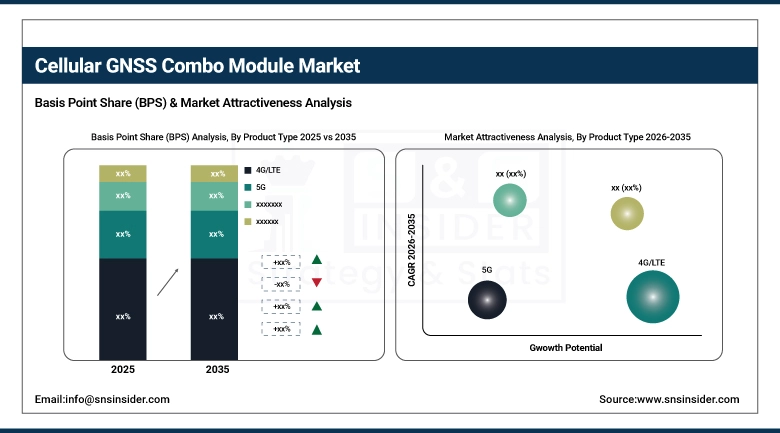
By Product Type, 4G/LTE dominated the Cellular GNSS Combo Module Market with ~49% share in 2025; 5G fastest growing (CAGR).
-
By Application, Automotive dominated the Cellular GNSS Combo Module Market with ~33% share in 2025; Transportation & Logistics fastest growing (CAGR).
-
By End-User, OEMs dominated the Cellular GNSS Combo Module Market with ~70% share in 2025; Aftermarket fastest growing (CAGR).
Cellular GNSS Combo Module Market Segment Analysis
By Product Type, 4G/LTE segment dominates the GNSS Cellular Module Market, 5G segment expected to grow fastest.
4G/LTE segment dominates in 2025 due to the extensive coverage of its networks, robust infrastructure, and affordability in terms of connectivity. This makes the segment well-suited for the implementation of large-scale GNSS solutions. The solution also offers reliable communication capability in real time for tracking and navigation services in the automotive and industrial sectors. With extensive penetration and reliability, it remains the preferred choice of technology.
The 5G segment is expected to experience the highest growth rate between 2026 and 2035 because of ultra-low latency, high bandwidth, and improved connectivity for more advanced GNSS implementations. It provides instant positioning for autonomous cars, smart cities, and industrial automation devices. With the increasing number of installed 5G networks and higher demand for precise location data, its usage will continue to grow.
By Module Interface, UART segment dominates the GNSS Cellular Module Market, USB segment expected to grow fastest.
UART segment holds dominant position in 2025 due to its wide applicability to embedded systems, affordability, and ease of implementation in GNSS cellular modules. UART is commonly applied in automobile, industry, and Internet of Things gadgets that require efficient serial communication. The segment’s low energy consumption and reliability in transmitting real-time information boost its applicability in mass-produced electronic and tracking devices worldwide.
USB segment is anticipated to witness the highest CAGR from 2026 to 2035 owing to increasing need for fast data transmission rate, ease of connection, and easy integration with existing computer system. The segment offers fast prototyping for consumer electronics and IoT devices. Besides, growing usage of portable navigation devices, diagnostic tools, and IoT-enabled devices would help in propelling its adoption rate.
By Application, Automotive segment dominates the GNSS Cellular Module Market, Transportation & Logistics segment expected to grow fastest.
Automotive segment dominates in 2025 due to the integration of GNSS cellular modules into vehicle navigation systems, fleet management, and connectivity. The increased demand for real-time tracking, safety applications, and entertainment will drive the adoption rate. The increased production of smart vehicles and EVs will also contribute positively to its adoption rate. The automotive industry places great emphasis on precision positioning and connectivity solutions.
The transportation & logistics segment will grow at the highest CAGR during 2026–2035 due to the increased demand for real-time fleet monitoring, route optimization, and logistics. The increased popularity of e-commerce and international trade will increase the need for accurate GPS-based systems. GNSS cellular modules will improve the efficiency of operations, cut down delivery times, and optimize asset utilization.
By End-User, OEMs segment dominates the GNSS Cellular Module Market, Aftermarket segment expected to grow fastest.
The OEM segment leads the market in 2025 because of the integration of the GNSS cellular modules into the devices during the production process, making it efficient in terms of costs and effectiveness. The massive production of these modules in the automotive industry, industrial and consumer electronics boosts their adoption. Partnership between OEMs and module manufacturers helps in designing standard modules and securing long-term contracts.
The Aftermarket Segment is expected to experience the highest growth rate from 2026 to 2035 owing to the growing need for upgrading tracking and connectivity solutions. There are many businesses adopting GNSS modules in their existing automobiles or machinery to improve their tracking abilities. Market growth in fleet upgrades, telematics and asset management solutions will drive this expansion.
Cellular GNSS Combo Module Market Regional Analysis
Asia Pacific Cellular GNSS Combo Module Market Insights
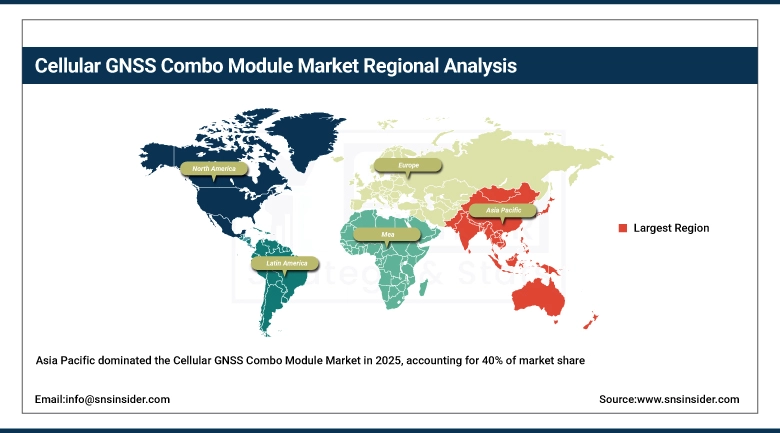
The Asia Pacific held the leading position in terms of highest share of revenues of 40% in the Cellular GNSS Combo Module Market in 2025 owing to the presence of electronics manufacturing hubs, increasing adoption of IoT devices and connected devices, and rising use of automotive telematics and transportation technologies. Investments in the development of 5G infrastructure and smart city solutions drive the growth of the market. Affordable manufacturing and availability of skilled workforce and supply chain add on to the region's dominance in the GNSS/cellular combo market.
Get Customized Report as per Your Business Requirement - Enquiry Now
North America Cellular GNSS Combo Module Market Insights
The Cellular GNSS Combo Module Market in North America is fueled by a high level of acceptance of connected cars, autonomous vehicles, and Internet of Things (IoT)-based fleet management systems. It enjoys solid infrastructure for 5G connectivity, presence of major technology firms, and high investments in smart mobility and defense systems. Demand for enhanced tracking, precision navigation, and automation in various industries drives its market growth.
Europe Cellular GNSS Combo Module Market Insights
The Europe cellular GNSS combo module market is driven by high automotive sector requirements, stringent safety standards, and quick adaptation to connectivity-based mobility technology. Advancements in intelligent transportation systems, efficient logistics management, and automation processes fuel market expansion. The growing interest in electric vehicles, telematics systems, and sophisticated navigation systems propels the adoption rate. The presence of a robust regulatory environment and the importance of precision positioning applications also play a pivotal role in the market’s growth.
Middle East & Africa and Latin America Cellular GNSS Combo Module Market Insights
The Middle East & Africa, and Latin American markets for the Cellular GNSS combo module are experiencing steady growth owing to the growing use of fleet management systems, transportation logistics solutions, and asset tracking systems. Investments being made in building infrastructure and establishing smart cities are also responsible for the growth of this market. The growing adoption of GPS systems and cellular connectivity is also aiding the growth of the market.
Cellular GNSS Combo Module Market Competitive Landscape:
Fibocom Wireless Inc.
Fibocom Wireless Inc. is an international pioneer in the field of wireless communication modules and IoT connectivity solutions since its establishment in 2010. The firm has expertise in providing 4G/5G/GNSS-enabled modules in sectors such as automotive, industrial, and smart mobility. Fibocom emphasizes intelligent connectivity through its positioning and communication capabilities to assist companies in developing robust IoT networks through real-time tracking, telematics, and edge intelligence.
-
2026: Fibocom showcased full-series GNSS + cellular integrated modules at MWC 2026, expanding its positioning + connectivity portfolio for automotive, industrial IoT, and telematics applications with enhanced multi-constellation GNSS accuracy and 5G integration.
-
2025: Fibocom strengthened cellular GNSS combo module roadmap, integrating 5G connectivity with multi-band GNSS positioning to support autonomous systems, fleet management, and smart mobility solutions requiring real-time tracking and low-latency communication.
Quectel Wireless Solutions
Quectel Wireless Solutions was established in 2010 and operates as a leading IoT modules supplier, providing a wide range of cellular, GNSS, Wi-Fi, and Bluetooth communications modules. Quectel is committed to creating high-quality modules that facilitate efficient connectivity and accurate positioning solutions. The Quectel ecosystem ensures smooth IoT deployments in various sectors such as smart mobility, industrial IoT, and connected infrastructure systems.
-
2026: Quectel expanded its 9-in-1 combo antenna ecosystem integrating cellular, Wi-Fi, Bluetooth and GNSS, supporting next-generation IoT modules used in connected vehicles, smart mobility, and industrial tracking applications requiring high-precision positioning.
-
2024: Quectel expanded its GNSS-enabled cellular module ecosystem, introducing enhanced multi-mode LTE/5G modules designed for high-precision positioning applications in transportation, telematics, and smart city infrastructure deployments.
u-blox Holding AG
u-blox Holding AG, founded in 1997, is among the world leaders in providing positioning and wireless communication technology solutions. It provides GNSS modules, chips, and short-range wireless connectivity solutions, which can be applied to the automotive, industrial, and IoT sectors. u-blox technology products emphasize the provision of precise positioning, reliable communication, and energy efficiency of communication technology solutions.
-
2025: u-blox continued advancing GNSS-focused positioning modules combined with cellular connectivity solutions, strengthening its automotive and industrial IoT portfolio after exiting pure cellular modules and refocusing on high-precision GNSS + short-range connectivity integration.
-
2024: u-blox launched advanced GNSS positioning modules with LTE Cat 1bis cellular connectivity, enabling compact combo solutions for automotive navigation, asset tracking, and industrial IoT with improved urban positioning accuracy.
MediaTek Inc.
MediaTek Inc., which was incorporated in 1997, is a technology company that designs chips used in connectivity and Internet of Things. The company incorporates cellular connectivity, GNSS, and AI processing technology in its SoC architecture. Through its innovations, MediaTek Inc. provides advanced connectivity and localization technology in smartphones, automobiles, and smart appliances. The firm has been contributing towards enabling 5G networks and accurate localization technology.
-
2024: MediaTek advanced integrated cellular + GNSS chipset platforms, enabling smartphone and IoT devices with improved multi-frequency GNSS positioning and 5G connectivity for enhanced location-based services and mobility applications.
Key Players
Some of the Cellular GNSS Combo Module Market Companies
-
u-blox Holding AG
-
Quectel Wireless Solutions
-
Telit Cinterion
-
Sierra Wireless
-
Fibocom Wireless Inc.
-
SIMCom Wireless Solutions
-
Thales Group
-
Murata Manufacturing Co., Ltd.
-
MediaTek Inc.
-
Qualcomm Technologies, Inc.
-
Broadcom Inc.
-
STMicroelectronics
-
SkyTraq Technology
-
Septentrio NV
-
Trimble Inc.
-
Hexagon AB
-
NovAtel Inc.
-
Sony Semiconductor Israel (Altair Semiconductor)
-
Nordic Semiconductor
-
Furuno Electric Co., Ltd.
| Report Attributes | Details |
|---|---|
| Market Size in 2025 | USD 3.84 Billion |
| Market Size by 2035 | USD 13.58 Billion |
| CAGR | CAGR of 13.53% From 2026 to 2035 |
| Base Year | 2025 |
| Forecast Period | 2026-2035 |
| Historical Data | 2022-2024 |
| Report Scope & Coverage | Market Size, Segments Analysis, Competitive Landscape, Regional Analysis, DROC & SWOT Analysis, Forecast Outlook |
| Key Segments | • By Product Type (2G, 3G, 4G/LTE, 5G) • By Application (Automotive, Industrial, Consumer Electronics, Transportation & Logistics, Healthcare, Others) • By Module Interface (UART, USB, SPI, I2C, Others) • By End-User (OEMs, Aftermarket, Others) |
| Regional Analysis/Coverage | North America (US, Canada), Europe (Germany, UK, France, Italy, Spain, Russia, Poland, Rest of Europe), Asia Pacific (China, India, Japan, South Korea, Australia, ASEAN Countries, Rest of Asia Pacific), Middle East & Africa (UAE, Saudi Arabia, Qatar, South Africa, Rest of Middle East & Africa), Latin America (Brazil, Argentina, Mexico, Colombia, Rest of Latin America). |
| Company Profiles | u-blox Holding AG, Quectel Wireless Solutions, Telit Cinterion, Sierra Wireless, Fibocom Wireless Inc., SIMCom Wireless Solutions, Thales Group, Murata Manufacturing Co., Ltd., MediaTek Inc., Qualcomm Technologies, Inc., Broadcom Inc., STMicroelectronics, SkyTraq Technology, Septentrio NV, Trimble Inc., Hexagon AB, NovAtel Inc., Sony Semiconductor Israel (Altair Semiconductor), Nordic Semiconductor, Furuno Electric Co., Ltd. |

Frequently Asked Questions
Asia Pacific dominated the Cellular GNSS Combo Module Market in 2025.
The UART segment dominated the Cellular GNSS Combo Module Market in 2025.
Rising demand for connected vehicles, IoT devices, and real-time positioning solutions in navigation and telematics ecosystems worldwide expansion trends.
The Cellular GNSS Combo Module Market was valued at USD 3.84 billion in 2025.
The Cellular GNSS Combo Module Market is expected to grow at a CAGR of 13.53% from 2026 to 2035.
