
Procurement Analytics Market Report Scope & Overview:
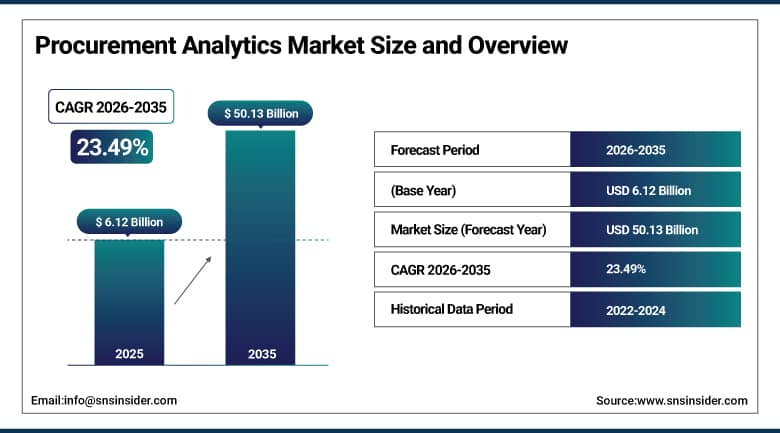
The Procurement Analytics Market was valued at USD 6.12 Billion in 2025 and is expected to reach USD 50.13 Billion by 2035, growing at a CAGR of 23.49% from 2026 to 2035.
Among the many digital transformation solutions available currently, procurement analytics enables firms to have increased visibility into expenditures, improve the performance of their suppliers, improve sourcing, adhere to contracts, and support procurement activities through the use of data analytics solutions. Companies from different industries including manufacturing, BFSI, healthcare, retail, energy, and government are using more and more artificial intelligence (AI)-driven procurement analytics platforms for optimizing their procurement processes, reducing costs, collaborating better with their suppliers, and addressing procurement risks caused by disruptions in global supply chains and increased prices. Adoption of cloud-based procurement environments, integration with ERP systems, and predictive analytics capabilities have fueled the adoption of advanced procurement intelligence software among enterprises around the world. Procurement analytics offers a very solid commercial value proposition, primarily in terms of cost savings.
SAP SE reported that its cloud ERP and procurement-related cloud revenue exceeded USD 15 Billion annually in recent fiscal reporting, supported by growing enterprise adoption of SAP Ariba procurement analytics and intelligent spend management solutions across manufacturing, retail, and public sector organizations. The company also expanded AI-assisted sourcing and supplier recommendation capabilities across its procurement ecosystem, enabling enterprises to automate spend classification and supplier risk analysis at large scale.
To Get More Information On Procurement Analytics Market - Request Free Sample Report
Procurement Analytics Market Trends
-
Rising AI-driven spend analytics adoption is accelerating procurement digitalization globally.
-
Increasing supplier risk management needs are driving predictive procurement analytics demand.
-
Growing cloud procurement adoption is improving real-time sourcing visibility and efficiency.
-
Expanding AI and machine learning integration is enhancing procurement automation capabilities.
-
Rising ESG and compliance focus is boosting demand for sustainable procurement analytics solutions.
U.S. Procurement Analytics Market Outlook
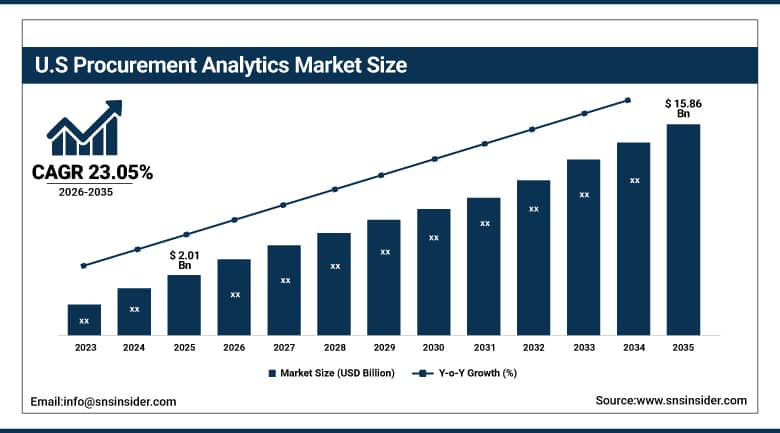
The U.S. Procurement Analytics Market was valued at USD 2.01 Billion in 2025 and is expected to reach USD 15.86 Billion by 2035, growing at a CAGR of 23.05%.
United States emerges as a key market for procurement analytics due to its digitization at the enterprise level, cloud computing technology adoption, and involvement of multinationals engaged in sourcing goods from other countries. Large enterprises in sectors such as manufacturing, BFSI, retail, healthcare, and government are using AI-powered procurement analytics tools to help increase their transparency in spend, better manage their suppliers, make strategic sourcing decisions, and maintain compliance in procurement. The increasing use of cloud-enabled ERP, intelligent automation software, and predictive procurement analytics tools is contributing to market growth in this country. The uncertainties in supply chains, rising prices caused by inflation, and compliance issues are prompting businesses to undergo a procurement analytics transformation journey.
Coupa Software Inc. expanded its AI-driven procurement intelligence capabilities in 2025 by enhancing autonomous spend analysis and supplier risk monitoring functions across its Business Spend Management platform handling more than USD 6 Trillion in business spend transactions globally. SAP SE continued strengthening its SAP Ariba procurement ecosystem through expanded generative AI integration and intelligent sourcing automation tools designed to improve enterprise procurement efficiency, supplier collaboration, and contract analytics performance.
Procurement Analytics Market Segment Analysis
-
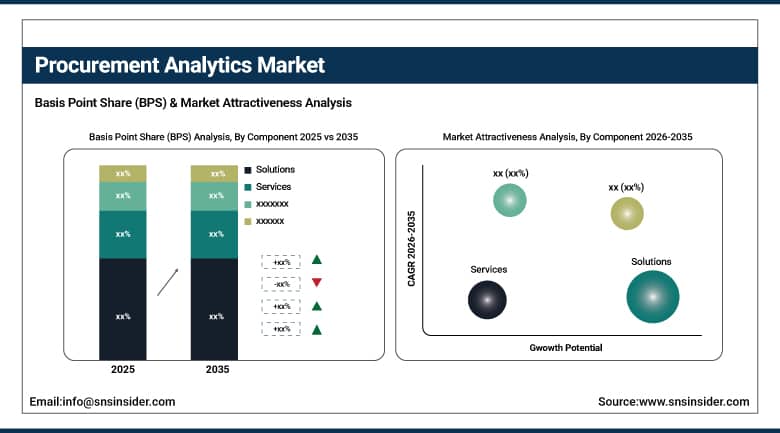
By Component, solutions segment dominated the procurement analytics market with 71.41% share in 2025, while the services segment is the fastest growing component during 2026 to 2035.
-
By Deployment Mode, cloud-based segment dominated the procurement analytics market with 55.29% share in 2025, while the hybrid deployment segment is the fastest growing deployment mode during 2026 to 2035.
-
By Analytics Type, descriptive analytics segment dominated the procurement analytics market with 39.47% share in 2025, while the prescriptive analytics segment is the fastest growing analytics type during 2026 to 2035.
-
By Application, spend analysis segment dominated the procurement analytics market with 31.49% share in 2025, while the risk analytics & compliance management segment is the fastest growing application during 2026 to 2035.
-
By Enterprise Function, direct procurement segment dominated the procurement analytics market with 36.15% share in 2025, while the strategic procurement segment is the fastest growing enterprise function during 2026 to 2035.
By Component, solutions dominate, services grow fastest
Solutions accounted for 71.41% of procurement analytics market revenue in 2025. More emphasis is being placed on procurement intelligence systems that can provide spend visibility, supplier performance management, sourcing optimization, and procurement automation in cloud-based procurement systems. Procurement analytics systems have gained more prominence through greater collaboration between artificial intelligence, ERP systems, and supplier management systems in enterprises engaged in global sourcing activities.
Services are the fastest-growing component segment, motivated by increased enterprise demands for custom implementation services for procurement analytics, cloud migration, ERP integration, and workflow improvement. Enterprises are now increasingly focusing on providing expertise in deploying procurement analytics software in conjunction with traditional sourcing applications and multi-vendor procurement processes.
By Deployment Mode, cloud-based dominates, hybrid deployment grows fastest
Cloud-based deployment accounted for 55.29% of procurement analytics market revenue in 2025. Scalability, reduced infrastructure costs, remote access, and real-time procurement visibility are some of the advantages provided by cloud-based procurement analytics solutions that have driven their adoption in firms adopting digital procurement transformation initiatives. Cloud-based procurement solutions also facilitate quicker deployment of analytics solutions and easy integration with supplier collaboration and spend management platforms.
Hybrid deployment is the fastest-growing deployment mode when corporations try to leverage the benefits of cloud computing’s flexibility while maintaining the level of control over procurement information that can be maintained in-house. This kind of hybrid procurement system is increasing in popularity in regulated sectors and multi-national corporations.
By Analytics Type, descriptive analytics dominate, prescriptive analytics grow fastest
Descriptive analytics accounted for 39.47% of procurement analytics market revenue in 2025, driven by robust business needs for spend visibility, procurement reporting, supplier tracking, and historic buying analyses. The focus on descriptive analytics remains high because organizations find it important to be more transparent, find procurement inefficiencies, and enforce procurement management.
Prescriptive analytics represent the fastest-growing analytics type with more enterprises employing procurement recommendation engines that utilize artificial intelligence, procurement sourcing optimization solutions, and procurement decision intelligence platforms, prescriptive analytics are playing an increasingly significant role in recommending sourcing activities, optimizing suppliers, and enhancing procurement agility.
By Application, spend analysis dominates, risk analytics & compliance management grows fastest
Spend analysis accounted for 31.49% of procurement analytics market revenue in 2025. Organizations will continue to focus on spend visibility and procurement cost optimization programs to enable effective supplier negotiations, detect uncontrolled procurement, and improve procurement efficiency within both direct and indirect procurement operations. Spend analytics applications have been vital in the organizational procurement transformation processes for the benefits they offer in cost savings and budgeting.
Risk analytics & compliance management is the fastest-growing application segment as supply chain disruption issues, environmental-social-governance (ESG) regulation, cybersecurity, and supply chain compliance have made companies pay more attention to procurement risk monitoring tools. Organizations are now investing heavily in analytics-based procurement risk intelligence and procurement compliance management systems.
By Enterprise Function, direct procurement dominates, strategic procurement grows fastest
Direct procurement accounted for 36.15% of procurement analytics market revenue in 2025. Large manufacturing companies, retailers, hospitals, and industrial companies utilize procurement analytic software solutions for efficient sourcing of materials, collaboration between suppliers, purchasing of stocks, and production-related procurement processes. The size of operations and expenditure involved in the procurement process continue to favor segment domination in international firms.
Strategic procurement is the fastest-growing enterprise function segment as companies begin to favor longer-term supplier relationships, sourcing information, diversity among suppliers, and procurement planning skills. Procurement analytics systems have been able to assist corporations in making better decisions about their sourcing, predicting supplier performance, and increasing procurement value through advanced procurement analytics systems.
Regional Insights
|
Region |
Major Country |
Share within Region, 2025 (%) |
|---|---|---|
|
North America |
United States |
84.64% |
|
Europe |
Germany |
26.47% |
|
Asia Pacific |
China |
39.74% |
|
Middle East & Africa |
UAE |
24.38% |
|
Latin America |
Brazil |
41.29% |
North America Procurement Analytics Market Insights
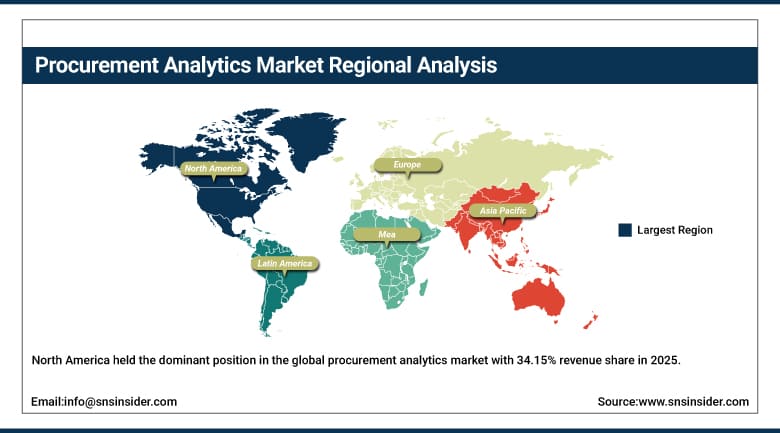
North America held the dominant position in the global procurement analytics market with 34.15% revenue share in 2025, supported by extensive enterprise digitization, advanced adoption of cloud technologies, and significant uptake of AI-based procurement transformation solutions in both countries. Many large enterprises from the manufacturing, BFSI, healthcare, retail, and public sectors have already started leveraging procurement analytics tools for such use cases as spending visibility, vendor risk management, optimized procurement sourcing, and procurement compliance automation. The strong presence of major ERP providers, cloud procurement technology companies, and enterprise analytics vendors is further fueling procurement transformation initiatives.
More than USD 2.4 billion was invested in procurement digitization and intelligent sourcing transformation initiatives across North American enterprises during 2025, while several Fortune 500 companies expanded AI-enabled procurement analytics deployment across supplier ecosystems involving over 40,000 global vendors to improve sourcing visibility and contract compliance efficiency.
Get Customized Report as Per Your Business Requirement - Enquiry Now
Europe Procurement Analytics Market Insights
Europe is an important market for procurement analytics, owing to its robust industrial automation ecosystem, stringent ESG compliance, and procurement digital transformation efforts seen in Germany, the United Kingdom, France, Italy, and the Nordic countries. Companies based in this region are implementing procurement analytics solutions that integrate advanced technologies such as AI, predictive sourcing, and supplier governance frameworks to enhance procurement visibility, efficiency, and compliance. Sustainable sourcing and digital supply chain strategies continue to make Europe a fertile ground for the use of procurement analytics software solutions.
An investment of more than EUR 4 billion was made for the digitalization of enterprise procurement and the modernization of procurement supply chain intelligence solutions in Europe in 2025, while global manufacturers increased their adoption of cloud-based procurement analytics solutions to oversee procurement processes for more than 25,000 suppliers.
Asia Pacific Procurement Analytics Market Insights
Asia Pacific is projected to register the highest CAGR of 6.13% from 2026–2035 in the procurement analytics market, fueled by factors such as the growth of industries, adoption of cloud services, manufacturing, and growing digitization of businesses in China, India, Japan, South Korea, and Southeast Asia. Increasing procurement complexity, need for supplier diversification policies, and increased use of industrial procurement supply chains have led companies to adopt procurement analytics solutions driven by artificial intelligence to enable real-time spend management and sourcing optimization. Investments in smart manufacturing and digital procurement platforms are further driving market growth.
China and India together accounted for procurement modernization initiatives spanning more than 60,000 enterprise supplier networks integrated with cloud-based procurement analytics platforms during 2025, while large manufacturing and e-commerce enterprises across Southeast Asia implemented AI-enabled spend intelligence systems reducing procurement processing time by nearly 30%.
Latin America, Middle East & Africa (LAMEA) Procurement Analytics Market Insights
The LAMEA procurement analytics market is experiencing steady growth owing to factors such as industrialization, infrastructure development, greater adoption of cloud computing, and growing concerns about procurement transparency among enterprises in countries like Brazil, Mexico, Saudi Arabia, UAE, and South Africa. Procurement analytics solutions are being used by companies in the region to enhance supply chain management, optimize their sourcing activities, procure efficiently, and minimize procurement risks involved in their operations.
Middle Eastern enterprises expanded procurement intelligence deployment across supplier ecosystems involving more than 20,000 vendors during 2025 through integration of AI-enabled sourcing analytics and cloud procurement platforms, while Brazilian industrial operators accelerated implementation of predictive procurement analytics systems supporting procurement coordination across 700+ large-scale mining, energy, and infrastructure project sites.
Growth Drivers: Increasing enterprise focus on procurement efficiency and supplier intelligence
Increasingly complex global supply chains, escalating procurement expenses, and rising supplier risks are driving enterprise spending on procurement analytics technologies that can enable better sourcing visibility, spend management, and procurement decision-making. Enterprises in manufacturing, retail, BFSI, healthcare, and logistics domains are increasingly adopting procurement intelligence platforms based on artificial intelligence technology to automate supplier evaluation processes, speed up the procurement process, and ensure procurement contracts' compliance within expansive supplier ecosystems. Adoption of cloud procurement technologies and digital transformation efforts are further fueling industry growth across the globe. In 2025, large enterprises executing procurement operations with annual spend above USD 100 billion adopted procurement analytics technologies based on artificial intelligence across extensive supplier networks comprising more than 50,000 vendors worldwide.
Restraints: Data integration complexity and fragmented procurement ecosystems limit analytics efficiency
Procurement analytics solutions usually encounter certain challenges because of disjointed procurement systems, inconsistent suppliers’ databases, and difficult integration needs for ERP, sourcing, finance, and supply chain management processes. Companies are still running legacy procurement systems where procurement data is available in several non-integrated systems, thus reducing accuracy of real-time analysis and transparency in spending. Furthermore, such issues as data security, cybersecurity threats, supplier confidentiality, and compliance are becoming additional obstacles to deploying procurement analytics tools within highly regulated companies. Moreover, small and medium-sized businesses suffer from limited budgets and lack of IT resources needed for implementation of sophisticated procurement analytics solutions.
Opportunities: AI-driven procurement automation and ESG-focused sourcing analytics create long-term market potential
The fast adoption of technologies such as generative AI, predictive sourcing intelligence, and ESG procurement governance tools provides a lot of potential for future growth in the global procurement analytics market. Today, businesses actively invest in AI procurement software that can automate processes of supplier selection, categorization, sourcing recommendations, and procurement risk management within their global supplier base. Another factor driving the demand for supplier intelligence and procurement governance software is increased attention from regulators to issues of sustainability and ESG compliance. In 2025, multinational corporations have increased the use of AI-based procurement automation solutions in their procurement environments with more than 70,000 suppliers, saving up to 18% on their procurement costs by using predictive sourcing software and automated supplier management systems.
Recent Developments
-
2026: SAP SE expanded AI-powered sourcing and supplier risk analytics capabilities within SAP Ariba, improving procurement automation and enterprise spend visibility across global supply chains.
-
2026: Oracle Corporation enhanced predictive procurement analytics and supplier intelligence tools across Oracle Fusion Cloud Applications to strengthen real-time sourcing optimization and procurement decision-making.
-
2025: Coupa Software Inc. expanded autonomous spend management capabilities across procurement operations handling over USD 6 trillion in enterprise spend transactions globally, supporting AI-driven procurement efficiency and supplier intelligence.
-
2025: IBM Corporation strengthened AI-enabled procurement analytics and supplier risk forecasting solutions through expanded watsonx integration, supporting intelligent sourcing and automated procurement decision support for enterprises.
Procurement Analytics Market Key Players
-
SAP SE
-
Oracle Corporation
-
Coupa Software Inc.
-
Jaggaer
-
GEP Worldwide
-
Ivalua Inc.
-
Zycus Inc.
-
SynerTrade
-
Corcentric LLC
-
SAS Institute Inc.
-
Rosslyn Data Technologies
-
Genpact Limited
-
BirchStreet Systems
-
SpendHQ
-
Sievo Oy
-
Tamr Inc.
-
Fairmarkit
Procurement Analytics Market Report Scope:
| Report Attributes | Details |
|---|---|
| Market Size in 2025 | USD 6.12 Billion |
| Market Size by 2035 | USD 50.13 Billion |
| CAGR | CAGR of 23.49% From 2026 to 2035 |
| Base Year | 2025 |
| Forecast Period | 2026-2035 |
| Historical Data | 2022-2024 |
| Report Scope & Coverage | Market Size, Segments Analysis, Competitive Landscape, Regional Analysis, DROC & SWOT Analysis, Forecast Outlook |
| Key Segments | • By Component (Solutions, Services) • By Deployment Mode (Cloud-Based, On-Premise, Hybrid Deployment) • By Analytics Type (Descriptive Analytics, Predictive Analytics, Prescriptive Analytics, Diagnostic Analytics) • By Application (Spend Analysis, Supplier Performance Management, Contract Management, Risk Analytics & Compliance Management, Strategic Sourcing, Procure-to-Pay (P2P) Optimization) • By Enterprise Function (Direct Procurement, Indirect Procurement, Operational Procurement, Strategic Procurement) |
| Regional Analysis/Coverage | North America (US, Canada), Europe (Germany, UK, France, Italy, Spain, Russia, Poland, Rest of Europe), Asia Pacific (China, India, Japan, South Korea, Australia, ASEAN Countries, Rest of Asia Pacific), Middle East & Africa (UAE, Saudi Arabia, Qatar, South Africa, Rest of Middle East & Africa), Latin America (Brazil, Argentina, Mexico, Colombia, Rest of Latin America). |
| Company Profiles | SAP SE, Oracle Corporation, Coupa Software Inc., Jaggaer, IBM Corporation, GEP Worldwide, Ivalua Inc., Zycus Inc., SynerTrade, Corcentric LLC, Proactis Holdings Plc, SAS Institute Inc., Rosslyn Data Technologies, Genpact Limited, BirchStreet Systems, SpendHQ, Sievo Oy, Tamr Inc., Fairmarkit, Xeeva Inc. |

Frequently Asked Questions
The procurement analytics market is expected to grow at a CAGR of 23.49% from 2026 to 2035.
The procurement analytics market was valued at USD 6.12 Billion in 2025.
The primary growth factors include the integration of AI and machine learning allows systems to produce data-based demand forecasting, automate routine workflows, and shift procurement from a reactive operational task to a strategic function.
The Solutions segment dominated the procurement analytics market with 71.41% share in 2025.
North America dominated the procurement analytics market in 2025, holding a 38.74% of global revenues, with the United States accounting for a 84.64% of North American revenues.
