
5G Edge Cloud Network and Services Market Report Scope & Overview:
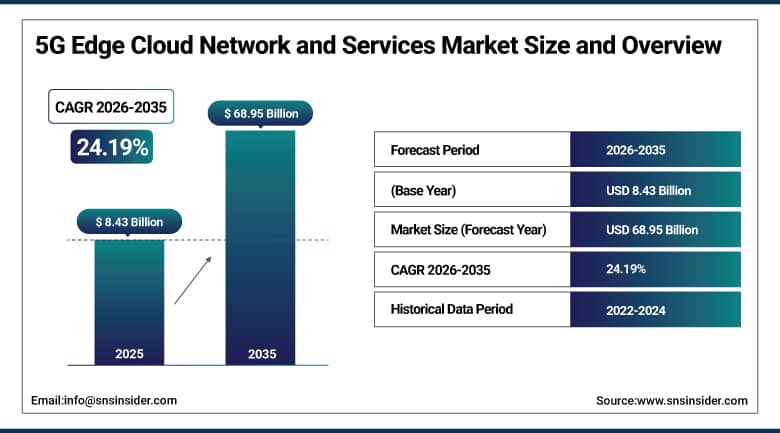
The 5G Edge Cloud Network and Services Market was valued at USD 8.43 Billion in 2025 and is expected to reach USD 68.95 Billion by 2035, growing at a CAGR of 24.19% from 2026 to 2035.
The 5G edge cloud network and services market are a critical element of digitalization because this market is based on SA and MEC, allowing to implement real-time analysis and local computing with low-latency characteristics. Nowadays, the current market is being analyzed from the perspective of next-generation applications, such as autonomous mobility, automated industry, VR/AR services, smart cities, and healthcare innovations. At the same time, there is a significant move from cloud computing to edge computing because of the increasing amounts of generated data, need for real-time analytics, and demand for backhaul reduction. The growth of private 5G and edge computing solutions within enterprises plays a critical role in the acceleration of commercialization. Therefore, with such key characteristics of the market as network slicing, MEC applications, and micro data centers equipped with GPUs/accelerators, the QoS, scalability, isolation, and safety are guaranteed.
In 2025, hyperscale cloud providers and telecom operators significantly accelerated edge infrastructure expansion, with AWS Wavelength expanding to 35+ global zones across 20+ countries, enabling ultra-low latency compute for 5G applications such as gaming and connected mobility. Microsoft Azure Edge Zones surpassed 100+ enterprise deployments worldwide, reflecting rapid adoption of distributed cloud models across manufacturing, retail, and healthcare sectors.
To Get More Information On 5G Edge Cloud Network and Services Market - Request Free Sample Report
5G Edge Cloud Network and Services Market Trends
-
Rapid commercialization of 5G Standalone cores with network slicing is enabling deterministic SLAs for latency- and throughput-sensitive enterprise workloads.
-
Rising adoption of MEC platforms integrated with cloud marketplaces is simplifying application onboarding, observability, and multi-tenant monetization at the edge.
-
Proliferation of AI at the edge is accelerating demand for GPU/ASIC-enabled micro data centers to support real-time vision, anomaly detection, and digital twin workloads.
-
Enterprise pivot to hybrid and multi-cloud edge architectures is driving investments in zero-trust security, SD-WAN/SASE convergence, and cloud-native orchestration.
-
Growth in private 5G deployments for factories, ports, and campuses is expanding the addressable market for on-prem edge stacks with industrial-grade reliability.
U.S. 5G Edge Cloud Network and Services Market Outlook
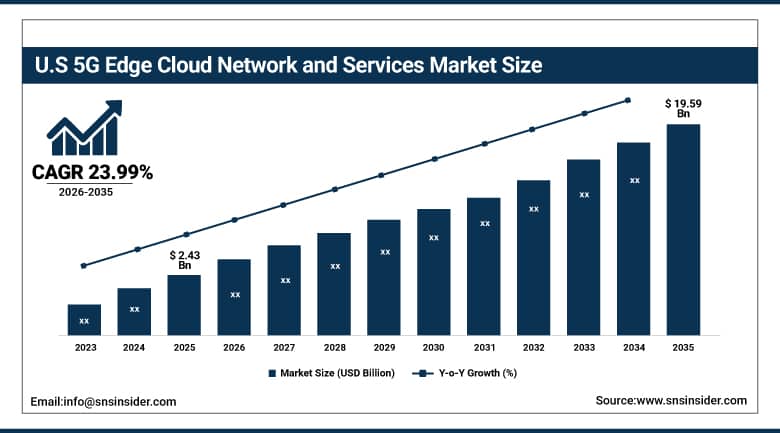
The U.S. 5G Edge Cloud Network and Services Market were valued at USD 2.43 Billion in 2025 and is expected to reach USD 19.59 Billion by 2035, growing at a CAGR of 23.99%.
The US market represents the biggest market among all countries when it comes to 5G edge cloud, due to extensive 5G mid and mmWave network coverage, strong ecosystems of cloud services and semiconductors, and the emergence of various early adopters from sectors including auto manufacturing, logistics, media, and health care. The implementation of MEC environments co-located with metropolitan data centers that connect to distributed cloud infrastructure would accelerate the process of commercialization through making programmers able to bring their workloads closer to consumers. The private 5G campus network, which is usually built in partnership with system integrators, is becoming more prevalent in large-scale manufacturing, energy, and intelligent warehouses, where requirements related to latency and density cannot be fulfilled using Wi-Fi technology. There has been an increasing demand for streamable content, video games, and edge rendering as well as low-latency data pipes for autonomous equipment.’
Major U.S. carriers and cloud partners continued to expand local zones in 2025, pairing 5G SA slicing with workload placement policies that align application tiers to latency budgets, data gravity, and compliance requirements. Convergence of OT and IT domains is broadening the buyer base to operations and plant managers, who prioritize deterministic uptime, zero-touch failover, and cyber resilience in their vendor selection criteria.
5G Edge Cloud Network and Services Market Segment Analysis
-
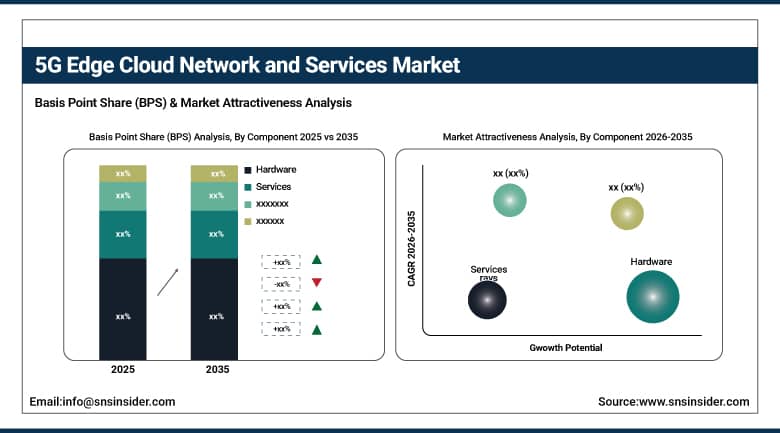
By Component, hardware segment dominated the 5G edge cloud network and services market with 42.12% share in 2025, while the services segment is the fastest growing component with the highest CAGR of 25.81% from 2026–2035.
-
By Deployment Mode, public edge cloud segment dominated the market with 48.14% share in 2025, while the hybrid edge cloud segment is the fastest growing deployment mode with the highest CAGR of 25.28% from 2026–2035.
-
By Network Type, 5G standalone (SA) segment dominated the market with 52.16% share in 2025, while the 5G non-standalone (NSA) segment is the fastest growing network type with the highest CAGR of 24.83% from 2026–2035.
-
By Application, autonomous vehicles & connected mobility segment dominated the market with 26.15% share in 2025, while the AR/VR & immersive media segment is the fastest growing application with the highest CAGR of 25.94% from 2026–2035.
-
By Enterprise Size, large enterprises segment dominated the market with 72.15% share in 2025, while the SMEs segment is the fastest growing enterprise size with the highest CAGR of 24.68% from 2026–2035.
By Component, hardware dominates the 5G edge cloud network and services market, services grow fastest
Hardware Segment accounted for 42.12% Market Share in the year 2025 due to extensive deployment of edge servers, distributed data centers, MEC-capable base stations, routers, and high-performing networking infrastructure to facilitate ultra-low latency 5G use cases. Telecom service providers as well as hyperscalers have been focusing on deploying more edge nodes for alleviation of backhaul capacity issues and enhance efficiency for real-time processing of mission-critical use cases such as autonomous mobility and industrial automation. Other factors contributing to growth of this segment include upgrades in 5G standalone infrastructure as well as AI-based hardware at the edge.
Services Segment represents the highest CAGR during the forecast period from 2026 to 2035 owing to increasing adoption of edge computing-as-a-service offerings, orchestration solutions, systems integrations, and lifecycle management.
By Deployment Mode, public edge cloud dominates the 5G edge cloud network and services market, hybrid grows fastest
The public edge cloud captured the highest market share of 48.14%, mostly because of the emergence of hyperscale-led ecosystems such as Amazon Web Services, Microsoft Azure, and Google. The latter have been adding new edge zones around the world, ensuring fast response for gaming, streaming, connected mobility, and Internet of Things applications. Telecommunications companies have also been teaming up with cloud providers to add more edge capabilities near their customers.
The hybrid edge cloud will be the most rapidly growing area between 2026 and 2035, mainly because organizations will be shifting towards architectures that merge private edge computing with cloud-based solutions. These types of hybrid infrastructures are becoming increasingly common in industries with high compliance requirements.
By Network Type, 5G SA dominates the 5G edge cloud network and services market, NSA grows fastest
The 5G standalone (SA) category was prominent in the market during the year 2025 with 52.16% market share due to its capability to fully harness the cloud-based nature of 5G core infrastructure to provide ultra-low latency and advanced edge computing services. This technology is critical for accommodating future applications like self-driving cars and smart factories that demand latency assurances. It has been boosted significantly by various telecommunications upgrades taking place in regions like North America, Europe, and parts of the Asia-Pacific region.
On the other hand, the 5G non-standalone (NSA) is the fastest-growing segment from 2026-2035 since various underdeveloped and emerging nations have been taking advantage of their existing 4G LTE infrastructure in order to adopt 5G in a more cost-effective manner.
By Application, autonomous mobility dominates the 5G edge cloud network and services market, AR/VR grows fastest
The autonomous vehicles & connected mobility segment holds the largest market share, representing 26.15% in 2025 because it depends highly on URLLC, processing of sensor information in real time, and vehicle-to-everything communication through edge computing. Automotive companies, telecom companies, and cloud service providers are working together intensively to deploy intelligent transportation solutions and smart mobility solutions.
AR/VR & Immersive Media is the most rapidly growing segment during 2026–2035 owing to increasing requirements for cloud gaming, applications of the metaverse, real-time 3D rendering, and immersive training simulations. Such applications require distributed edge computing systems to reduce latency.
By Enterprise Size, large enterprises dominate the 5G edge cloud network and services market, SMEs grow fastest
The Large Enterprises category held the largest market share of 72.15% in 2025 due to their early adoption of technologies such as private 5G networks, edge data centers, and MEC implementation in several vertical markets including automotive, manufacturing, health care, and logistics. These companies have the financial resources and technical know-how to implement more sophisticated systems involving edge analytics using AI.
The SME segment will grow the fastest between 2026 and 2035 due to the introduction of managed edge solutions, pay-as-you-go pricing models, and simplified platform offerings from telecom providers and cloud providers.
Regional Insights
|
Region |
Major Country |
Share within Region, 2025 (%) |
|---|---|---|
|
North America |
United States |
84.54% |
|
Europe |
Germany |
29.47% |
|
Asia Pacific |
China |
36.74% |
|
Middle East & Africa |
UAE |
23.38% |
|
Latin America |
Brazil |
44.84% |
North America 5G Edge Cloud Network and Services Market Insights
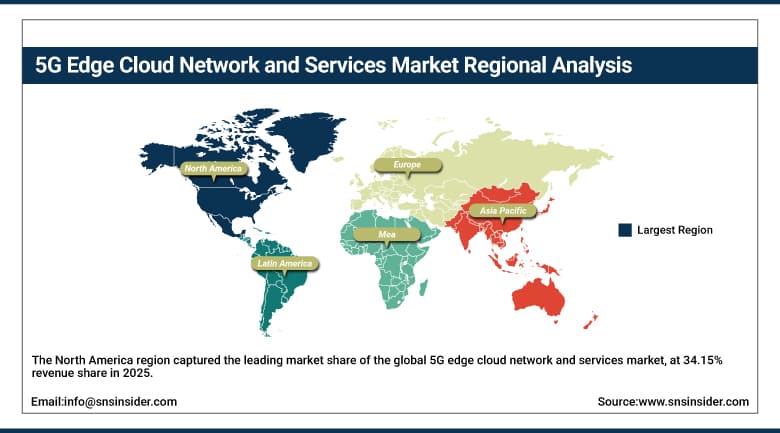
The North America region captured the leading market share of the global 5G edge cloud network and services market, at 34.15% revenue share in 2025, driven by the early adoption of standalone 5G technology, massive hyperscale edge installations, and high adoption of applications requiring low latency among enterprises. The North American region is blessed with well-developed telecom infrastructure, deep cloud ecosystem penetration, and significant investment in MEC-enabled systems in defense, automotive, and industrial industries. Leading the regional market is the U.S., owing to the adoption of network slicing, mass-scale private 5G services, and AI-powered edge computing within enterprises.
High-impact ecosystem acceleration is also visible through defense-led edge modernization programs, where over 60% of new military communication systems are being designed with edge-native processing capabilities for real-time battlefield analytics and autonomous coordination. Additionally, telecom–cloud co-investment models have expanded edge node density across more than 120 metro locations, reducing latency for mission-critical applications by up to 35 to 40%, particularly in smart mobility and industrial automation use cases.
Get Customized Report as Per Your Business Requirement - Enquiry Now
Europe 5G Edge Cloud Network and Services Market Insights
Europe is one of the important regional markets supported by stringent data sovereignty laws, leadership in industrial automation, and high uptake of private 5G and edge computing technologies in industries, logistics, and defense. Europe was a major contributor in 2025 in 5G edge cloud network and services market, with many deployments of edge-based industrial IoT devices, and there was good compliance with EU digital infrastructure policy guidelines. Leading countries were Germany, France, UK, and Nordic nations due to adoption in Industry 4.0 and logistics optimization.
Edge integration in Europe is accelerating through large-scale industrial digitalization, where more than 55% of advanced manufacturing plants are now using edge-based analytics to reduce operational downtime by 20–30% through predictive maintenance systems. Additionally, transport and rail modernization projects across major EU corridors have integrated real-time edge computing platforms that process over 1.5 billion data points daily for fleet optimization, energy efficiency, and autonomous traffic coordination across multi-modal logistics networks.
Asia Pacific 5G Edge Cloud Network and Services Market Insights
Asia Pacific is expected to hold the highest CAGR of 24.94% during the forecast period of 2026-2035in the 5G edge cloud network and services market due to rapid 5G network deployment, digitization of industries, and widespread use of edge computing in manufacturing processes, transportation systems, and smart cities. Nations like China, India, Japan, and South Korea are making significant efforts toward the deployment of edge nodes for high IoT density ecosystems and autonomous vehicles. The growth of the region will be further propelled by the cost-effective deployment of telecom networks and digital transformation projects supported by governments.
Edge adoption intensity is significantly increasing in infrastructure and industrial corridors, where over 70% of new smart manufacturing facilities are being designed with localized edge computing layers to reduce cloud dependency and improve real-time decision-making efficiency by 30 to 45%. Additionally, large-scale transportation and energy corridors exceeding 8,000 km of operational smart infrastructure are now integrating MEC-enabled monitoring systems, enabling predictive maintenance and real-time traffic and energy optimization across multiple national networks.
Latin America, Middle East & Africa (LAMEA) 5G Edge Cloud Network and Services Market Insights
LAMEA is experiencing continuous growth in 5G edge cloud network and services market through modernization in telecommunications, increased oil and gas exploration, digitized mining, and the building of infrastructure in remote areas. Nations like Brazil, Mexico, Saudi Arabia, UAE, South Africa, and Nigeria are spending in edge-enabled telecommunication infrastructure that will aid their industries operate in remote regions. LAMEA has embraced mobile edge computing technology owing to the lack of fixed infrastructure and the need for real-time control systems.
Edge deployment is increasingly concentrated in energy and industrial zones, where over 65% of large-scale oil, mining, and construction operations are now integrating portable edge-enabled communication systems to improve operational uptime by 25–35%. Additionally, mega infrastructure projects across the region are deploying distributed edge computing units across more than 3,000+ active industrial sites, enabling real-time equipment monitoring, workforce coordination, and remote asset management across high-latency environments.
Growth Drivers: Rising demand for ultra-low latency computing and edge-enabled digital ecosystems is accelerating market adoption
Increased utilization of real-time digital services is creating a high demand for 5G edge cloud networks and their services. Enterprises are increasingly relying on edge computing technology to deploy latency-sensitive applications such as autonomous vehicles, industrial robots, augmented/virtual reality services, and telemedicine. There is also an ongoing transition from centralized computing architecture to a distributed model that will reduce dependence on centralized cloud solutions and improve the responsiveness of critical business processes. Moreover, the growth of IoT ecosystems and connected devices is placing increased strain on network edge infrastructure as there is a need for more data processing capabilities.
Restraints: High infrastructure complexity, interoperability challenges, and security concerns are limiting faster scalability
However, the 5G edge cloud network and services market encounter significant limitations due to the difficulty in implementing edge architecture that is distributed. Interconnection among various players such as telecoms, clouds, and enterprise systems usually leads to complications and delays in widespread implementations. Moreover, the requirement for dense deployment infrastructure raises the complexity of the implementation and becomes costly. Security issues can also become an important factor since edge nodes do not function within data centers where information is usually safe. Lack of uniform standards among multiple providers may further complicate matters, especially those involving multi-cloud and hybrid-edge scenarios.
Opportunities: AI integration, private 5G expansion, and edge-native applications are unlocking new growth avenues
The merging of artificial intelligence technology with edge computing is proving very instrumental, thanks to real-time processing of information that can be performed close to the user. Organizations are considering the integration of their private 5G network with edge-based infrastructure to improve efficiency and increase their security level. With emerging edge-native apps in areas such as gaming, manufacturing, logistics, and healthcare, there is more commercial interest in the application of edge computing technologies. Telecommunication companies are coming up with novel revenue generation models that capitalize on differentiated edge services.
Recent Developments
-
2026: Ericsson strengthened its 5G edge ecosystem by expanding cloud-native MEC platform capabilities integrated with AI-driven network automation, enabling telecom operators to improve real-time service orchestration and reduce edge latency across enterprise deployments in manufacturing and smart mobility use cases.
-
2026: Microsoft Azure Edge Zones advanced its distributed edge infrastructure by extending hybrid edge-cloud integration features across telecom partner networks, improving workload mobility and enabling enterprises to deploy latency-sensitive applications such as IoT analytics and immersive media closer to end users.
-
2025: Nokia expanded its 5G Standalone (SA)-enabled edge computing portfolio by enhancing its private wireless and MEC solutions for industrial clients, strengthening adoption across smart factories, logistics hubs, and critical infrastructure projects in Europe and North America.
-
2025: Amazon Web Services (AWS Wavelength) scaled its carrier-integrated edge zones by deepening partnerships with global telecom operators, improving ultra-low latency application performance for gaming, connected vehicles, and real-time video processing workloads.
5G Edge Cloud Network and Services Market Key Players
-
Amazon Web Services (AWS)
-
Microsoft Corporation (Azure Edge)
-
Google LLC (Google Distributed Cloud)
-
Ericsson
-
Nokia Corporation
-
Cisco Systems Inc.
-
IBM Corporation
-
Intel Corporation
-
NVIDIA Corporation
-
Samsung Electronics (Networks Division)
-
Oracle Corporation
-
Hewlett Packard Enterprise (HPE)
-
Dell Technologies
-
Qualcomm Incorporated
-
AT&T Inc.
-
T-Mobile US Inc.
-
ZTE Corporation
-
Fujitsu Limited
5G Edge Cloud Network and Services Market Report Scope:
| Report Attributes | Details |
|---|---|
| Market Size in 2025 | USD 8.43 Billion |
| Market Size by 2035 | USD 68.95 Billion |
| CAGR | CAGR of 24.19% From 2026 to 2035 |
| Base Year | 2025 |
| Forecast Period | 2026-2035 |
| Historical Data | 2022-2024 |
| Report Scope & Coverage | Market Size, Segments Analysis, Competitive Landscape, Regional Analysis, DROC & SWOT Analysis, Forecast Outlook |
| Key Segments | • By Component (Hardware, Software, Services) • By Deployment Mode (Public Edge Cloud, Private Edge Cloud, Hybrid Edge Cloud) • By Network Type (5G Standalone (SA), 5G Non-Standalone (NSA), Multi-access Edge Computing (MEC)-enabled networks) • By Application (Autonomous vehicles & connected mobility, Smart cities & infrastructure, Industrial IoT (IIoT), AR/VR & immersive media, Healthcare, Gaming & real-time streaming) • By Enterprise Size (Large Enterprises, SMEs) |
| Regional Analysis/Coverage | North America (US, Canada), Europe (Germany, UK, France, Italy, Spain, Russia, Poland, Rest of Europe), Asia Pacific (China, India, Japan, South Korea, Australia, ASEAN Countries, Rest of Asia Pacific), Middle East & Africa (UAE, Saudi Arabia, Qatar, South Africa, Rest of Middle East & Africa), Latin America (Brazil, Argentina, Mexico, Colombia, Rest of Latin America). |
| Company Profiles | Amazon Web Services (AWS), Microsoft Corporation (Azure Edge), Google LLC (Google Distributed Cloud), Huawei Technologies Co. Ltd., Ericsson, Nokia Corporation, Cisco Systems Inc., IBM Corporation, Intel Corporation, NVIDIA Corporation, Samsung Electronics (Networks Division), Oracle Corporation, Hewlett Packard Enterprise (HPE), Dell Technologies, Qualcomm Incorporated, Verizon Communications Inc., AT&T Inc., T-Mobile US Inc., ZTE Corporation, Fujitsu Limited |

Frequently Asked Questions
The 5G edge cloud network and services market are expected to grow at a CAGR of 24.19% from 2026 to 2035.
The 5G edge cloud network and services market was valued at USD 8.43 Billion in 2025.
The primary growth factors include rising demand for ultra-low latency connectivity and real-time data processing, increasing adoption of edge computing for IoT and industrial automation applications, and growing deployment of private 5G networks and MEC-enabled infrastructure across enterprises.
The Hardware segment dominated the 5g edge cloud network and services market with 46.12% share in 2025.
North America dominated the 5g edge cloud network and services market in 2025, holding 34.15% of global revenues, with the United States accounting for 84.54% of North American revenues.
