
Demand Side Platform (DSP) Market Report Scope & Overview:
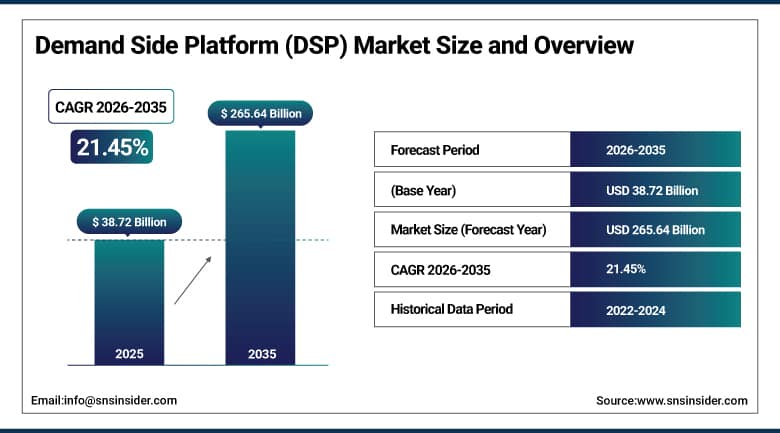
The Demand Side Platform (DSP) Market was valued at USD 38.72 Billion in 2025 and is expected to reach USD 265.64 Billion by 2035, growing at a CAGR of 21.45% from 2026 to 2035.
DSPs have become the technological core of contemporary programmatic advertising operations, facilitating advertisers, agencies, and brand marketers to access digital advertising inventory on numerous ad exchanges, SSPs, and publishers' ad networks using one platform. The revolutionizing movement from direct insertion order-based media buying to algorithm-based auction-driven programmatic media purchasing processes has radically changed the digital media supply chain, with DSP technology being the key technology for transforming advertisers' target audiences, campaigns, and budgets requirements into bid decisions made on billions of daily ad impressions. The business model of DSP technology depends on optimizing three dimensions simultaneously in ways not possible manually: audience targeting accuracy, bidding price optimization, and coordination of channel coverage including display, video, mobile, connected TV, and digital audio inventory environments.
The Trade Desk, Inc., the world's largest independent DSP provider by revenue, reported full-year 2024 revenue of USD 2.44 Billion, representing a 26% year-over-year increase, with connected television and retail media identified as the two fastest-growing inventory categories within its platform.
To Get More Information On Demand Side Platform (DSP) Market - Request Free Sample Report
Demand Side Platform (DSP) Market Trends:
-
Accelerating adoption of AI and machine learning for real-time bid optimization is substantially improving advertiser return on ad spend across programmatic campaigns.
-
Rapid growth of connected television (CTV) inventory is expanding the addressable universe for DSP-managed programmatic buying beyond traditional digital display and mobile environments.
-
Rising importance of first-party data activation is driving integration between DSP platforms and advertiser customer data platforms, enabling privacy-compliant audience targeting in a cookieless environment.
-
Retail media network expansion is creating new DSP-addressable closed-loop measurement environments where purchase data attribution validates advertising effectiveness for brand and performance marketers.
-
Programmatic audio advertising adoption is extending DSP functionality into podcast, streaming radio, and digital audio inventory categories whose listener engagement metrics are attracting increasing advertiser investment.
U.S. Demand Side Platform (DSP) Market Outlook:
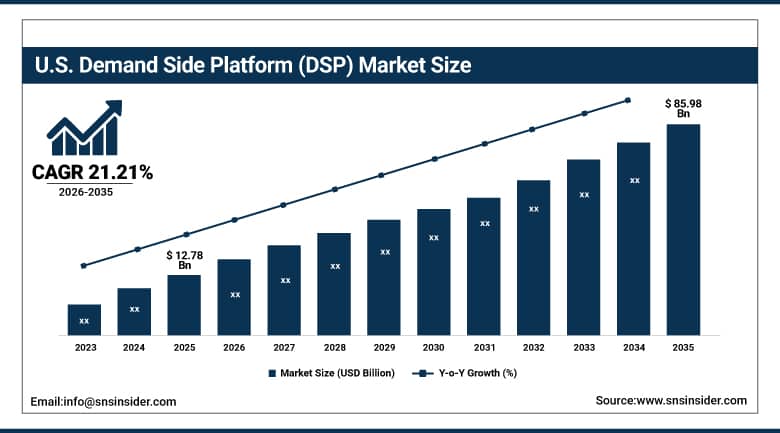
The U.S. Demand Side Platform Market was valued at approximately USD 12.78 Billion in 2025 and is expected to reach approximately USD 85.98 Billion by 2035, growing at a CAGR of approximately 21.21%.
United States is the world’s largest individual national DSP market owing to the structural nature of the United States as the hub for digital advertising innovations as well as developments in the DSP technology sector. Headquartered in the United States are many of the world’s most innovative players in the DSP technology segment such as The Trade Desk, Google Display & Video 360, Amazon DSP, Adobe Advertising Cloud, and Microsoft Advertising, whose technological capabilities set the benchmark and drive further innovation in DSP technology across the globe. High spending on digital advertising in the United States, which was greater than USD 270 billion in 2024, forms the economic foundation which supports continuous advancements in DSP technology. The sophisticated programmatic technology ecosystem of the United States, inclusive of sophisticated supply-side platform technologies, data management platforms integration, and brand safety technologies, offers the most conducive operational environment for executing campaigns powered by DSPs.
Google LLC's Display & Video 360 platform announced in 2025 the general availability of its AI Max for Display & Video 360 feature set, incorporating Gemini-powered creative optimization and audience expansion capabilities that automatically generate and test ad creative variants and identify incremental audience segments beyond manually specified targeting parameters.
Demand Side Platform (DSP) Market Segment Analysis:
-
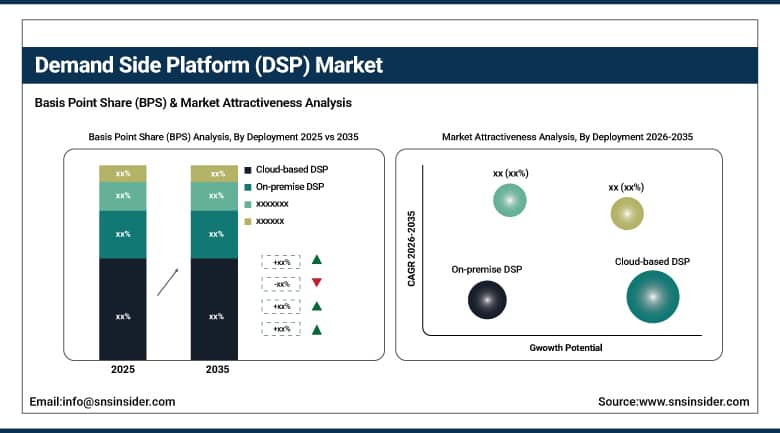
By Deployment, Cloud-based DSP dominated the market with 82.41% share in 2025, while Cloud-based DSP continues as the fastest growing deployment mode with the highest CAGR of 21.56% from 2026 to 2035.
-
By Type, Real-Time Bidding (RTB) Platforms dominated the market with 68.41% share in 2025, while Programmatic Premium Buying (PPB) Platforms is the fastest growing type with the highest CAGR of 21.93% from 2026 to 2035.
-
By Application, Display Advertising dominated the market with 30.15% share in 2025, while Connected TV (CTV) Advertising is the fastest growing application with the highest CAGR of 23.01% from 2026 to 2035.
-
By End User, Brand Advertisers dominated the market with 26.15% share in 2025, while Retail & E-commerce Platforms is the fastest growing end user segment with the highest CAGR of 22.68% from 2026 to 2035.
By Deployment, Cloud-based DSP dominates, On-premise DSP maintains enterprise presence
Cloud-based DSP accounted for 82.41% of demand side platform (DSP) market revenue in 2025, reflecting the deployment model's combination of elastic processing capacity, rapid feature deployment cycles, and accessible pricing structures that make cloud-based DSP functionality available to advertisers and agencies across the full range of organizational size and technical sophistication. Cloud-based DSP infrastructure enables real-time processing of bid request volumes that peak at billions of daily auctions without requiring advertisers to provision and maintain equivalent on-premise server capacity, creating a fundamental economic and operational advantage that has made cloud deployment the default architecture for new DSP deployments globally. On-premise DSP maintains meaningful market presence among large enterprise advertisers and global media holding companies whose data governance requirements, latency optimization needs, and proprietary audience data protection policies make centralized cloud-based data processing architecturally unacceptable regardless of the economic advantages that cloud deployment offers in standard advertiser operating environments.
By Type, Real-Time Bidding platforms dominate, Programmatic Premium Buying grows fastest
Real-Time Bidding (RTB) Platforms retained the dominant type position with 68.41% of demand side platform (DSP) market revenue in 2025. The RTB auction model's combination of impression-level targeting precision, dynamic pricing efficiency, and cross-exchange inventory access delivers the most commercially scalable mechanism for programmatic media buying across the full spectrum of digital advertising formats. RTB's ability to evaluate individual ad impressions against advertiser audience specifications and bid accordingly within milliseconds creates a continuous optimization feedback loop that manual media buying and guaranteed reservation-based approaches cannot replicate at equivalent scale and targeting granularity.
Programmatic Premium Buying (PPB) Platforms are the fastest-growing type segment, driven by the growing adoption of private marketplace deals, programmatic guaranteed arrangements, and preferred deal structures among premium publisher partners whose brand safety requirements and revenue floor commitments necessitate more controlled programmatic transaction formats than open auction RTB environments can consistently provide.
By Application, Display Advertising dominates, Connected TV (CTV) grows fastest
Display Advertising accounted for 30.15% of DSP application revenue in 2025. The programmatic display advertising ecosystem represents the most mature and deeply integrated DSP application environment, with the broadest publisher inventory availability, most established audience targeting infrastructure, and longest track record of advertiser investment and optimization learning that makes display the default starting point for programmatic campaign strategy across most advertiser categories. Video Advertising contributed 26.54% of market revenue, reflecting the growing programmatic availability of premium video inventory across broadcaster video-on-demand, social video platforms, and digital video networks whose audience targeting capabilities and brand-safe contextual environments are attracting increasing shares of brand awareness advertising budgets.
Connected TV (CTV) Advertising is the fastest-growing application segment at a CAGR of 23.01%, driven by the rapid growth of streaming service advertising tiers, the programmatic opening of broadcast network streaming inventory, and the measurement superiority of addressable CTV advertising over linear television whose gross rating point metrics cannot deliver the impression-level audience verification and attribution that DSP-powered CTV campaigns provide.
By End User, Brand Advertisers dominate, Retail & E-commerce grows fastest
Brand Advertisers accounted for 26.15% of DSP end-user revenue in 2025, reflecting the segment's sustained investment in programmatic technology as the primary mechanism for delivering precisely targeted awareness, consideration, and conversion campaigns at scale across global and national consumer audiences. Brand advertisers' adoption of DSP technology has been driven by the demonstrable audience targeting precision advantages over traditional media buying, the cross-channel coordination capabilities that enable consistent brand messaging across display, video, mobile, CTV, and audio touchpoints, and the campaign performance measurement transparency that DSP reporting dashboards provide relative to conventional media agency opaque buying practices.
Retail & E-commerce Platforms are the fastest-growing end-user segment, driven by the acceleration of retail media network development as major e-commerce platforms including Amazon, Walmart, Target, and Kroger commercialize their first-party shopper data through DSP-enabled programmatic advertising products whose purchase attribution capabilities represent a structurally superior measurement environment compared to the probabilistic attribution models that conventional digital advertising relies upon.
Regional Insights:
|
Region |
Major Country |
Share within Region, 2025 (%) |
|---|---|---|
|
North America |
United States |
86.54% |
|
Europe |
Germany |
28% |
|
Asia Pacific |
China |
38% |
|
Middle East & Africa |
UAE |
30% |
|
Latin America |
Brazil |
46% |
North America Demand Side Platform Market Insights
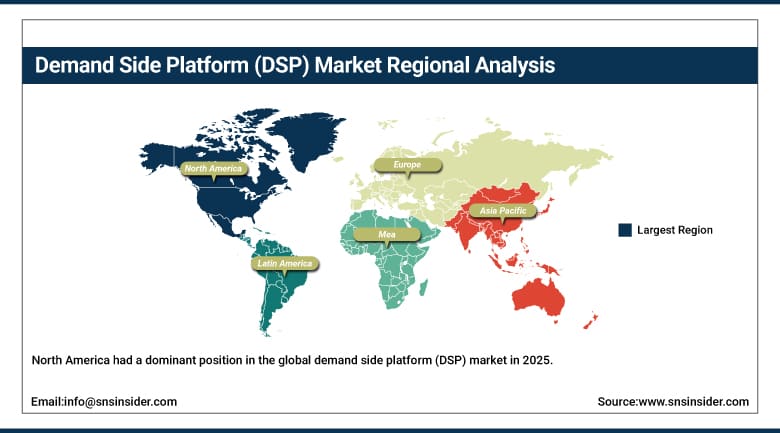
North America had a dominant position in the global demand side platform (DSP) market in 2025, contributing roughly 38.15% of global revenues, while the USA made up nearly 86.54% of regional revenue. The strong performance of North America is due to the fact that it sits at the heart of global innovation in programmatic technology, digital advertising market size, and home to the most advanced global system of advertisers, agencies, and technology providers that consistently innovate DSP capabilities, data infrastructure, and measurement methodology setting the benchmark of global programmatic advertising practices. The USA digital advertising market is one of the largest adopters of programmatic technologies in the world where programmatic methodologies have been applied in the vast majority of digital display, video, and CTV advertising deals. This level of programmatic adoption allows achieving the transactional volume needed for DSPs to invest in their technological advancement and to improve data network effects over time. The second country that adds regional demand is Canada as a technologically advanced digital advertising market with similar programmatic adoption practices to those in the USA.
Get Customized Report as Per Your Business Requirement - Enquiry Now
Europe Demand Side Platform Market Insights
The Europe region contributed about 25.14% of total DSPs revenue in 2025. The European region is characterized by unique regulatory complexities, which have been shaped by laws such as GDPR, the Digital Services Act, and the interpretation of enforcement actions taken by national data protection authorities. These regulations have significantly constrained the use of audience data gathering techniques, site-cross tracking capabilities, and behavioral targeting capabilities that characterize traditional DSPs capabilities. European DSPs have thus led to rapid innovation towards privacy-first targeting technology innovations, such as contextual advertising, audience segmentation using cohorts, and clean rooms that offer relevant audiences through first party data without the need for third party cookies. Germany makes up 28% of European revenue owing to a large digital advertising industry, robust programmatic landscape, and presence of major European advertisers and media agencies that invest in programmatic technology due to stringent privacy regulation compliance and advanced digital media environment. United Kingdom, France, The Netherlands, and Nordics make valuable contribution due to strong digital advertising industry in the regions.
Asia Pacific Demand Side Platform Market Insights
Asia Pacific is leading in demand side platform (DSP) market growth rate at a CAGR of around 22.32% until 2035. The Chinese market generates about 38% of Asia Pacific revenues due to being the world's biggest mobile internet market with an advanced programmatic infrastructure built upon high volumes, strong domestic platform presence, and compliance with governmental regulations. The Indian market is set to become the leading country-level DSP market in the region, owing to its rapidly-growing digital advertising market, increased adoption of programmatic by both domestic brands and MNCs operating there, and building up of programmatic infrastructure by local digital media platforms. Southeast Asian countries present promising growth opportunities due to their mobile-first internet adoption, increasing spend on digital advertising, and maturing programmatic infrastructure, which will enable efficient execution of DSP-based campaigns in Indonesia, the Philippines, Vietnam, Thailand, and Malaysia.
MEA & Latin America Demand Side Platform Market Insights
The Middle East and Latin America are two new demand side platform (DSP) market characterized by rising digital advertising spending, development of mobile internet connectivity, and adoption of programmatic advertising techniques by both regional and domestic advertisers leading to market growth trends. The UAE is ahead of the rest of MEA countries in terms of revenues due to its advanced digital media environment, high level of digital advertising penetration among the youthful and mobile population, and presence of regional offices for global technology, FMCG, and financial companies that have standardized their use of programmatic technologies in line with global DSPs. The most rapidly developing national market in the region is Saudi Arabia, thanks to the country's vision of digital economy development and rapid growth of its digital advertising market. The largest contributor to Latin America revenues is Brazil with 46% of the market share due to the size of its mature digital advertising market that enjoys programmatic adoption backed up by global DSP service providers and technical expertise of Brazilian agencies.
Market Dynamics:
Growth Drivers: AI-powered optimization and connected television expansion
The combination of artificial intelligence and machine learning into the processes of DSP bid optimization, audience modeling, and creative personalization is providing clear performance benefits for advertisers, resulting in an increase in the use of DSP technologies among brands and direct response marketers who have specific return-on-ad-spend needs that act as a powerful motivation for buying DSP platforms that provide measurable benefits. Bid optimization algorithms powered by artificial intelligence technologies can make accurate assessments based on analyzing real-time audience signal data, historical performance, and data on competitive bids, leading to efficient pricing of ad impressions in ways that are not possible with simple rules-based algorithms, thus justifying investments in premium DSP platforms. The natural expansion of connected TV advertisement inventory, which is taking place due to the rapid development of ad-supported tiers on major streaming services, results in the formation of a significant volume of premium video advertisement inventory that is made available via DSPs, providing significantly higher targeting accuracy than what is available using traditional linear television's GRP metrics.
Restraints: Identity resolution complexity and signal loss in cookie less environments
The systematic depreciation of third-party cookies in the leading web browsers and limitations imposed on mobile advertising identifiers in the iOS and Android operating systems are limiting the signal availability in the form of audience data that is required for effective audience targeting via DSP technology. The shift of the programmatic advertising space to a privacy-first identity infrastructure has resulted in the need for substantial investments by DSP platform providers into new identity infrastructure capabilities, including first-party data onboarding, clean rooms integration, probabilistic identity resolution, and enhanced contextual targeting, adding to the technical and financial challenges associated with building effective differentiation strategies. As walled gardens, such as Google, Meta, Amazon, and Apple, limit cross-platform measurement opportunities, it becomes impossible for advertisers to build an integrated view of their customers across channels and, thus, allocate their DSP budgets accordingly.
Opportunities: Retail media programmatic infrastructure and CTV measurement convergence
The structural opportunity to monetize the programmatic ecosystem developed by retail media networks for e-commerce platforms is significant to the demand side platform (DSP) market given the value propositions that its assets (first-party shopper data), capabilities (closed-loop purchase attribution) and brand-safe media environment provide to FMCG, consumer electronics, and direct-to-consumer brand advertisers. DSP platforms that establish official partnerships with leading retailers such as Amazon Advertising, Walmart Connect, Kroger Precision Marketing, and Target Roundel will benefit from access to unique first-party data signals and deterministic purchase attribution capabilities, both of which can enhance campaign measurement compared to probabilistic attribution methods via traditional programmatic approaches. The convergence toward standardizing connected TV measurement metrics, enabled by industry efforts to introduce a cross-media currency for audience measurement, offers an increasing programmatic CTV buying opportunity whereby DSPs can prove their effectiveness at driving brand impact and household efficiency, enabling more advertiser investments in programmatic CTV buys versus declining linear television investments.
Recent Developments:
-
2025: The Trade Desk launched its Kokai AI platform update incorporating large language model-powered audience curation and predictive bidding capabilities, enabling DSP buyers to specify campaign objectives in natural language while the AI system automatically configures targeting parameters, bid strategies, and budget allocation across inventory channels.
-
2025: Amazon DSP expanded its sponsored display and video advertising capabilities through new programmatic access to streaming TV inventory across Prime Video, enabling advertisers to programmatically purchase premium CTV inventory with Amazon's first-party shopper data targeting applied to household-level audience segments.
Demand Side Platform (DSP) Market Key Players:
-
Google (Display & Video 360)
-
The Trade Desk
-
Amazon DSP
-
Adobe Advertising Cloud
-
Yahoo DSP
-
Criteo
-
Xandr (Microsoft Advertising Platform)
-
MediaMath
-
Amobee (Nielsen)
-
StackAdapt
-
Basis Technologies (Centro)
-
Quantcast
-
RTB House
-
InMobi Advertising
-
Verizon Media DSP
-
SmartyAds
-
Viant Technology Inc.
-
Centro DSP (Basis Global Technologies)
Demand Side Platform (DSP) Market Report Scope:
| Report Attributes | Details |
|---|---|
| Market Size in 2025 | USD 38.72 Billion |
| Market Size by 2035 | USD 265.64 Billion |
| CAGR | CAGR of 21.45% From 2026 to 2035 |
| Base Year | 2025 |
| Forecast Period | 2026-2035 |
| Historical Data | 2022-2024 |
| Report Scope & Coverage | Market Size, Segments Analysis, Competitive Landscape, Regional Analysis, DROC & SWOT Analysis, Forecast Outlook |
| Key Segments | • By Type (Real-Time Bidding (RTB) Platforms, Programmatic Premium Buying (PPB) Platforms) • By Deployment (Cloud-based DSP, On-premise DSP) • By Application (Display Advertising, Video Advertising, Mobile Advertising, Connected TV (CTV) Advertising, Digital Audio Advertising) • By End User (Brand Advertisers, Advertising Agencies, Media Buying Agencies, Retail & E-commerce Platforms, BFSI, Telecom, Automotive Industry) |
| Regional Analysis/Coverage | North America (US, Canada), Europe (Germany, UK, France, Italy, Spain, Russia, Poland, Rest of Europe), Asia Pacific (China, India, Japan, South Korea, Australia, ASEAN Countries, Rest of Asia Pacific), Middle East & Africa (UAE, Saudi Arabia, Qatar, South Africa, Rest of Middle East & Africa), Latin America (Brazil, Argentina, Mexico, Colombia, Rest of Latin America). |
| Company Profiles | Google (Display & Video 360), The Trade Desk, Amazon DSP, Adobe Advertising Cloud, Microsoft Advertising, Yahoo DSP, Criteo, Xandr (Microsoft Advertising Platform), MediaMath, Amobee (Nielsen), StackAdapt, Basis Technologies (Centro), Quantcast, RTB House, Adform, InMobi Advertising, Verizon Media DSP, SmartyAds, Viant Technology Inc., Centro DSP (Basis Global Technologies) |
Frequently Asked Questions
North America dominated the Demand Side Platform (DSP) Market in 2025, holding approximately 38.15% of global revenues.
Connected TV (CTV) Advertising is the fastest-growing application segment in the Demand Side Platform Market, with a CAGR of 23.01% from 2026 to 2035.
The Real-Time Bidding (RTB) Platforms segment dominated the Demand Side Platform (DSP) Market with 68.41% share in 2025.
The primary growth factors include the accelerating adoption of AI-powered bid optimization technology, the rapid expansion of connected television programmatic advertising inventory, and the growing enterprise demand for cross-channel programmatic buying platforms that consolidate display, video, mobile, CTV, and audio advertising management within unified DSP infrastructure.
The Demand Side Platform (DSP) Market is projected to reach USD 265.64 Billion by 2035.
The Demand Side Platform (DSP) Market was valued at USD 38.72 Billion in 2025.
