
Climate Resilient Crops Market Report Scope & Overview:
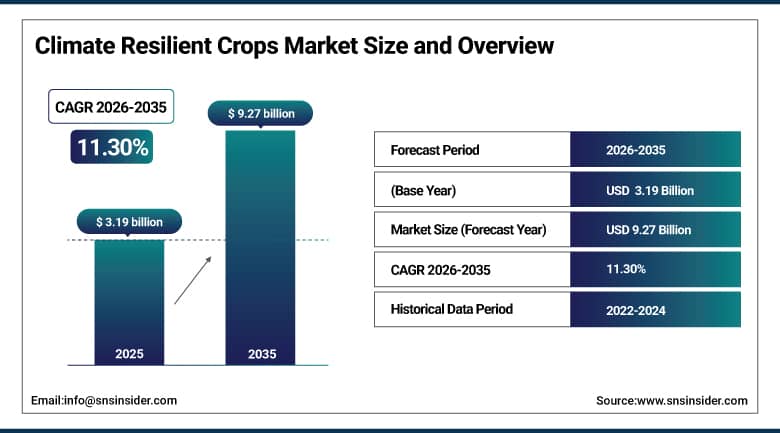
The Climate Resilient Crops Market size is estimated to be valued at 3.19 billion in 2025 and is expected to reach 9.27 billion by 2035, growing at a CAGR of 11.30% during the forecast period 2026-2035.
The Climate Resilient Crops Market analysis report includes a comprehensive assessment of the market dynamics, crop innovation technologies, and their applications. Climate change, increasing concerns over food security, drought- and heat-tolerant crops, and increasing investments in agri-biotechnology are the factors contributing to the growth of the Climate Resilient Crops Market during the forecast period 2026-2035.
Exceeding 220 million hectares in 2025, the adoption of climate-resilient crops is fueled by increasing exposure to extreme weather events and the need for sustainable agriculture productivity.
To Get More Information On Climate Resilient Crops Market - Request Free Sample Report
Climate Resilient Crops Market Trends:
-
Climate variability and extreme weather events, such as drought, heat, and floods, are creating a need for drought, heat, and flood-tolerant crops.
-
Increased emphasis on food security and sustainable agriculture is fueling the growth of climate-resilient crops.
-
Advances in breeding technologies, including genetic engineering and genome editing (CRISPR), are enhancing crop yield, adaptability, and resilience.
-
Development of crops with multiple traits is enhancing crop adaptability in different environmental conditions, thus enhancing farmer productivity.
-
Increased government initiatives, subsidies, and programs promoting climate-smart agriculture are fueling the growth of resilient crops.
-
Partnerships between seed companies, agribiotech, research, and industry associations are accelerating crop innovation and market expansion.
U.S. Climate Resilient Crops Market Insights:
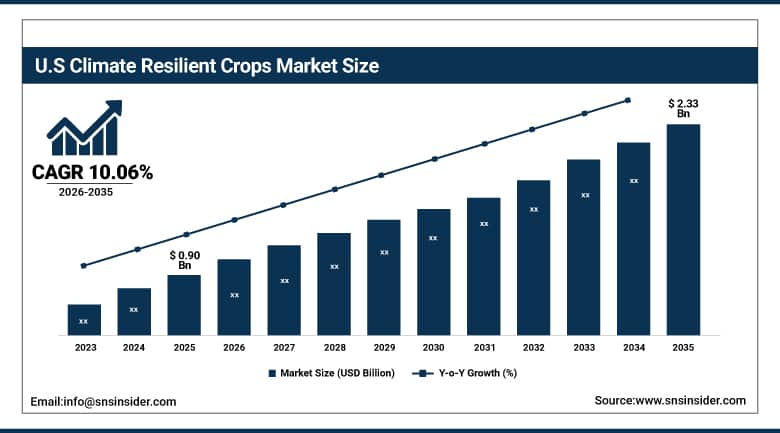
The United States Climate Resilient Crops Market is expected to grow from 0.90 billion in 2025 to 2.33 billion by 2035 at a CAGR of 10.06%. Factors contributing to the growth include increased instances of climate change, increased use of drought- and heat-tolerant crops, a robust base for advanced agri-biotech firms, and high investments in genetic engineering and genome editing technologies. Increased government backing for CSA practices and the need for sustainable agriculture practices are also fueling the growth of the Climate Resilient Crops Market.
Climate Resilient Crops Market Growth Drivers:
-
Rising climate change impacts and increased frequency of extreme weather events are fueling the need for climate-resilient crops.
The increasing climate change impacts, including droughts, floods, and temperature fluctuations, are major growth inducers for the Climate Resilient Crops Market. Climate-resilient crops, including drought-resistant, temperature-resistant, and salinity-resistant crops, are being increasingly adopted by farmers, agricultural associations, and government agencies. The increased productivity of these crops is also adding momentum to their adoption. The use of genetic engineering, genome editing, and marker-assisted breeding is also increasing, which is further adding strength to climate-resilient crops.
More than 46% of large-scale farming and agricultural schemes adopted climate-resilient crop varieties in 2025, driven by climate change risks and need for consistent agricultural output.
Climate Resilient Crops Market Restraints:
-
High development costs and inaccessibility of advanced seed technologies are significant restraints for the Climate-Resilient Crops Market in emerging markets.
High development costs and inaccessibility of advanced seed technologies are significant restraints for the Climate-Resilient Crops Market in emerging markets. Advanced breeding techniques, including genetic engineering and genome editing (CRISPR) technology, increase the cost of development of climate-resilient seeds, thereby hindering the market growth in small and mid-scale farming sectors in emerging markets. Inconsistent subsidy policies, lack of awareness, and affordability are also significant restraints for the Climate-Resilient Crops Market in emerging markets. In addition, complex regulations for genetically modified crops, supply chain constraints, and lack of technical expertise in precision farming practices are also hindering the growth of the Climate-Resilient Crops Market in emerging markets, despite growing concerns about climate change and food security.
Climate Resilient Crops Market Opportunities:
-
More investment in climate-smart agriculture and sustainable farming is another opportunity for growth in this market.
The Climate-Resilient Crops Market is expected to experience growth opportunities due to increased investment in climate-smart agriculture across the globe. The growing interest in climate-smart agriculture is due to the active participation of governments, funding organizations, and businesses. At the same time, many farmers and agricultural groups are using modern seed varieties, along with digital farming, precision farming, and data-driven farming methods, to improve productivity in different climates.
Therefore, companies can take advantage of this opportunity and develop more varieties of seeds for different regions. Investment in seed technology is on the rise, and with it, the potential for growth in the climate-resilient crops market. This expansion is further fueled by the emergence of public-private partnerships and sustainability efforts.
More than 52% of large-scale agricultural projects are using climate-smart and climate-resilient crop solutions in 2025.
Climate Resilient Crops Market Segmentation Analysis:
-
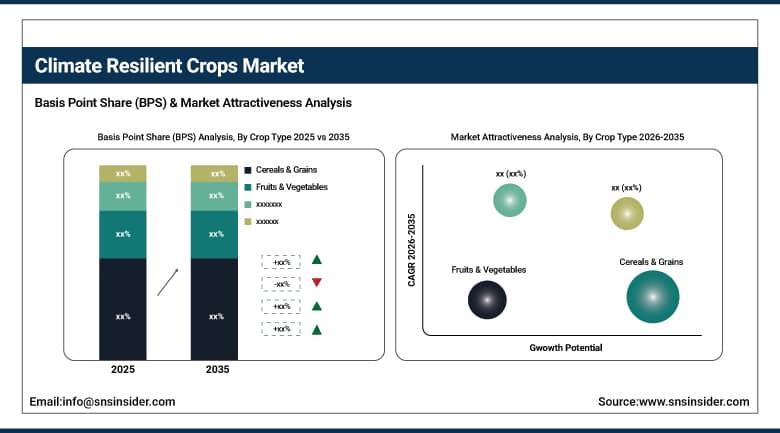
By Crop Type, Cereals & Grains held the largest market share of 41.65% in 2025, while Fruits & Vegetables are expected to grow at the fastest CAGR of 12.54% during 2026–2035.
-
By Trait Type, Drought-Tolerant Crops dominated with 38.98% market share in 2025, whereas Heat-Resistant Crops are projected to record the fastest CAGR of 12.89% through 2026–2035.
-
By Technology, Conventional Breeding accounted for the highest market share of 44.41% in 2025, while Genome Editing (CRISPR) is expected to grow at the fastest CAGR of 14.20% during the forecast period.
-
By Application, Agriculture Production dominated with a 63.12% share in 2025, while Food Security Programs are anticipated to expand at the fastest CAGR of 12.14% through 2026–2035.
-
By End User, Farmers held the largest share of 58.24% in 2025, while Government Agencies are expected to grow at the fastest CAGR of 11.61% during the forecast period.
By Crop Type, Cereals & Grains Dominate While Fruits & Vegetables Grow Rapidly:
The Cereals & Grains segment led the market due to its large area of cultivation, dietary importance, and early adoption of climate-resilient characteristics. In 2025, the area of climate-resilient cereal cultivation was over 120 million hectares, indicating a high preference among farmers for stable yield crops even in changing climatic conditions.
The Fruits & Vegetables segment is the fastest-growing segment due to the increasing demand for high-value crops, high climate sensitivity of this segment, and the rapid growth of protected and precision farming. The adoption of climate-resilient characteristics was seen at a high rate, and over 55 million hectares of area was under climate-resilient cultivation in 2025, especially in areas prone to heat stress and water scarcity.
By Trait Type, Drought-Tolerant Crops Dominate While Heat-Resistant Crops Grow Rapidly:
Drought-Tolerant Crops segment held the largest share in the market, as this type of crop is commonly used to maintain productivity even in water-scarce environments. In 2025, more than 135 million hectares were under cultivation for drought-resistant crops, indicating the high reliance on this segment by farmers and agricultural programs.
Heat-Resistant Crops segment is growing at the fastest rate, driven by the rise in temperatures and the occurrence of more heatwaves, affecting crop productivity. This segment has been adopted for more than 60 million hectares in 2025.
By Technology, Conventional Breeding Dominates While Genome Editing (CRISPR) Grows Rapidly:
Conventional Breeding segment held the largest share in the market due to its cost-effectiveness and acceptance for developing climate-resilient crop varieties. In 2025, more than 65% of resilient crop varieties were developed using traditional breeding methods and marker-assisted breeding.
Genome Editing (CRISPR) is the fastest-growing segment in the market due to its ability to develop precise crop varieties with resistance to various stresses using a shorter period for research and development activities. Over 1,500 active research projects were initiated in 2025 for developing crop varieties with desirable traits for the climate-resilient crop varieties market.
By Application, Agriculture Production Dominates While Food Security Programs Grow Rapidly:
The Agriculture Production segment was also dominant, with over 180 million hectares of land being used for climate-resilient cultivation in 2025, which is a clear indicator of the need for stable crop production in different environmental conditions. Farmers and farming associations are increasingly depending on resilient crops for stable crop production, thereby minimizing crop loss.
Food Security Programs is the fastest-growing segment, with an increase in government initiatives, international funding, and adaptation to different environmental conditions. Food Security Programs covered over 70 million hectares of land in 2025, especially in developing countries, where resilient crops are being widely used for addressing hunger and enhancing sustainable crop production.
By End User, Farmers Dominate While Government Agencies Grow Rapidly:
Farmers Segment: This segment held a dominant market position as the early adopters of climate-resilient crops, covering over 200 million hectares in 2025. Their direct contribution to the cultivation of crops, awareness of the impacts of climate change, and need for yield stability are key factors that continue to drive market growth from this segment.
Government Agencies: This segment holds the highest growth rate due to increased investments in climate-resilient agriculture, subsidies, and food security programs. In 2025, Government Agencies contributed over 80 million hectares of adoption, indicating increased support for the development and use of climate-resilient crops in vulnerable regions.
Climate Resilient Crops Market Regional Analysis:
North America Climate-Resilient Crops Market Insights:
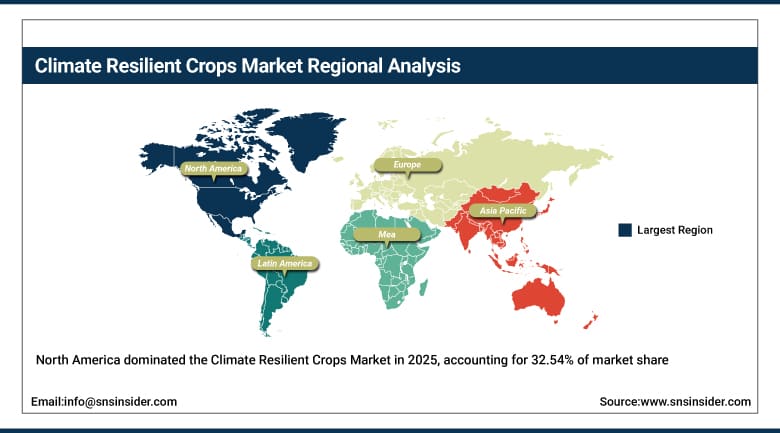
The North America Climate Resilient Crops Market has the highest market share of 32.54% in the year 2025, due to the presence of well-developed agricultural infrastructure, the highest adoption of genetically improved seeds, and the presence of agri-biotech companies in the United States and Canada. The high adoption of drought and heat-resistant crop cultivars, along with the adoption of precision agriculture, has also contributed to the growth of the climate-resilient crops market in the region.
Get Customized Report as Per Your Business Requirement - Enquiry Now
U.S. Climate Resilient Crops Market Insights:
The U.S. Climate Resilient Crops Market is driven by the presence of large-scale commercial farms, the highest adoption of advanced breeding techniques, and the integration of digital agriculture practices in the region. The increasing focus on climate variability, the need to optimize crop yields, and the highest adoption of genetically engineered and genome-edited crops have also driven the climate-resilient crops market in the United States, making it the highest contributor to the overall North America climate-resilient crops market.
Asia-Pacific Climate-Resilient Crops Market Insights:
The Asia-Pacific Climate Resilient Crops Market is the fastest-growing market, which is projected to register a CAGR of 14.04% between 2026 and 2035. The market is driven by factors such as increased climate stress on crops, increased food demands, and increased acceptance of climate-resilient crops in countries such as China, India, Japan, and Southeast Asian nations. Food security initiatives, increased investments in modernizing agriculture, and increased awareness of climate adaptation techniques are also fueling market growth. Increased initiatives in research activities and access to advanced seed technologies are also fueling strong market growth in this region.
China Climate Resilient Crops Market Insights:
The China Climate Resilient Crops Market is driven by factors such as increased climate variability, water scarcity issues, and increased government initiatives toward achieving food self-sufficiency. Increased acceptance of drought-tolerant and salinity-tolerant crops, combined with increased investments in agricultural biotechnology and genome editing, is fueling market growth. Increased initiatives in modernizing agriculture, precision agriculture, and increased government initiatives toward achieving climate-resilient farming are positioning the China Climate Resilient Crops Market as a strong contributor toward the overall Asia-Pacific market growth.
Europe Climate-Resilient Crops Market Insights:
The Europe climate-resilient crops market is driven by high sustainability initiatives, stringent environmental regulations, and an increase in climate-smart agricultural practices. Countries such as Germany, France, and the United Kingdom are contributing to shaping the climate-resilient crops market in their regions by implementing advanced breeding techniques and climate-resilient crop varieties. The increase in organic farming practices, research initiatives, and agricultural regulations is contributing to market growth. Continuous innovation in non-GM breeding techniques and sustainable crop varieties is adding to the importance of the European climate-resilient crops market.
Germany Climate-Resilient Crops Market Insights:
Germany is an important market for the climate-resilient crops market in Europe. It is driven by advanced agricultural research infrastructure and a high emphasis on sustainable agricultural practices. The market is growing due to an increase in climate-resilient seed varieties, precision agriculture techniques, and environmental regulations by the government. Strong regulations on sustainable agricultural practices and research collaborations between agricultural research institutions and agri-biotech companies are contributing to market innovation and development.
Latin America Climate Resilient Crops Market Overview:
The Latin America Climate Resilient Crops Market is expanding due to factors such as increasing climate variability, growth of commercial farms, and increasing demand for yield stability in major countries. The growth of the market is further fueled by the increasing use of drought and heat-tolerant crop varieties in countries such as Brazil, Argentina, and Mexico. The growth of the market is further fueled by the increasing use of advanced seed technologies and precision and sustainable agriculture practices.
Middle East and Africa Climate Resilient Crops Market Overview:
The Middle East and Africa Climate Resilient Crops Market is expanding due to factors such as increasing water scarcity, desertification, and the need to adopt sustainable agriculture practices in arid and semi-arid regions. The growth of the market is further fueled by the increasing use of salinity and drought-tolerant crop varieties in countries such as Saudi Arabia, the UAE, and South Africa. The growth of the market is further fueled by government initiatives to ensure food security and the increasing need to adopt climate adaptation strategies.
Climate Resilient Crops Market Competitive Landscape:
Bayer AG is a dominant player in the Climate Resilient Crops Market, being a leader in advanced seed technologies and GE crops for stress tolerance. The company provides solutions for climate-resilient crops, including corn, soybean, and cotton, which include traits for drought and pest resistance. Its strong R&D capabilities, digital farming, and distribution network make Bayer a dominant player in sustainable agriculture. The strategic investments in advanced breeding technologies and climate-resilient solutions make Bayer a strong competitor in this market.
-
November 2025, Bayer AG launched Alivio, a digital agri‑insurance platform combining weather intelligence and satellite analytics to help farmers manage climate risks, build resilience against drought and unpredictable weather, and protect crop productivity.
Another prominent player in the market, based in the United States, is Corteva Agriscience, which specializes in seed innovation and development of crops with high resilience against environmental conditions. The organization makes use of advanced breeding techniques, including gene editing and stacking, for the development of crops with high resilience against adverse conditions. The wide range of products, along with high farmer engagement, makes the organization a prominent player in the market.
-
February 2026, Syngenta Group prepared the launch of X‑Terra hybrid wheat across Europe, introducing hybrid wheat varieties with improved yield stability and stress tolerance to enhance resilience against climate variability and extreme weather.
Syngenta Group is a prominent player in the Climate Resilient Crops Market, recognized for its "integrated approach, bringing seeds, crop protection, and digital farming under one umbrella." The company is committed to "addressing climate change challenges such heat stress, water scarcity, and soil degradation" through biotechnology and conventional breeding of climate-resilient crops.
-
In January 2026, Corteva Agriscience advanced climate‑resilient seed solutions, introducing drought‑tolerant and climate‑adapted hybrid crop varieties in key regions, aimed at boosting yields and helping farmers maintain productivity under water‑limited conditions.
Climate Resilient Crops Market Key Players:
Some of the Climate Resilient Crops Market Companies are:
-
Bayer AG
-
Corteva Agriscience
-
Syngenta Group
-
BASF SE
-
KWS SAAT SE & Co. KGaA
-
Groupe Limagrain
-
Land O'Lakes Inc.
-
Cargill Inc.
-
Archer Daniels Midland Company
-
Nutrien Ltd.
-
Deere & Company
-
CNH Industrial
-
Indigo Ag
-
Pivot Bio
-
Benson Hill
-
Arcadia Biosciences
-
Olam Agri
-
Mahyco
-
Rallis India
-
UPL Limited
| Report Attributes | Details |
|---|---|
| Market Size in 2025 | USD 3.19 Billion |
| Market Size by 2035 | USD 9.27 billion |
| CAGR | CAGR of 11.30% From 2026 to 2035 |
| Base Year | 2025 |
| Forecast Period | 2026-2035 |
| Historical Data | 2022-2024 |
| Report Scope & Coverage | Market Size, Segments Analysis, Competitive Landscape, Regional Analysis, DROC & SWOT Analysis, Forecast Outlook |
| Key Segments | • By Crop Type (Cereals & Grains, Oilseeds & Pulses, Fruits & Vegetables, Others) • By Trait Type (Drought-Tolerant Crops, Flood-Tolerant Crops, Heat-Resistant Crops, Salinity-Resistant Crops, Others) • By Technology (Conventional Breeding, Genetic Engineering (GM Crops), Genome Editing (CRISPR), Marker-Assisted Selection, Others) • By Application (Agriculture Production, Food Security Programs, Research & Development (R&D), Others) • By End-User (Farmers, Agricultural Organizations, Research & Academic Institutes, Government Agencies, Others) |
| Regional Analysis/Coverage | North America (US, Canada), Europe (Germany, UK, France, Italy, Spain, Russia, Poland, Rest of Europe), Asia Pacific (China, India, Japan, South Korea, Australia, ASEAN Countries, Rest of Asia Pacific), Middle East & Africa (UAE, Saudi Arabia, Qatar, South Africa, Rest of Middle East & Africa), Latin America (Brazil, Argentina, Mexico, Colombia, Rest of Latin America). |
| Company Profiles | Bayer AG, Corteva Agriscience, Syngenta Group, BASF SE, KWS SAAT SE & Co. KGaA, Limagrain, UPL Limited, Nufarm Limited, DLF Seeds A/S, Sakata Seed Corporation, Takii & Co., Ltd., Rijk Zwaan, East-West Seed, Advanta Seeds (UPL Group), Mahyco (Maharashtra Hybrid Seeds Company), Evogene Ltd., Inari Agriculture, Pairwise Plants, Benson Hill Inc., Calyxt Inc |

Frequently Asked Questions
The Climate Resilient Crops Market is expected to grow at a CAGR of 11.30% during 2026–2035.
The market is valued at USD 3.19 Billion in 2025 and is projected to reach USD 9.27 Billion by 2035.
Cereals & Grains dominated with a 41.65% market share in 2025, while Fruits & Vegetables are projected to grow at the fastest CAGR of 12.54% during 2026–2035.
North America dominated with a 32.54% share in 2025, while Asia-Pacific is the fastest-growing region, expected to expand at a CAGR of 14.04% during 2026–2035.
Growth is driven by climate change, extreme weather, food security needs, drought- and heat-tolerant crops, and advances in agri-biotechnology such as genetic engineering and genome editing.
