
Food Vacuum Machine Market Report Scope & Overview:
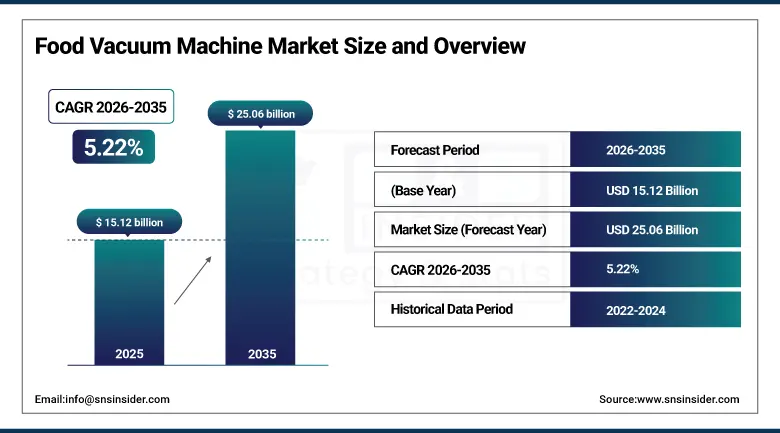
The Food Vacuum Machine Market was valued at USD 15.12 Billion in 2025 and is expected to reach USD 25.06 Billion by 2035, growing at a CAGR of 5.22% from 2026 to 2035.
The global market for food vacuum packing machines has become firmly entrenched as a crucial pillar within the food processing, packaging, and preservation industry, thus helping to significantly increase the shelf-life of products, preserve their nutritional content, and minimize food wastage along intricate global supply lines. Vacuum packers remove air from packages in order to eliminate any form of growth, oxidation, or decay in foods, thus offering a highly necessary commercial solution in meat processing, dairy products, fishery, bakery, and prepared meals industries. High versatility of vacuum packaging machines, as evidenced by both commercial and domestic application areas, has become a key contributor to market growth.
Sealed Air Corporation (CRYOVAC) processed and supplied packaging solutions supporting over 50 billion food packages annually across more than 115 countries in 2024, reflecting strong demand for vacuum packaging technologies driven by expanding protein exports, cold-chain logistics investments, and growing adoption of vacuum skin packaging formats in retail and foodservice applications.
To Get more information on Food Vacuum Machine Market - Request Free Sample Report
Food Vacuum Machine Market Trends
-
Rising demand for longer shelf-life foods is boosting vacuum machine adoption in meat, dairy, and seafood processing.
-
IoT-enabled sensors and automation are making vacuum packaging operations smarter and more efficient.
-
Growing consumer focus on food preservation is increasing demand for handheld and compact vacuum sealers.
-
Sustainable packaging trends are driving development of recyclable vacuum packaging materials.
-
Expansion of ready-to-eat foods and meal kits is fueling demand for automated tray sealing and thermoforming systems.
The U.S. Food Vacuum Machine Market Outlook
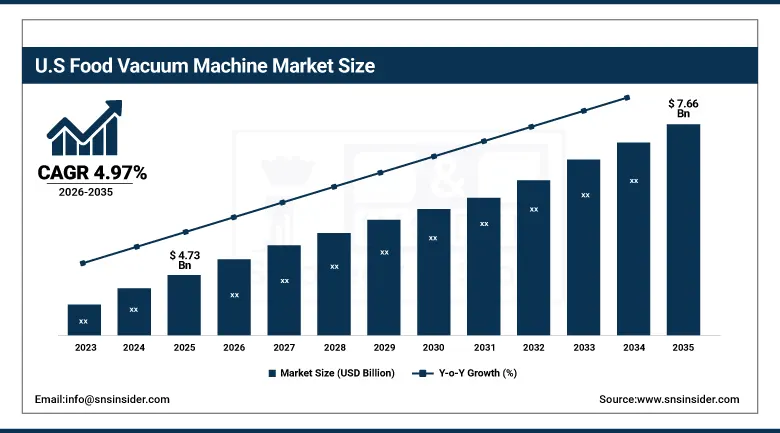
The U.S. Food Vacuum Machine Market was valued at USD 4.73 Billion in 2025 and is expected to reach USD 7.66 Billion by 2035, growing at a CAGR of 4.97%.
The United States of America emerges as the biggest national market in terms of sales of vacuum food machines due to the country's huge and very advanced food processing industry, its huge cold chain delivery infrastructure, and consistent high consumer expenditure on food safety and quality preservation products through commercial and residential markets. Meat processing plants of USA, among others, which contribute to very high per capita consumption rate in the country, create great demand for heavy-duty industrial chamber vacuum machines, thermoforming lines, and vacuum skin packaging machines, respectively.
Multivac Group announced in 2025 its expansion of its R 105 thermoforming packaging machine series designed specifically for the North American food market, featuring enhanced film tension control, hygienic design improvements, and digital connectivity modules enabling real-time production monitoring and remote diagnostic capabilities for food processors operating at scale.
Food Vacuum Machine Market Segment Analysis
-
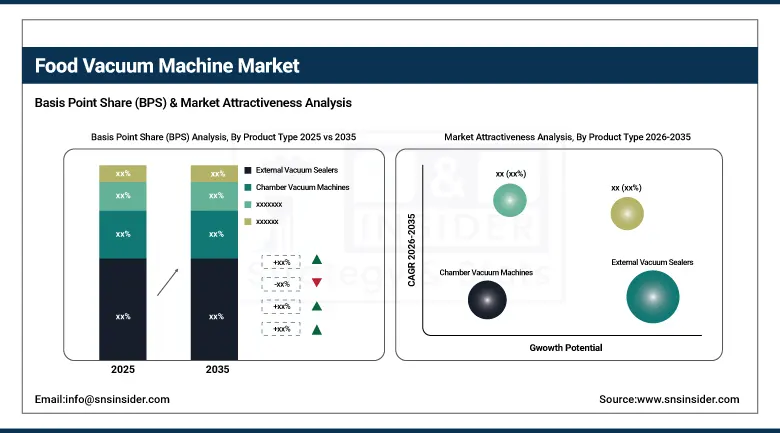
By Product Type, external vacuum sealers dominated the market with 34.15% share in 2025, while handheld vacuum sealers are the fastest growing product type with the highest CAGR of 6.69% from 2026 to 2035.
-
By Packaging Type, bags & pouches dominated the market with 45.68% share in 2025, while trays are the fastest growing packaging type with the highest CAGR of 6.02% from 2026 to 2035.
-
By Application, meat, poultry & seafood dominated the market with 38.46% share in 2025, while fruits & vegetables is the fastest growing application with the highest CAGR of 6.53% from 2026 to 2035.
-
By End User, food processing companies dominated the market with 40.24% share in 2025, while household/residential users are the fastest growing end user segment with the highest CAGR of 6.42% from 2026 to 2035.
By Product Type, external vacuum sealers dominate the food vacuum machine market, while handheld vacuum sealers are the fastest-growing segment.
External Vacuum Sealers segment dominated the market with the highest revenue share of approximately 34.15% in 2025 owing to the widespread use in both food processing plants and professional kitchens, where their combination of durability, efficiency of sealing, and low cost of purchasing compared to chamber machines has made them a favorite choice as the first-line vacuum packing system. The ability of external vacuum sealers to accommodate a variety of pouches in terms of size and material type, along with their compact size and ease of handling, has maintained strong demand for these systems among butcher shops, delis, caterers, and small to mid-size food producers around the world.
Handheld Vacuum Sealers segment is estimated to register the highest CAGR during the forecast period of 2026–2035, driven by the fast-growing trend of consumers recognizing the need to preserve their food at home, expanding online sales channels for kitchen appliances, and increasing affordability of consumer vacuum-sealing equipment. As a result of the growing demand to reduce the amount of wasted food, increase the time food can be stored in fridges and freezers, and preserve food prepared for meals, the demand for vacuum sealer units is growing steadily.
By Packaging Type, bags & pouches dominate the food vacuum machine market, while trays are the fastest-growing segment.
Bags & Pouches segment dominated the market with the largest revenue share of approximately 45.68% in 2025. Their attributes include universality, which means their suitability for all kinds of vacuum packing machines, adaptation to different types of products like meat slices, cheeses, vegetables, and ready-made meals, and the low cost of raw materials compared to rigid containers. The ongoing innovation in the field of multi-layered films that provide greater resistance against the transmission of oxygen and moisture is another factor that has cemented the popularity of flexible packs among high-end food packagers.
The segment of trays is expected to register the fastest CAGR over the forecast period from 2026-2035 due to the increasing popularity of the vacuum skin and modified atmosphere packaging formats for presenting foods in stores, which use rigid or semi-rigid trays that offer better visibility of the food, protection during transportation, and better shelf appeal. This is due to the rising popularity of ready-to-eat meals, as well as prepared and convenience foods, which utilize trays rather than pouches.
By Application, meat, poultry & seafood dominates the food vacuum machine market, while fruits & vegetables is the fastest-growing segment.
Meat, Poultry & Seafood segment emerged as the market leader with a dominant share of 38.46% in 2025, reflecting the paramount significance of vacuum packing technologies in ensuring the integrity of quality, safety, and presentation of highly perishable protein products. The cumulative impact of strict regulations on food safety for protein products, preference among consumers for longer storage time of chilled foods, and the export of vacuum-packed meat products sustain the extraordinarily high level of demand for vacuum packaging machinery in the processing of domestic as well as exported protein products.
Fruits & Vegetables segment is anticipated to record the fastest CAGR throughout the forecast period of 2026–2035, propelled by the growth in the fresh produce retailing industry, along with increased customer preference for packaged salads and vegetables and ready-to-eat fresh produce packs; and also because of the rising popularity of MAP vacuum packing among fresh produce packers looking to minimize shrinkage and enhance shelf-life. Increased awareness about health issues and the need for convenience when consuming fresh vegetables is boosting segment growth.
By End User, food processing companies dominate the food vacuum machine market, while household/residential users are the fastest-growing segment.
Food Processing Companies segment dominated the food vacuum machine market with the highest revenue share of 40.24% in 2025, reflective of the magnitude, frequency, and value of capital involved in equipment purchases by industrial food processors who employ vacuum packaging machinery as an integral part of their manufacturing process. With the convergence of factors like compliance, economies of scale, and technically proven vacuum packaging machinery, there will always be a steady flow of demand in the market from the food processing sector for vacuum packaging machinery and services.
Household/Residential Users segment is projected to register the highest CAGR during the forecast period of 2026–2035, fuelled by the rise of accessibility of vacuum sealing technology owing to the availability of affordable compact devices, consumer education about food preservation techniques, and continuous growth of online marketplaces that have increased consumer access to vacuum sealers, compounded by the effects of increasing food prices, awareness of reducing food waste at home, and consumer tendencies towards buying in bulk and preparing meals in advance, the residential vacuum sealer market size will continue to increase.
Regional Analysis
|
Region |
Major Country |
Share within Region, 2025 (%) |
|---|---|---|
|
North America |
United States |
86.54% |
|
Europe |
Germany |
31.46% |
|
Asia Pacific |
China |
36.45% |
|
Middle East & Africa |
UAE |
31.42% |
|
Latin America |
Brazil |
42.16% |
North America Food Vacuum Machine Market Insights
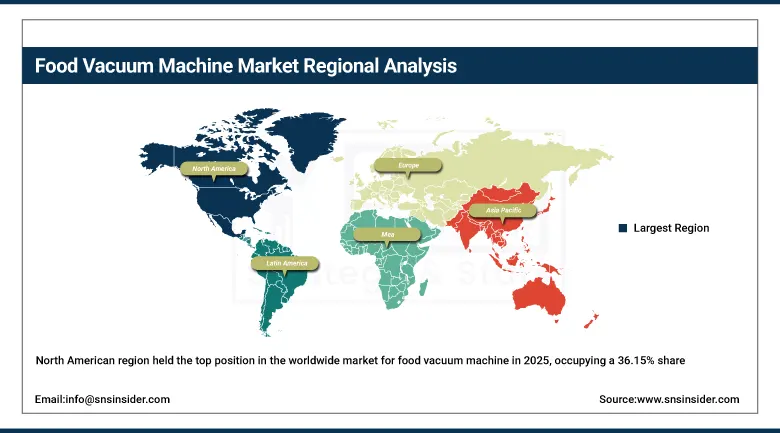
The North American region held the top position in the worldwide market for food vacuum machine in 2025, occupying a 36.15% share of the world revenue, with 86.54% of the region's revenue being contributed by the United States. Market dominance in the North American region is mainly supported by the dominant status of the United States as the largest economy in terms of food processing industry, which includes meat, poultry, fish and seafood, and dairy products. High investments in vacuum packaging machines are made due to their high level of adoption in this industrial sector. Moreover, North American food retail sector continuously enhances its vacuum packing technology according to the requirements of the shelf life and safety of the product.
The U.S. food processing industry represents one of the world's largest single-country food manufacturing sectors, with annual food and beverage manufacturing shipments exceeding USD 1 trillion, generating sustained high-volume demand for industrial vacuum packaging equipment across meat, dairy, produce, and prepared food categories.
Get Customized Report as per Your Business Requirement - Enquiry Now
Europe Food Vacuum Machine Market Insights
Europe represents the second-largest regional food vacuum machine market globally, sustained by a combination of stringent food safety regulations under EU framework directives, a strong tradition of high-quality packaged food production across Germany, France, Italy, Spain, the Netherlands, and the United Kingdom, and the presence of several globally leading vacuum packaging equipment manufacturers including Multivac, ULMA Packaging, and Webomatic within the region. Germany, as Europe's largest food processing economy and the home market of Multivac Group, the world's leading thermoforming packaging machine manufacturer, accounts for the largest national share of European food vacuum machine market revenues and serves as the innovation and export hub for European vacuum packaging equipment supply to global markets.
Europe's sustainability initiatives are accelerating adoption of advanced vacuum packaging systems, with more than 60% of food manufacturers actively transitioning toward recyclable or reduced-material vacuum packaging formats compatible with modern equipment.
Asia Pacific Food Vacuum Machine Market Insights
Asia Pacific is the fastest-growing regional food vacuum machine market, projected to grow at a CAGR of 5.91% through 2035, with China accounting for the dominant share of regional revenues as the world's largest food manufacturing economy continues to invest heavily in food processing modernization, cold chain infrastructure, and food safety compliance capabilities. China's government-driven food safety reform agenda, which has intensified inspection standards and packaging quality requirements across the food supply chain following high-profile food safety incidents, has accelerated the migration from manual and semi-automated food packaging operations toward fully automated vacuum packaging lines that deliver the consistent, validated performance required by both domestic regulators and international export market customers.
China's food processing industry comprises over 35,000 large-scale food manufacturing enterprises, creating substantial demand for industrial vacuum packaging equipment. China's food industry modernization, supported by the 14th Five-Year Plan, is driving demand for vacuum packaging equipment through investments in food safety, cold-chain infrastructure, and advanced processing technologies.
MEA & Latin America Food Vacuum Machine Market Insights
Middle East & Africa and Latin America can be considered commercially promising growth regions for companies producing food vacuum machines because of the rising number of organized retail food chains, investment in cold chain infrastructure development, and increased consumer preferences for hygienic packaging and shelf stability of food items in both urban and emerging markets. Leading in the revenue generation of the region is the UAE, owing to its highly developed food processing and export facilities, high expenditure of consumers on high-quality packaged foods, and investments in ensuring food safety across the retail and hospitality sectors, where vacuum packaging machines of an advanced standard are required. Leading the Latin American market is Brazil, owing to its extensive exports of beef and poultry products, requiring vacuum packaging.
Brazil exports more than 2 million tonnes of beef annually, with vacuum packaging serving as a critical technology for preserving product quality during long-distance shipments.
Market Dynamics
Growth Drivers: Food safety regulatory compliance and shelf-life extension demand
Structural Growth Drivers in the Case of the Food Vacuum Machine Market Include the Rising Regulatory and Commercial Pressure on Food Manufacturers, Retailers, and Food Service Providers to Meet Higher and Higher Standards of Compliance with Food Safety Norms That Explicitly Call for the Use of Validated Packaging Technologies That Can Efficiently Prevent Microbial Growth, Oxidation and Moisture Contamination During the Period of Distribution and Storage. Stringent Food Safety Laws that are being enacted in North America, Europe and major Asia Pacific economies such as those based on the FSMA requirements in the US, the EU Food Safety Framework Regulations and China's National Food Safety Standards have forced food manufacturers to deploy packaging technologies validated through rigorous testing.
Restraints: High capital investment requirements and technical complexity
The main challenge that the food vacuum machine industry faces is the need for considerable initial investments in the procurement of sophisticated machinery for thermoforming, tray sealing, and vacuum packing of products. These machines have high costs, and can be priced at hundreds of thousands or even more U.S. dollars depending on their sophistication and ability to integrate quality control systems and even connectivity features associated with Industry 4.0. In most developing economies, where food processing equipment might not be easily available, the high costs pose a huge barrier to uptake of such machines.
Opportunities: Smart packaging integration and emerging market cold chain expansion
The vacuum machine market is found at the intersection of two revolutionary business opportunities that hold considerable growth prospects for manufacturers and technology developers who have the right products to capitalize on them. Incorporating smart packaging technologies such as time-temperature indicators, freshness indicators, QR codes for product traceability, and active packaging into cutting-edge vacuum packaging machine systems provides a lucrative product development opportunity that will yield high premiums and strong customer loyalty from food manufacturers in need of unique packaging solutions for their premium retail and foodservice products. Increased cold-chain infrastructure, organized retail, and export food processing in emerging countries create a large demand for industrial vacuum packaging machines and certified packaging solutions.
Recent Developments:
-
2025: Multivac Group expanded its R 245 thermoforming packaging machine series with enhanced multi-format tooling flexibility, integrated vision system quality control, and OPC-UA data connectivity enabling seamless integration with Industry 4.0 manufacturing execution systems for large food processing customers.
-
2025: Sealed Air Corporation (CRYOVAC) introduced its Darfresh On Tray vacuum skin packaging platform with enhanced sustainability features including reduced film gauge capability and compatibility with recyclable mono-material tray substrates, addressing growing retail customer sustainability procurement requirements.
-
2026: ULMA Packaging launched its ARTIC thermoforming vacuum packaging machine with integrated modified atmosphere packaging capability, advanced hygienic design certification, and digital remote monitoring functions targeting fresh meat and seafood processors operating extended production runs.
-
2026: Henkelman Vacuum Systems introduced an expanded range of smart-connected chamber vacuum machines with integrated recipe management, production data logging, and remote diagnostics capabilities designed for artisan food producers and mid-scale food processing operations.
Food Vacuum Machine Market Key Players are:
-
Multivac Group
-
ULMA Packaging
-
Sealed Air Corporation (CRYOVAC)
-
GEA Group AG
-
Ishida Co. Ltd.
-
Henkelman Vacuum Systems
-
Henkovac International B.V.
-
Webomatic Maschinenfabrik GmbH
-
KOMET Maschinenfabrik GmbH
-
VAC-STAR AG
-
Sammic S.L.
-
Orved S.p.A.
-
Promarks Vacuum Packaging Machinery
-
Minipack-Torre S.p.A.
-
Sipromac Inc.
-
Boss Verpackungsmaschinen GmbH & Co. KG
-
Reiser (Ross Industries)
-
Fuji Machinery Co. Ltd.
-
Audion Elektro B.V.
-
Zhejiang Hongzhan Packing Machinery Co. Ltd.
Food Vacuum Machine Market Report Scope:
| Report Attributes | Details |
|---|---|
| Market Size in 2025 | USD 15.12 Billion |
| Market Size by 2035 | USD 25.06 Billion |
| CAGR | CAGR of 5.22% From 2026 to 2035 |
| Base Year | 2025 |
| Forecast Period | 2026-2035 |
| Historical Data | 2022-2024 |
| Report Scope & Coverage | Market Size, Segments Analysis, Competitive Landscape, Regional Analysis, DROC & SWOT Analysis, Forecast Outlook |
| Key Segments | • By Product Type (External Vacuum Sealers, Chamber Vacuum Machines, Handheld Vacuum Sealers, Tray Sealing Vacuum Machines, Thermoforming Vacuum Packaging Machines) • By Packaging Type (Bags & Pouches, Trays, Films, Containers) • By Application (Meat, Poultry & Seafood, Dairy Products, Fruits & Vegetables, Bakery & Confectionery, Ready-to-Eat Meals) • By End User (Food Processing Companies, Foodservice & Hospitality, Retail & Supermarkets, Household/Residential Users, Others) |
| Regional Analysis/Coverage | North America (US, Canada), Europe (Germany, UK, France, Italy, Spain, Russia, Poland, Rest of Europe), Asia Pacific (China, India, Japan, South Korea, Australia, ASEAN Countries, Rest of Asia Pacific), Middle East & Africa (UAE, Saudi Arabia, Qatar, South Africa, Rest of Middle East & Africa), Latin America (Brazil, Argentina, Mexico, Colombia, Rest of Latin America). |
| Company Profiles | Multivac Group, ULMA Packaging, Sealed Air Corporation (CRYOVAC), GEA Group AG, Ishida Co. Ltd., Henkelman Vacuum Systems, Henkovac International B.V., Webomatic Maschinenfabrik GmbH, KOMET Maschinenfabrik GmbH, VAC-STAR AG, Sammic S.L., Orved S.p.A., Promarks Vacuum Packaging Machinery, Minipack-Torre S.p.A., Sipromac Inc., Boss Verpackungsmaschinen GmbH & Co. KG, Reiser (Ross Industries), Fuji Machinery Co. Ltd., Audion Elektro B.V., Zhejiang Hongzhan Packing Machinery Co. Ltd. |

Frequently Asked Questions
The food vacuum machine market is expected to grow at a CAGR of 5.22% from 2026 to 2035.
The food vacuum machine market was valued at USD 15.12 Billion in 2025.
The primary growth factors include stricter food safety regulations, rising demand for longer food shelf life, and increasing adoption of automated and smart vacuum packaging technologies.
Handheld Vacuum Sealers is the fastest-growing product type in the food vacuum machine market.
North America dominated the food vacuum machine market in 2025, accounting for 36.15% of global revenues, with the United States representing 86.54% of North American revenues.
