
Wine Fining Agents Market Report Scope & Overview:
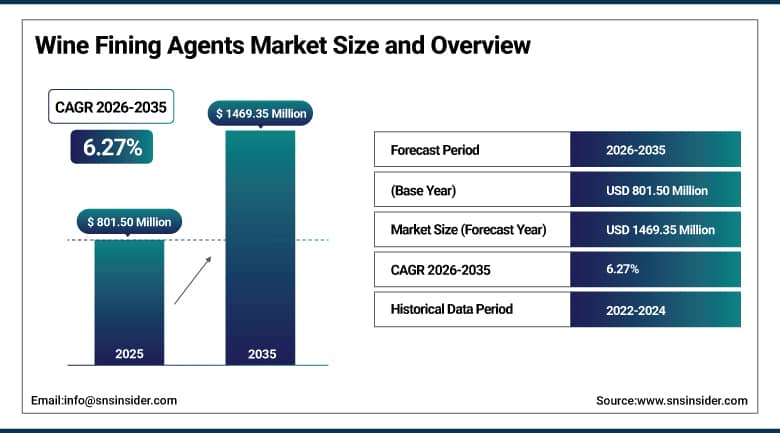
The Wine Fining Agents Market was valued at USD 801.50 million in 2025 and is expected to reach USD 1469.35 million by 2035, growing at a CAGR of 6.27% from 2026–2035.
The wine fining agents market is witnessing steady growth in the global market due to increasing wine production activities and quality improvement demand. Rising preference for clarified, stable, and premium wines is driving strong market expansion across wineries. Expanding usage of plant-based and vegan fining agents is significantly supporting market growth. Growing adoption in red, white, and sparkling wine production is further strengthening demand. Increasing urbanization and premium beverage consumption are boosting consumption of fining agent-based wine processing worldwide.
In the EU, wine production follows Regulation (EU) No 1308/2013 and delegated rules (EU 2019/934), which allow fining agents like bentonite, casein, egg albumin, plant proteins, and chitosan when approved under OIV standards. The OIV Code confirms these are “processing aids” used only to achieve clarity, stability, and sensory balance, with mandatory compliance to enological codex limits. Globally, OIV standards guide most countries, ensuring controlled and safe use of fining agents in winemaking.
To Get More Information On Wine Fining Agents Market - Request Free Sample Report
Wine Fining Agents Market Trends
-
Increasing use of plant-based fining agents is rising in wineries. Vegan alternatives like pea protein and bentonite are widely adopted for clean wine production.
-
Clean label wine demand is growing due to consumer preference for natural and low-additive products. Wineries are shifting toward transparent and simple processing methods.
-
Sustainable fining solutions are expanding as companies reduce animal-based inputs. Eco-friendly and biodegradable agents are gaining strong industry adoption globally.
-
Advanced filtration and hybrid fining technologies are improving efficiency. These systems reduce processing time while enhancing wine clarity and stability.
-
Premium wine consumption is increasing demand for high-quality fining agents. Producers focus on better taste, aroma retention, and visual appearance.
-
Food safety and wine regulations have an impact on fining procedures. Organizations including TTB and EU regulate wine processing additives.
The U.S. Wine Fining Agents Market Size Outlook.
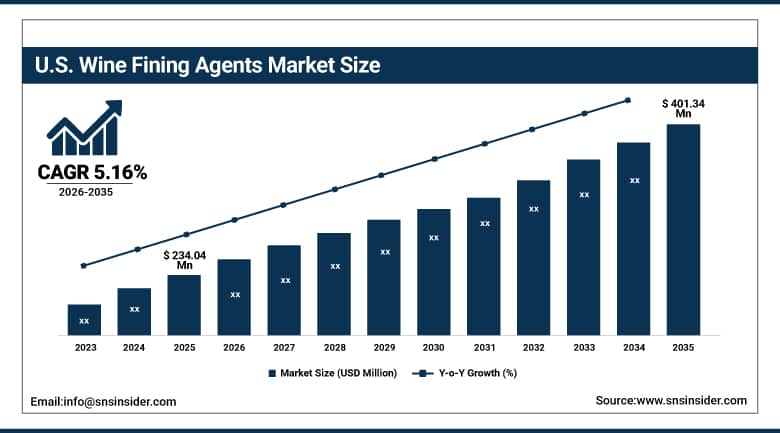
The U.S. Wine Fining Agents Market was valued at USD 234.04 million in 2025 and is expected to reach around USD 401.34 million by 2035, growing at a CAGR of 5.16% from 2026–2035.
In the U.S. the market for wine fining agents has been witnessing consistent expansion owing to high demand from the industries of wine production, beverages, and premium alcohol in the country. Consistent use of wine fining agents to produce quality, stable, and clear wines has been contributing to the growth observed in the market for wine fining agents. Development of wineries, along with the rising demand for premium wines, has been causing consistent consumption of the wine fining agent product range. The growing demand for organic and vegan wines has caused increased usage of wine fining agents derived from plants. Regulations established by the TTB ensure the quality and safety of wines produced in the United States.
In the USA, the wine industry manufactures about 647.7 million gallons of wine (2024). Almost 81% of the total production comes from California. The process of wine clarification requires around 18,000-22,000 metric tons of fining agents per year, which are primarily made up of bentonite. Bentonite is a popular fining agent due to its high efficiency in the removal of haze-producing proteins.
Wine Fining Agents Market Segment Analysis
-
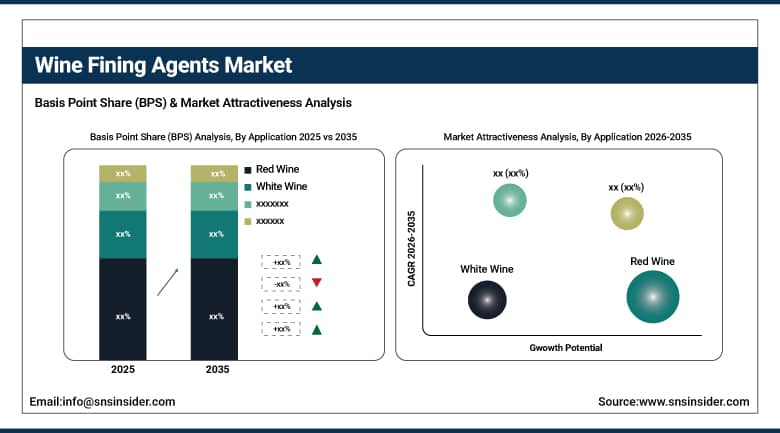
By Application, application dominated the wine fining agents market with 54.70% share in 2025; while white wine is the fastest growing segment with CAGR of 7.70% during 2026 to 2035.
-
By Form, liquid dominated the wine fining agents market with 61.30% share in 2025; while powder is the fastest growing segment with CAGR of 7.69% during 2026 to 2035.
-
By Source, plant-based fining agents stabilizers dominated the wine fining agents market with a 52.00% share in 2025, and it is also the fastest-growing segment with a CAGR of 8.29% during 2026–2035.
By Application, red wine dominated the wine fining agents market, while white wine is the fastest growing segment.
Red wine segment held a significant position in the wine fining agents market owing to higher production, increased use of fining agents for tannin removal and color stabilization, and high demand for aged wine. Red wine needs extensive fining to enhance flavor, aroma, and appearance. High consumption across the globe coupled with high-end positioning of products helps it retain dominant market share.
White wine was anticipated to witness fastest growth rate during 2026-2035 due to increasing preferences for light alcohol drinks. Effective fining process is needed to stabilize proteins and make white wine more attractive in appearance. Higher adoption of vegan fining agents, along with clean label processing, is contributing to its growth. Increasing demand for white wine in premium hospitality and lifestyle consumptions is another factor driving its growth.
By Form, liquid form dominated the wine fining agents market, while powder form is the fastest growing segment.
Liquid form segment holds the dominated share of revenues in the wine fining agents market in 2025. The reason behind the popularity is that it offers easier solubility, faster mixing, and uniform distribution. It is highly favored by wine producers due to ease of usage and efficiency in wine production processes. It takes less time for preparation and provides control over the dosage applied during winemaking processes. High level of acceptance by commercial wineries helps in retaining leadership in the market.
Powder form segment is likely to register a fastest CAGR during 2026-2035. Longer shelf life, low transportation costs, and convenient storage options contribute to its fast growth rate. Fining agents in powder form provide greater flexibility and can be used in small or medium-sized wineries. High levels of demand for affordable and efficient wine processing solutions drive its adoption. Its increasing usage in developing markets helps achieve faster growth rates in the market.
By Source, plant-based fining agents dominated the wine fining agents market and are also the fastest-growing segment.
Plant-based fining agents segment accounted for the dominated revenue share in the Wine Fining Agents Market, attributed to increasing consumer inclination towards making vegan and allergen-free wines. Plant-based proteins such as pea and potato proteins have been witnessing an increased preference in wineries as they are considered safe for wine clarification. The growing trend of making clean label and sustainable wines is positively influencing market growth.
It is also projected to register the fastest CAGR from 2026 to 2035 on account of increasing consumer inclination towards ethical consumption of wines, which is in turn raising the number of consumers adopting animal-free wine processing practices. Growing awareness about animal-free wine processing techniques and improvements in technology related to the extraction of plant proteins are further contributing towards rapid product adoption.
Regional Analysis
|
Region |
Major Country |
Share within Region, 2025(%) |
|---|---|---|
|
North America |
United States |
83.40% |
|
Europe |
Germany |
31.25% |
|
Asia Pacific |
China |
34.80% |
|
Middle East & Africa |
UAE |
9.55% |
|
Latin America |
Brazil |
11.95% |
North America Wine Fining Agents Market Insights.
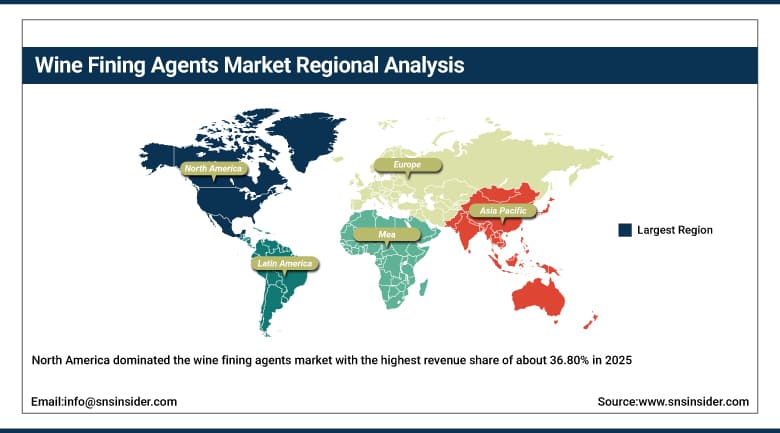
North America dominated the wine fining agents market with the highest revenue share of about 36.80% in 2025 due to strong wine production activities and premium beverage demand. The region benefits from advanced winery infrastructure, high adoption of plant based fining agents, and strict food quality regulations. Strong presence of key wine producers and technological processing systems further supports market expansion across the United States and Canada. Rising consumption of premium and organic wines is accelerating fining agent usage across wineries.
As per the Institute in the USA, approximately 85% of the total volume of wine made in the USA is produced in California. The use of fining agents is essential for the clarification and stabilization of wines in North America, as indicated by the CFIA of Wine Institute Canada.
Get Customized Report as Per Your Business Requirement - Enquiry Now
Europe Wine Fining Agents Market Insights.
Europe accounts for a considerable share in the wine fining agents market in 2025 owing to strong wine production heritage and strict quality standards. Countries such as France, Germany, Italy, and Spain are key contributors to market demand. Growing consumption of premium wines and organic certifications is supporting steady market growth across the region. Advanced winery practices and sustainable production regulations are further strengthening adoption of fining agents in Europe.
Regulation (EU) 2018/848 of the EU encourages sustainable and organic wine making process, thus creating high demand for vegetable fining materials. Such companies as Laffort S.A.S. and Enartis S.r.l. have been developing innovative methods of vegan wine clarification. It should be mentioned that the European Commission ensures food safety standards and wine quality standards.
Asia Pacific Wine Fining Agents Market Insights.
Asia Pacific holds a strong growth position in the wine fining agents market in 2025 with CAGR of about 8.17% due to rising wine consumption and expanding middle class population. Countries such as China, India, Japan, and Australia are major demand centers. Increasing urbanization, premium beverage adoption, and growing winery investments are driving usage of fining agents across the region. Expanding domestic wine production is further supporting market growth in emerging economies.
Based on the OIV (International Organisation of Vine and Wine), China, Japan, Australia, have seen rising wine production and stabilization, causing a rise in the demand for fining materials like bentonite and protein. Beverage processing data based on FAO guidelines also reveals that there is an impressive growth in the utilization of beverage clarifiers in Asia Pacific owing to the development of modern wine-making facilities. Wine additives have been increased due to government-supported trade deals such as Japan-EU EPA.
Middle East & Africa and Latin America Wine Fining Agents Market Insights.
Middle East & Africa region and Latin America region are experiencing gradual growth in the wine fining agents market in 2025 due to increasing urbanization and rising premium beverage consumption. Countries including UAE, South Africa, Brazil, and Mexico are key contributors. Expanding hospitality sectors and imported wine consumption are supporting demand for fining agents across these regions. Growth in retail distribution and wine trade is further driving market expansion.
According to the OIV, South America makes up 14% of the world’s wine. Among others, Argentina and Chile lead wine production in South America. Wine production and consumption in Brazil is on the rise, while South Africa remains the major wine producing country in Africa. Regulatory bodies such as Wines of Chile and INV Argentina encourage quality winemaking leading to high demand for natural clarification materials.
Market Dynamics
Growth Drivers: Expansion of Plant-Based and Allergen-Free Fining Solutions in Sustainable Winemaking Practices
A higher consumer demand for organic, vegan, allergen-free, and sustainable wines is revolutionizing their production methods. This is because there is a shift from using animal products in fining to using plant fining agents like pea protein, bentonite, and activated carbon. This shift is being motivated by the increasing regulations in Europe, South America, and in the premium wine industry concerning clean-labeling and vegan certifications. Sustainability efforts made by winemakers are creating new environmentally friendly clarifying methods.
According to the recent market analysis, around 54 percent of the total worldwide plant fining consumption is because of the vegan trend as well as the adoption of clean label ingredients. Bentonite is still the preferred type of plant fining employed by the industry, whereas the amount of pea protein always remains 20 g/hL.
Restraints: Regulatory Restrictions on Animal-Derived Fining Agents and Supply Chain Limitations Affecting Market Consistency
The restrictions imposed by certain countries when it comes to the use of fining agents such as casein, gelatin, and isinglass have been brought about by stringent policies in regard to safety issues and labeling issues. Such include the stringent requirement for vegan labeling, as well as labeling concerning possible food allergies. One more issue that serves as an obstacle to constant production is the inconsistency in the supply chain process when producing with the use of natural fining agents.
Opportunities: Growth of Vegan and Clean-Label Wine Consumption Creating Strong Demand for Innovative Fining Solutions
There will be emerging possibilities in the field of vegan and clean-label wine consumption that will present an opportunity for fining agents' producers. Nowadays consumers look for vegan wines that do not require any processing agents derived from animals. It means that wine producers start to use organic and plant-based fining agents, and the number of certifications of vegan and sustainable wines continues to grow across the globe. There has been a growing innovation in bio-based clarifying agents that improve the efficiency of wine production and ensure that the sensory characteristics remain intact.
The latest Trends in the wine fining agents market include the tendency towards manufacturing vegan and clean-label wines, which shows a consistent trend towards replacing animal fining agents such as gelatin and casein with plant-based alternatives. The global wine production reached 258 million hectoliters in 2024. Clean-label trends have also been fueled by food label regulations established by the EU.
Recent Developments
-
2026: Lallemand Inc. expanded yeast-derived fining and clarification solutions, supporting the shift toward clean-label and vegan winemaking, improving wine stability and reducing reliance on animal-based fining agents across global wineries
-
2026: Novozymes A/S advanced enzyme-based wine clarification systems, enhancing protein removal efficiency and improving filtration performance in large-scale wine production, supporting sustainable and chemical-reduced oenology processes.
-
2025: Enartis S.r.l. strengthened its integrated oenological fining portfolio, combining bentonite, plant proteins, and activated carbon solutions to improve clarity, reduce haze formation, and support consistent wine sensory profiles.
-
2024: Kerry Group plc developed clean-label ingredient systems applicable to beverage and wine processing, supporting the rising demand for allergen-free and plant-based fining alternatives in global wine manufacturing
Wine Fining Agents Market Key Players are:
-
Lallemand Inc.
-
Enartis S.r.l.
-
AEB Group S.p.A.
-
Laffort S.A.S.
-
Scott Laboratories Inc.
-
E. & J. Gallo Winery
-
BASF SE
-
Kerry Group plc
-
GELITA AG
-
Ashland Inc.
-
Merck KGaA
-
International Flavors & Fragrances Inc.
-
CP Kelco U.S., Inc.
-
Novozymes A/S
-
Oenobrands SAS
-
Erbslöh Geisenheim GmbH
-
Angel Yeast Co., Ltd.
-
Institut Œnologique de Champagne (IOC)
-
FMC Corporation
-
Chr. Hansen Holding A/S
Wine Fining Agents Market Report Scope:
| Report Attributes | Details |
|---|---|
| Market Size in 2025 | USD 801.50 Million |
| Market Size by 2035 | USD 1469.35 Million |
| CAGR | CAGR of 6.27% From 2026 to 2035 |
| Base Year | 2025 |
| Forecast Period | 2026-2035 |
| Historical Data | 2022-2024 |
| Report Scope & Coverage | Market Size, Segments Analysis, Competitive Landscape, Regional Analysis, DROC & SWOT Analysis, Forecast Outlook |
| Key Segments | • By Application (Red Wine, White Wine, Sparkling Wine, Dessert Wine, Food, Beverages & Nutrition) • By Form (Liquid, Powder, Granular) • By Source (Animal-Based Fining Agents, Plant-Based Fining Agents, Synthetic Fining Agents) |
| Regional Analysis/Coverage | North America (US, Canada), Europe (Germany, UK, France, Italy, Spain, Russia, Poland, Rest of Europe), Asia Pacific (China, India, Japan, South Korea, Australia, ASEAN Countries, Rest of Asia Pacific), Middle East & Africa (UAE, Saudi Arabia, Qatar, South Africa, Rest of Middle East & Africa), Latin America (Brazil, Argentina, Mexico, Colombia, Rest of Latin America). |
| Company Profiles | Lallemand Inc., Enartis S.r.l., AEB Group S.p.A., Laffort S.A.S., Scott Laboratories Inc., E. & J. Gallo Winery (Wine making & treatment division relevance), BASF SE, Kerry Group plc, GELITA AG, Ashland Inc., Merck KGaA, International Flavors & Fragrances Inc., CP Kelco U.S., Inc., Novozymes A/S, Oenobrands SAS, Erbslöh Geisenheim GmbH, Angel Yeast Co., Ltd., Institut Œnologique de Champagne (IOC), FMC Corporation, Chr. Hansen Holding A/S |
Frequently Asked Questions
The wine fining agents market is expected to grow at a CAGR of 6.27% from 2026 to 2035.
The wine fining agents market was valued at USD 801.50 million in 2025.
Rising demand for premium, stable wines and vegan fining agents is driving growth. Clean label trends and expanding wine production further support demand.
The Plant-Based Fining Agents segment dominated the market in 2025 due to strong demand for vegan wines, allergen free processing, and sustainable winemaking practices.
North America dominated the market in 2025 due to strong wine production, advanced winery infrastructure, and high consumption of premium and organic wines.
