
CMO/CDMO Market Report Scope & Overview:
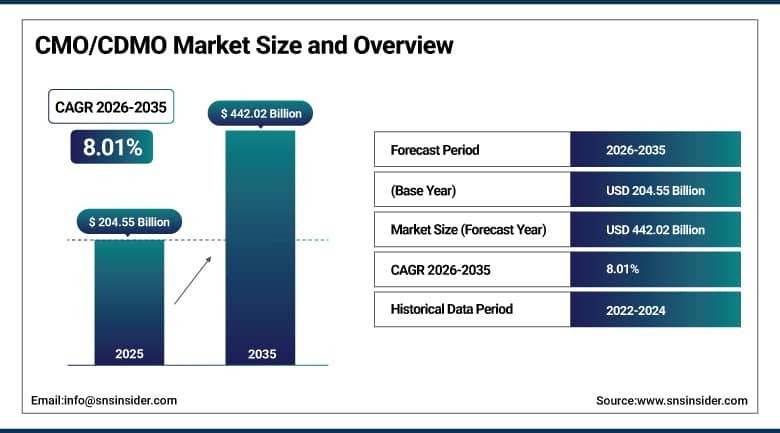
The CMO/CDMO Market was valued at USD 204.55 Billion in 2025 and is expected to reach USD 442.02 Billion by 2035, growing at a CAGR of 8.01% from 2026-2035.
The CMO/CDMO Market is growing as drug developers hand more development and manufacturing work to specialist partners. Contract manufacturers produce active ingredients, finished dosage forms and sterile products, while contract development and manufacturing organizations add process development, analytics and clinical supply. Biologics, biosimilars, GLP-1 drugs and cell and gene therapies are raising demand for complex capacity. Biotech companies without plants rely on partners from early trials to launch. Large pharmaceutical firms outsource peak demand and specialty steps to stay flexible.
⮞In its 2025 year-end summary, the U.S. Food and Drug Administration reported that its Center for Drug Evaluation and Research approved 46 novel drugs in 2025. Each approval needs commercial supply, and many sponsors rely on contract partners for it.
To Get More Information On CMO/CDMO Market - Request Free Sample Report
CMO/CDMO Market Trends:
-
Capacity expansion for biologics, antibody-drug conjugates and GLP-1 products
-
Sterile fill-finish and drug-product investments
-
Supply chain diversification away from single-country concentration
-
Integrated development-to-commercial partnerships
-
Acquisitions of plants from large pharmaceutical companies
U.S. CMO/CDMO Market Outlook:
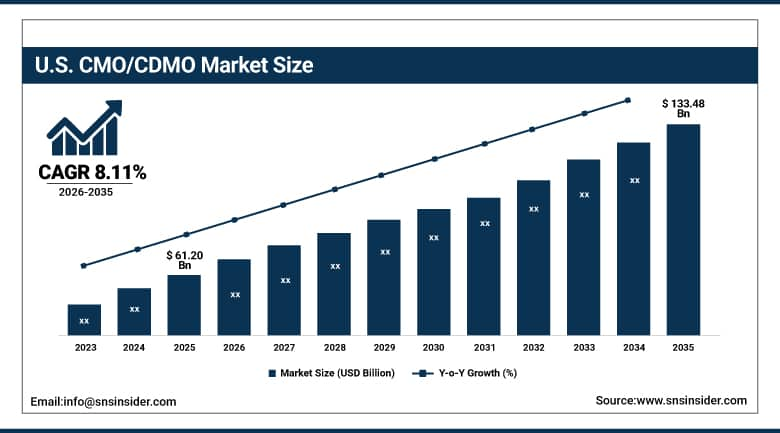
The U.S. CMO/CDMO Market was valued at USD 61.20 Billion in 2025 and is expected to reach USD 133.48 Billion by 2035, growing at a CAGR of 8.11% from 2026-2035.
The U.S. CMO/CDMO Market is the largest national market, supported by the world's largest biotech sector, high drug launch activity and strong venture funding for new modalities. Sponsors use U.S. sites for clinical supply and commercial launches.Federal policy is encouraging onshoring of drug manufacturing, and recent legislation limits work with certain foreign providers. Tariffs on imported patented drugs and ingredients are shifting supply decisions. Labor and facility costs are high.
⮞In September 2025, PhRMA said its member companies were delivering $500 billion in new U.S.-based manufacturing and infrastructure investment. Onshoring plans increase demand for local capacity, including contract partners.
CMO/CDMO Market Segment Analysis:
-
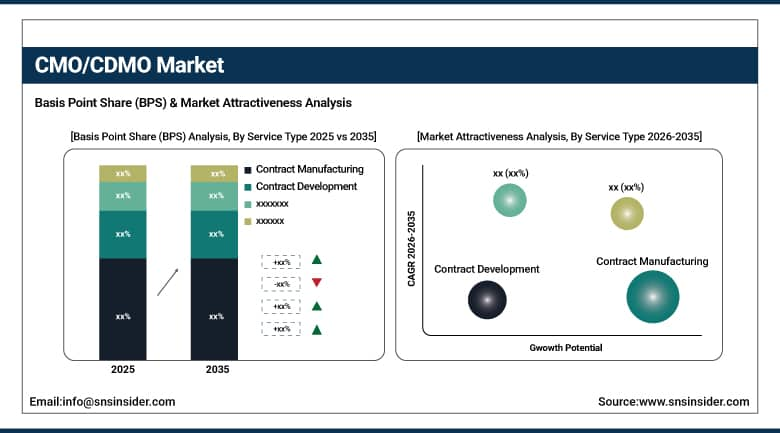
By Service Type, the Contract Manufacturing segment dominated the CMO/CDMO Market with approximately 59.19% share in 2025, while the Contract Development segment is the fastest growing with a CAGR of approximately 10.51%.
-
By Molecule Type, the Small Molecules segment dominated the CMO/CDMO Market with approximately 52.50% share in 2025, while the Biologics segment is the fastest growing with a CAGR of approximately 8.91%.
-
By End User, the Big Pharma segment dominated the CMO/CDMO Market with approximately 42.00% share in 2025, while the Small and Mid-Sized Pharma and Biotech segment is the fastest growing with a CAGR of approximately 9.51%.
-
By Development Phase, the Phase III segment dominated the CMO/CDMO Market with approximately 31.90% share in 2025, while the Phase II segment is the fastest growing with a CAGR of approximately 8.31%.
By Service Type, Contract Manufacturing Dominates the CMO/CDMO Market and Contract Development Grows Fastest
Contract manufacturing leads because producing active ingredients, finished doses and sterile products at commercial scale is the largest and most repeated part of the work. Sponsors sign multi-year supply agreements, and plants run continuously once a product launches. Capacity, quality records and regulatory approvals make established sites hard to replace. Long qualification periods mean sponsors rarely switch suppliers once a process is validated, which protects utilization at large plants.
Contract development grows fastest as biotech companies outsource process development, analytical methods, formulation and clinical supply to move candidates quickly. Early partnerships often lead to commercial manufacturing, so providers invest in integrated offers. Complex modalities need specialist know-how that small sponsors do not have. Providers that combine development and manufacturing under one quality system shorten timelines and win follow-on supply contracts.
⮞In July 2025, the Government of India told parliament that its bulk drug production-linked incentive scheme had recorded cumulative sales of about USD 218 million through March 2025, including about USD 55 million of exports. Incentive schemes are building active ingredient capacity in new locations.
By Molecule Type, Small Molecules Dominates the CMO/CDMO Market and Biologics Grows Fastest
Small molecules lead because most approved medicines and most generic volumes are chemical drugs. Established synthesis routes, large batch sizes and global demand keep contract plants busy. Many sponsors outsource ingredient production for cost and regulatory reasons, and long product lives support steady contracts. Process improvements, solvent recovery and continuous chemistry are helping providers defend margins in this mature area.
Biologics grow fastest as antibodies, biosimilars, RNA therapies and cell and gene therapies move into late-stage trials and launch. They need specialized bioreactors, purification, fill-finish and strict quality control, so many sponsors prefer contract partners. Capacity for large-scale cell culture remains in demand. Single-use systems and higher-titer processes are changing plant designs, and sponsors increasingly request flexible suites that can switch between products.
⮞In April 2026, the Korean biopharma publication BioSpectrum Asia reported that South Korea's drug regulator has approved more than 70 biosimilars since 2012, including 18 in 2024. Biosimilar approvals are widening demand for biologic manufacturing capacity.
By End User, Big Pharma Dominates the CMO/CDMO Market and Small and Mid-Sized Pharma and Biotech Grows Fastest
Big pharma leads because the largest companies place the highest volumes of ingredient, dose and packaging work and sign long-term agreements. They outsource to add capacity for launches, balance plant loads and access specialist technology. Their supplier audits and quality standards shape the industry. Preferred-provider programs concentrate volumes with a small group of qualified partners, which rewards scale and consistent inspection records.
Small and mid-sized pharma and biotech grow fastest because most of these companies have no plants and depend on partners from preclinical studies through launch. New modalities come from start-ups that need flexible, small-batch capacity. Funding cycles affect timing, but the long-term shift to virtual models continues. Providers respond with smaller minimum batch sizes, milestone-based pricing and project teams assigned to each client.
⮞In 2025, the Association for Accessible Medicines reported that generic drugs accounted for 90% of U.S. prescriptions, about 3.9 billion against 435 million for brands. High-volume generic supply continues to rely on contract and specialty producers.
By Development Phase, Phase III Dominates the CMO/CDMO Market and Phase II Grows Fastest
Phase III leads because late-stage trials need large batches for many patients and sponsors must lock in commercial-scale processes before filing. Validation lots, stability studies and technology transfer generate high-value work. Partners chosen at this stage often continue into commercial supply. Because comparability and validation work is costly to repeat, late-stage choices carry weight for the full product life cycle.
Phase II grows fastest as a large pipeline of biotech candidates moves from early safety studies to efficacy trials. Sponsors outsource clinical supply, analytics and process improvements to keep programs moving on tight budgets. Cell and gene therapy and RNA programs add demand for specialized suites. Clinical supply networks across several regions are also needed to support multinational trials.
⮞In December 2025, the World Health Organization issued its first global guideline on GLP-1 medicines for obesity and said obesity affects more than 1 billion people. Late-stage demand for these drugs is increasing manufacturing needs.
Regional Analysis:
|
Region |
Major Country |
Share within Region, 2025 (%) |
|---|---|---|
|
North America |
U.S. |
88.00 |
|
Europe |
Germany |
21.50 |
|
Asia Pacific |
China |
34.10 |
|
Latin America |
Brazil |
46.00 |
|
Middle East & Africa |
Saudi Arabia |
27.00 |
North America CMO/CDMO Market Insights
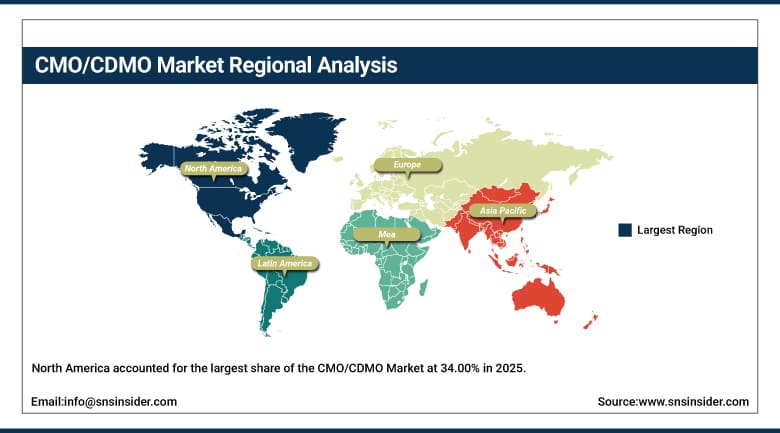
North America accounted for the largest share of the CMO/CDMO Market at 34.00% in 2025, led by the United States and followed by Canada. The region has the largest biotech sector, high drug launch activity and strong funding for new modalities. Sponsors use local sites for clinical supply and commercial launches. Fill-finish, antibody and gene therapy capacity is concentrated in Massachusetts, North Carolina, California and New Jersey.
Federal policy favors onshoring, and the BIOSECURE Act restricts work with certain foreign providers, which is moving programs to local and allied sites. High costs and labor shortages limit new plant construction, and tariff rules add uncertainty to cross-border supply. Canada is positioning itself as a lower-cost option for clinical and early commercial biologics.
⮞In March 2025, the Government of Canada supported a 103,000 square foot biomanufacturing facility in Edmonton through its Strategic Innovation Fund. Public funding is adding contract-ready capacity in Canada.
Get Customized Report as Per Your Business Requirement - Enquiry Now
Asia Pacific CMO/CDMO Market Insights
Asia Pacific held about 31.60% of the CMO/CDMO Market in 2025 and is projected to be the fastest growing region, at a CAGR of 10.27% over 2026-2035. China, India, South Korea, Japan and Singapore lead. Skilled chemists, large capacity and lower costs attract global sponsors. Singapore and Japan add advanced biologics and cell therapy capability, while South Korea has built some of the largest single-site antibody plants.
Indian providers lead in small molecule ingredients and are expanding in biologics, while South Korea builds large-scale antibody capacity and China hosts integrated development platforms. Geopolitical risk and US restrictions push sponsors to diversify, which also benefits India and Singapore. Sponsors increasingly pair a China or India site with a second source elsewhere in the region.
⮞In 2025, China's National Medical Products Administration approved 120 new drugs, including 80 conventional drugs and 40 biologics, according to a DIA Global Forum review. A large local pipeline is raising local demand for contract capacity.
Europe CMO/CDMO Market Insights
Europe held about 24.40% of the CMO/CDMO Market in 2025, led by Switzerland, Germany, Ireland, the United Kingdom and Italy. The region has large biologics plants, strong sterile manufacturing and specialist providers of complex chemistry. Switzerland hosts leading ingredient and biologics operations, and Ireland draws large investments in sterile and biologics plants.
Providers are acquiring sites from large pharmaceutical companies and expanding fill-finish lines. Strict quality standards support premium work, while energy costs and wage levels raise operating expenses. Pricing reforms and supply security policies are reshaping medicine supply chains. Spain and Italy have built competitive fill-finish and antibiotic production bases.
⮞In June 2026, the European Medicines Agency reported that 104 human medicines were recommended for authorization in 2025, 38 of them with a new active substance. A steady flow of approvals supports commercial supply contracts.
MEA & Latin America CMO/CDMO Market Insights
Latin America and the Middle East and Africa together hold about 10.00% of the CMO/CDMO Market. In Latin America, Brazil, Mexico, Argentina and Colombia lead, driven by local production requirements for public health programs and growth in biosimilars. Brazil's partnership programs link public laboratories with private producers to transfer technology for local manufacture.
In the Middle East and Africa, Saudi Arabia, the United Arab Emirates, Egypt and South Africa lead. Gulf states are funding local drug manufacturing to reduce import reliance, while limited technical talent and regulatory capacity restrain growth in much of Africa. South Africa and Morocco are building vaccine and finished-dose capacity to serve regional needs.
⮞In September 2025, a GaBI journal review reported that Brazil's regulator ANVISA had approved 67 biosimilars. A growing biosimilar base supports demand for local and contract manufacturing.
Market Dynamics:
Growth Drivers: Biologics Pipeline Growth and Supply Chain Security Policies Drive Growth in the CMO/CDMO Market
Biologics pipeline growth is the main driver. Antibodies, antibody-drug conjugates, GLP-1 drugs, RNA therapies and cell and gene therapies are entering late-stage trials and launches, and they need specialized capacity that few sponsors own. Biotech start-ups outsource nearly all production, which keeps contract partners busy. Demand for viral vector, plasmid and lipid nanoparticle capacity is rising along with it.
Supply chain security policies add momentum. Governments want medicines made closer to home or in trusted countries, and new laws restrict work with some foreign suppliers. Sponsors are dual-sourcing and moving programs to new sites, creating work for providers in the United States, Europe, India and Singapore. Technology transfers between sites are becoming routine as a result.
⮞In December 2025, the BIOSECURE Act became law as part of the fiscal year 2026 National Defense Authorization Act, with a list of companies of concern due within one year. The law is reshaping supplier choices for US sponsors.
Restraints: Tariffs and Capacity Bottlenecks Restrain Growth in the CMO/CDMO Market
Tariffs restrain growth. New duties on imported patented drugs and ingredients raise costs and force sponsors to rethink where they manufacture. Uncertainty over rates and exemptions delays contracts, and providers must invest in local capacity without knowing future demand. Contract terms increasingly include clauses that share tariff costs between sponsors and providers.
Capacity bottlenecks add limits. Sterile fill-finish lines, large-scale bioreactors and highly potent suites are in short supply, and new plants take years to build and qualify. Skilled labor shortages and quality problems at some sites, including regulatory warning letters, slow output and make sponsors cautious. Lead times for specialized equipment such as isolators and filling machines also extend project schedules.
⮞On 2 April 2026, a US presidential proclamation under Section 232 set a 100% duty on patented drugs and ingredients from companies without pricing or onshoring deals, with 15% rates for the European Union, Japan and South Korea. Tariffs add cost and uncertainty to cross-border supply.
Opportunities: Biosimilar Expansion and Government Manufacturing Incentives Create Opportunities in the CMO/CDMO Market
Biosimilar expansion offers a major opportunity. Patents on many biologic drugs are expiring, and regulators are streamlining approval of copies. Developers in emerging markets often lack plants and turn to contract partners for cell culture, purification and filling, creating demand for flexible biologics capacity. Technology transfer packages and local regulatory support are becoming part of the service offer.
Government manufacturing incentives offer further potential. Countries including India, Singapore, Japan and the United States are funding new plants, trial networks and workforce training. Providers that win incentives can add capacity at lower risk, and sponsors benefit from more locations to diversify supply. Workforce training programs tied to these incentives also ease a persistent shortage of skilled operators.
⮞In February 2026, India's Union Budget announced the Biopharma SHAKTI initiative of about USD 1.2 billion over five years for biologics and biosimilars, with more than 1,000 accredited clinical trial sites. Public funding is widening the base for biologics production.
Recent Developments:
-
In September 2026, Samsung Biologics signed a USD 262.18 million manufacturing contract with a European pharmaceutical company, running through 31 December 2033. The deal lifts its cumulative order total to about USD 21.9 billion.
-
In May 2026, Siegfried completed the acquisition of three drug substance sites in Wilmington, Athens and Westbury in Australia. The company said the sites add about USD 100 million of expected 2026 sales.
-
In June 2026, Recipharm announced a multi-million-dollar investment in sterile fill-finish capacity in the United States. The investment follows a clinical fill-finish agreement and targets biologics and advanced therapies.
CMO/CDMO Market Key Players:
-
Lonza Group AG
-
Samsung Biologics Co., Ltd.
-
WuXi Biologics (Cayman) Inc.
-
WuXi AppTec Co., Ltd.
-
FUJIFILM Diosynth Biotechnologies
-
Siegfried Holding AG
-
Piramal Pharma Solutions
-
Divi's Laboratories Limited
-
Sai Life Sciences Limited
-
Pharmaron Beijing Co., Ltd.
-
Jubilant Pharmova Limited
-
Curia Global, Inc.
-
Recipharm AB
-
Syngene International Limited
-
Thermo Fisher Scientific Inc. (Patheon)
CMO/CDMO Market Report Scope:
| Report Attributes | Details |
|---|---|
| Market Size in 2025 | USD 204.55 Billion |
| Market Size by 2035 | USD 442.02 Billion |
| CAGR | CAGR of 8.01% From 2026 to 2035 |
| Base Year | 2025 |
| Forecast Period | 2026-2035 |
| Historical Data | 2022-2024 |
| Report Scope & Coverage | Market Size, Segments Analysis, Competitive Landscape, Regional Analysis, DROC & SWOT Analysis, Forecast Outlook |
| Key Segments | • By Service Type (Contract Manufacturing and Contract Development) • By Molecule Type (Small Molecules and Biologics) • By End User (Big Pharma, Small and Mid-Sized Pharma and Biotech, and Generic Pharma) • By Development Phase (Preclinical, Phase I, Phase II, Phase III, and Commercial) |
| Regional Analysis/Coverage | North America (US, Canada), Europe (Germany, UK, France, Italy, Spain, Russia, Poland, Rest of Europe), Asia Pacific (China, India, Japan, South Korea, Australia, ASEAN Countries, Rest of Asia Pacific), Middle East & Africa (UAE, Saudi Arabia, Qatar, South Africa, Rest of Middle East & Africa), Latin America (Brazil, Argentina, Mexico, Colombia, Rest of Latin America). |
| Company Profiles | Lonza Group AG, Samsung Biologics Co., Ltd., WuXi Biologics (Cayman) Inc., WuXi AppTec Co., Ltd., FUJIFILM Diosynth Biotechnologies, Siegfried Holding AG, Piramal Pharma Solutions, Divi's Laboratories Limited, Sai Life Sciences Limited, Pharmaron Beijing Co., Ltd., Jubilant Pharmova Limited, Curia Global, Inc., Recipharm AB, Syngene International Limited, Thermo Fisher Scientific Inc. (Patheon) |

Frequently Asked Questions
Key players include Lonza, Samsung Biologics, WuXi Biologics, WuXi AppTec, FUJIFILM Diosynth Biotechnologies, Siegfried, Piramal Pharma Solutions, Divi's Laboratories, Sai Life Sciences, Pharmaron, Jubilant Pharmova, Curia, Recipharm, Syngene and Thermo Fisher Scientific (Patheon).
Key opportunities include biosimilar expansion, government manufacturing incentives, sterile fill-finish and advanced therapy capacity, and fast-growing Asia Pacific demand.
Growth of biologics and other complex drug pipelines, together with policies that diversify medicine supply chains, is the main growth factor.
By Service Type, the Contract Manufacturing segment dominated the market in 2025 with an estimated 59.19% share, supported by long-term commercial supply agreements.
North America dominated the market with a share of 34.00% in 2025, driven by the largest biotech sector and high drug launch activity.
