
Coaxial Cable Market Report Scope & Overview:
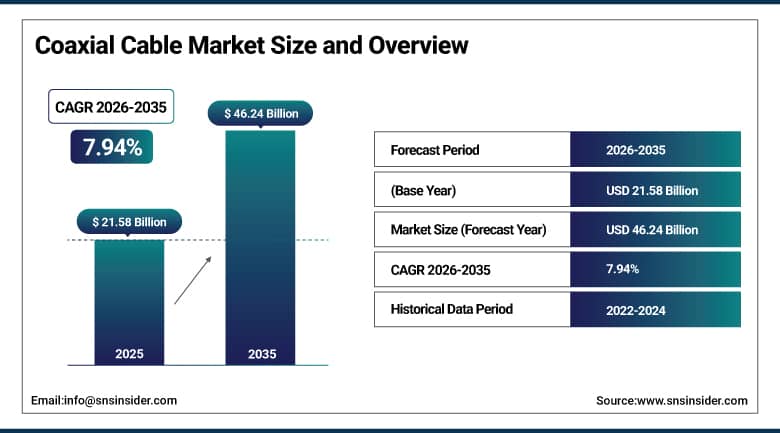
The Coaxial Cable Market was valued at USD 21.58 billion in 2025 and is expected to reach USD 46.24 billion by 2035, growing at a CAGR of 7.94% from 2026–2035.
The coaxial cable market is witnessing steady growth in the global market owing to the expansion of broadband and cable television networks worldwide. The rising demand for high-speed internet connectivity is promoting the usage of coaxial cables in telecom and data transmission applications. Investments made by organizations in 5G infrastructure and hybrid fiber-coaxial networks are contributing to market growth. Increasing developments in video distribution systems and radio frequency communication are playing a major role in driving the demand for coaxial cables. Growth in telecommunications infrastructure and digital connectivity programs are fueling the demand for coaxial cables.
According to the OECD Broadband Statistics Database, developments in fixed broadband infrastructure have continued within member countries where fibre accounts for 41% of all fixed broadband subscriptions in June 2023, followed by cable that holds 30.5% of subscriptions; fixed wireless access and satellite each hold 3.7% and 0.7%, respectively. In comparison with 2020, fibre subscriptions have seen an increase of 56% whereas fixed wireless subscriptions have grown by 64% from 2020 to 2023.
To Get More Information On Coaxial Cable Market - Request Free Sample Report
Coaxial Cable Market Trends:
-
Accelerated DOCSIS 4.0 deployment boosts broadband capacity improvements by over 40% across global cable infrastructure networks.
-
Hybrid fiber-to-coax networks expand coverage, reducing latency by 25%–35% in urban and suburban connectivity ecosystems.
-
Regulatory broadband expansion mandates drive household connectivity targets reaching 80%+ in developing and developed regions.
-
Advanced shielding and low-loss materials adoption reduces signal attenuation rates by 20%–30% in long-distance transmission systems.
-
Rising residential high-bandwidth demand increases coaxial cable installation volumes by nearly 15% annually across global markets.
-
Sustainable manufacturing initiatives improve resource efficiency, reducing production waste generation by approximately 25% across cable manufacturing processes.
U.S. Coaxial Cable Market Size Outlook:
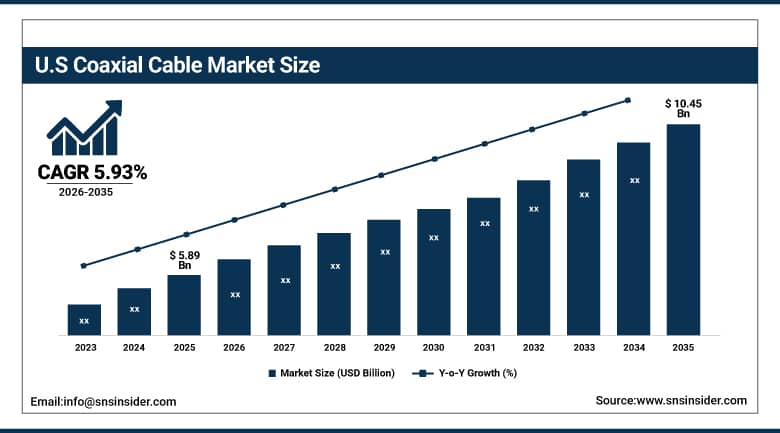
The U.S. Coaxial Cable Market was valued at USD 5.89 Billion in 2025 and is expected to reach around USD 10.45 Billion by 2035, growing at a CAGR of 5.93% from 2026–2035.
The U.S. coaxial cable market is witnessing steady growth because of increasing demand for broadband services and cable television infrastructure. Coaxial cable deployment across telecommunications networks, internet service providers, and broadcasting systems has been responsible for strong market expansion. Increasing investments in network modernization and hybrid fiber coaxial upgrades have led to rising demand for advanced communication infrastructure. Growing development of high-speed internet connectivity, digital streaming platforms, and RF transmission systems is further supporting market adoption. Continuous focus on network reliability and upgraded telecom infrastructure is strengthening market growth.
According to the Federal Communication Commission Broadband Deployment Reports, cable broadband using HFC technology, utilizing coaxial as the last mile connection technology, had approximately 71.8 million residential connections in the United States, and with DOCSIS 3.1 technology, available in census blocks which comprise about 78% of total the U.S. households.
Coaxial Cable Market Segment Analysis:
-
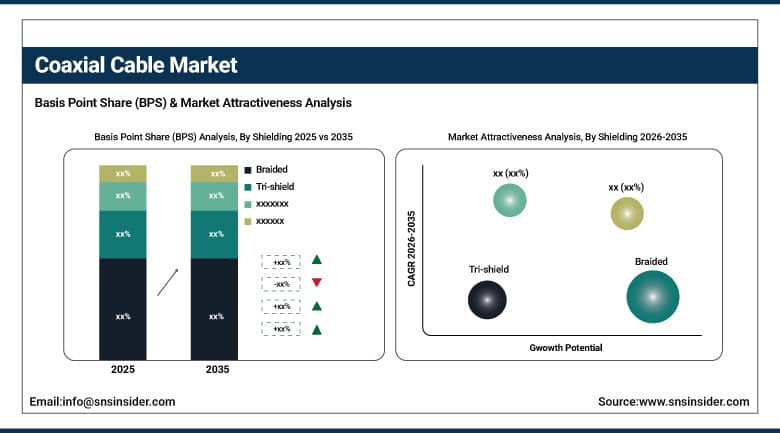
By Shielding, braided dominated the coaxial cable market with 52.40% share in 2025; while tri-shield are the fastest growing segment with CAGR of 7.51% during 2026 to 2035.
-
By Cable Type, RG-6 dominated the coaxial cable market with 46.90% share in 2025; while radiating cable are the fastest growing segment with CAGR of 14.71% during 2026 to 2035.
-
By Application, video distribution dominated the coaxial cable market with 48.50% share in 2025; while internet data transfer is the fastest growing segment with CAGR of 10.89% during 2026 to 2035.
-
By End-User, telecommunication service providers dominated the coaxial cable market with 37.10% share in 2025; while internet service providers are the fastest growing segment with CAGR of 11.79% during 2026 to 2035.
By Shielding, braided dominated the coaxial cable market in 2025, while tri-shield is the fastest growing segment.
The Braided segment held the dominated share in coaxial cable market in 2025. The reasons behind its dominance include its excellent shielding efficiency, affordability, and extensive use in television broadcasting and broadband communication networks. It provides excellent protection of signals from any form of electromagnetic interference. Its durability along with easy installation in various applications helps it maintain a strong position in the market.
The Tri-shield segment has the fastest-growing CAGR between 2026 and 2035. This rapid growth can be attributed to its high-performance signal transmission with effective noise elimination features and superior shielding ability. It finds extensive application in broadband, high frequency communication, and high-speed data networks. The growing use in smart infrastructure, 5G, and high-speed Internet technologies is further boosting its demand.
By Cable Type, RG-6 dominated the coaxial cable market in 2025, while radiating cable is the fastest growing segment.
The RG-6 segment ruled the coaxial cable market in terms of revenue share in 2025 owing to its significant applications in the transmission of signals through cable television services, broadband internet, and residential communication applications. RG-6 coaxial cable exhibits low signal loss, has high bandwidth and is very economical in nature. The segment will continue to benefit from rising demand from residential consumers and telecom operators for use in the communication network.
The Radiating Cable market is likely to witness the fastest CAGR during the forecast period from 2026 to 2035 driven by increasing application in tunnels, railway tracks, metro trains, and underground communication systems. The radiating cable helps achieve signal coverage in closed structures where normal cables cannot be used owing to signal loss issues. Investments in smart transportation system and safe communication infrastructure have led to adoption. Increased automation and mission-critical communication need also support growth prospects.
By Application, video distribution dominated the coaxial cable market in 2025, while internet data transfer is the fastest growing segment.
Video Distribution accounted for the dominated revenue share in the coaxial cable market during 2025. The growth of this segment can be attributed to the presence of several cable TV networks, satellite TV broadcasting system, and existing video transmission technologies. High penetration rates of pay TV services and constant demand for video transmission of high-quality video services contribute to the extensive usage of coaxial cables. Existing infrastructure in both residential and commercial areas also support stable revenue generation from this segment.
The Internet Data Transfer segment is projected to register the fastest CAGR from 2026 to 2035 due to the increasing demand for high-speed internet connectivity across the world. Deployment of broadband networking technologies, hybrid fiber-coaxial networks, and higher data consumption from various sources such as streaming services and cloud computing are some factors driving the growth of this segment.
By End-User, telecommunication service providers dominated the coaxial cable market in 2025, while internet service providers are the fastest growing segment.
Telecommunication Service Providers segment accounted for the dominated revenue share in coaxial cable market in 2025 owing to large scale presence of coaxial technology within existing telecommunication networks and broadband delivery system. High dependency on hybrid fiber coaxial network enables higher level of data transfer capability. Continuous upgrading of network, urban connectivity, and established ecosystem of service providers further boosts demand. Investment in high-end backbone communication infrastructure also adds to their dominant market standing worldwide.
Internet Service Providers segment is poised to experience the fastest CAGR between 2026–2035 owing to increasing demands of fast-speed internet connections from residential as well as commercial end-users. Fast adoption of broadband and fiber hybrid connection networks is supporting growth. High levels of consumption in form of video streaming, online gaming, and various applications based on cloud computing further contribute to growth. Digitalization policies of governments along with rural connectivity drives also aid growth. Growth is also driven by constant growth in last-mile connectivity solutions globally.
Regional Analysis:
|
Region |
Major Country |
Share within Region, 2025(%) |
|---|---|---|
|
North America |
United States |
78.40% |
|
Europe |
Germany |
26.30% |
|
Asia Pacific |
China |
43.20% |
|
Middle East & Africa |
UAE |
18.40% |
|
Latin America |
Brazil |
47.10% |
North America Coaxial Cable Market Insights.
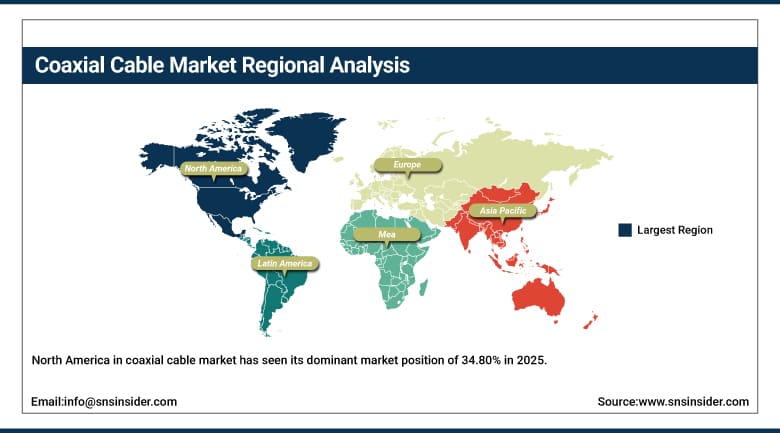
North America in coaxial cable market has seen its dominant market position of 34.80% in 2025 due to advanced broadband infrastructure and strong telecom networks. The region benefits from extensive cable television penetration, hybrid fiber coaxial upgrades, and high-speed internet adoption. Increasing demand for reliable data transmission, streaming services, and RF communication systems is driving steady growth across the United States and Canada. Strong investments in network modernization and digital connectivity initiatives are further supporting market expansion.
As per the OECD Broadband Statistics database, cable broadband accounted for approximately 30.5% of total fixed broadband subscriptions across OECD economies, including North America, where the United States and Canada remain among the highest cable-penetration countries with about 24–23 subscriptions per 100 inhabitants. OECD data further indicates fibre growth is displacing legacy cable, while overall fixed broadband subscriptions continue rising per 100 inhabitants across the region, supported by hybrid fibre-coaxial upgrades and DOCSIS-enabled infrastructure modernization.
Get Customized Report as Per Your Business Requirement - Enquiry Now
Europe Coaxial Cable Market Insights.
The Europe coaxial cable market makes an important contribution in 2025 owing to strong telecommunications infrastructure and broadcasting networks. Countries like Germany, United Kingdom, France, Italy, and Spain are leading contributors to regional demand. High focus on broadband expansion, cable television services, and industrial communication systems is supporting consistent market growth. Increasing investments in digital infrastructure and network modernization programs are strengthening adoption across telecom and media sectors.
According to digital connectivity statistics from the Organisation for Economic Co-operation and Development (OECD) and the European Commission, the OECD reveals that cable accounts for approximately 30% of fixed broadband subscriptions among all OECD countries, whereas DSL has fallen below 22% by 2023. Fixed broadband subscriptions using fibre continue to grow at an impressive rate, accounting for more than 40% of fixed broadband subscriptions in OECD nations.
Asia Pacific Coaxial Cable Market Insights.
Asia Pacific is well positioned to experience the fastest growing CAGR of 10.12% in the coaxial cable market in 2025 with strong demand expansion across telecom and broadband networks. China, India, Japan, South Korea, and Southeast Asia are key contributors. Rising internet penetration, urbanization, and increasing data consumption are boosting adoption. Expanding 5G rollout, cable TV services, and industrial communication systems are further strengthening regional market growth.
According to S&P Global Market Intelligence, Asia-Pacific fixed broadband households reached 57.2% penetration by 2025, with strong disparity between advanced markets exceeding 100% penetration and developing economies below 40%. Fibre technology accounts for over 83% of fixed broadband households, indicating rapid fibre-driven network transformation across the region.
Middle East & Africa and Latin America Coaxial Cable Market Insights.
The Middle East & Africa region along with Latin America will exhibit steady growth in the coaxial cable market up to 2025 due to increasing investments in telecom infrastructure development. Countries such as UAE, Saudi Arabia, South Africa, Brazil, and Mexico are emerging contributors. Growing demand for broadband connectivity, cable television expansion, and digital communication services is increasing adoption. Infrastructure modernization and urban connectivity projects are further driving market expansion.
As per the International Telecommunication Union World Telecommunication/ICT Indicators Database and World Bank regional classifications, fixed broadband penetration in the Middle East & Arab States reached about 12.4 subscriptions per 100 inhabitants in 2025, while Africa recorded around 1.2 per 100 inhabitants, reflecting a significant digital infrastructure gap. In Latin America & Caribbean, fixed broadband penetration stood near 27.7 per 100 inhabitants in 2025, supported by rising fiber adoption where FTTH accounts for nearly 67% of residential broadband connections, indicating uneven but expanding coaxial-based broadband transition across regions.
Market Dynamics:
Growth Drivers: Rising broadband demand and high-speed internet expansion driving global coaxial cable network deployment growth
Increasing demand for high-speed internet connectivity and broadband services is significantly accelerating deployment of coaxial cable networks across residential and commercial sectors. Growing data consumption from streaming platforms, cloud applications, and online services is strengthening requirement for reliable transmission infrastructure. Telecom operators are continuously upgrading hybrid fiber coaxial networks to support higher bandwidth and stable connectivity. Expansion of cable television services and digital communication systems is further boosting adoption. Government initiatives promoting digital connectivity and rural broadband penetration are also supporting steady market growth across developed and emerging economies worldwide.
According to OECD broadband, fixed broadband penetration continues to rise alongside technology upgrades, with fibre-based networks expanding significantly and fibre accounting for 41% of total fixed broadband subscriptions in OECD countries by 2023. ITU reports also show that 92.7% of the global population is covered by LTE networks and 55.1% by 5G in 2025, reflecting accelerating high-speed connectivity expansion driving broadband infrastructure deployment including coaxial cable networks.
Restraints: Increasing competition from fiber optic technologies reducing long term dependency on coaxial cable systems in modern networks
Rapid adoption of fiber optic technology is creating strong competition for coaxial cable systems in modern communication networks. Fiber optics offer higher bandwidth, faster data transmission, and lower signal loss over long distances. Telecom operators are increasingly shifting investments toward fiber-based infrastructure for future ready networks. This transition is reducing demand for traditional coaxial cable installations in new projects. However, existing infrastructure dependency and hybrid network models still support partial usage. Continuous technological advancements in fiber deployment are expected to further limit coaxial cable growth in high-speed broadband and long-distance communication applications globally.
Opportunities: Growth in smart cities and 5G infrastructure development creating new demand opportunities for coaxial cable systems globally
Expansion of smart cities and 5G network infrastructure is generating new opportunities for coaxial cable deployment in communication backhaul and distribution systems. Increasing need for reliable signal transmission in urban connectivity networks is supporting hybrid fiber coaxial integration. Growth in IoT devices, smart surveillance systems, and digital communication platforms is further driving demand. Infrastructure modernization in developing economies is also creating installation opportunities. Coaxial cables continue to play a supportive role in intermediate network layers, ensuring stable performance in high density data environments. These advancements are expanding market scope across telecom, industrial, and broadcasting applications worldwide.
According to the International Telecommunication Union (ITU) and OECD broadband, global digital infrastructure expansion shows that fibre connections accounted for 44.6% of fixed broadband subscriptions and 5G accounted for 33% of mobile subscriptions across OECD countries, indicating rapid deployment of high-capacity networks.
Recent Developments:
-
2026: Prysmian Group expands global production supporting offshore wind HVDC interconnections digital grid modernization sustainability initiatives across Europe North America markets.
-
2025: CommScope enhances broadband connectivity solutions supporting 5G upgrades fiber expansion DOCSIS evolution and enterprise network modernization initiatives across global markets
-
2025: Belden strengthens industrial networking portfolio focusing automation cybersecurity smart manufacturing industrial ethernet and Industry 4.0 adoption solutions worldwide expansion globally.
-
2024: Nexans focuses electrification renewable grid projects offshore wind subsea cables expansion low carbon manufacturing transition initiatives globally strategy execution ongoing.
Coaxial Cable Market Key Players are:
-
Prysmian Group
-
Nexans
-
CommScope
-
Amphenol
-
Belden
-
LS Cable & System
-
Sumitomo Electric Industries
-
Fujikura Ltd.
-
Furukawa Electric Co., Ltd.
-
TE Connectivity
-
Huber+Suhner
-
Rosenberger Group
-
Southwire Company
-
Leoni AG
-
Jiangsu Zhongtian Technology Group
-
Hengxin Technology Ltd.
-
Futong Group
-
Radiall
-
Carlisle Interconnect Technologies
-
Hengtong Group
Coaxial Cable Market Report Scope:
| Report Attributes | Details |
|---|---|
| Market Size in 2025 | USD 21.58 Billion |
| Market Size by 2035 | USD 46.24 Billion |
| CAGR | CAGR of 7.94% From 2026 to 2035 |
| Base Year | 2025 |
| Forecast Period | 2026-2035 |
| Historical Data | 2022-2024 |
| Report Scope & Coverage | Market Size, Segments Analysis, Competitive Landscape, Regional Analysis, DROC & SWOT Analysis, Forecast Outlook |
| Key Segments | • By Shielding (Braided, Foil, Tri-shield) • By Cable Type (Hardline, RG-6, Triaxial Cable, Radiating Cable, Others) • By Application (Video Distribution, Internet Data Transfer, Radio Frequency Transfer) • By End-User (Aerospace & Defense, Internet Service Providers, Television, Telecommunication Service Providers, System Integrators, Others) |
| Regional Analysis/Coverage | North America (US, Canada), Europe (Germany, UK, France, Italy, Spain, Russia, Poland, Rest of Europe), Asia Pacific (China, India, Japan, South Korea, Australia, ASEAN Countries, Rest of Asia Pacific), Middle East & Africa (UAE, Saudi Arabia, Qatar, South Africa, Rest of Middle East & Africa), Latin America (Brazil, Argentina, Mexico, Colombia, Rest of Latin America). |
| Company Profiles | Prysmian Group, Nexans, CommScope, Amphenol, Belden, LS Cable & System, Sumitomo Electric Industries, Fujikura Ltd., Furukawa Electric Co., Ltd., TE Connectivity, Huber+Suhner, Rosenberger Group, Southwire Company, Leoni AG, Jiangsu Zhongtian Technology Group, Hengxin Technology Ltd., Futong Group, Radiall, Carlisle Interconnect Technologies, Hengtong Group |
Frequently Asked Questions
The coaxial cable market is expected to grow at a CAGR of 7.94% from 2026 to 2035.
The coaxial cable market was valued at USD 21.58 billion in 2025.
Rising broadband demand, expansion of cable television networks, and 5G infrastructure development are driving global coaxial cable demand.
RG-6 cables dominated the market in 2025 due to widespread use in broadband internet and cable television applications.
North America dominated the coaxial cable market due to strong broadband infrastructure and high cable television penetration.
