
Ethernet Card Market Report Scope & Overview:
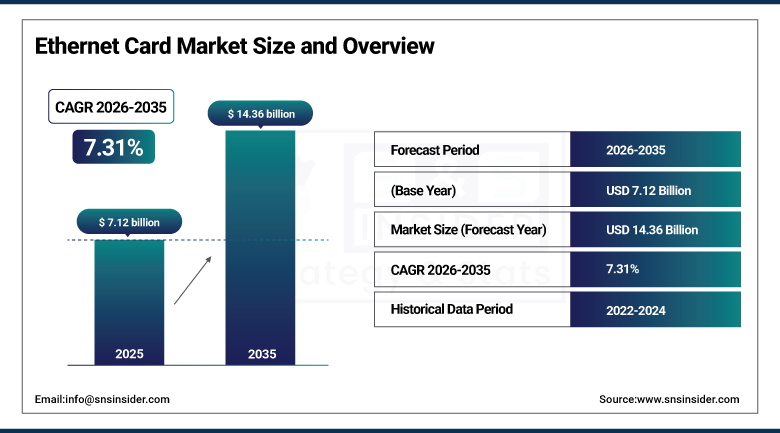
The global Ethernet Card Market size was valued at USD 7.12 Billion in 2025 and is expected to reach USD 14.36 Billion by 2035, growing at a CAGR of 7.31% from 2026 to 2035.
The growth of the Ethernet Card market is driven by several factors, such as the increasing demand for high-speed networking infrastructures, rapid growth of data centers, high growth rate of cloud computing and rising need for reliable wired connectivity solutions in enterprises and industrial settings. Ethernet cards are critical to the operation of the network. They enable fast data transfer and sophisticated features like AI, edge computing, IoT and high-performance computing. The growing use of enterprise networks, telecom infrastructures, industrial automation and connected devices is also driving the demand for advanced Ethernet solutions.
In 2025, Infineon Technologies announced the acquisition of Marvell Technology’s automotive ethernet business at an approximate valuation of USD 2.5 billion. This will improve the company’s high-speed communication solutions and enable advanced ethernet solutions for future generations of automotive and industrial edge applications.
Market Size and Forecast
-
Market Size in 2026E: USD 7.61 Billion
-
Market Size by 2035: 14.36 Billion
-
CAGR: 7.31% from 2026 to 2035
-
Fastest Growing Region: Asia Pacific
-
Largest Region: Asia Pacific
To Get more information Ethernet Card Market - Request Free Sample Report
Ethernet Card Market Trends
-
Rising adoption of high-speed networking infrastructure, cloud computing, and data centre expansion is increasing demand for advanced Ethernet cards with improved bandwidth, reliability, and faster data transmission capabilities.
-
Growing deployment of artificial intelligence, edge computing, and high-performance computing applications is accelerating the adoption of high-speed Ethernet solutions to support large-scale data processing and real-time connectivity requirements.
-
Increasing integration of Ethernet connectivity in industrial automation, Internet of Things (IoT), and smart manufacturing environments is driving demand for reliable and efficient network interface solutions.
-
Expansion of automotive networking, connected vehicles, and advanced driver assistance systems (ADAS) is creating strong demand for automotive-grade Ethernet cards that enable high-speed communication between electronic systems.
-
Strategic collaborations among semiconductor manufacturers, networking solution providers, and technology companies are supporting the development of energy-efficient, high-performance, and next-generation Ethernet connectivity solutions.
U.S. Ethernet Card Market Size Outlook
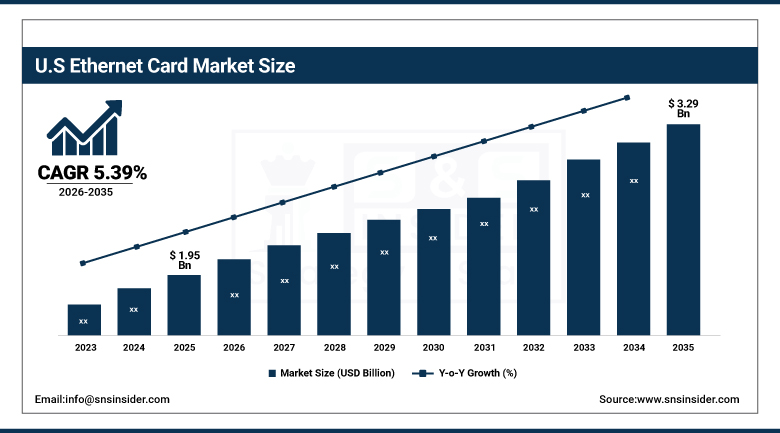
The U.S. Ethernet Card Market was valued at USD 1.95 Billion in 2025 and is expected to reach USD 3.29 Billion by 2035, growing at a CAGR of 5.39% from 2026 to 2035.
The United States Ethernet Card Market is estimated to grow at a steady rate during the forecast period. The growth factors are growing demand for high-speed networking infrastructure, growing hyperscale data centres, rising adoption of cloud computing and rising deployment of artificial intelligence and high-performance computing applications. The US has a strong technology ecosystem with leading data centre operators, semiconductor companies and networking solution providers. High-speed data transfer, low latency links and reliable network infrastructure are increasingly in demand, driving the adoption of sophisticated Ethernet cards across data centres, telecoms, enterprise networks, industrial automation and automotive applications.
IDC reported strong growth in the data centre market segment of the global Ethernet switch and high-speed networking hardware market in 2026 with the market reaching $9.9 billion in Q4 2025 with 63.0 % YoY growth. The U.S.-based hyperscalers building AI workload clusters are fuelling demand for high-bandwidth 200G, 400G and 800G Ethernet adapter cards to support next-generation computing infrastructure.
Ethernet Card Market Segment Analysis
-
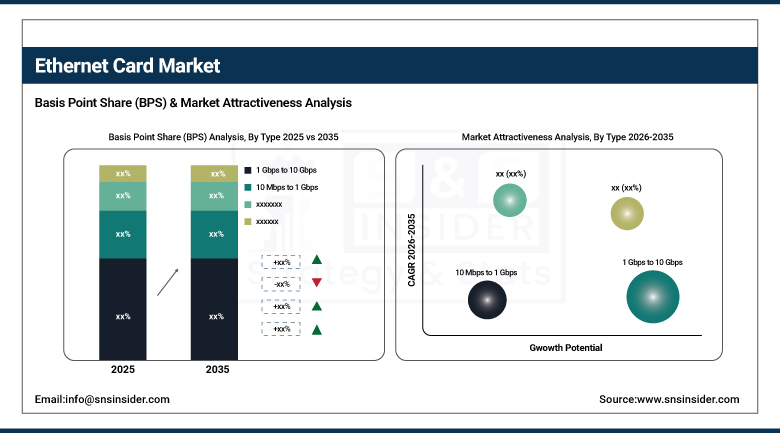
By Type, 1 Gbps to 10 Gbps dominated the Ethernet Card Market with a 46.80% share in 2025, while Above 10 Gbps is the fastest-growing type segment with a CAGR of 12.24% from 2026–2035.
-
By Product Type, Internal Ethernet Cards dominated the Ethernet Card Market with a 72.40% share in 2025, while External Ethernet Cards are the fastest-growing product type segment with a CAGR of 8.83% from 2026–2035.
-
By Application, Telecommunications dominated the Ethernet Card Market with a 28.40% share in 2025, while Automotive is the fastest-growing application segment with a CAGR of 9.48% from 2026–2035.
-
By End User, Commercial dominated the Ethernet Card Market with a 39.80% share in 2025, while Industrial is the fastest-growing end-user segment with a CAGR of 8.31% from 2026–2035.
By Type, 1 Gbps to 10 Gbps dominated the Ethernet Card Market, while Above 10 Gbps is expected to register the fastest growth.
The 1 Gbps to 10 Gbps segment dominated the Ethernet Card Market with a 46.80% revenue share in 2025. Wide deployment across enterprise networks, data centres, telecommunications infrastructure and commercial applications demanding reliable high-speed connectivity continues to position the segment at the top. Ethernet cards at this speed range strike a good balance of performance, price point, and compatibility with existing networking infrastructure. The increasing digital transformation initiatives, expansion of cloud services, and growing demand for efficient data transmission across organisations are supporting the continued adoption of 1 Gbps to 10 Gbps Ethernet solutions.
The Above 10 Gbps segment is anticipated to witness the fastest CAGR of 12.24% during the forecast period of 2026–2035. Growth is fuelled by growing demand for ultra-high-speed networking solutions, rapid growth in artificial intelligence workloads, hyperscale data centres and high-performance computing environments. The increasing use of 200G, 400G and 800G networking technology is speeding up the use of advanced Ethernet cards that can handle massive amounts of data. Further segment growth is anticipated to be driven by growing investments in next-generation communication infrastructure and low-latency networking solutions.
By Product Type, Internal Ethernet Cards dominated the Ethernet Card Market, while External Ethernet Cards are expected to register the fastest growth.
The Internal Ethernet Cards segment dominated the Ethernet Card Market with a 72.40% revenue share in 2025. Internal Ethernet cards are popular because they connect directly to servers, desktops, workstations and enterprise networking systems. These cards are more reliable, offer faster data transfer rates and have lower latency than external cards. The demand for internally installed Ethernet connectivity solutions continues to be driven by the increasing deployment of enterprise IT infrastructure, data centres, and industrial computing systems.
The External Ethernet Cards segment is anticipated to witness the fastest CAGR of 8.83% over the forecast period. “The growth is driven by increasing demand for flexible networking solutions, ease of upgrading devices and portable connectivity options. External Ethernet cards can be easily added or upgraded on existing hardware and are especially useful for laptops, consumer electronics and industrial systems. The segment growth is driven by the increasing adoption of remote work solutions, IoT devices, and advanced connectivity applications.
By Application, Telecommunications dominated the Ethernet Card Market, while Automotive is expected to register the fastest growth.
The Telecommunications segment dominated the Ethernet Card Market with a 28.40% revenue share in 2025. The leadership of the segment is attributed to the rise in investments in network infrastructure, the expansion of broadband connectivity, and the fast deployment of 5G and advanced communication networks. Ethernet cards are essential for high-speed data transfer, network reliability and scalable communication infrastructure. The growth of the segment is attributed to the growing demand for better bandwidth and low latency connectivity between telecom operators.
The Automotive segment is expected to grow at the fastest CAGR of 9.48% during the forecast period 2026-2035. The increasing integration of connected vehicles, advanced driver assistance systems (ADAS), autonomous driving technologies and in-vehicle networking solutions is fuelling the growth. Automotive Ethernet cards are becoming a must-have for high-volume data communication between vehicle systems, sensors, cameras and electronic control units. The increasing investments in smart mobility and electric vehicle technologies are likely to generate profitable growth opportunities in the market for the use of Ethernet cards in automotive applications.
By End User, Commercial dominated the Ethernet Card Market, while Industrial is expected to register the fastest growth.
The Commercial segment dominated the Ethernet Card Market with a 39.80% revenue share in 2025. Due to enterprise networking, cloud applications, office connectivity and high-speed data communication requirements, Ethernet cards are widely adopted by commercial organisations. Increasing digitalisation, expansion of corporate IT infrastructure and growing dependence on reliable networking systems are driving demand in commercial environments. The rising demand for Ethernet cards is due to the need for scalable and efficient networking solutions, sought by businesses.
The Industrial segment is projected to grow at the fastest CAGR of 8.31% during the forecast period. The growth is driven by the increasing use of industrial automation, smart manufacturing, Industrial IoT (IIoT) and real-time data exchange systems. Ethernet cards help industrial equipment, sensors, controllers and automated systems communicate reliably. Growing investments in Industry 4.0 technologies, smart factories and the connected industrial infrastructure will likely drive the demand for advanced Ethernet connectivity solutions across a variety of industrial applications.
Regional Analysis
|
Region |
Major Country |
Share within Region, 2025 (%) |
|---|---|---|
|
North America |
United States |
83.55% |
|
Europe |
Germany |
26.40% |
|
Asia Pacific |
China |
52.80% |
|
Middle East & Africa |
UAE |
28.60% |
|
Latin America |
Brazil |
41.40% |
Asia Pacific Ethernet Card Market Insights
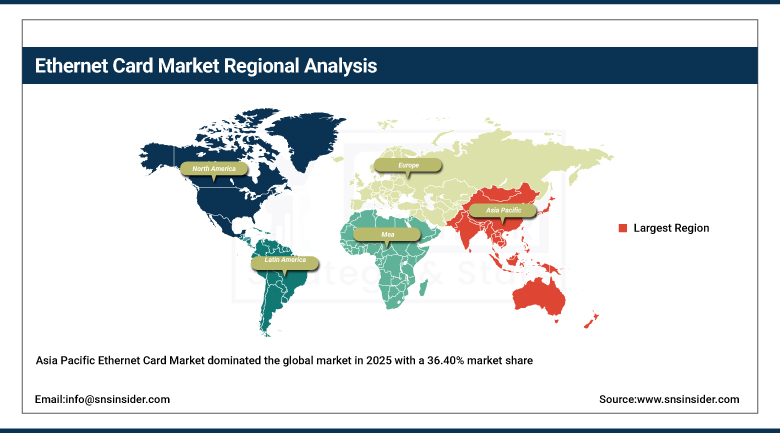
The Asia Pacific Ethernet Card Market dominated the global market in 2025 with a 36.40% market share and is also expected to register the fastest CAGR of 9.00% from 2026 to 2035. The region’s leadership is driven by the rapid growth of data centres, increased adoption of high-speed networking infrastructure, booming demand for cloud computing and rising investments in telecommunications and industrial automation. The presence of major electronics manufacturing hubs and growing adoption of advanced Ethernet technologies by enterprises are also driving the growth of the market in the region.
The Asia Pacific Ethernet Card Market is fuelled by growing demand for high-bandwidth connectivity, expansion of AI workloads, increasing adoption of IoT-enabled devices, and modernisation of enterprise networks. Countries such as China, Japan, South Korea and India are playing a big role with developments in semiconductors, 5G infrastructure, data centre expansion and digital transformation initiatives. The growth of Ethernet card in the region is expected to be driven by growing investments in industrial networking, cloud infrastructure, and next-generation communication systems during the forecast period.
Get Customized Report as per Your Business Requirement - Enquiry Now
North America Ethernet Card Market Insights
The North America Ethernet Card Market is driven by state-of-the-art digital infrastructure, high acceptance of fast networking technology solutions and increasing need for reliable connections among enterprises, data centres and telecommunication networks. The presence of major technology companies in the region, advanced semiconductor technologies, and investments into cloud computing, artificial intelligence infrastructure, and advanced communication systems are some of the factors supporting the market growth. The rise in the demand for efficient data transfer and the modernisation of networks pushes up the usage of advanced Ethernet cards.
North America Ethernet Card Market is driven by the United States which has a well-established technology ecosystem, a strong presence of data centres and a rapid adoption of advanced networking solutions. The market is driven by the factors such as the growth of the hyperscale cloud providers’ investments, growth of the enterprise networks and need for high-performance computing solutions. Canada also helps build the market through digital transformation, cloud computing and deployment of advanced communication networks.
Europe Ethernet Card Market Insights
The Europe Ethernet Card Market is growing at a decent rate due to the rise in digitalisation, development of enterprise networking infrastructure, and the high demand for data communication solutions. The European region is working to build data centre capabilities, industrial connectivity and smart manufacturing. The increasing use of cloud services, automation technology and sophisticated communication systems is driving companies to invest in new networking solutions such as the Ethernet card in a wide range of sectors.
Germany is a key country in the Europe Ethernet Card Market owing to its industrial base, manufacturing industry and increasing Industry 4.0. Some of the other countries that are driving the regional market growth include the United Kingdom, France and the Netherlands owing to their data centres, telecommunication infrastructure development and digitalisation initiatives. The region will gain additional opportunities for growth with increased demand for enterprise networking and industrial communication systems.
Middle East & Africa and Latin America Ethernet Card Market Insights
Ethernet Card Markets in Middle East & Africa and Latin America are witnessing sluggish growth owing to digital transformation, improved communication infrastructure and increasing adoption of enterprise networking solutions. The increasing investments in cloud computing, data centres, telecommunication network and industrial automation are generating new opportunities for the manufacturers of Ethernet cards. The market in both regions is experiencing robust growth, driven by the escalating demand for quicker and more dependable data connectivity in business, government and industrial facilities.
Brazil is becoming a major contributor in the Latin American Ethernet Card Market. With the growth of digital infrastructure and increasing investments in telecommunication networks, there is a growing need for enterprise connectivity. In the Middle East & Africa, UAE and Saudi Arabia are spearheading the market growth with smart city initiatives, data centre development and communication infrastructure modernisation. The growing adoption of advanced networking technologies is anticipated to boost the regional demand in the upcoming years.
Market Dynamics
Growth Drivers: Rising demand for high-speed connectivity and expansion of data center infrastructure driving market growth
The Ethernet Card Market is expected to witness huge growth owing to increasing demand for fast data transmission, increasing presence of data centres and increasing adoption of networking solutions among enterprises. Ethernet cards are increasingly used for cloud computing, AI workloads, IoT applications and high-performance computers. The market growth is driven by the increasing demand for fast network speeds, low latency communications and large data transfers in industries such as telecommunications, industry, automotive and consumer electronics.
Technology has been revolutionising the networking space of the enterprises and industries with the advent of high-speed Ethernet cards, improved network interfaces, energy efficient designs and compatibility with next generation communication standards. The growth of 5G networks, smart manufacturing, edge computing, and interconnected devices is driving demand for Ethernet connectivity solutions. Similarly, investment in networking infrastructure is being offered by cloud service providers, data centre players and technology companies with huge growth prospects.
Restraints: High infrastructure costs and compatibility challenges limiting market adoption
The high cost of upgrading the networking infrastructure continues to be a major hurdle in the growth of the Ethernet Card Market. As faster Ethernet cards become available, you have to replace switches, servers, cables and other networking equipment, which adds to the cost of installation. Small and medium size companies would have problems in implementing advanced Ethernet technology due to constraints such as budget, maintenance costs and experts required to manage the networking environment.
The second big challenge is the compatibility and complexity of implementation in existing network systems. Upgrading the legacy infrastructure and maintaining compatibility and cybersecurity on advanced ethernet networks are some of the complications organisations may find difficult to make use of the advanced technology. The volatility of semiconductor manufacturing industry, increased prices of components may also affect Cost conscious end user.
Opportunities: Expansion of AI-driven data centers and next-generation networking technologies creating new growth avenues
The growing adoption of artificial intelligence, machine learning, cloud computing, and high-performance computing technologies is anticipated to create lucrative growth opportunities for the Ethernet Card Market. Increased demand for high bandwidth connectivity solutions in AI data centres, hyperscale clouds and enterprise networks will propel manufacturers to develop advanced Ethernet cards for offering high-speed, efficient and reliable connectivity solutions. The increasing demands of data processing in the modern era, driven by advancements in 200G, 400G, and 800G Ethernet technologies are expected to fuel the growth of the market.
Growth opportunities for the market will be provided by developing economies in the Asia Pacific, Latin America, and Middle East & Africa regions due to digital transformation policies, growth in telecom networks, and investments in smart cities and industrial automation. Ethernet cards will be improved by continuous improvements in network virtualization, edge computing, cloud networking and energy-efficient data transfer technologies. During the forecast period, innovation and market growth will continue to be driven by collaborations between semiconductor companies, networking equipment vendors, and data centre operators.
Recent Developments:
-
2025: The IEEE announced the commercial maturity of 800 Gigabit Ethernet (800GbE) standards while accelerating development toward 1.6T Ethernet architectures, guiding OEMs in designing next-generation enterprise network interface cards.
-
2026: Market reports highlighted strong hyperscale investments in advanced Ethernet controller silicon, with cloud providers adopting RDMA over Converged Ethernet (RoCE) solutions to improve GPU cluster performance and reduce networking bottlenecks.
-
2026: FMI reported increasing adoption of Ethernet access and connectivity hardware as enterprises upgrade LAN infrastructure, with growing demand for smart NICs featuring virtualization support, SR-IOV, and dynamic queue management capabilities.
Ethernet Card Companies are:
-
Intel Corporation
-
NVIDIA Corporation (Mellanox Technologies)
-
Marvell Technology, Inc.
-
Realtek Semiconductor Corp.
-
Qualcomm Technologies, Inc.
-
Advanced Micro Devices, Inc. (AMD)
-
TP-Link Technologies Co., Ltd.
-
D-Link Corporation
-
Hewlett Packard Enterprise (HPE)
-
Cisco Systems, Inc.
-
Dell Technologies Inc.
-
Lenovo Group Limited
-
Super Micro Computer, Inc.
-
Allied Telesis Holdings K.K.
-
Silicom Ltd.
-
StarTech.com Ltd.
-
Microchip Technology Inc.
-
Tehuti Networks Ltd.
Ethernet Card Market Report Scope:
| Report Attributes | Details |
|---|---|
| Market Size in 2025 | USD 7.12 Billion |
| Market Size by 2035 | USD 14.36 Billion |
| CAGR | CAGR of 7.31% From 2026 to 2035 |
| Base Year | 2025 |
| Forecast Period | 2026-2035 |
| Historical Data | 2022-2024 |
| Report Scope & Coverage | Market Size, Segments Analysis, Competitive Landscape, Regional Analysis, DROC & SWOT Analysis, Forecast Outlook |
| Key Segments | • By Type (10 Mbps to 1 Gbps, 1 Gbps to 10 Gbps, Above 10 Gbps) • By Product Type (Internal Ethernet Cards, External Ethernet Cards) • By Application (Consumer Electronics, Industrial, Automotive, Telecommunications, Others) • By End User (Residential, Commercial, Industrial) |
| Regional Analysis/Coverage | North America (US, Canada), Europe (Germany, UK, France, Italy, Spain, Russia, Poland, Rest of Europe), Asia Pacific (China, India, Japan, South Korea, Australia, ASEAN Countries, Rest of Asia Pacific), Middle East & Africa (UAE, Saudi Arabia, Qatar, South Africa, Rest of Middle East & Africa), Latin America (Brazil, Argentina, Mexico, Colombia, Rest of Latin America). |
| Company Profiles | Intel Corporation, Broadcom Inc., NVIDIA Corporation (Mellanox Technologies), Marvell Technology, Inc., Realtek Semiconductor Corp., Qualcomm Technologies, Inc., Advanced Micro Devices, Inc. (AMD), ASUSTeK Computer Inc., TP-Link Technologies Co., Ltd., D-Link Corporation, Hewlett Packard Enterprise (HPE), Cisco Systems, Inc., Dell Technologies Inc., Lenovo Group Limited, Super Micro Computer, Inc., Allied Telesis Holdings K.K., Silicom Ltd., StarTech.com Ltd., Microchip Technology Inc., Tehuti Networks Ltd. |
Frequently Asked Questions
The Ethernet Card Market is expected to grow at a CAGR of 7.31% from 2026 to 2035.
The Ethernet Card Market was valued at USD 7.12 Billion in 2025.
The market is driven by increasing demand for high-speed networking, rapid expansion of AI data centres, cloud computing, enterprise digital transformation, and deployment of advanced Ethernet infrastructure.
