
Generative AI Server Market Report Scope & Overview:
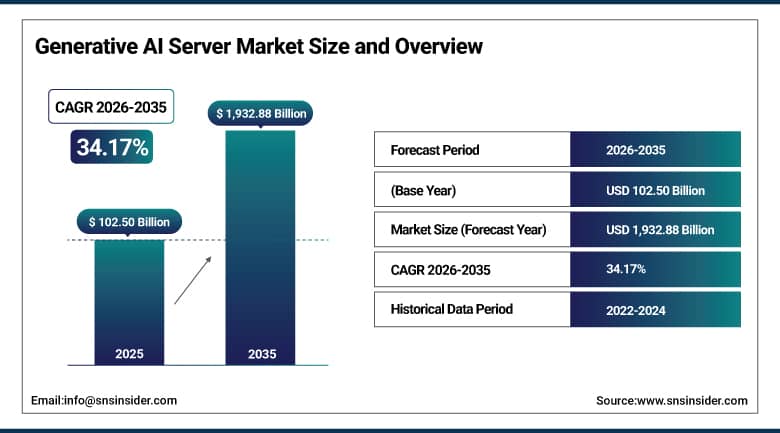
The global Generative AI Server Market size was valued at USD 102.50 Billion in 2025 and is expected to reach USD 1,932.88 Billion by 2035, growing at a CAGR of 34.17% from 2026 to 2035.
The Generative AI Server Market is growing at a very rapid pace due to the increasing popularity of the AI applications, increasing need for training the large language models (LLM) and increasing adoption of the high-performance computing solutions. High-performance Generative AI Servers are key for companies, cloud service providers and research institutes to run complex AI workloads with advanced GPUs, AI accelerators and high-speed network capabilities. Furthermore, the market growth is being further boosted by the growing investments in hyperscale data centers, AI applications, cloud AI solutions and next generation computing systems.
Oracle and Open AI have made infrastructure investments with multi-phase “Stargate” AI data center programme to increase 4.5 GW more AI server capacity in global cloud nodes. It is one of the largest infrastructure investments in AI and thus driving the need for ultra-high density GPU server architecture and 800G optical interconnect system.
Market Size and Forecast
-
Market Size in 2026E: USD 137.15 Billion
-
Market Size by 2035: 1,932.88 Billion
-
CAGR: 34.17% from 2026 to 2035
-
Fastest Growing Region: Asia Pacific
-
Largest Region: North America
To Get More Information On Generative AI Server Market - Request Free Sample Report
Generative AI Server Market Trends
-
Rising adoption of large language models (LLMs), generative AI applications, and enterprise AI solutions is increasing demand for high-performance AI servers equipped with advanced GPUs and AI accelerators.
-
Growing investments in hyperscale data centers and cloud AI infrastructure are accelerating the deployment of high-density GPU-based servers for AI training and inference workloads.
-
Increasing demand for faster AI processing capabilities is driving integration of advanced processors, high-bandwidth memory (HBM), and next-generation networking technologies in generative AI servers.
-
Expansion of edge AI computing and real-time AI applications is creating strong demand for compact, energy-efficient, and scalable AI server architectures.
-
Strategic partnerships among AI chip manufacturers, cloud service providers, and server vendors are supporting the development of powerful AI computing platforms with improved performance, scalability, and energy efficiency.
U.S. Generative AI Server Market Size Outlook
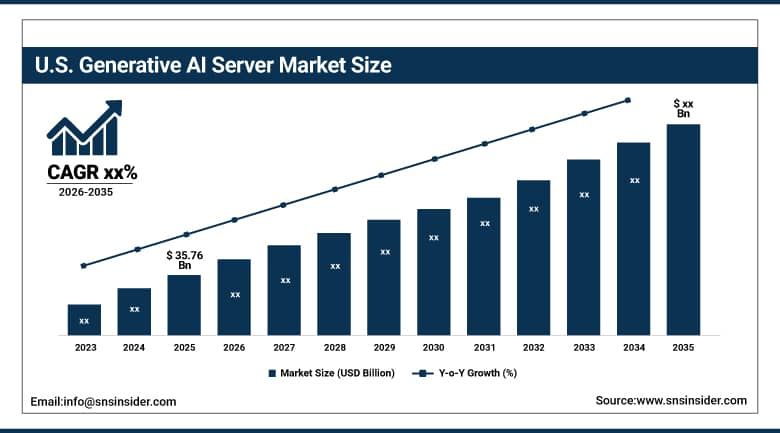
The U.S. Generative AI Server Market was valued at USD 35.76 Billion in 2025 and is expected The U.S. Generative AI Server market is forecasted to grow at an impressive pace owing to high investments in artificial intelligence infrastructure, hyperscale data centers, cloud computing platforms, and computing systems. The nation boasts a robust technology sector, leading semiconductor players, and high adoption rates of advanced computing infrastructures. The growing requirement of training and inference AI models, LLMs, and enterprise AI solutions is driving the adoption of advanced AI servers that offer high-end GPUs, AI accelerators, and high bandwidth memory technologies. In addition to this, the growing expansion of cloud AI platforms and generative AI infrastructures is helping the market to grow.
In 2026, AMD signed an unprecedented deal with Anthropic to deliver it tens of billions of dollars’ worth of AI servers featuring AMD’s latest Instinct MI450 accelerator series, offering 2 GW of AI compute capacity. The deal, which includes AMD’s $5 billion equity investment, further solidifies AMD’s position as a prominent rival to NVIDIA in the U.S. generative AI server infrastructure market.
Generative AI Server Market Segment Analysis
-
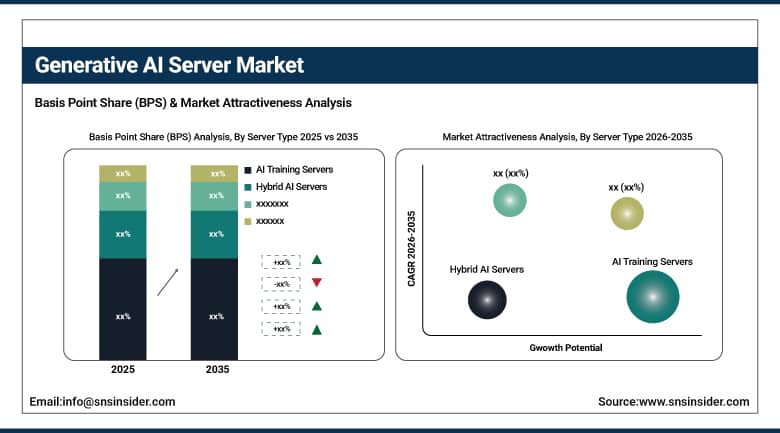
By Server Type, AI Training Servers dominated the Generative AI Server Market with a 38.60% share in 2025, while Hybrid AI Servers is the fastest-growing server type segment with a CAGR of 36.52% from 2026–2035.
-
By Processor Type, GPU-Based Servers dominated the Generative AI Server Market with a 68.40% share in 2025, while Heterogeneous Computing Servers is the fastest-growing processor type segment with a CAGR of 39.55% from 2026–2035.
-
By Deployment, Cloud-Based dominated the Generative AI Server Market with a 45.60% share in 2025, while Cloud-Based is also the fastest-growing deployment segment with a CAGR of 35.88% from 2026–2035.
-
By Form Factor, Rack Servers dominated the Generative AI Server Market with a 46.80% share in 2025, while Modular AI Servers is the fastest-growing form factor segment with a CAGR of 39.44% from 2026–2035.
-
By Cooling Technology, Air Cooling dominated the Generative AI Server Market with a 62.40% share in 2025, while Direct Liquid Cooling is the fastest-growing cooling technology segment with a CAGR of 41.77% from 2026–2035.
-
By Application, Large Language Model Training dominated the Generative AI Server Market with a 42.60% share in 2025, while Generative Design is the fastest-growing application segment with a CAGR of 37.22% from 2026–2035.
-
By End User, Cloud Service Providers dominated the Generative AI Server Market with a 31.80% share in 2025, while Healthcare & Life Sciences is the fastest-growing end-user segment with a CAGR of 36.46% from 2026–2035.
By Server Type, AI Training Servers dominated the Generative AI Server Market, while Hybrid AI Servers is expected to register the fastest CAGR during the forecast period 2026–2035.
The AI Training Servers segment dominated the Generative AI Server Market with a revenue share of 38.60% in 2025. The largest segment is due to growing demand for training large language models, deep learning models and sophisticated generative AI applications. Cloud providers, research institutions and enterprises are increasingly using AI training servers equipped with high-performance GPUs, cutting-edge accelerators, and high-bandwidth memory for big data processing and building complex AI models. The demand for AI training server solutions is fueled by the rapid growth of AI infrastructure, rising investments in hyperscale data centers, and the increasing adoption of generative AI platforms.
The Hybrid AI Servers segment is anticipated to witness the fastest CAGR of 36.52% during the forecast period 2026-2035. The growing need for flexible AI infrastructure which can cater to both training and inference workloads is driving the growth of this segment. Hybrid AI servers can provide better resource utilization, scalability, and operational efficiency for enterprises deploying AI applications across cloud, edge and on-premises environments. Growing adoption of enterprise AI, real-time analytics, and AI-powered automation is expected to drive the deployment of hybrid AI server architectures.
By Processor Type, GPU-Based Servers dominated the Generative AI Server Market, while Heterogeneous Computing Servers is expected to register the fastest CAGR during the forecast period 2026–2035.
The GPU-Based Servers segment dominated the Generative AI Server Market with a revenue share of 68.40% in 2025. GPU-based servers are the most popular choice because of their superior parallel processing capabilities for complex AI model training, deep learning workloads, and large-scale generative AI applications. GPU-based server deployments are being fueled by rising adoption of AI platforms, demand for accelerated computing and growth of AI-focused data centers.
The Heterogeneous Computing Servers segment is expected to hold the fastest CAGR of 39.55% during the forecast period 2026-2035. The growth is driven by the growing integration of GPUs, CPUs, AI accelerators and dedicated processing units into a single computing architecture. These servers offer improved performance, energy efficiency, and workload optimization for advanced AI applications. Increasing complexity of AI workloads and the need for customized computing solutions are expected to support the adoption of heterogeneous computing servers.
By Deployment, Cloud-Based dominated the Generative AI Server Market, while Cloud-Based is expected to register the fastest CAGR during the forecast period 2026–2035.
The Cloud-Based segment dominated the Generative AI Server Market with a revenue share of 45.60% in 2025. The segment’s dominance can be attributed to the rising adoption of cloud AI platforms, scalable computing infrastructure and AI-as-a-Service solutions. Cloud deployment allows organizations to access high-performance AI servers without the need for large capital investments in physical infrastructure. Growth Drivers The growth of cloud-based generative AI server deployments is being driven by growing demand for flexible AI computing resources, enterprise adoption of AI, and growth of hyperscale cloud data centers.
Cloud-Based segment is expected to witness the fastest CAGR of 35.88% during the forecast period 2026–2035. The segment growth is attributed to the growing migration to cloud AI infrastructure, growing demand for scalable computing resources, and growing usage of AI workloads across industries. Cloud providers are also always investing in AI server capacity to support generative AI apps, machine learning models and other large-scale data processing needs.
By Form Factor, Rack Servers dominated the Generative AI Server Market, while Modular AI Servers is expected to register the fastest CAGR during the forecast period 2026–2035.
The Rack Servers segment dominated the Generative AI Server Market with a revenue share of 46.80% in 2025. Rack servers have become popular because of the high computing density and scalability features as well as the compatibility with the hyperscale data centers. These servers can handle large GPU clusters and also perform AI workloads, hence making them important for the training of AI models and AI infrastructure for enterprises. Increased investments in the AI data centers and high-performance computing will fuel the need for rack-based AI server solutions.
Modular AI Servers are set to record the fastest growth rate of 39.44%. Increased need for flexible, scalable, and efficient AI infrastructure will fuel growth in this segment. The modular AI servers enable companies to adjust computing power according to workloads. Increased need for AI factories, edge AI infrastructure, and customized AI infrastructure will drive the market.
By Cooling Technology, Air Cooling dominated the Generative AI Server Market, while Direct Liquid Cooling is expected to register the fastest CAGR during the forecast period 2026–2035.
The Air-Cooling segment dominated the Generative AI Server Market with a revenue share of 62.40% in 2025. The use of air-cooling technology continues to be popular due to the reason that it is relatively cost-effective and simple to maintain and operate alongside conventional data center technology infrastructure. The use of air-cooling systems is still ongoing in many enterprises for handling AI tasks that do not require high processing power.
The Direct Liquid Cooling category is projected to show the fastest CAGR of 41.77% during the forecast period of 2026-2035. It will continue to witness growth due to increasing demand for thermal management in high density AI servers. With respect to direct liquid cooling, it has excellent heat dissipation ability for GPU-intensive tasks along with reduced energy consumption in AI data centers.
By Application, Large Language Model Training dominated the Generative AI Server Market, while Generative Design is expected to register the fastest CAGR during the forecast period 2026–2035.
The Large Language Model Training segment dominated the Generative AI Server Market with a revenue share of 42.60% in 2025. The segment is attributed to the growing development of advanced AI models, growing demand for natural language processing applications, and surging investments in foundation models. The training of large language models requires powerful AI servers to process huge datasets and complex algorithms, increasing the demand for high-performance computing infrastructure.
The Generative Design segment is expected to grow at the fastest CAGR of 37.22% during the forecast period 2026-2035. Growing use of AI-powered design solutions across engineering, manufacturing, architecture and product development industries is fueling the growth. Generative design applications require sophisticated AI servers to run fast simulations, optimization and automated content creation, creating a high demand for scalable AI computing infrastructure.
By End User, Cloud Service Providers dominated the Generative AI Server Market, while Healthcare & Life Sciences is expected to register the fastest CAGR during the forecast period 2026–2035.
The Cloud Service Providers segment dominated the Generative AI Server Market with a revenue share of 31.80% in 2025. This segment’s dominance is supported by increased investments from cloud companies in AI infrastructure, hyperscale data centers and GPU based computing platforms. Cloud providers are increasing AI server capacity to support enterprise AI workloads, generative AI applications and large-scale machine learning services.
The Healthcare & Life Sciences segment is projected to witness the fastest CAGR of 36.46% during the forecast period 2026–2035 This is driven by increasing AI adoption for drug discovery, medical imaging, personalized medicine and healthcare analytics. Generative AI servers enable the swift handling of intricate biological data and advanced AI models, driving breakthroughs in healthcare research and clinical applications.
Regional Insights:
|
Region |
Major Country |
Share within Region, 2025 (%) |
|---|---|---|
|
North America |
United States |
83.87% |
|
Europe |
Germany |
26.40% |
|
Asia Pacific |
China |
52.80% |
|
Middle East & Africa |
UAE |
28.60% |
|
Latin America |
Brazil |
41.40% |
North America Generative AI Server Market Insights
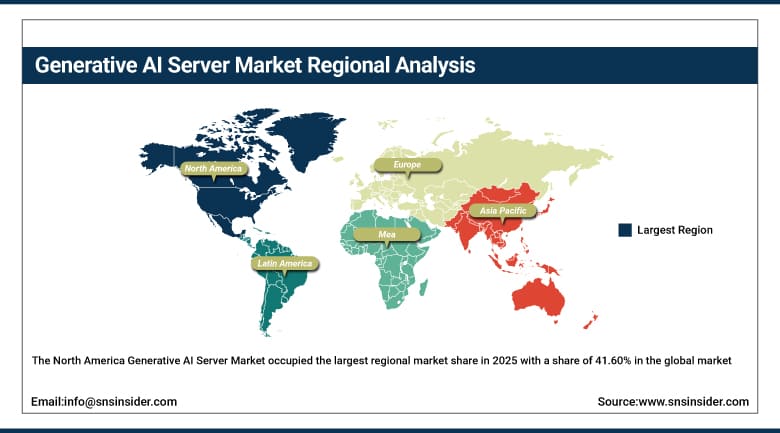
The North America Generative AI Server Market occupied the largest regional market share in 2025 with a share of 41.60% in the global market due to the growing infrastructure of AI, implementation of hyperscale data centers, the availability of semiconductor technology, and the rising expenditure on generative AI platforms. The region provides a number of advantages such as presence of leading cloud service providers, AI technology companies, and server manufacturers that enable faster adoption of GPU-based servers, AI training infrastructure, and high-performance computing systems.
The US was the leading country within the North America Generative AI Server Market in 2025 with a market share of 83.87% of the regional market because of the growing investments in AI data centers, computing infrastructure, and AI model development. Canada is making its contribution to regional growth through the rising adoption of cloud, AI activities, and sustainable data center infrastructure.
Get Customized Report as Per Your Business Requirement - Enquiry Now
Europe Generative AI Server Market Insights
The Europe region was a major contributor to the Generative AI Server Market in 2025. This is attributed to the growing adoption of AI in various industries, increase in investment in cloud computing services, and government initiatives to promote digital transformation. Adoption of generative AI servers increases in Europe with the rise in popularity of AI-based automation tools and intelligent computing systems.
Germany is one of the major markets in Europe region owing to the presence of robust industrial environment in the region, the development of advanced manufacturing industry in the region and increasing adoption of AI. Other countries such as the United Kingdom, France, Netherlands are also helping with the growth of the market through investments in AI infrastructure.
Asia Pacific Generative AI Server Market Insights
The Asia Pacific Generative AI Server Market is expected to witness the fastest growth rate of 37.51% CAGR during 2026-2035. The market growth is driven by trends such as digitalization, increased adoption of AI solutions, growth in the number of hyperscale data centers, investments in cloud computing, and advancements in semiconductors. The rising demand for training large language models, AI-integrated applications, and improved infrastructure of high-performance computing is driving the wider adoption of AI server solutions among enterprises and governments.
China is one of the main growth drivers in the Asia Pacific Generative AI Server Market, owing to its strong technology ecosystem, well-established data center infrastructure, and advancements in artificial intelligence. The country has a high adoption of GPU servers, AI training systems, and enterprise AI platforms across different industries such as manufacturing, automotive, healthcare, and finance. Japan, South Korea and India are also contributing to the market growth by their efforts in cloud infrastructure development, semiconductors development, AI-related research projects, digital transformations.
Middle East & Africa and Latin America Generative AI Server Market Insights
Middle East & Africa and Latin American regions are beginning to adopt Generative AI Servers as investments are being made towards digitalization, cloud computing infrastructure and AI programmers. The financial industry, health care sector, government and manufacturing industries are demanding AI-based solutions, and that is opening avenues for deploying advanced servers. During the forecast period, the growth of the market in emerging economies will be driven by the growth of data centers, improved connectivity infrastructure, and increased awareness about AI technologies.
Brazil is set to be a prominent Latin American market fueled by the growth of cloud services, adoption of AI by companies and the development of digital infrastructure. The Middle East & Africa region has UAE and Saudi Arabia investing in AI-oriented data centers, smart city initiatives, and advanced computing infrastructure.
Growth Drivers: Rising adoption of AI infrastructure and expansion of hyperscale data centers driving market growth
The growing demand for artificial intelligence applications, rapid growth of the hyperscale data center market, increased adoption of large language models, and the growing need for high-performance computing infrastructure are some of the main drivers of the Generative AI Server Market growth. The fast data processing capability, high computational capability, and effective processing of complex AI models make the generative AI servers indispensable for AI training and inference. Growing usage of GPU based servers, AI accelerators and processors is driving the market growth
Technological advances in AI hardware, including high-performance GPUs, heterogeneous computing architectures, cooling technologies and efficient server designs, have improved the effectiveness and scalability of the generative AI infrastructure. Increasing usage of cloud-based AI platforms, enterprise automation platforms and AI applications in various industries such as healthcare, banking, finance, manufacturing and technology is driving the growth of demand for generative AI servers. Further, investments in AI data centers, machine learning infrastructure, and next-generation computing systems are providing profitable growth opportunities to the market.
Restraints: High infrastructure costs and complex deployment challenges limiting market expansion
One of the main barriers to market development is the cost associated with the creation of generative AI server infrastructures. AI servers are expensive to build because they require high-end processors, capacity memory solutions, special networking tools and cooling systems. Businesses may also encounter several challenges during deployment, including the costs of operation, energy consumption, and maintenance of large AI computing environments. These barriers are likely to slow down the speed of implementation, especially in small and medium ventures with limited budgets for technology.
The other hurdle for the firms is the complexity to handle the AI servers, which entails problems like hardware optimization, software compatibility, data management and cybersecurity aspects. Also, the lack of staff with enough expertise to design and maintain AI computing environment is a hindrance that can affect deployment procedures. Supply chain issues (advanced semiconductors, growing demand for AI accelerators, reliance on hardware components) could also pose a challenge.
Opportunities: Expansion of AI-driven computing and next-generation data centers creating new growth avenues
The widespread use of AI, ML, Deep Learning, and HPC is predicted to generate many opportunities for the Generative AI Server Market. There will be increased demand for efficient server architecture for training large language models and other types of applications for generative AI, autonomous machines, and enterprise AI. The increase in the use of hyperscale data centers, AI cloud services, and edge AI infrastructures is anticipated to contribute to the growth of advanced generative AI servers.
There is a considerable growth opportunity in emerging economies from Asia Pacific, Latin America, and the Middle East & Africa due to growing digital transformation and cloud services, along with AI development by governments. The integration of advanced AI servers with networking and efficient cooling, along with advanced computing infrastructure, is likely to add growth opportunity for this market. The increasing investment by technology companies, cloud service providers, and enterprises in AI infrastructure development will fuel growth in the market for the coming forecast period.
Recent Developments
-
2025: Saudi developer DataVolt signed a strategic agreement with NEOM to develop a $5 billion net-zero AI factory campus in the Oxagon region. The first phase will provide 1.5 GW of high-density computing capacity designed for next-generation generative AI server architectures, advanced liquid-cooling systems, and renewable energy integration.
-
2025: Fujitsu, Supermicro, and Nidec formed a joint technology alliance to accelerate the deployment of energy-efficient AI servers. The collaboration integrates Fujitsu’s liquid-cooling control software, Supermicro’s high-density GPU server racks, and Nidec’s Coolant Distribution Units (CDUs) to reduce data center cooling energy consumption by up to 40%.
-
2026: Samsung Electronics and SK Hynix launched mass production of 6th-generation High Bandwidth Memory (HBM4) to overcome memory bandwidth limitations in AI servers. The technology enables next-generation generative AI servers to process trillion-parameter large language models (LLMs) with improved performance and lower latency.
-
2026: TSMC expanded its Chip-on-Wafer-on-Substrate (CoWoS) advanced packaging capacity, targeting approximately 130,000 wafers per month by late 2026. The expansion addresses AI chip supply constraints and supports server manufacturers including Dell, HPE, Foxconn, and Lenovo in producing advanced AI server systems powered by Nvidia Blackwell, AMD Instinct, and custom hyperscale silicon.
Generative AI Server Companies are:
-
Advanced Micro Devices, Inc. (AMD)
-
Dell Technologies Inc.
-
Hewlett Packard Enterprise (HPE)
-
Lenovo Group Limited
-
Super Micro Computer, Inc. (Supermicro)
-
IBM Corporation
-
Intel Corporation
-
Alphabet Inc. (Google)
-
Microsoft Corporation
-
Amazon Web Services, Inc. (AWS)
-
Oracle Corporation
-
Huawei Technologies Co., Ltd.
-
Fujitsu Limited
-
Inspur Systems Co., Ltd.
-
ASUSTeK Computer Inc. (ASUS)
-
Quanta Computer Inc.
-
Foxconn Technology Group
-
Samsung Electronics Co., Ltd.
Generative AI Server Market Report Scope:
| Report Attributes | Details |
|---|---|
| Market Size in 2025 | USD 102.50 Billion |
| Market Size by 2035 | USD 1,932.88 Billion |
| CAGR | CAGR of 34.17% From 2026 to 2035 |
| Base Year | 2025 |
| Forecast Period | 2026-2035 |
| Historical Data | 2022-2024 |
| Report Scope & Coverage | Market Size, Segments Analysis, Competitive Landscape, Regional Analysis, DROC & SWOT Analysis, Forecast Outlook |
| Key Segments | • By Server Type (AI Training Servers, AI Inference Servers, Hybrid AI Servers, Edge AI Servers, Rack-Scale AI Systems) • By Processor Type (GPU-Based Servers, CPU-Based Servers, Heterogeneous Computing Servers) • By Deployment (On-Premises, Cloud-Based, Hybrid Cloud) • By Form Factor (Rack Servers, Blade Servers, Tower Servers, Modular AI Servers, Open Compute Project Servers) • By Cooling Technology (Air Cooling, Direct Liquid Cooling, Rear Door Heat Exchanger Cooling) • By Application (Large Language Model Training, Computer Vision, Generative Design, Drug Discovery, Code Generation, Content Generation) • By End User (Cloud Service Providers, Hyperscale Data Centers, IT & Telecommunications, BFSI, Healthcare & Life Sciences, Manufacturing, Media & Entertainment, Others) |
| Regional Analysis/Coverage | North America (US, Canada), Europe (Germany, UK, France, Italy, Spain, Russia, Poland, Rest of Europe), Asia Pacific (China, India, Japan, South Korea, Australia, ASEAN Countries, Rest of Asia Pacific), Middle East & Africa (UAE, Saudi Arabia, Qatar, South Africa, Rest of Middle East & Africa), Latin America (Brazil, Argentina, Mexico, Colombia, Rest of Latin America). |
| Company Profiles | NVIDIA Corporation, Advanced Micro Devices, Inc. (AMD), Dell Technologies Inc., Hewlett Packard Enterprise (HPE), Lenovo Group Limited, Super Micro Computer, Inc. (Supermicro), IBM Corporation, Cisco Systems, Inc., Intel Corporation, Alphabet Inc. (Google), Microsoft Corporation, Amazon Web Services, Inc. (AWS), Oracle Corporation, Huawei Technologies Co., Ltd., Fujitsu Limited, Inspur Systems Co., Ltd., ASUSTeK Computer Inc. (ASUS), Quanta Computer Inc., Foxconn Technology Group, Samsung Electronics Co., Ltd. |
Frequently Asked Questions
The market is driven by increasing adoption of artificial intelligence, expansion of hyperscale data centers, rising demand for large language model training, growth of cloud-based AI platforms, and increasing investments in high-performance computing infrastructure.
The Generative AI Server Market was valued at USD 102.50 Billion in 2025.
The Generative AI Server Market is expected to grow at a CAGR of 34.17% from 2026 to 2035.
The North America region dominated the Generative AI Server Market in 2025, accounting for approximately 41.60% market share.
