
Product-as-a-Service Market Report Scope & Overview:
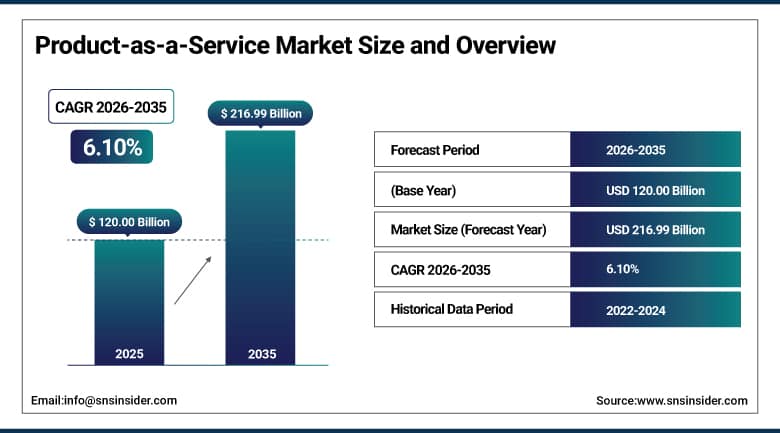
The Product-as-a-Service Market size was valued at USD 120.00 Billion in 2025 and is projected to reach USD 216.99 Billion by 2035, expanding at a CAGR of 6.10% during the forecast period 2026–2035.
Product-as-a-Service (PaaS) is revolutionizing the process of procurement and use of physical assets for organizations moving away from asset ownership to consumption of assets based on subscriptions and outcomes. Rather than spend huge investments in equipment, companies are looking for flexible access to products along with maintenance, monitoring, up gradation, and management services. Organizations are able to manage their expenses effectively, improve efficiency, minimize downtime, and speed up digital transformations through such a model. The convergence of Internet-of-Things enabled connected devices, predictive analytics, cloud-based asset management systems, and AI enabled monitoring systems is enhancing the business case of Product-as-a-Service in manufacturing, healthcare, IT infrastructure, mobility, and industrial domains.
Increasing focus on the concepts of circular economy, sustainability, and resource efficiency is fueling the demand for Product-as-a-Service. Companies are rethinking their entire business models by owning the products while deriving continuous income streams from their customers. Through digital twins, predictive maintenance software, remote diagnostics, and connected asset ecosystem, organizations are optimizing their equipment operations during the entire product lifecycle.
Market Size and Forecast
-
Market Size 2026E: USD 127.30 Billion
-
Market Size 2035: USD 216.99 Billion
-
CAGR: 6.10% from 2026 to 2035
-
Fastest Growing Region: Asia Pacific
-
Largest Region: North America
To Get More Information On Product-as-a-Service Market - Request Free Sample Report
Product-as-a-Service Market Trends
-
Rising transition from product ownership to subscription- and outcome-based business models across industries.
-
Increasing deployment of IoT-connected products for real-time monitoring and predictive service delivery.
-
Growing adoption of AI-driven predictive maintenance and digital twin technologies for lifecycle optimization.
-
Expansion of circular economy initiatives encouraging product reuse, refurbishment, and sustainability.
-
Increasing integration of cloud-based asset management platforms with automated billing and contract lifecycle management.
U.S. Product-as-a-Service Market Size Outlook
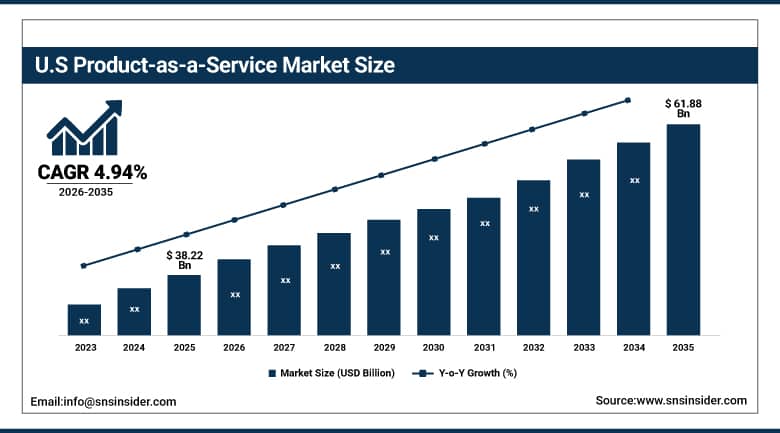
The U.S. Product-as-a-Service Market was valued at USD 38.22 billion in 2025 and is expected to reach approximately USD 61.88 billion by 2035, expanding at a CAGR of 4.94% during 2026–2035.
The United States continues to dominate the North American Product-as-a-Service Market thanks to the growing adoption of the subscription-based business model in the manufacturing industry, healthcare, enterprise IT services, mobility, and industrial automation. Companies are shifting from capital-intensive buying to subscription-based procurement models where equipment, software, maintenance, analytics, and lifecycle management is included in one service contract. Mature cloud infrastructure, development of IoT technologies, artificial intelligence-driven asset intelligence, and enterprise digital transformation contribute to faster market growth. Businesses use Product-as-a-Service models to become more flexible, efficient in the use of assets, cut the cost of maintenance, and achieve sustainability goals at the same time, thus generating stable recurrent revenues for manufacturers.
Product-as-a-Service Market Segment Analysis
-
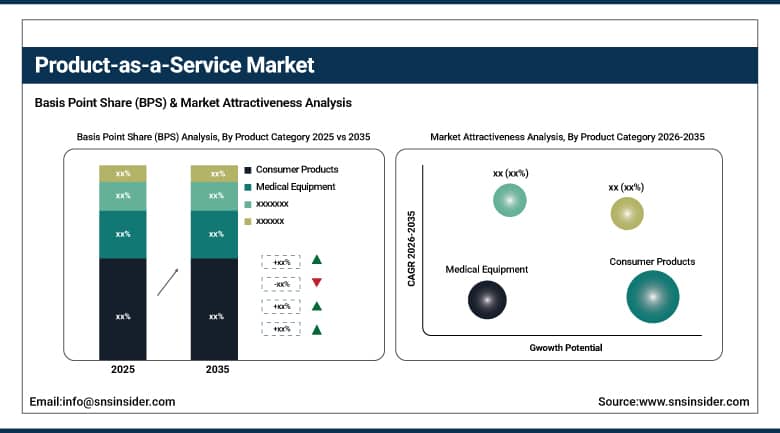
By Product Category, consumer products dominated the market with 30.00% share in 2025, while medical equipment is projected to witness the fastest growth with 7.75% CAGR during the forecast period.
-
By Service Model, subscription/access-based dominated the market with 34.00% share in 2025, while performance/outcome-based is projected to witness the fastest growth with 8.15% CAGR during the forecast period.
-
By Technology, IoT-connected asset platforms dominated the market with 31.00% share in 2025, while digital twins & remote monitoring is projected to witness the fastest growth with 9.83% CAGR during the forecast period.
-
By End User, large enterprises dominated the market with 43.00% share in 2025, while small & medium-sized enterprises are projected to witness the fastest growth with 8.13% CAGR during the forecast period.
By Product Category, consumer products dominated, while medical equipment fastest-growing.
Consumer products emerged as the leading product-as-a-service market segment, holding a 30.00% share of revenues in 2025. The domination is due to growing consumer inclination towards accessing the products of electronics, home appliances, personal devices, and smart products via subscription service as against ownership. The manufacturers are increasingly incorporating maintenance services, software updates, warranty, and replacement service packages along with the products for retaining the customers and creating ongoing revenue sources. The development is supported by digital commerce, connected product ecosystem, and circular economy.
The fastest CAGR of 7.75% is predicted by the medical equipment segment in the forecast period. Increasingly, the healthcare providers are resorting to Product-as-a-Service approach to access the advanced diagnostic imaging equipment, patient monitoring equipment, lab equipment, and surgical equipment without making any heavy upfront capital investments. The subscription service for the medical equipment provides greater financial flexibility besides ensuring ongoing software updates, predictive maintenance, regulatory compliance, and greater equipment availability.
By Service Model, subscription/access-based dominated, while performance/outcome-based fastest-growing.
The subscription/access-based segment held the largest market share of 34.00% in 2025. Enterprises within manufacturing, IT, healthcare, and commerce industries have been preferring subscription arrangements as these not only allow the conversion of capital expenditure to consistent operating expenses but simplify budgeting and refreshing cycles of the organizations as well. Service providers offer comprehensive services such as maintenance, software updates, monitoring of assets, technical support, and asset lifecycle management services under subscription arrangement models. The rising use of cloud-driven asset management platforms and digital service ecosystems has enabled the subscription-based models to gain popularity among all the industries. Dell Technologies is offering additional services in their APEX platform enabling the enterprises to use infrastructure, devices, and lifecycle services.
The performance/outcome-based segment is projected to record the highest CAGR of 8.15% throughout the forecast period till 2035. The organizations want service arrangements which are based on performance of equipment, uptime, productivity and business outcomes, not just on ownership or usage basis. With the help of developments in IoT connectivity, analytics, predictive maintenance, and digital twins, service providers can measure the performance of equipment in real time and provide guarantees with respect to service level agreements.
By Technology, IoT-Connected Asset Platforms dominated, while Digital Twins & Remote Monitoring is the fastest-growing.
In terms of market share, the IoT-connected asset platforms segment accounted for a 31.00% share of the Product-as-a-Service Market in 2025. With the proliferation of connected sensors, asset management software, and real-time equipment monitoring solutions, it has become easy for businesses to switch from reactive to intelligent services. Companies use IoT products that collect operational data, manage assets, schedule services, and improve their lifecycle performance. The adoption of IoT solutions has helped enterprises to improve asset visibility, minimize downtime, and enhance recurring service models. Thus, these technologies have emerged as the backbone of Product-as-a-Service platforms.
The digital twins & remote monitoring segment will be the fastest-growing in terms of CAGR of 9.83%. Companies are actively embracing digital twin technology to build virtual replicas of their physical assets, which can be used for performance simulations, predictive diagnostics, and remote operations optimizations. With the help of digital twins, machine learning algorithms, and IoT, service providers can foresee problems, schedule maintenance, decrease operating expenses, and increase the lifespan of equipment. Adoption rates in Industry 4.0 and smart manufacturing environments are expected to grow substantially.
Regional Analysis
|
Region |
Major Country |
Share within Region, 2025 (%) |
|---|---|---|
|
North America |
United States |
91.00% |
|
Europe |
Germany |
31.00% |
|
Asia Pacific |
China |
25.00% |
|
Middle East & Africa |
UAE |
5.00% |
|
Latin America |
Brazil |
4.00% |
North America Product-as-a-Service Market Insights
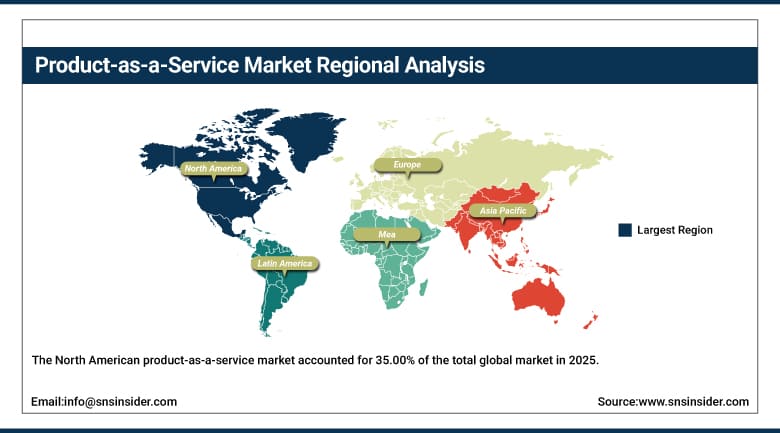
The North American product-as-a-service market accounted for 35.00% of the total global market in 2025. This makes the North American region the dominant regional player. The dominance of the North American market is enabled by the extensive digitization of enterprises, robust cloud architecture, and fast adoption of subscription-based business models in various sectors including manufacturing, healthcare, IT, mobility, and industry. Companies are moving from owning the business model to the service model which integrates connected products, predictive maintenance, lifecycle management, and digital analytics. Significant investments in the Industrial IoT, artificial intelligence enabled asset intelligence, and circular economy drive the growth of the market.
Get Customized Report as Per Your Business Requirement - Enquiry Now
Europe Product-as-a-Service Market Insights
Europe is still recording high adoption of the Product-as-a-Service model as companies continue to emphasize sustainability, efficiency, and the circular economy approach. Germany, UK, France, Italy, and The Netherlands are some of the countries that are increasingly adopting the service business model in order to enhance efficiency and reduce costs and impact on the environment. The regulatory focus on the durability, reparability, and efficient use of resources is encouraging product manufacturers to maintain ownership of the products and provide long-term services. Industrial automation, intelligent manufacturing, and asset connectivity solutions are also enhancing the demand in the region. Schneider Electric is continuously increasing its digital services offering in Europe using connected asset solutions, predictive maintenance solutions, and lifecycle energy-efficient solutions.
Asia Pacific Product-as-a-Service Market Insights
The Asia Pacific region is estimated to experience the fastest CAGR of 9.09%. The fast-paced industrialization, rising manufacturing capabilities, increasing digitization, and adoption of cloud services have generated strong demand for the product-as-a-service model in countries like China, Japan, India, South Korea, and Southeast Asian countries. Businesses are increasingly relying on the use of subscriptions of industrial equipment, IT infrastructures, mobility, and connected technologies to optimize processes without increasing capital investments. The government backing of the digital economy, Industry 4.0, and smart manufacturing initiatives has increased the potential for market growth. The company Siemens is continuously increasing its footprint in digital manufacturing and connected assets in the Asia Pacific region.
Middle East & Africa and Latin America Product-as-a-Service Market Insights
Middle East & Africa’s growth in the areas of smart city development, industrial diversification, digital infrastructure, and advanced manufacturing has led to increased use of equipment that provides service-based and connected asset management solutions within UAE, Saudi Arabia, and South Africa. Increasing usage of subscription-based technology solutions is observed by companies seeking greater efficiency in their operations and better performance from their assets. ABB Ltd. continues to grow its digital industrial services portfolio in the region via solutions for connected automation, predictive maintenance, and lifecycle management.
Latin America continues growing due to increasing efforts to modernize industrial operations and implement enterprise digital transformation strategies. Countries such as Brazil, Mexico, Chile, and Argentina have started to adopt Product-as-a-Service solution models in order to increase financial flexibility while decreasing the risk of ownership of industrial equipment, enterprise IT, and mobility assets. Expansion of the cloud infrastructure, IoT implementation, and growth of the managed services ecosystem is likely to drive future market growth. Dell Technologies continues growing its subscriptions and Device-as-a-Service portfolios in Latin America.
Growth Drivers: Increased use of subscription business model and circular economic initiatives.
The increased transition of customers from ownership to subscription business models is one of the key drivers for Product-as-a-Service Market growth. There is a clear shift in favor of purchasing services as this helps companies reduce upfront cost investments and ensure regular access to technology through subscriptions. Product producers, on the other hand, are also shifting towards circular economy and retaining ownership of the products while earning repeated revenue through maintenance, upgrading, repairing, and managing the entire lifecycle of the product. In addition to boosting efficiency through IoT devices, predictive maintenance with the help of artificial intelligence, cloud asset management, and digital twins, the inclusion of these technologies extends the lifecycle of the product.
Restraints: Complicated contract management and expensive implementation.
Despite the importance of market momentum, there is a high cost involved in the adoption of Product-as-a-Service model due to the need for technological infrastructure, cloud computing, IoT sensors, security, analytics, and enterprise system integration. Firms have to restructure their existing sales model from product-oriented one to service-oriented and build up their skills in remote monitoring and preventive maintenance and capabilities of managing the whole lifecycle of the product through financing. There are a number of challenges that an organization will face such as pricing, SLAs, ownership, data management, and jurisdiction issues. Small companies frequently face the difficulty of connecting their connected products to the current enterprise resource planning and asset management systems.
Opportunities: Growth in connected products, lifecycle management driven by AI, and digital services ecosystem.
The rising adoption of Industrial IoT, Artificial Intelligence, cloud computing, and digital twin technology is creating great opportunities for Product-as-a-Service players around the world. Connected products with the capability of real-time monitoring can help organizations optimize the performance, maintain the product, conduct diagnostics, and provide service remotely throughout the product lifecycle. Enterprises want integrated digital ecosystems that integrate all aspects of hardware, software, analytics, maintenance, financing, and sustainability reporting on common subscription platforms. Some of the emerging technologies that can further augment the value proposition include AI-based asset intelligence, lifecycle traceability using block chain, and autonomous service management. The investments in smart manufacturing, connected healthcare, intelligent mobility, and sustainable infrastructure will keep opening up opportunities for Product-as-a-Service models.
Recent Developments
-
2026: HP Inc. expanded its Device-as-a-Service (DaaS) portfolio by introducing enhanced AI-powered device lifecycle management, predictive analytics, and security capabilities, enabling enterprises to improve endpoint performance, automate fleet management, and support hybrid work environments.
-
2025: Dell Technologies strengthened its Dell APEX portfolio with expanded as-a-service infrastructure offerings, providing organizations with greater flexibility through subscription-based compute, storage, device, and multicloud solutions while improving operational scalability and cost optimization.
-
2025: Siemens enhanced its Siemens Xcelerator digital business platform by expanding industrial digital twin, IoT connectivity, and lifecycle service capabilities to accelerate Product-as-a-Service adoption across manufacturing, infrastructure, and industrial automation sectors.
-
2026: Schneider Electric expanded its EcoStruxure platform with advanced AI-driven predictive maintenance, remote asset monitoring, and sustainability analytics, helping enterprises optimize equipment performance while supporting subscription-based service and circular economy business models.
Product-as-a-Service Companies are:
-
HP Inc.
-
Siemens AG
-
Schneider Electric SE
-
ABB Ltd.
-
Koninklijke Philips N.V.
-
Caterpillar Inc.
-
Xerox Holdings Corporation
-
Hilti Corporation
-
Rolls-Royce plc
-
Signify N.V.
-
Atlas Copco AB
-
Kaeser Kompressoren SE
-
Interface, Inc.
-
Michelin Group
-
Trane Technologies plc
-
Komatsu Ltd.
-
Hitachi, Ltd.
-
Bosch Rexroth AG
Product-as-a-Service Market Report Scope:
| Report Attributes | Details |
|---|---|
| Market Size in 2025 | USD 120.00 Billion |
| Market Size by 2035 | USD 216.99 Billion |
| CAGR | CAGR of 6.10% From 2026 to 2035 |
| Base Year | 2025 |
| Forecast Period | 2026-2035 |
| Historical Data | 2022-2024 |
| Report Scope & Coverage | Market Size, Segments Analysis, Competitive Landscape, Regional Analysis, DROC & SWOT Analysis, Forecast Outlook |
| Key Segments | • By Product Category (Consumer Products, Industrial Equipment, Medical Equipment, IT Hardware, Mobility Products) • By Service Model (Subscription/Access-Based, Pay-per-Use, Performance/Outcome-Based, Managed Lifecycle, Others) • By Technology (IoT-Connected Asset Platforms, Predictive Maintenance, Digital Twins & Remote Monitoring, Billing & Contract Lifecycle, Others) • By End User (Large Enterprises, Small & Medium-Sized Enterprises, Public Sector & Institutions, Households & Consumers, Others) |
| Regional Analysis/Coverage | North America (US, Canada), Europe (Germany, UK, France, Italy, Spain, Russia, Poland, Rest of Europe), Asia Pacific (China, India, Japan, South Korea, Australia, ASEAN Countries, Rest of Asia Pacific), Middle East & Africa (UAE, Saudi Arabia, Qatar, South Africa, Rest of Middle East & Africa), Latin America (Brazil, Argentina, Mexico, Colombia, Rest of Latin America). |
| Company Profiles | HP Inc., Dell Technologies Inc., Siemens AG, Schneider Electric SE, ABB Ltd., Koninklijke Philips N.V., Cisco Systems, Inc., Caterpillar Inc., Xerox Holdings Corporation, Hilti Corporation, Rolls-Royce plc, Signify N.V., Atlas Copco AB, Kaeser Kompressoren SE, Interface, Inc., Michelin Group, Trane Technologies plc, Komatsu Ltd., Hitachi, Ltd., Bosch Rexroth AG |
Frequently Asked Questions
North America dominated the global Product-as-a-Service Market in 2025.
The Consumer Products segment accounted for the largest market share of 30.00% in 2025.
The market is expected to expand at a CAGR of 6.10% during the forecast period.
The market is projected to reach USD 216.99 Billion by 2035.
The Product-as-a-Service Market was valued at USD 120.00 Billion in 2025.
