
Drilling Stabilizers Market Report Scope & Overview:
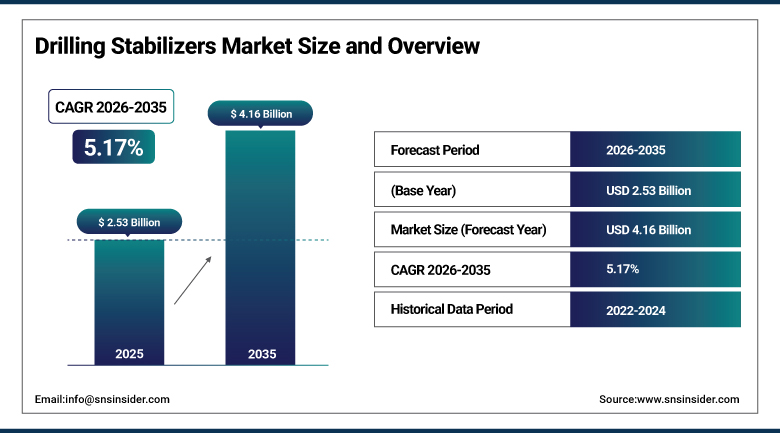
The Drilling Stabilizers Market was valued at USD 2.53 Billion in 2025 and is expected to reach USD 4.16 Billion by 2035, growing at a CAGR of 5.17% from 2026 to 2035.
The drilling stabilizers market is a foundational segment of the global oilfield equipment and services industry, providing essential functions in wellbore stabilization, borehole trajectory control, and bottom-hole assembly centralization. These tools are critical for safe, efficient, and technically precise drilling across onshore and offshore oil and gas operations, as well as geothermal energy development and mining applications. Drilling stabilizers keep the drill string centered within the borehole, helping prevent lateral deviation, reduce differential sticking, and minimize vibration-related fatigue on downhole equipment. They also support directional drilling accuracy, enabling modern wells to achieve precise trajectory control required for complex reservoir targeting and horizontal well completion designs.
In 2025, sustained oil price stability in the USD 70–85 per barrel range, combined with supportive capital expenditure policies from national oil companies in the Middle East and continued expansion of unconventional tight oil and shale gas drilling in North America, maintained steady global drilling activity and consistent demand for advanced stabilizer systems. During this period, several oilfield service companies, including Baker Hughes and Halliburton, introduced upgraded drilling tool and bottom-hole assembly (BHA) solutions through product development initiatives and field optimization programs. In addition, collaborative efforts between operators, service providers, and technology partners focused on improving drilling efficiency, reducing well construction costs, and enhancing stabilizer performance in mature and high-complexity drilling basins.
To Get more information Drilling Stabilizers Market - Request Free Sample Report
Drilling Stabilizers Market Trends
-
Rising adoption of tungsten carbide-hard faced and PDC-reinforced stabilizer blades is extending tool run life in abrasive formations, reducing per-well tool replacement costs.
-
Growing deployment of non-rotating stabilizer systems in extended-reach and horizontal wellbore applications is reducing borehole wall friction, improving weight-on-bit transmission.
-
Increasing integration of downhole vibration and shock measurement sensors within stabilizer bodies is enabling real-time BHA dynamics monitoring.
-
Expanding geothermal energy drilling activity creating new application demand for high-temperature-rated stabilizer systems engineered for the elevated formation temperatures and hard crystalline rock conditions
-
Progressive adoption of automated directional drilling and rotary steerable systems is generating demand for precision-manufactured stabilizer gauges.
The U.S. Drilling Stabilizers Market Outlook
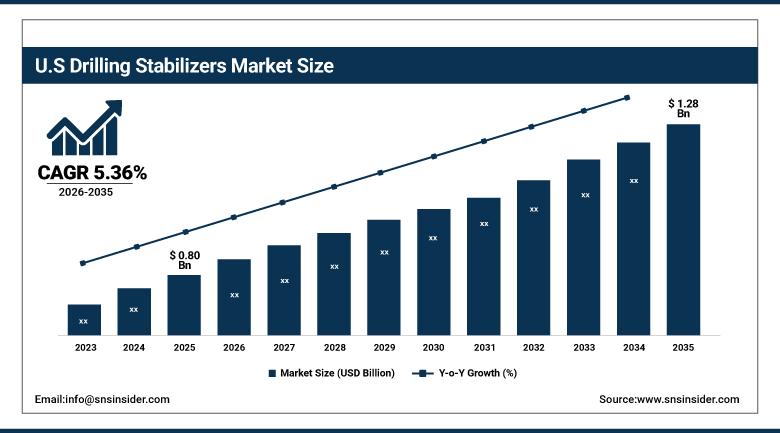
The U.S. Drilling Stabilizers Market was valued at approximately USD 0.80 Billion in 2025 and is expected to reach approximately USD 1.28 Billion by 2035, growing at a CAGR of approximately 5.36%.
The United States is the world's most active drilling market by rig count and the largest single national consumer of drilling stabilizer equipment, driven by the structural scale and technological intensity of its unconventional tight oil and shale gas drilling industry whose horizontal well drilling programs in the Permian Basin, Eagle Ford Shale, Bakken Formation, Haynesville Shale, and Marcellus and Utica plays generate consistent high-volume demand for premium stabilizer products capable of delivering reliable gauge maintenance, vibration damping performance, and directional compatibility across the high-dogleg, extended-reach lateral wellbore geometries that characterize modern multi-stage hydraulic fracturing completion programs.
The U.S. Department of Energy's Office of Fossil Energy and Carbon Management, under its USD 580 Million Unconventional Resources Technology Program, co-funded a joint field development initiative with Baker Hughes to engineer and commercialize a next-generation rotary stabilizer series optimized for extended-reach Permian Basin horizontal drilling programs. Field deployment across 34 qualifying wells in the Midland and Delaware sub-basins demonstrated a 23% reduction in average stabilizer replacement frequency per lateral, a 17% improvement in weight-on-bit transmission efficiency, and an aggregate well construction cost saving of approximately USD 180,000 per well compared with legacy BHA stabilizer configurations, directly supporting operator capital efficiency objectives within the U.S. unconventional drilling recovery program.
Drilling Stabilizers Market Segment Analysis
-
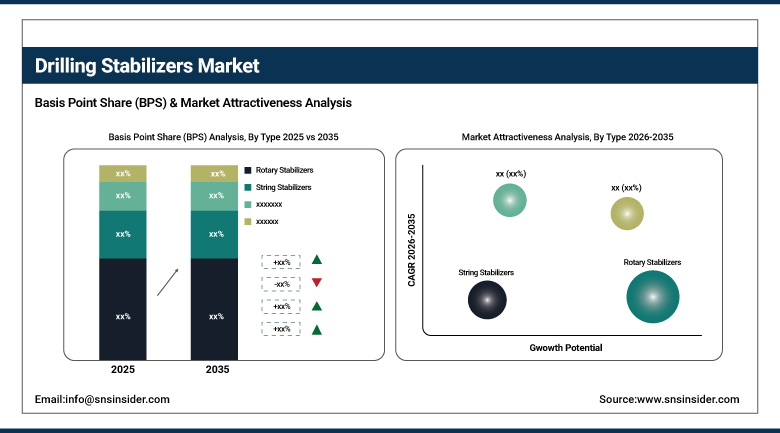
By Type, the rotary stabilizers segment dominated the drilling stabilizers market with 25.78% share in 2025, while the non-rotating stabilizers segment is the fastest growing type with the highest CAGR of 6.18% from 2026 to 2035.
-
By Material, the steel stabilizers segment dominated the drilling stabilizers market with 31.56% share in 2025, while the tungsten carbide stabilizers segment is the fastest growing material type with the highest CAGR of 6.21% from 2026 to 2035.
-
By Application, the onshore drilling segment dominated the drilling stabilizers market with 35.69% share in 2025, while the offshore drilling segment is the fastest growing application with the highest CAGR of 6.14% from 2026 to 2035.
-
By End User, the oil & gas companies segment dominated the drilling stabilizers market with 40.82% share in 2025, while the geothermal energy operators segment is the fastest growing end user category with the highest CAGR of 6.65% from 2026 to 2035.
By Type, rotary stabilizers dominate the drilling stabilizers market, non-rotating stabilizers grow fastest
Rotary stabilizers accounted for 25.78% of drilling stabilizers market revenue in 2025, reflecting their fundamental role as the baseline BHA centralization and gauge maintenance tool across the broadest range of vertical, directional, and horizontal drilling applications in conventional and unconventional formations globally. Rotary stabilizers rotate with the drill string, providing continuous borehole wall contact and consistent lateral support for the BHA across the full range of rotary drilling applications that constitute the majority of global drilling activity. Their mechanical simplicity, broad formation compatibility, and well-understood performance characteristics across diverse drilling environments make them the default stabilizer specification for the majority of BHA designs assembled by drilling engineers and directional drilling service.
Non-rotating stabilizers represent the fastest-growing type segment in the drilling stabilizers market, driven by rising adoption in extended-reach and horizontal drilling operations across unconventional tight oil and deep offshore reservoirs. Their design reduces rotational torque and improves tool efficiency in high-inclination wellbores, enabling longer lateral sections and more precise directional control. This enhances weight-on-bit transmission and overall drilling performance in complex geological formations. Additionally, reduced contact-induced vibration and borehole wall damage helps improve wellbore quality and strengthens cement bonding integrity in production casing programs. These performance advantages are accelerating their preference over conventional stabilizer types in high-complexity drilling environments.
By Material, steel stabilizers dominate the drilling stabilizers market, tungsten carbide stabilizers grow fastest
Steel stabilizers accounted for 31.56% of drilling stabilizers market revenue in 2025, reflecting the material's combination of machinability, mechanical toughness, dimensional stability, and cost competitiveness that makes it the standard material platform for the majority of commercially deployed stabilizer bodies across conventional drilling applications where formation abrasivity and wellbore temperature conditions do not exceed the performance envelope of API-grade alloy steel construction with standard hardfacing overlay coatings. The broad availability of steel stabilizer products across the global oilfield equipment supply chain, including from domestic manufacturers, sustains the material's dominant market share position through competitive pricing dynamics that make steel the default specification in cost-sensitive drilling markets.
Tungsten carbide stabilizers represent the fastest-growing material segment in the drilling stabilizers market, driven by increasing economic justification for premium hardfacing solutions in highly abrasive drilling environments. These include silica-rich sandstone, chert-interbedded shale, and hard carbonate formations, where conventional materials experience rapid wear. Tungsten carbide offers superior abrasion resistance compared with chromium carbide or crushed carbide overlays, enabling extended blade gauge retention and improved tool life. This results in fewer stabilizer replacements, reduced tripping operations, and lower non-productive rig time. Across multi-well drilling programs, these efficiency gains translate into meaningful reductions in overall well construction costs and improved operational productivity.
By Application, onshore drilling dominates the drilling stabilizers market, offshore drilling grows fastest
Onshore drilling accounted for 35.69% of drilling stabilizers application revenue in 2025. The structural primacy of onshore drilling as the largest application segment reflects the global distribution of hydrocarbon resource development activity, with the majority of global active rig count concentrated in onshore basins across North America, the Middle East, Russia, China, Latin America, and Africa whose combined well construction programs represent the foundational demand base for drilling stabilizer consumption. The North American onshore unconventional drilling industry alone accounts for a disproportionate share of global stabilizer demand through its high-intensity horizontal drilling programs whose BHA designs require multiple stabilizer placements per assembly and whose high-volume pad drilling operations generate consistent, predictable tool procurement demand.
Offshore drilling represents the fastest-growing application segment, driven by the resumption of deepwater and ultra-deepwater drilling investment cycles in the Gulf of Mexico, pre-salt Brazil, West Africa, and the Eastern Mediterranean following the upstream capital discipline cycle of 2020–2022, combined with the sustained expansion of offshore drilling activity in the Middle East, Southeast Asia, and the North Sea where national oil companies and international operators are pursuing offshore reserve development programs whose technical complexity and high dayrate operating cost environments create premium demand for high-performance stabilizer systems that maximize drilling efficiency and minimize non-productive time.
By End User, Oil & Gas Companies dominate, Geothermal Energy Operators grow fastest
Oil & gas companies accounted for 40.82% of drilling stabilizers market revenue in 2025, reflecting their structural dominance as primary upstream operators driving global drilling activity. This leadership is driven by the capital-intensive nature of hydrocarbon exploration and production, where stabilizers form essential components of bottom-hole assemblies in both conventional vertical wells and increasingly complex directional and horizontal drilling operations. The segment’s strength is reinforced by concentrated drilling activity among national oil companies and international oil companies across North America, the Middle East, Russia, and offshore basins. Large-scale well construction programs in these regions ensure steady demand for high-performance stabilizers that improve borehole integrity, reduce vibration, and enhance rate of penetration.
Geothermal energy operators represent the fastest-growing end user category in the drilling stabilizers market, driven by accelerating global demand for renewable baseload energy and the increasing use of geothermal systems for decarbonized heat and power generation. Growth is supported by government-led clean energy transition policies across Europe, North America, and parts of Asia-Pacific, alongside rising private investment in enhanced geothermal systems (EGS). These projects require deep, high-temperature directional drilling similar in complexity to unconventional oil & gas wells. Such demanding conditions increase the need for advanced stabilizer systems that maintain directional accuracy and performance under extreme downhole environments, driving strong segment expansion.
Regional Analysis
|
Region |
Major Country |
Share within Region, 2025 (%) |
|---|---|---|
|
North America |
United States |
79.34% |
|
Europe |
Germany |
28.47% |
|
Asia Pacific |
China |
38.74% |
|
Middle East & Africa |
UAE |
21.38% |
|
Latin America |
Brazil |
46.84% |
North North America Drilling Stabilizers Market Insights
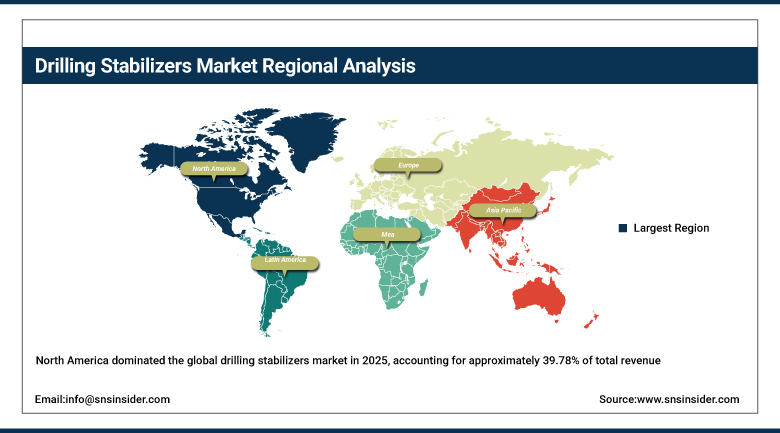
North America dominated the global drilling stabilizers market in 2025, accounting for approximately 39.78% of total revenue, with the United States contributing nearly 79.34% of regional demand. This leadership is driven by the scale and technical intensity of unconventional oil and gas drilling activity, particularly horizontal well programs across the Permian, Appalachian, Williston, and Mid-Continent basins. High-frequency pad drilling operations and complex bottom-hole assembly requirements result in elevated stabilizer consumption rates. The region’s dominance is further supported by strong oilfield equipment manufacturing and innovation hubs in Houston and Alberta, where continuous engineering advancements enhance tool durability, precision, and operational efficiency across global drilling applications.
In 2025, Major North American directional drilling service providers launched proprietary bottom-hole assembly (BHA) modeling software that analyzes stabilizer gauge wear data from previous drilling runs. This enables more accurate prediction of optimal blade replacement intervals and supports refined BHA design adjustments for subsequent wells drilled on the same pad. The use of predictive analytics improves stabilizer utilization efficiency, reduces unplanned tool failures, and enhances drilling performance. It also lowers total tool inventory requirements, supporting more cost-effective and streamlined operations across multi-well pad drilling campaigns in the region.
Get Customized Report as per Your Business Requirement - Enquiry Now
Europe Drilling Stabilizers Market Insights
Europe accounted for approximately 15.96% of global drilling stabilizers revenue in 2025. The regional market is characterized by a mature yet highly technical offshore drilling base in the North Sea, alongside expanding geothermal drilling activity across Germany, the Netherlands, Iceland, Italy, and the United Kingdom. Additionally, ongoing onshore oil and gas exploration in Romania, Poland, and Norway contributes steady demand. Across these markets, operators typically require high-specification stabilizers with strict dimensional tolerances and advanced material performance characteristics. This combination of offshore complexity, energy transition drilling, and selective upstream exploration supports consistent demand for premium stabilizer systems throughout the European region.
The European Commission's REPowerEU energy security framework, which committed over EUR 300 Billion in clean and domestic energy infrastructure investment through 2030, has directly stimulated deep geothermal and domestic hydrocarbon drilling activity across member states. The Federal Ministry for Economic Affairs and Climate Action's Geothermal Action Programme, which allocated USD 180 Million in 2024–2025 to accelerate deep geothermal well construction in the Upper Rhine Graben and the Bavarian Molasse Basin. Halliburton and Equinor jointly qualified a new tungsten carbide non-rotating stabilizer series in 2025 through a structured field trial program across three Norwegian Continental Shelf development wells, demonstrating a 22% reduction in stabilizer-induced borehole tortuosity and a 17% improvement in lateral weight-on-bit transmission efficiency compared with legacy rotary stabilizer BHA configurations.
Asia Pacific Drilling Stabilizers Market Insights
Asia Pacific is the second-largest regional market, accounting for approximately 28.47% of global drilling stabilizers revenue in 2025 and expanding at a steady growth rate through 2035. China represents 38.74% of regional demand, driven by large-scale onshore and offshore drilling programs led by CNPC, CNOOC, and Sinopec across the Tarim, Ordos, and Sichuan basins, as well as the South China Sea. These extensive well construction activities make China the largest drilling market in the region. Additional demand comes from Southeast Asia, Australia, and South Korea through active offshore and onshore operations. Growing geothermal development in Indonesia, the Philippines, and New Zealand further supports demand for high-temperature stabilizer systems.
China's National Energy Administration, under its 14th Five-Year Plan allocating CNY 2.4 Trillion toward domestic energy security, directly accelerated CNPC and Sinopec's deep shale drilling programs in the Sichuan and Tarim basins, prompting Schlumberger and CNPC to jointly develop a high-torque non-rotating stabilizer series in 2025 specifically engineered for China's deep ultra-high-pressure formations, delivering a 19% improvement in lateral drilling efficiency across pilot deployments. In Indonesia, Pertamina and NOV collaborated in 2025 under the government's geothermal 5.5 GW capacity expansion target to field-qualify high-temperature stabilizer assemblies for deep geothermal wellbores, successfully completing trials across four Sumatra geothermal wells with zero stabilizer-related non-productive time events recorded.
Middle East & Africa and Latin America Drilling Stabilizers Market Insights
Middle East & Africa and Latin America represent among the most dynamic growth regions in the drilling stabilizers market, driven by expanding national oil company capital expenditure, renewed offshore development programs, and sustained onshore exploration drilling activity. These regions are experiencing above-average growth compared to more mature markets due to large-scale upstream investment cycles and increasing deployment of complex directional and deepwater drilling technologies. In Latin America, Brazil accounts for approximately 46% of regional revenue, supported by Petrobras’s extensive pre-salt deepwater drilling operations in the Santos and Campos basins. These ultra-deepwater wells, characterized by high pressure and complex wellbore geometries, generate strong demand for advanced, high-performance stabilizer systems.
The UAE's Ministry of Energy and Infrastructure, under its Net Zero 2050 Strategic Initiative, supported ADNOC's offshore field expansion program in the Lower Zakum and Umm Shaif reservoirs, where SLB and ADNOC Drilling jointly qualified a tungsten carbide non-rotating stabilizer platform in 2024 that delivered a 31% improvement in extended-reach lateral drilling efficiency across UAE offshore BHA configurations. In East Africa, Mozambique's National Petroleum Institute (INP) partnered with TotalEnergies under the government's Rovuma LNG development framework to qualify premium stabilizer systems for deep offshore frontier drilling conditions, with NOV supplying a newly engineered replaceable sleeve stabilizer series in 2025 that reduced tool reconditioning turnaround time by 38% across Mozambique Basin deepwater well campaigns, supporting the region's emergence as a significant new demand center for advanced drilling equipment.
Market Dynamics
Growth Drivers: Recovery in global upstream capital expenditure and unconventional drilling activity expansion is sustaining structural stabilizer market demand
The sustained recovery of global upstream oil and gas capital expenditure following the capital discipline cycle of 2020–2022 is a key growth driver for the drilling stabilizers market. Supported by relatively stable oil prices in the USD 70–85 per barrel range and increased energy security priorities among national oil companies in the Middle East, Southeast Asia, and Africa, global drilling activity and active rig counts have steadily increased. This expansion directly translates into higher demand for drilling stabilizers across major regions. Additionally, the structural shift toward horizontal and directional drilling in global well construction, driven by unconventional tight oil and shale gas development, continues to intensify stabilizer usage per well and support long-term market growth.
The UAE Ministry of Energy and Infrastructure, under its Net Zero 2050 Strategic Initiative and ADNOC's USD 150 Billion five-year upstream investment plan delivered a corrosion-resistant alloy non-rotating stabilizer series engineered for the high-salinity, sour-service formation conditions of the Abu Dhabi offshore environment, with field qualification results across 16 offshore development wells demonstrating a 34% extension in average tool run life, a 22% reduction in borehole wall contact friction in high-inclination wellbore sections, and a USD 67,000 per-well reduction in drilling tool procurement costs compared with previously specified international supplier stabilizer configurations.
Restraints: Volatile upstream capital expenditure cycles and competitive pricing pressure from low-cost manufacturing create market uncertainty
The drilling stabilizers market is inherently exposed to cyclical fluctuations in global upstream oil and gas capital expenditure, which is highly sensitive to oil price volatility, demand outlook uncertainty, and operator balance sheet discipline. These factors can trigger rapid and substantial reductions in drilling activity within one to two fiscal quarters when commodity prices decline and capital budgets are revised. The 2020 downturn highlighted this risk, when global rig counts fell by more than 50% within six months of oil price deterioration. This sharp contraction led to severe demand destruction across oilfield equipment markets, placing significant financial pressure on stabilizer manufacturers due to fixed production costs and inventory carrying burdens during periods of low activity.
Opportunities: Geothermal energy drilling expansion and digital downhole monitoring integration represent high-growth technology frontiers
The accelerating global investment in geothermal energy development, driven by energy transition policies that recognize deep geothermal as a baseload renewable energy source, is creating steadily growing demand for specialized drilling stabilizer systems. These systems are engineered for the high-temperature, hard rock, and corrosive fluid conditions typical of deep geothermal wellbores, which often exceed the performance limits of conventional oil and gas stabilizers. As geothermal projects expand in scale and depth, the need for more durable and thermally resistant stabilizer designs is increasing. Additionally, the integration of downhole sensors and telemetry into stabilizer bodies represents an emerging innovation opportunity, transforming stabilizers into active data-gathering components within intelligent drilling assemblies.
Brazil's Agência Nacional do Petróleo (ANP), under its Petrobras Strategic Plan 2025–2029 jointly developed platform, qualified across nine pre-salt development wells in 2025, delivered a 31% reduction in stabilizer-induced borehole tortuosity, a 24% improvement in lateral section drilling efficiency, and reduced average tool reconditioning turnaround time by 36% through its field-interchangeable blade insert design, supporting Petrobras's capital discipline objectives within its accelerating deepwater rig utilization program.
Recent Developments:
-
2026: Baker Hughes advanced its TerrAdapt adaptive stabilizer technology platform by introducing new blade geometry configurations specifically engineered for high-abrasivity carbonate and chert formations in the Middle East and North Africa, delivering extended gauge maintenance performance that reduces stabilizer replacement frequency in challenging offset well programs across active Saudi Arabian and UAE development drilling campaigns.
-
2026: Halliburton expanded its drilling stabilizer product line with a new series of high-temperature non-rotating stabilizer systems rated for continuous operation at wellbore temperatures exceeding 300°C, targeting the growing deep geothermal energy drilling market in Europe and North America where conventional elastomeric bearing stabilizer systems fail prematurely in the elevated temperature environments characteristic of deep crystalline basement geothermal reservoir targets.
-
2025: National Oilwell Varco (NOV) introduced a new generation of modular replaceable sleeve stabilizers incorporating tungsten carbide hardfaced blade inserts that can be field-replaced without full tool body replacement, reducing stabilizer total cost of ownership in high-wear formation environments by enabling worn blade elements to be exchanged at the rig site during connection intervals rather than requiring full tool pull-out-of-hole and shop reconditioning cycles.
-
2025: Schlumberger (SLB) integrated real-time downhole vibration monitoring sensors within its drilling stabilizer assemblies as part of its Performance Live drilling optimization service, enabling continuous BHA dynamics data acquisition that allows directional drillers to identify resonance-induced vibration events and adjust rotational speed and weight-on-bit parameters in real time to protect premium bit and motor components from fatigue damage.
Drilling Stabilizers MarketKey Players are:
-
Baker Hughes Company
-
Halliburton Company
-
Schlumberger Limited (SLB)
-
National Oilwell Varco (NOV)
-
Weatherford International plc
-
Hunting PLC
-
Drillmaster Inc.
-
Ulterra Drilling Technologies
-
Andergauge Ltd.
-
Kingdream Public Limited Company
-
BICO Drilling Tools Inc.
-
Stabil Drill (Innovex Downhole Solutions)
-
Drill-Quip Inc.
-
Forum Energy Technologies
-
Varel Energy Solutions
-
Dynomax Drilling Tools
-
Abrasive Technology Inc.
-
XTreme Drilling Corp.
-
Cathedral Energy Services
-
Stewart & Stevenson Services Inc.
Drilling Stabilizers Market Report Scope:
| Report Attributes | Details |
|---|---|
| Market Size in 2025 | USD 2.53 Billion |
| Market Size by 2035 | USD 4.16 Billion |
| CAGR | CAGR of 5.17% From 2026 to 2035 |
| Base Year | 2025 |
| Forecast Period | 2026-2035 |
| Historical Data | 2022-2024 |
| Report Scope & Coverage | Market Size, Segments Analysis, Competitive Landscape, Regional Analysis, DROC & SWOT Analysis, Forecast Outlook |
| Key Segments | • By Type (Rotary Stabilizers, String Stabilizers, Near-bit Stabilizers, Non-Rotating Stabilizers, Others), • By Material (Steel Stabilizers, Tungsten Carbide Stabilizers, Integral Blade Stabilizers, Replaceable Sleeve Stabilizers, Others), • By Application (Onshore Drilling, Offshore Drilling, Directional Drilling, Horizontal Drilling, Others), • By End User (Oil & Gas Companies, Drilling Contractors, Geothermal Energy Operators, Mining & Exploration Companies, Others) |
| Regional Analysis/Coverage | North America (US, Canada), Europe (Germany, UK, France, Italy, Spain, Russia, Poland, Rest of Europe), Asia Pacific (China, India, Japan, South Korea, Australia, ASEAN Countries, Rest of Asia Pacific), Middle East & Africa (UAE, Saudi Arabia, Qatar, South Africa, Rest of Middle East & Africa), Latin America (Brazil, Argentina, Mexico, Colombia, Rest of Latin America). |
| Company Profiles | Baker Hughes Company, Halliburton Company, Schlumberger Limited (SLB), National Oilwell Varco (NOV), Weatherford International plc, Hunting PLC, Drillmaster Inc., Ulterra Drilling Technologies, Andergauge Ltd., Kingdream Public Limited Company, BICO Drilling Tools Inc., Stabil Drill (Innovex Downhole Solutions), Drill-Quip Inc., Forum Energy Technologies, Varel Energy Solutions, Dynomax Drilling Tools, Abrasive Technology Inc., XTreme Drilling Corp., Cathedral Energy Services, Stewart & Stevenson Services Inc. |

Frequently Asked Questions
The drilling stabilizers market is expected to grow at a CAGR of 5.17% from 2026 to 2035.
The drilling stabilizers market was valued at USD 2.53 Billion in 2025.
The primary growth factors include rising consumer preference for convenient and resealable packaging, growing demand for lightweight flexible packaging.
The onshore drilling segment dominated the drilling stabilizers market with 46.84% share in 2025.
North America dominated the drilling stabilizers market in 2025, holding approximately 39.78% of global revenues.
