
Hydraulic Pressers Market Report Scope & Overview:
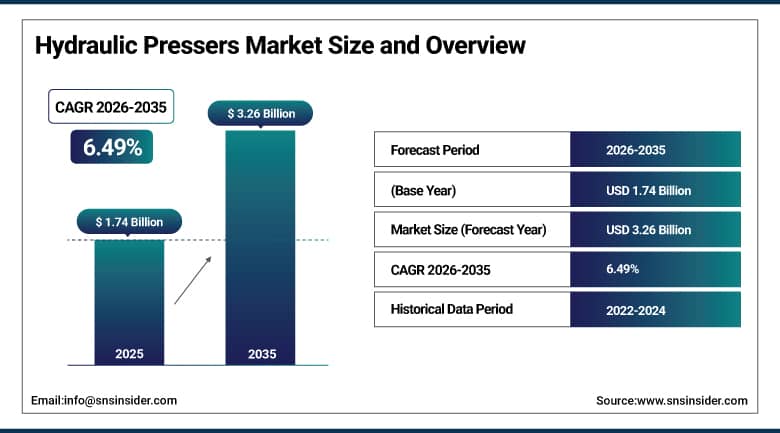
The Hydraulic Pressers Market was valued at USD 1.74 Billion in 2025 and is projected to reach USD 3.26 Billion by 2035, expanding at a CAGR of 6.49% during the forecast period from 2026 to 2035.
Increasing industrial automation, greater investments in precision manufacturing and rising demand for high-performance metal forming equipment in automotive, aerospace, construction and heavy engineering sectors are driving market growth. More and more manufacturers are adopting hydraulic press systems, as they can improve production efficiency, reduce waste of materials and allow more advanced materials to be processed with greater accuracy. The increased adoption of Industry 4.0 technologies, servo-hydraulic systems and programmable control platforms are also further improving equipment productivity, while enabling the modernization of manufacturing facilities throughout both developed and emerging industrial economies.
In 2026 Schuler Group launched AI-enabled hydraulic press automation solutions for better monitoring of production and higher efficiency in manufacturing in automotive plants. In 2025 Beckwood Press Company enhanced its intelligent servo-hydraulic press portfolio with advanced motion control technologies for aerospace, composite material processing and precision industrial manufacturing applications.
To Get More Information On Hydraulic Pressers Market - Request Free Sample Report
Market Trends:
-
Growing adoption of AI-enabled hydraulic press monitoring to improve equipment performance, predictive maintenance, and production efficiency.
-
Increasing deployment of servo-hydraulic press systems for precision metal forming and energy-efficient manufacturing operations.
-
Rising demand for automated hydraulic presses integrated with robotics and Industry 4.0 production environments.
-
Expanding use of hydraulic pressers for lightweight materials including aluminum alloys and advanced composites across automotive and aerospace sectors.
-
Growing investments in smart manufacturing facilities driving upgrades to digitally controlled hydraulic forming and stamping equipment.
U.S. Hydraulic Pressers Market Outlook:
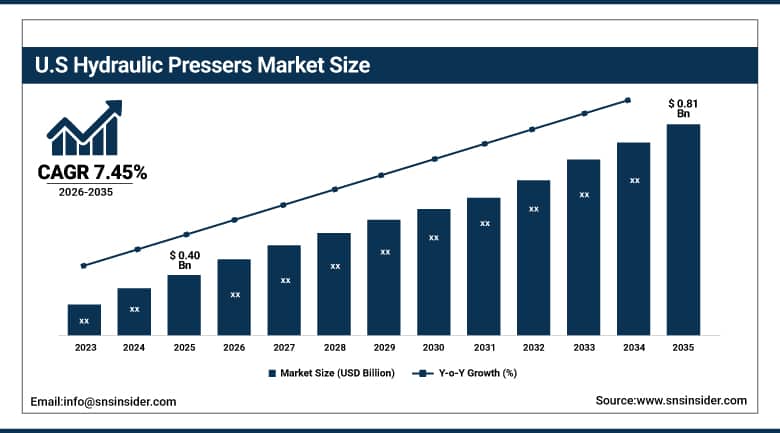
The U.S. Hydraulic Pressers Market was valued at approximately USD 0.40 Billion in 2025 and is expected to reach approximately USD 0.81 Billion by 2035, growing at a CAGR of approximately 7.45% from 2026 to 2035.
The North America Hydraulic Pressers Market was dominated by the U.S. due to its advanced manufacturing base, strong automotive and aerospace industries, and continuous investment in industrial automation. Automotive, defense, heavy machinery and fabricated metal industries are witnessing growing demand for precision metal forming, automated production systems and high-capacity hydraulic pressing equipment which is expected to drive the market growth. The country’s growing electric vehicle manufacturing, smart factory technologies deployment and industrial production facilities modernization continue to drive the market for digitally controlled and energy-efficient hydraulic press systems.
Greenerd Press & Machine Company, Inc. expands its custom engineered hydraulic press solutions for aerospace, defense and heavy industrial manufacturing applications. Pacific Press Holdings has added advanced automation, programmable controls and integrated robotic handling systems to its portfolio of intelligent hydraulic forming equipment for high-volume metal fabrication and precision manufacturing operations throughout the U.S. industrial sector.
Hydraulic Pressers Market Segment Analysis:
-
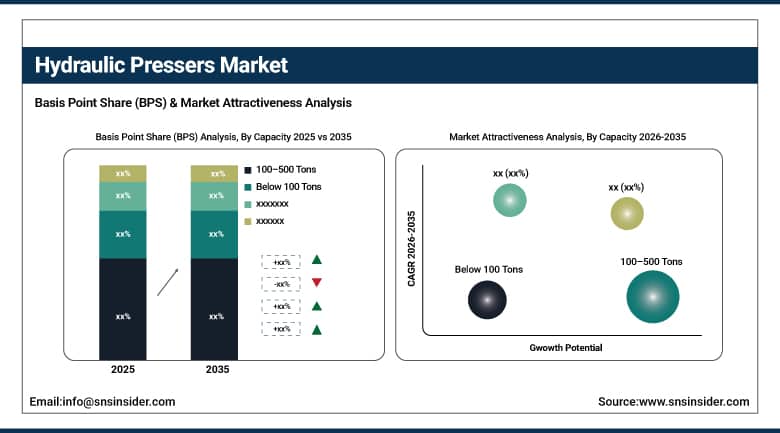
By Capacity, 100–500 Ton Hydraulic Pressers dominated the Hydraulic Pressers Market with 46.00% share in 2025, while Above 500 Ton Hydraulic Pressers are the fastest-growing capacity segment from 2026 to 2035.
-
By Product Type, H-Frame Hydraulic Pressers dominated the Hydraulic Pressers Market with 41.00% share in 2025, while Four-Column Hydraulic Pressers are the fastest-growing product segment from 2026 to 2035.
-
By Application, Metal Forming dominated the Hydraulic Pressers Market with 38.00% share in 2025, while Forging is the fastest-growing application segment from 2026 to 2035.
-
By End User, Automotive dominated the Hydraulic Pressers Market with 43.00% share in 2025, while Aerospace is the fastest-growing end-user segment from 2026 to 2035.
By Capacity, 100–500 Ton Hydraulic Pressers dominate, above 500 Ton Hydraulic Pressers grow fastest
The Hydraulic Pressers Market was dominated by 100–500 tone hydraulic pressers and held about 46.00% revenue share. The versatility and cost effectiveness of this capacity range has made it a popular choice in automotive manufacturing, fabricated metal products, machinery production and industrial component manufacturing. Manufacturers increasingly chose medium-duty hydraulic press systems to support stamping, bending, punching and forming operations while enhancing production throughput, operational flexibility and manufacturing efficiency in a variety of industrial applications.
Hydraulic presses above 500 tones are expected to grow at the fastest CAGR, due to the increasing demand for heavy engineering, aerospace, shipbuilding, railway equipment and large forging industries. Growing production of oversized industrial components and high-strength structural materials is spurring investment in ultra-high-capacity hydraulic press equipment. Strong demand for high-capacity hydraulic pressing solutions globally is still being fueled by the increase in heavy manufacturing infrastructure and the rise in automation in industrial manufacturing facilities.
By Product Type, H-Frame Hydraulic Pressers dominate, Four-Column Hydraulic Pressers grow fastest
H-Frame hydraulic pressers dominated the Hydraulic Pressers Market in 2025, contributing about 41.00% of revenue. Their use in heavy duty metal forming, forging, stamping and assembly operations in automotive, industrial machinery and fabrication industries aided market leadership. As manufacturers found it structurally rigid, had a high load bearing capacity and operated reliably, the H-frame design became increasingly popular. The adoption in large scale industrial manufacturing environments is further driven by growing investments in automated production facilities and precision manufacturing equipment across the globe.
Four-column hydraulic pressers are anticipated to register the fastest CAGR over the forecast period due to the rising demand from high-precision forming, composite molding, and complex industrial fabrication applications. The systems provide excellent load distribution with increased accuracy and more flexibility in processing of lightweight materials. The rapid pace of four-column hydraulic press technology deployment in developed and emerging manufacturing economies is being driven by increasing investments in aerospace manufacturing, composite component production and automated industrial plants.
By Application, Metal Forming dominates, Forging grows fastest
Metal forming dominated the Hydraulic Pressers Market in 2025 and accounted for approximately 38.00% revenue share. Hydraulic press systems remain essential for sheet metal forming, bending, deep drawing, punching, and precision fabrication across automotive, construction equipment, industrial machinery, and consumer durable manufacturing. Increasing production of lightweight metal components, together with rising automation of fabrication processes, continues supporting widespread adoption of hydraulic press technologies for high-volume precision manufacturing operations worldwide.
Forging is expected to register the fastest CAGR throughout the forecast period due to increasing demand for high-strength components across aerospace, defense, automotive, railway, and heavy equipment industries. Manufacturers continue investing in hydraulic forging technologies capable of producing complex components with superior mechanical properties and dimensional accuracy. Growing infrastructure investments and increasing production of heavy industrial equipment are further strengthening demand for advanced forging press systems globally.
By End User, Automotive dominates, Aerospace grows fastest
The Automotive segment dominated the Hydraulic Pressers Market by revenue in 2025, with a share of about 43.00%. Hydraulic press systems are widely used by vehicle manufacturers for body panel stamping, chassis manufacturing, structural component manufacturing and precision assembly operations. Growing global vehicle production, growth in electric vehicle manufacturing, and increasing use of lightweight materials continue to drive investment in advanced hydraulic press equipment that can support automated high-volume manufacturing processes in automotive production facilities.
Aerospace is projected to witness the fastest CAGR during the forecast period owing to increasing aircraft production and rising demand for precision-formed lightweight structural components. Hydraulic press technologies are being used more and more for forming titanium, aluminum alloy and composite material where exceptional dimensional accuracy and material integrity are needed. Growing commercial aviation and defense procurement, plus expanding aerospace manufacturing capacity.
Regional Analysis:
|
Region |
Major Country |
Share within Region, 2025 (%) |
|---|---|---|
|
North America |
United States |
79.75% |
|
Europe |
Germany |
29.60% |
|
Asia Pacific |
China |
41.20% |
|
Middle East |
Saudi Arabia |
31.45% |
|
Latin America |
Brazil |
46.80% |
Asia Pacific Hydraulic Pressers Market Insights
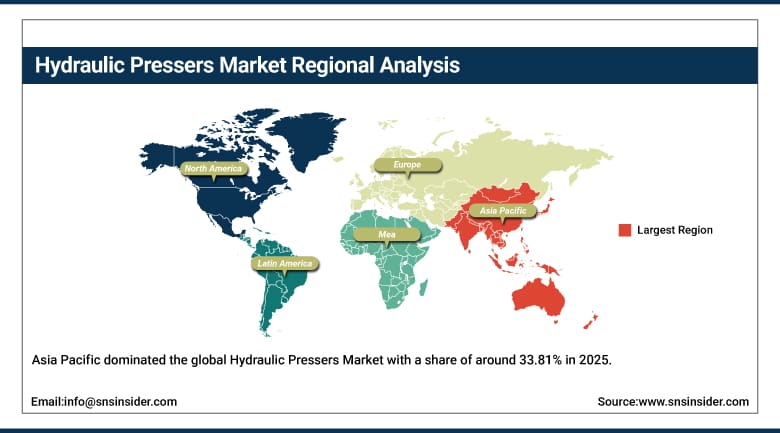
Asia Pacific dominated the global Hydraulic Pressers Market with a share of around 33.81% in 2025. The region’s leadership is maintained through its large manufacturing ecosystem, strong automotive production, growing heavy machinery industry and ongoing investments in industrial infrastructure. Rapid industrialization in major manufacturing economies continues to fuel the large-scale deployment of hydraulic press equipment.
Manufacturers across the region are continuing to invest in factory automation, precision metal forming technologies and high-capacity production facilities to meet growing industrial demand. The region’s leadership in the adoption of hydraulic press equipment is further strengthened by the expansion of infrastructure projects, the increasing export of industrial machinery, and the continued modernization of manufacturing operation.
Get Customized Report as Per Your Business Requirement - Enquiry Now
North America Hydraulic Pressers Market Insights
North America is expected to witness the highest CAGR during the forecast period. In the Asia Pacific rapid investment is being made in smart factories, industrial automation and the modernization of automotive and aerospace manufacturing facilities. Demand across the metal fabrication, defense and heavy equipment manufacturing industries continues to be driven by increased use of Industry 4.0 technologies, robotic production systems and digitally controlled hydraulic presses.
Regional manufacturers are increasingly replacing traditional hydraulic equipment with servo-hydraulic and energy-efficient press systems to improve operational performance and production flexibility. North America sees strong demand for precision hydraulic pressing technologies, fueled by growth in electric vehicle manufacturing, aerospace component production, and investments in advanced manufacturing infrastructure.
Europe Hydraulic Pressers Market Insights
Europe is a big market because of its well-developed industrial machines market, the presence of many automotive, aerospace and metal fabrication manufacturers, and despite all the issues that crop up from time to time. We keep investing in sustainable manufacturing, energy-efficient production technologies and forming equipment to ensure steady market growth. An increasing number of companies are modernizing their production sites to improve their productivity and cut expenses.
The use of intelligent hydraulic press systems is driven by the increasing popularity of digital manufacturing and strict industrial quality requirements. The continuous development of precision engineering and the demand for light metal processing equipment will be favorable to European manufacturers.
Middle East & Africa & Latin America Hydraulic Pressers Market Insights
The Middle East and Latin America are emerging as promising markets with the growth of industrial development, expansion of metal fabrication industries and increasing investments in manufacturing infrastructure. Increasing construction activity, production of mining equipment and industrial diversification programmers are creating new opportunities for hydraulic press installations in a wide spectrum of industrial sectors.
For better production efficiency and product quality, manufacturers are gradually embracing automated hydraulic press systems. The steady market growth is supported by rising government infrastructure investments, growing industrial machinery manufacturing, and rising demand for fabricated metal products in both regions.
Market Dynamics:
Growth Driver: Rising Industrial Automation and Precision Manufacturing Demand
The hydraulic presser’s market is majorly driven by a rise in industrial automation and the increasing demand for precision manufacturing in automotive, aerospace, heavy engineering, and fabricated metal industries. Manufacturers are putting money into sophisticated hydraulic press systems that boost production efficiency, cut material waste, and increase forming accuracy. The growing demand for lightweight metal components and high strength materials is still driving the adoption of digitally controlled hydraulic pressing technologies in the modern manufacturing plants across the globe.
Market growth is being further supported by increasing implementation of Industry 4.0, robotic production lines and servo-hydraulic technologies. Intelligent hydraulic press systems with programmable controls, real-time monitoring and predictive maintenance capabilities allow manufacturers to optimize productivity while reducing downtime. Ongoing investments in the modernization of manufacturing, electric vehicle production, and aerospace component fabrication are expected to sustain long-term demand for advanced hydraulic pressing equipment.
Restraint: High Capital Investment and Equipment Maintenance Costs
The market is challenged by the high capital investment required for the purchase, installation and maintenance of advanced hydraulic press systems. Switching from conventional machinery to automated hydraulic pressing technologies can be a budget challenge for small and medium-sized manufacturers. Specialized maintenance, high installation costs and the need for skilled operators continue to limit equipment adoption in cost sensitive manufacturing sectors.
Also, the changes of steel price, cost of hydraulic components and industrial machinery supply chains affect the cost of equipment and investment of projects. Manufacturers are facing operational challenges due to production downtime for equipment servicing and the rising energy consumption of traditional hydraulic systems. These factors still influence buying decisions, especially in the smaller fabrication shops and upstart industrial businesses.
Opportunity: Expansion of Smart Manufacturing and Servo-Hydraulic Technologies
Growing investments in smart manufacturing and intelligent factory automation present significant growth opportunities for the Hydraulic Pressers Market. Manufacturers are increasingly adopting servo-hydraulic systems, AI-enabled monitoring platforms, and IoT-connected equipment to improve operational efficiency, reduce energy consumption, and enhance production flexibility. Rising demand for precision processing of advanced materials is creating new opportunities for technologically advanced hydraulic press solutions.
The expansion of electric vehicle production, aerospace manufacturing, renewable energy equipment, and heavy industrial infrastructure continues supporting demand for high-performance hydraulic press systems. Integration of robotics, digital twins, automated quality inspection, and predictive maintenance technologies is enabling manufacturers to improve productivity while minimizing operational costs. Continuous technological innovation and industrial modernization initiatives are expected to create sustained market opportunities throughout the forecast period.
Recent Developments:
-
2026: Schuler Group advanced its ServoDirect hydraulic press technology, improving energy efficiency, precision forming, and automated control systems for automotive and industrial metal forming applications globally.
-
2026: Safran invested in a 30,000-ton high-capacity hydraulic press facility in France, strengthening aerospace forging production capabilities and expanding in-house engine component manufacturing.
-
2025: Beckwood Press Company launched Ascent hydraulic press systems, offering pre-engineered smart presses with reduced installation time and improved production efficiency for industrial users.
-
2025: OMCN introduced a new double-speed electro-hydraulic press series, enhancing workshop-level forming speed, precision, and operational productivity across metal fabrication industries.
Key Players:
-
Schuler Group
-
SMS Group
-
Komatsu Ltd.
-
Beckwood Press Company
-
Nippon Steel Engineering
-
Hydraulico Group
-
Yamaha Robotics
-
Macrodyne Technologies Inc.
-
Fagor Arrasate
-
Enerpac Tool Group
-
JIER Machine Tool Group
-
Siempelkamp Group
-
Oshkosh Corporation
-
Accurpress America Inc.
-
Greenerd Press & Machine Company
-
Rajesh Power Press
-
Kempler Industries
-
Hare Press Company
-
Yadon Machinery
-
Aida Engineering Ltd.
Hydraulic Pressers Market Report Scope:
| Report Attributes | Details |
|---|---|
| Market Size in 2025 | USD 1.74 Billion |
| Market Size by 2035 | USD 3.26 Billion |
| CAGR | CAGR of 6.49% from 2026 to 2035 |
| Base Year | 2025 |
| Forecast Period | 2026-2035 |
| Historical Data | 2022-2024 |
| Report Scope & Coverage | Market Size, Segments Analysis, Competitive Landscape, Regional Analysis, DROC & SWOT Analysis, Forecast Outlook |
| Key Segments | • By Product Type (C-Frame Hydraulic Pressers, H-Frame Hydraulic Pressers, Four-Column Hydraulic Pressers, Bench Hydraulic Pressers) • By Capacity (Below 100 Tons, 100–500 Tons, Above 500 Tons) • By Application (Metal Forming, Forging, Stamping, Molding, Assembly Operations) • By End User (Automotive, Aerospace, Manufacturing, Construction, Industrial Machinery) |
| Regional Analysis/Coverage | North America (US, Canada, Mexico), Europe (Eastern Europe [Poland, Romania, Hungary, Turkey, Rest of Eastern Europe] Western Europe] Germany, France, UK, Italy, Spain, Netherlands, Switzerland, Austria, Rest of Western Europe]), Asia Pacific (China, India, Japan, South Korea, Vietnam, Singapore, Australia, Rest of Asia Pacific), Middle East & Africa (Middle East [UAE, Egypt, Saudi Arabia, Qatar, Rest of Middle East], Africa [Nigeria, South Africa, Rest of Africa], Latin America (Brazil, Argentina, Colombia, Rest of Latin America) |
| Company Profiles | Schuler Group, SMS Group, Komatsu Ltd., Beckwood Press Company, Nippon Steel Engineering, Hydraulico Group, Yamaha Robotics, Macrodyne Technologies Inc., Fagor Arrasate, Enerpac Tool Group, JIER Machine Tool Group, Siempelkamp Group, Oshkosh Corporation, Accurpress America Inc., Greenerd Press & Machine Company, Rajesh Power Press, Kempler Industries, Hare Press Company, Yadon Machinery, Aida Engineering Ltd. |
Frequently Asked Questions
The Hydraulic Pressers Market is expected to grow at a CAGR of approximately 4.3%–5.1% during the forecast period.
The Hydraulic Pressers Market was valued at approximately USD 6.2 Billion in 2025.
Rising demand for automotive metal forming, aerospace component manufacturing, and increasing adoption of Industry 4.0-enabled hydraulic automation systems are key growth drivers.
Asia Pacific dominated the Hydraulic Pressers Market in 2025 due to strong manufacturing base, automotive production growth, and rapid industrial automation expansion across China, India, and Japan.
H-frame hydraulic pressers dominated the market in 2025 due to high adoption in automotive stamping, forging, and heavy industrial fabrication applications.
