
Gas Pipeline Infrastructure Market Report Scope & Overview:
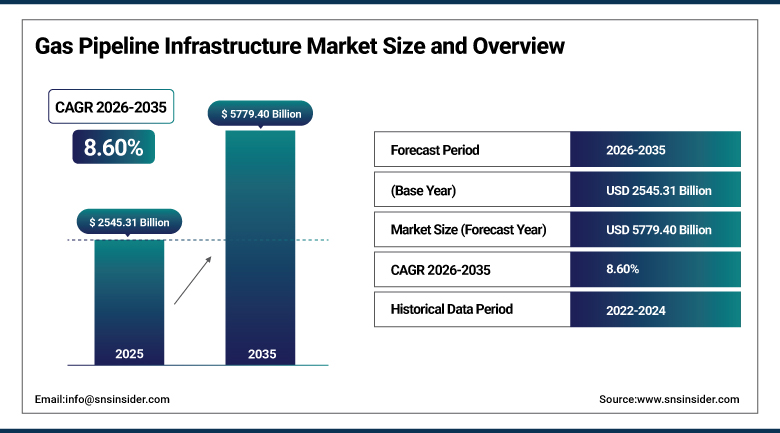
The Gas Pipeline Infrastructure Market was valued at USD 2545.31 billion in 2025 and is expected to reach USD 5779.40 billion by 2035, growing at a CAGR of 8.60% from 2026–2035.
The global gas pipeline infrastructure market is projected to grow on account of increasing natural gas consumption, construction of cross-border energy transportation networks, and rising investments in LNG infrastructure and gas distribution systems across the globe. Demand for gas pipeline infrastructure is strong as governments and energy companies build out transmission and distribution networks to improve energy security, industrial development and access to cleaner-burning fuels. The market is being significantly supported by growing investments in natural gas-fired power generation, industrial gas transportation and LNG import-export facilities during 2025-2026. The expansion of pipeline modernization projects, smart monitoring technologies and regional energy connectivity initiatives also further accelerate infrastructure development globally.
China’s national natural gas pipeline network exceeded 120,000 kilometers during 2025, significantly strengthening natural gas transportation capacity across major industrial regions. The expanding pipeline infrastructure supported growing energy demand, improved supply reliability, and enhanced connectivity between production centers and consumption markets.
To Get more information Gas Pipeline Infrastructure Market - Request Free Sample Report
Gas Pipeline Infrastructure Market Trends
-
Rising natural gas consumption is driving expansion of transmission and distribution pipeline networks globally.
-
Growing LNG trade and terminal development are increasing demand for gas transportation infrastructure.
-
Expansion of city gas distribution projects is supporting investments in regional pipeline networks.
-
Adoption of smart monitoring technologies is improving pipeline safety, efficiency, and reliability.
-
Increasing cross-border gas transportation projects are creating new infrastructure development opportunities worldwide.
The U.S. Gas Pipeline Infrastructure Market Outlook
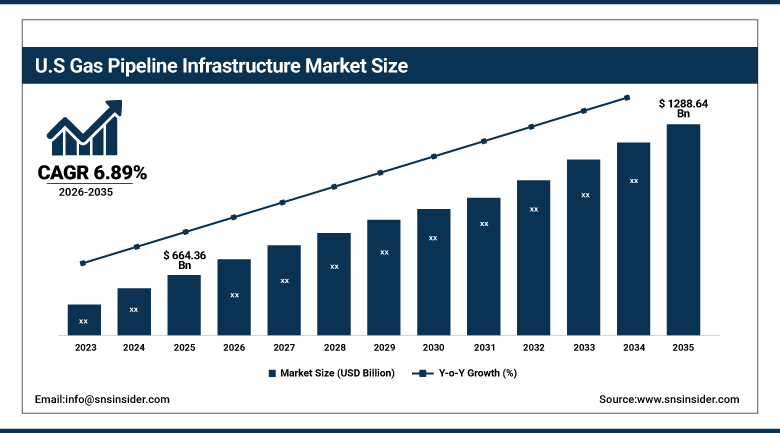
The U.S. Gas Pipeline Infrastructure Market was valued at USD 664.36 billion in 2025 and is expected to reach USD 1288.64 billion by 2035 at a CAGR of 6.89%.
The gas pipeline infrastructure market in the U.S. is expected to rise owing to rising natural gas production and increased LNG exports. Moreover, rising investment in the development of transmission and distribution pipeline modernization projects is fueling the growth of the market. There is an increase in the demand for gas pipeline infrastructure market in the U.S. because utilities, industrial companies, and power generation firms are increasingly using natural gas for energy security and efficiency. Investment in interstate pipelines, LNG facility connectivity, and pipeline surveillance technologies is contributing to market growth from 2025 to 2026.
U.S. LNG export capacity exceeded 15 billion cubic feet per day during 2025, increasing investments in pipeline infrastructure connecting production basins with export terminals.
Gas Pipeline Infrastructure Market Segment Analysis
-
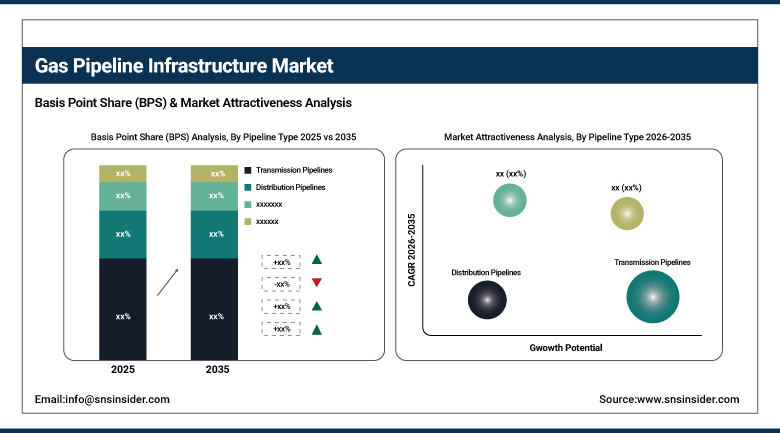
By Pipeline Type, transmission pipelines dominated with approximately 52.18% revenue share in 2025; gathering pipelines are expected to be the fastest-growing type segment at approximately 10.79% CAGR from 2026 to 2035.
-
By Application, natural gas transportation dominated with approximately 61.42% revenue share in 2025; LNG transportation is expected to be the fastest-growing type segment at approximately 11.68% CAGR from 2026 to 2035.
-
By End User, industrial dominated with approximately 57.46% revenue share in 2025; residential are expected to be the fastest-growing type segment at approximately 10.24% CAGR from 2026 to 2035.
-
By Diameter Size, small diameter pipelines dominated with approximately 22.46% revenue share in 2025; large diameter pipelines are expected to be the fastest-growing type segment at approximately 7.88% CAGR from 2026 to 2035.
By Pipeline Type, transmission pipelines dominating while gathering pipelines emerging as the fastest-growing
The segment of transmission pipelines held about 52.18% revenue share in 2025 since transmission pipelines act as the fundamental component used in the transportation of huge amounts of natural gas over vast distances from one production area to another. These pipelines are vital in ensuring a constant supply of gas to the respective power plants, industries, businesses, and households. There were notable investments in the construction of pipelines to increase energy security and reliability within the gas pipeline infrastructure market. The rise in the number of natural gas power plants, increased demand from industrial consumers, and the development of regional energy connections helped to propel the segment ahead.
Pipelines for gathering are anticipated to have the highest growth rate at a CAGR of about 10.79% between 2026 and 2035 due to increased production of natural gas as well as the development of oil and gas assets in the upstream sector. Pipelines for gathering serve a very important function in facilitating transportation of gas from the production wellhead to plants for processing and transportation. Investments in production of shale gas, development of unconventional sources of gas, and construction of field-level infrastructure have contributed immensely to the increased demand for gathering pipelines.
By Application, natural gas transportation dominating while LNG transportation emerging as the fastest-growing
The natural gas transportation segment captured nearly 61.42% of revenue share in 2025 due to natural gas being one of the most commonly used sources of energy for domestic and commercial applications such as residential heating, industrial production, and electricity generation. With widespread pipelines and other transmission/distribution networks, transportation of natural gas continued in a consistent manner both nationally and internationally. The gas pipeline infrastructure market registered a robust demand from utilities, manufacturers, and energy companies that required solutions for effective fuel transportation. Increasing consumption of natural gas, growth in the number of city gas distribution systems, and increased investments made in energy infrastructure helped achieve the leading market share.
The LNG transportation segment is expected to grow at a CAGR of around 11.68% during 2026-2035 due to growing LNG trade across the globe and increasing investments in import-export terminal infrastructure. Countries are expanding the capacity of LNG receiving and regasification facilities to diversify energy sources and enhance supply security. The demand for cross-border gas trade is increasing fast and the development of LNG export projects and greater connectivity between LNG terminals and pipeline networks are contributing to accelerating growth. The segment is expected to witness robust expansion during the forecast period owing to the expansion of international energy trade routes and investments in LNG infrastructure.
By Diameter Size, small diameter pipelines dominating while large diameter pipelines emerging as the fastest-growing
The small diameter pipelines segment contributed to around 22.46% revenue share in 2025 since the pipelines find wide applications in gas distribution networks, residential networks, commercial, and small-scale industrial applications. Flexible nature, low installation cost, and applicability in urban distribution networks have enabled their wide adoption globally in developed as well as developing economies. There was robust growth witnessed in the gas pipeline infrastructure market from the demand generated for small diameter networks owing to increasing city gas distribution network projects and residential natural gas connections. Increased investments towards the development of local networks played an important role behind the success of the segment.
The large diameter pipelines market is predicted to experience the highest growth rate of nearly 7.88%, from 2026 through 2035, due to rising need for transport of gas in large quantities through long distance pipeline systems. Large diameter pipelines ensure efficient transfer of considerable amounts of gas between production sites, LNG facilities, and areas of consumption. Many governments and companies have been making huge investments in cross-border projects to increase gas transmission capacity. It is forecasted that expansion of large gas transportation projects will be instrumental in the growth of this segment in the coming years.
Regional Insights
|
Region |
Major Country |
Share within Region,2025 (%) |
|---|---|---|
|
North America |
United States |
86% |
|
Europe |
Germany |
24% |
|
Asia Pacific |
China |
45% |
|
Middle East & Africa |
UAE |
27% |
|
Latin America |
Brazil |
39% |
North America Gas Pipeline Infrastructure Market Insights
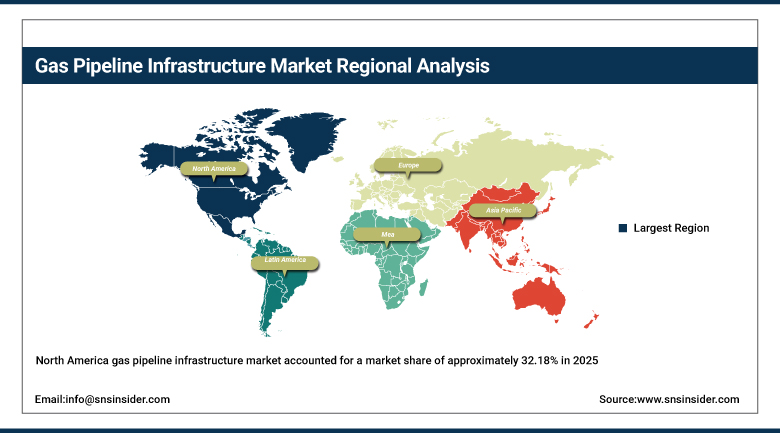
The North America gas pipeline infrastructure market accounted for a market share of approximately 32.18% in 2025 and is expected to grow at a CAGR of 7.02% through 2035. The region has one of the world’s largest natural gas transmission and distribution networks supporting industrial, commercial, residential and power generation sectors. The United States had more than 3 million kilometers of natural gas pipelines and LNG export capacity of more than 15 billion cubic feet per day in 2025. Gas services were used by more than 78 million households across the country. Investment in inter-state transmission projects, interconnections of LNG terminals, pipeline upgrades, leak detection systems and digital monitoring technologies will continue to enhance infrastructure reliability and facilitate long-term market growth across North America.
Get Customized Report as per Your Business Requirement - Enquiry Now
Europe Gas Pipeline Infrastructure Market Insights
Market share held by the gas pipeline infrastructure industry in Europe was valued to be around 20.24% in 2025 and will continue expanding at a CAGR of 7.22% till 2035. Heavy investments in transmission networks upgrade, cross-border connections, and liquefied natural gas systems in Europe are helping the region to ensure better energy security. During 2025, Europe was able to maintain a network consisting of over 200,000 kilometers of gas transmission pipelines operating under high pressure. Germany and Italy along with other significant regions continued efforts towards increasing infrastructure efficiency and enhanced network monitoring. Increased importance being placed on resilience and interconnectivity of regional gas networks is likely to sustain the need for advanced gas pipeline infrastructure in the coming years.
Asia Pacific Gas Pipeline Infrastructure Market Insights
Asia Pacific gas pipeline infrastructure market was valued at around 34.46% market share in 2025 and is anticipated to witness fastest growth at a CAGR of 10.38% through 2035. Rapid industrialization and urbanization, together with growing consumption of natural gas, are spurring massive investments in pipeline construction projects in the region. The network of natural gas pipelines in China reached over 120,000 km by 2025, and in India the network exceeded 25,000 km. Governments are pouring billions into city gas distribution systems, LNG hookups and long-distance transmission corridors. Growing demand for industrial gas, cleaner energy initiatives and the build-out of domestic and imported gas infrastructure continue to support strong regional market growth.
Middle East & Africa and Latin America Gas Pipeline Infrastructure Market Insights
The gas pipeline infrastructure market in Latin America held around 7.04% market share in 2025 and it is expected to reach a CAGR of 9.08%. Whereas Middle East & Africa held around 6.08% market share with a CAGR of 9.09% by 2035. Brazil continued to expand transmission and distribution networks to support industry and gas-fired power generation. In the Middle East, Saudi Arabia and the UAE advanced key gas transport projects to support industrial diversification and domestic energy demand. Several regional developments in 2025 added thousands of kilometers of pipeline infrastructure which improved connectivity between production regions, processing facilities, LNG terminals and end-use markets across both regions.
Market Dynamics
Growth Drivers: Rising natural gas consumption and expansion of transmission infrastructure accelerating industry growth
Growth of the gas pipeline infrastructure market is expected to be driven by increasing natural gas consumption, expansion of LNG trade and rising investments in transmission and distribution network. The gas pipeline infrastructure market is experiencing a healthy demand as government and energy companies continue to expand pipeline infrastructure for enhancing energy security, industrial development and reliable fuel transportation. Market growth is driven by increasing natural gas-fired power generation, city gas distribution projects, and cross-border energy connectivity initiatives during 2025–2026. The global gas transportation network is seeing faster investments due to the expansion of smart pipeline monitoring systems, the modernization of ageing infrastructures and the increasing industrial gas demand.
Global LNG trade surpassed 400 million tons during 2025, significantly increasing demand for pipeline infrastructure connecting LNG import and export terminals with industrial facilities, power plants, distribution networks, and end-use energy markets worldwide.
Restraints: High capital investment requirements and regulatory approval challenges limiting market expansion
The gas pipeline infrastructure market faces a challenge due to high construction and maintenance costs associated with long-distance transmission networks and large-scale infrastructure projects. Complex regulatory approval processes, land acquisition problems and environmental compliance requirements can cause significant delays in project execution. Variability in natural gas prices could affect energy companies’ decisions about infrastructure investments. Concerns about methane emissions, pipeline safety, operational risks and growing competition from renewable energy sources may also limit new pipeline development activity. Over the forecast period, these factors can reduce project economics and inhibit infrastructure expansion across a number of regional markets.
Opportunities: Expansion of LNG infrastructure and cross-border gas transportation networks creating new opportunities
The gas pipeline infrastructure market is experiencing robust opportunities due to growing LNG export-import activities, expansion of international gas transportation corridors and increasing investments in advanced pipeline technologies. The gas pipeline infrastructure market is increasingly benefiting from the development of LNG terminals, industrial gas hubs and digital pipeline management systems. Increasing energy demand across the emerging economies and adoption of natural gas as a transition fuel are significantly increasing infrastructure investments during 2025–2026. Infrastructure developers globally are seeing solid long-term growth prospects from expansion of cross-border gas connectivity projects, pipeline modernization initiatives and the use of real-time monitoring technologies.
Natural gas generated approximately 43% of U.S. utility-scale electricity during 2025, highlighting its critical role in power generation and supporting continued investments in gas transportation, transmission pipelines, and energy infrastructure modernization projects nationwide.
Recent Developments:
-
April 2026 – Kinder Morgan advanced development of the Creekside Lateral Project, an approximately 11.2-mile, 42-inch pipeline in Central Texas designed to serve power generation, industrial facilities, and data centers. The project is targeted for service in the fourth quarter of 2026.
-
May 2026 – Williams signed customer agreements for the Silver Spur transmission project, a 275 MMcf/d expansion on its Northwest Pipeline system, while also announcing approximately 700 MMcf/d of gathering system expansions in the Marcellus and Haynesville regions.
-
February 2026 – TC Energy sanctioned approximately USD 0.5 billion of additional NGTL System expansion projects under its Multi-Year Growth Plan, with expected in-service dates beginning in 2028 to increase natural gas transportation capacity.
Gas Pipeline Infrastructure Market Key Players are:
-
Kinder Morgan, Inc.
-
The Williams Companies, Inc.
-
TC Energy Corporation
-
Enbridge Inc.
-
Energy Transfer LP
-
ONEOK, Inc.
-
Pembina Pipeline Corporation
-
Plains All American Pipeline, L.P.
-
Enterprise Products Partners L.P.
-
Snam S.p.A.
-
National Gas Transmission plc
-
Fluxys Belgium SA
-
GAIL (India) Limited
-
China Oil & Gas Pipeline Network Corporation (PipeChina)
-
Gazprom PJSC
-
PetroChina Company Limited
-
Saudi Arabian Oil Company (Saudi Aramco)
-
Abu Dhabi National Oil Company (ADNOC)
-
Transnet SOC Ltd.
-
APA Group.
Gas Pipeline Infrastructure Market Report Scope:
| Report Attributes | Details |
|---|---|
| Market Size in 2025 | USD 3065.62 Billion |
| Market Size by 2035 | USD 5779.40 Billion |
| CAGR | CAGR of 8.60% From 2026 to 2035 |
| Base Year | 2025 |
| Forecast Period | 2026-2035 |
| Historical Data | 2022-2024 |
| Report Scope & Coverage | Market Size, Segments Analysis, Competitive Landscape, Regional Analysis, DROC & SWOT Analysis, Forecast Outlook |
| Key Segments | • By Pipeline Type (Transmission Pipelines, Distribution Pipelines, Gathering Pipelines) • By Application (Natural Gas Transportation, Industrial Gas Transportation, LNG Transportation) • By End User (Residential, Commercial, Industrial) • By Diameter Size (Small Diameter Pipelines, Medium Diameter Pipelines, Large Diameter Pipelines) |
| Regional Analysis/Coverage | North America (US, Canada), Europe (Germany, UK, France, Italy, Spain, Russia, Poland, Rest of Europe), Asia Pacific (China, India, Japan, South Korea, Australia, ASEAN Countries, Rest of Asia Pacific), Middle East & Africa (UAE, Saudi Arabia, Qatar, South Africa, Rest of Middle East & Africa), Latin America (Brazil, Argentina, Mexico, Colombia, Rest of Latin America). |
| Company Profiles | Kinder Morgan, Inc., The Williams Companies, Inc., TC Energy Corporation, Enbridge Inc., Energy Transfer LP, ONEOK, Inc., Pembina Pipeline Corporation, Plains All American Pipeline, L.P., Enterprise Products Partners L.P., Snam S.p.A., National Gas Transmission plc, Fluxys Belgium SA, GAIL (India) Limited, China Oil & Gas Pipeline Network Corporation (PipeChina), Gazprom PJSC, PetroChina Company Limited, Saudi Arabian Oil Company (Saudi Aramco), Abu Dhabi National Oil Company (ADNOC), Transnet SOC Ltd., APA Group. |

Frequently Asked Questions
The Gas Pipeline Infrastructure Market is expected to grow at a CAGR of 8.60% from 2026 to 2035.
The Gas Pipeline Infrastructure Market was valued at USD 2545.31 billion in 2025.
Natural Gas Transportation dominated the market in 2025 with approximately 61.42% of revenues.
Transmission Pipelines dominated the market in 2025 with approximately 52.18% of revenues.
Asia-Pacific dominated the Gas Pipeline Infrastructure Market in 2025 with approximately 34.46% of global revenues.
