
Corporate E-learning Market Report Scope & Overview:
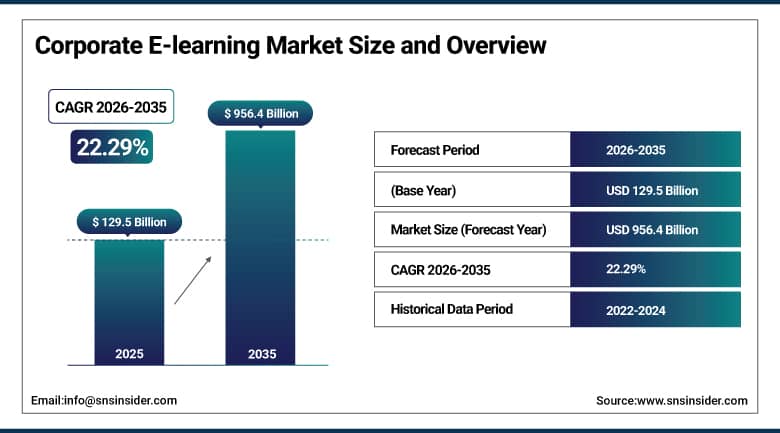
Corporate E-learning Market was valued at USD 129.5 billion in 2025 and is expected to reach USD 956.4 billion by 2035, growing at a CAGR of 22.29% from 2026-2035.
The growth of the Corporate E-learning Market is fueled by accelerated digitalization in various sectors and growing interest in cost-efficient employee training programs. Enterprises are using e-learning tools to upgrade employees' competencies, increase efficiency, and foster continuous learning processes. The developments in artificial intelligence, cloud technology, and mobile learning are contributing to making the training process more tailored and convenient. Furthermore, the globalization of businesses and the requirement to gain new skills in innovative technologies are boosting the use of corporate e-learning platforms.
IBM's training effectiveness research documents that e-learning reduces employee skill acquisition time by 40-60% compared to classroom instruction for equivalent learning outcomes. The Association for Talent Development (ATD) 2024 State of the Industry report found that organizations investing above average in employee training achieve 24% higher profit margins than comparable organizations with below-average training investment.
To Get More Information On Corporate E-learning Market - Request Free Sample Report
Corporate E-learning Market Trends
-
Rising demand for continuous workforce upskilling and digital training is driving the corporate e-learning market.
-
Growing adoption of remote work and hybrid work models is boosting market growth.
-
Expansion of cloud-based learning platforms and mobile learning applications is fueling deployment.
-
Increasing focus on employee engagement, performance improvement, and compliance training is shaping adoption trends.
-
Advancements in AI-driven personalization, gamification, and immersive learning technologies are enhancing effectiveness.
-
Rising need for cost-effective, scalable, and flexible training solutions is supporting market expansion.
-
Collaborations between e-learning providers, enterprises, and content developers are accelerating innovation and global adoption.
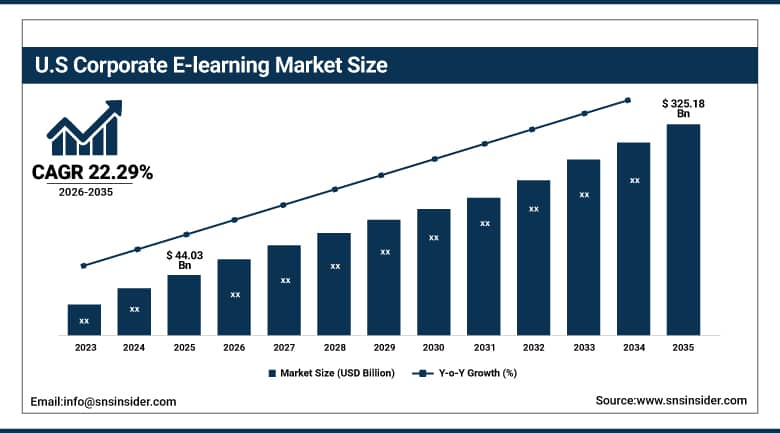
U.S. Corporate E-learning Market was valued at USD 44.03 billion in 2025 and is expected to reach USD 325.18 billion by 2035, growing at a CAGR of 22.29% from 2026-2035.
The Growth of the U.S. Corporate E-learning Market is fueled by accelerated digitization, widespread acceptance of remote/hybrid work arrangements, and the growing need for constant skill improvement among employees. Companies are increasingly using artificial intelligence-supported learning management systems and cloud services to increase the efficiency of their workforce.
The U.S. Bureau of Labor Statistics' Employer Costs for Employee Compensation data shows American companies spend an average of USD 1,252 per employee annually on formal training. OSHA mandatory safety training requirements affect approximately 130 million U.S. workers across covered industries, creating non-discretionary e-learning demand that sustains platform procurement independent of voluntary training investment.
Corporate E-learning Market Segment Analysis
-
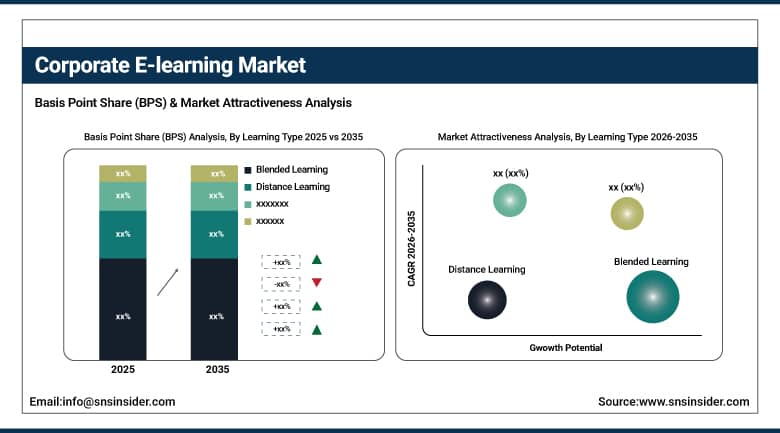
By Learning Type, Blended Learning segment dominated the Corporate E-learning Market in 2025 with ~42% share; Distance Learning segment fastest growing (CAGR).
-
By Organization Size, Large Enterprise segment dominated the Corporate E-learning Market in 2025 with ~58% share; SME segment fastest growing (CAGR).
-
By Vertical, IT segment dominated the Corporate E-learning Market in 2025 with ~31% share; Healthcare fastest growing (CAGR).
By Learning Type, Blended Learning dominates, Distance Learning growing fastest
Blended Learning dominates the Corporate E-learning Market in 2025 with ~42% share, due to the availability of both online digital courses and traditional training sessions in this segment. This segment is preferred because it ensures effective training through high levels of engagement, better absorption capacity, and superior performance of learners. Additionally, the demand for upskilling and performance management systems among businesses is rising because of which the importance of blended learning is increasing in many companies.
Distance Learning is the fastest-growing segment in the Corporate E-learning Market, because of the implementation of remote work culture by the businesses. The distance learning methodology provides businesses with the opportunity to conduct training for their employees through web-based courses and webcasts, thereby enabling them to gain more success. Cloud-based technology and mobile-based applications have enabled businesses to adopt remote learning techniques and successfully train their employees without increasing their training expenses.
By Organization Size, Large Enterprise dominates, SME growing fastest
Large Enterprise segment dominates the Corporate E-learning Market in 2025 with 58% share, owing to significant investments in workforce training and compliance programs and advanced digital learning platforms. Such businesses usually have a large number of employees operating from diverse geographical locations, and therefore such companies require scalable and structured learning processes. Being financially sound, such enterprises can easily deploy advanced and robust digital learning platforms that include analytics capabilities and other sophisticated AI-driven modules. The continuous focus on improving the skills and abilities of employees makes them more dominant in this segment.
SME segment is the fastest-growing in the Corporate E-learning Market, owing to the affordability of cloud-based e-learning platforms and increased awareness regarding benefits of upskilling workforces. Small and medium enterprises are increasingly investing in such platforms to ensure higher productivity and efficiency without making huge training costs. With the advent of flexible subscription models, easy deployment capabilities, and an intuitive interface, SMEs have adopted e-learning platforms quickly to stay relevant in highly competitive markets.
By Vertical, Large Enterprise dominates, SME growing fastest
IT segment dominates the Corporate E-learning Market in 2025 with 31% share due to the continuous requirement for rapid skill upgrades in areas like cloud computing, AI, cybersecurity, and big data analytics. In the IT vertical, corporations constantly have to update themselves on the latest technology trends. They spend heavily on digital learning systems to stay ahead of the competition. In addition to this, there are rising efforts towards digital transformation around the world, along with rising demand for certified professionals.
Healthcare is the fastest-growing vertical in the Corporate E-learning Market, driven by rising demands for compliance training, healthcare skills development, and professional learning. With rapid changes in healthcare technologies and increasing regulations, there will be a rising need for digital learning platforms to train employees. E-learning helps healthcare workers learn new healthcare techniques and gain access to updated information, thereby making their work easier and more efficient. There is also a growing demand for lifelong learning and standardization of healthcare practices across hospitals. This trend is changing the face of workforce training within the healthcare industry and will help its growth in digital learning.
Corporate E-learning Market Regional Analysis
|
Region |
Major Country |
Share within Region (%) |
|---|---|---|
|
North America |
United States |
88% |
|
Europe |
United Kingdom |
24% |
|
Asia Pacific |
India |
35% |
|
Middle East & Africa |
UAE |
38% |
|
Latin America |
Brazil |
48% |
North America Corporate E-learning Market Insights
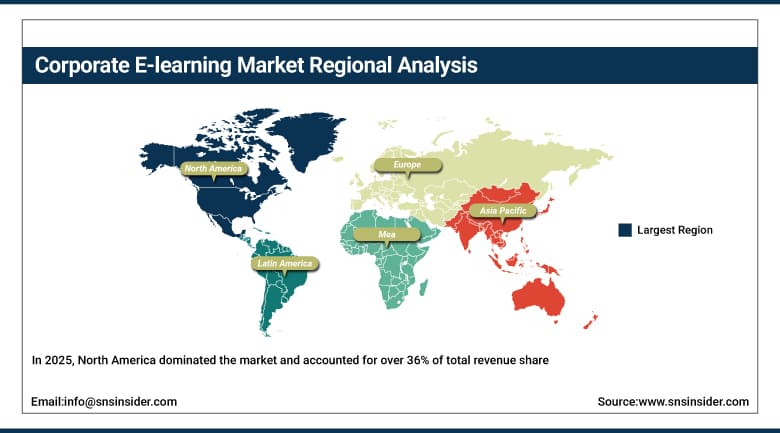
In 2025, North America dominated the market and accounted for over 36% of total revenue share, supported by strong technological infrastructure, high digital adoption, and significant investments in advanced solutions across industries. The region benefited from the presence of major market players, rapid implementation of cloud-based platforms, and increasing demand for automation and data-driven operations. Favorable government initiatives, rising enterprise spending on innovative technologies, and growing focus on operational efficiency further strengthened market expansion across the United States and Canada during the year.
Get Customized Report as Per Your Business Requirement - Enquiry Now
Asia Pacific Corporate E-learning Market Insights
Asia Pacific is the fastest-growing regional Corporate E-learning Market, driven by the region's large and rapidly growing workforce, increasing corporate training investment as organizations in developing economies formalize their talent development programs, and the mobile-first learning behavior of the region's digitally native workforce. India's large IT services industry employing millions of knowledge workers in roles requiring continuous upskilling to maintain relevance in a rapidly evolving technology landscape is one of the world's most active corporate e-learning markets by learner volume. China's manufacturing transformation toward higher-value production is requiring systematic workforce upskilling that e-learning platforms are positioned to deliver at the necessary scale. Southeast Asia's rapidly growing startup and technology ecosystems are creating demand for corporate learning platforms among organizations that have never had traditional training infrastructure to replace.
India's National Skill Development Corporation has integrated e-learning platforms into its skill certification programs, creating institutional demand for corporate e-learning content across priority sectors. LinkedIn Learning reports that Asia Pacific shows the highest growth rate in professional learning platform adoption globally, with skill development in AI, data science, and cloud computing ranking among the top course categories by completion volume.
Europe Corporate E-learning Market Insights
Europe Corporate E-learning Market experienced significant growth due to increasing adoption of digital workforce training solutions across industries. Organizations focused on improving employee productivity, compliance management, and remote learning capabilities through cloud-based learning platforms. Strong emphasis on upskilling and reskilling programs, combined with growing investments in AI-driven learning technologies, supported market expansion. Additionally, the presence of multinational enterprises and supportive digital education initiatives accelerated adoption of corporate e-learning solutions across the region.
Middle East & Africa and Latin America Corporate E-learning Market Insights
Middle East & Africa and Latin America Corporate E-learning Market witnessed steady growth driven by rising internet penetration, digital transformation initiatives, and increasing focus on employee skill development. Businesses increasingly adopted online training platforms to reduce operational training costs and enhance workforce efficiency. Expanding corporate sectors, growing smartphone usage, and government support for digital education initiatives further contributed to market development. Demand for flexible, remote, and multilingual learning solutions also supported regional market growth.
Corporate E-learning Market Growth Drivers:
-
Workforce upskilling demand and AI-powered personalized learning creating transformative corporate e-learning market growth globally
This unprecedented rate of growth in the corporate e-learning market demonstrates the synergy between various powerful pull factors for demand. There is a huge skills shortage because fast-paced technological advancements have outrun the development of workforce capabilities through conventional means, making investments into learning more pressing than ever and turning Learning and Development (L&D) into a business imperative rather than just another cost center. Failure to invest into equipping their employees with skills needed to implement new technologies such as AI, cloud computing, and automation renders companies obsolete; companies who do this successfully can maintain their competitive edge in an increasingly competitive environment. AI technology helps to improve the benefits offered by the learning platform through personalized adaptive learning pathways based on individual performance, immediate feedback from AI tutors on practice tests, and automated skills assessments to detect areas of weakness.
World Economic Forum's Future of Jobs Report 2023 estimates that 44% of workers' core skills will be disrupted within five years, creating a global reskilling imperative that corporate e-learning platforms are the primary mechanism to address at scale. McKinsey Global Institute research documents that companies with strong learning cultures are 30-50% more likely to be first-to-market with innovation and show measurably higher retention of high-performing employees.
Corporate E-learning Market Restraints:
-
Low learner engagement and cybersecurity concerns limiting corporate e-learning platform adoption and completion rates
Low completion rates remain the persistent challenge of corporate e-learning industry research consistently finds that self-paced e-learning course completion rates average 15-25%, far below the 80-90% completion rates of mandatory instructor-led programs. The underlying cause is the same as any voluntary behavioral challenge: when immediate demands compete with discretionary time allocation, structured self-directed learning loses to urgent operational tasks. E-learning platform vendors are addressing this through gamification, social learning features, and AI-driven nudge notifications, but the fundamental behavioral challenge persists. Cybersecurity concerns about personal and organizational learning data stored on cloud platforms are creating procurement friction in regulated industries healthcare, financial services, and defense where data governance requirements may preclude use of certain cloud e-learning platforms or require extensive vendor compliance documentation before deployment approval.
Corporate E-learning Market Opportunities:
-
Generative AI course creation and immersive VR training creating transformative new corporate e-learning growth opportunities
Generative AI applied to corporate e-learning course development is compressing course creation timelines from weeks to hours for standard instructional content, enabling organizations to keep training materials current with rapidly changing technology, regulation, and business practice at a pace that traditional instructional design processes could not sustain. Platforms including Coursera for Business, LinkedIn Learning, and Docebo are integrating AI course generation into their content creation tools, enabling L&D teams to produce customized, branded training content at a fraction of the previous production cost. VR-based training represents a higher-investment but demonstrably higher-impact opportunity for skill-critical training in industrial safety, medical procedures, customer service, and leadership development with documented retention rates and behavioral transfer metrics that justify the development cost premium for high-stakes training applications where the cost of skill failure is high.
Recent Developments:
-
2025: Coursera for Business launched an AI Skills Accelerator program in partnership with 50 major employers to deliver GenAI and machine learning upskilling to over 500,000 enterprise employees, using personalized learning paths generated by AI based on each employee's current role, existing skill profile, and organizational technology deployment roadmap.
-
2025: SAP SuccessFactors Learning released its generative AI content creation module that allows L&D administrators to describe a learning objective in natural language and receive a complete structured e-learning course with quizzes, branching scenarios, and assessment rubrics within minutes rather than the weeks that professional instructional design previously required.
-
2026: Microsoft Viva Learning expanded its integration with LinkedIn Learning, Microsoft Learn, and third-party learning content providers with new AI-powered skill gap identification that analyzes employee job performance signals from Microsoft 365 applications and recommends specific learning resources that address identified skill weaknesses in current work contexts.
Corporate E-learning Market Key Players
Some of the Corporate E-learning Market Companies
-
Cornerstone OnDemand Inc.
-
SAP SE
-
Oracle Corporation
-
Workday Inc.
-
Docebo Inc.
-
Degreed Inc.
-
LinkedIn Learning
-
Coursera for Business
-
Skillsoft Corporation
-
360Learning
-
Absorb Software Inc.
-
TalentLMS
-
Adobe Inc.
-
Blackboard Inc.
-
LearnUpon Ltd.
-
Instructure Holdings Inc.
-
Moodle Pty. Ltd.
-
iSpring Solutions Inc.
-
Articulate Global Inc.
-
SumTotal Systems
|
Report Attributes |
Details |
|
Market Size in 2025 |
USD 129.5 Billion |
|
Market Size by 2035 |
USD 956.4 Billion |
|
CAGR |
CAGR of 22.29% From 2026 to 2035 |
|
Base Year |
2025 |
|
Forecast Period |
2026-2035 |
|
Historical Data |
2022-2024 |
|
Report Scope & Coverage |
Market Size, Segments Analysis, Competitive Landscape, Regional Analysis, DROC & SWOT Analysis, Forecast Outlook |
|
Key Segments |
• By Learning Type (Distance Learning, Instructor-led Training, Blended Learning) |
|
Regional Analysis/Coverage |
North America (US, Canada), Europe (Germany, UK, France, Italy, Spain, Russia, Poland, Rest of Europe), Asia Pacific (China, India, Japan, South Korea, Australia, ASEAN Countries, Rest of Asia Pacific), Middle East & Africa (UAE, Saudi Arabia, Qatar, South Africa, Rest of Middle East & Africa), Latin America (Brazil, Argentina, Mexico, Colombia, Rest of Latin America). |
|
Company Profiles |
Cornerstone OnDemand Inc., SAP SE, Oracle Corporation, Workday Inc., Docebo Inc., Degreed Inc., LinkedIn Learning, Coursera for Business, Skillsoft Corporation, 360Learning, Absorb Software Inc., TalentLMS, Adobe Inc., Blackboard Inc., LearnUpon Ltd., Instructure Holdings Inc., Moodle Pty. Ltd., iSpring Solutions Inc., Articulate Global Inc., SumTotal Systems |
Frequently Asked Questions
Ans- Rising cyber threats and compliance issues pose risks to corporate e-learning platforms.
Ans- The growing need for skill enhancement and digital training solutions is driving market expansion.
Ans- Asia-Pacific is expected to register the fastest CAGR during the forecast period.
Ans- The CAGR of the Corporate E-learning Market during the forecast period is 22.29% from 2026-2035.
Ans: The Corporate E-learning Market was valued at USD 129.5 billion in 2025.
