
Dairy Alternatives Market Report Scope & Overview:
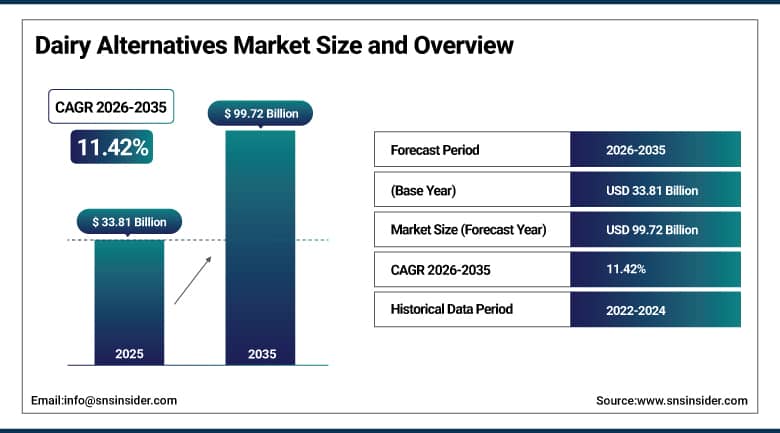
The Dairy Alternatives Market was valued at USD 33.81 Billion in 2025 and is expected to reach USD 99.72 Billion by 2035, growing at a CAGR of 11.42% from 2026 to 2035.
The Dairy Alternatives market is witnessing solid growth due to increased health awareness, higher incidences of lactose intolerance, and environmental concerns related to dairy farming practices. Over 65% of people around the world have been seen drinking dairy alternatives in recent years, showing significant consumer acceptance beyond a vegan consumer base. Plant milk constitutes a significant proportion of the total milk sales globally in terms of volume and this is something that has been achieved within just about a decade. In addition to this, rising use of flexitarian eating habits and constant improvements in taste and texture properties comparable with conventional dairy products also factor into this trend.
In November 2025, Danone’s Silk brand launched Silk Protein, a high-protein plant-based milk line delivering 13 grams of complete plant protein per serving, described as the highest protein content of any refrigerated plant-based beverage on U.S. shelves, with national rollout following in early 2026.
To Get More Information On Dairy Alternatives Market - Request Free Sample Report
Dairy Alternatives Market Trends
- Growing demand for high-protein plant-based formulations is emerging as brands respond to consumer scrutiny that plant-based sources account for only a fraction of total protein intake.
- Rising expansion of plant-based cheese alternatives in foodservice sectors is broadening category use beyond retail milk and yogurt formats.
- Expanding regulatory support, including policy changes permitting nutritionally equivalent plant-based milk in school meal programs, is opening new institutional demand channels.
- Increasing investment in taste and texture innovation is helping the category transition from an “alternative” positioning to products consumers choose on their own merits.
- Growing interest in whole-ingredient and less-processed formulations is reshaping product development priorities across the category.
U.S. Dairy Alternatives Market Outlook
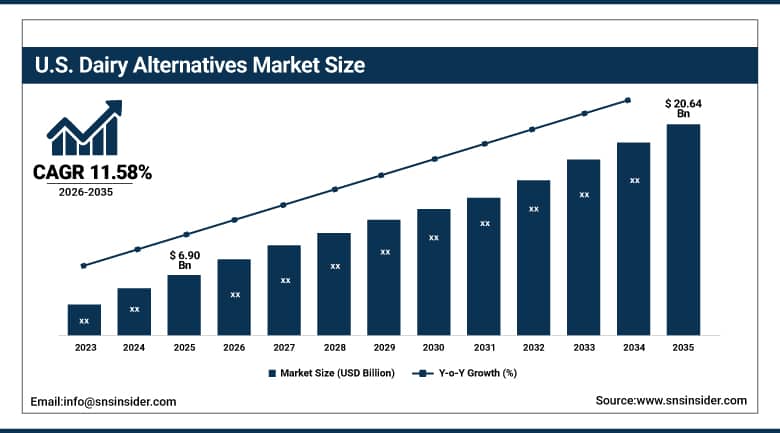
The U.S. Dairy Alternatives Market was valued at USD 6.90 Billion in 2025 and is projected to reach USD 20.64 Billion by 2035, growing at a CAGR of 11.58% during 2026-2035.
The United States Dairy Alternatives Market is flourishing, with plant-based milk contributing to nearly 15% of total milk sales by volume, a noteworthy milestone accomplished within a span of only about 10 years. The industry is moving past the stage of being automatically lucrative into becoming a more sophisticated and premium-focused sector because of brands competing for taste, protein level, and ingredient clarity. There have been regulatory changes in the form of updates that provide schools the flexibility to offer nutritionally equivalent plant-based milk, affecting millions of students every year. Innovation is seen in the form of high protein plant milk and whole ingredient offerings to give customers options. Strong distribution systems via supermarkets, specialty stores, and foodservice are providing increased product visibility.
2026: Danone USA announced plans to close its dairy-alternatives manufacturing facility in Bridgeton, New Jersey, which produces beverages under the Silk and So Delicious Dairy Free brands, reflecting ongoing portfolio and capacity optimization in the U.S. plant-based dairy segment.
Dairy Alternatives Market Segment Analysis
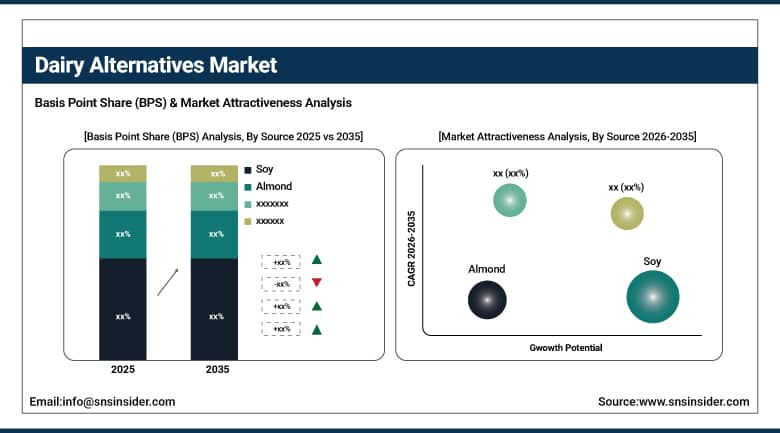
- By Source, Soy segment dominated the Dairy Alternatives Market in 2025 with around 38% share; Almond segment is the fastest-growing segment.
- By Product, Milk segment dominated the market in 2025 with around 51.65% share; Cheese segment is the fastest-growing segment.
- By Distribution Channel, Supermarkets & Hypermarkets segment dominated the market in 2025 with around 48% share; Online segment is the fastest-growing segment.
- By Formulation, Non-Fortified segment dominated the market in 2025; Fortified segment is the fastest-growing segment.
By Source, Soy Dominates the Dairy Alternatives Market While Almond Registers the Fastest Growth
The dominance of the Soy segment within the Dairy Alternatives Market can be attributed to its comprehensive amino acid content, cost effectiveness, and being the initial and longstanding source of dairy alternatives with a lot of consumer awareness built over decades. The segment has been gaining advantage through the already developed manufacturing system and extensive approval within the food categories, making it suitable for large-scale commercial manufacturing. The availability, nutritional value, and already developed manufacturing processes of the soy-based dairy alternatives are helping this segment retain its market leadership.
The growth of the Almond segment can be attributed to rising consumer preference towards its light and neutral taste, in addition to being calorie efficient. The growing preference for unsweetened almond milk that holds a greater majority within the unsweetened plant-based milk category is making it essential for manufacturers to develop further on their almond-based products. With strong brand competition and innovation within the leading almond milk brands, there is ample opportunity for commercialization within this segment.
By Product, Milk Dominates the Dairy Alternatives Market While Cheese Emerges as the Fastest-Growing Product
The Milk Category represents a major share of the overall Dairy Alternatives Market, with 51.65% of total sales in 2025, as it is the dairy alternative category that has been established and implemented for many years, with decades of development and wide retail availability of products. Versatility of the plant-based milk as a versatile ingredient used for drinking directly, in coffee, with cereals, and cooking makes it the core product format of the category. This versatility and well-established production process make this segment stay at the top of the market.
Cheese is experiencing fast growth due to the fast penetration of plant-based cheese alternatives into the foodservice industry and development of such characteristics of alternatives as melting, stretching, and flavor profile, which has always been inferior to other dairy alternatives categories. Increasing demand for plant-based cheese in foodservice application such as pizza and sandwiches makes companies put effort into R&D of the segment. Advances in fermentation and formulation technologies help to overcome challenges in texture and make commercial use possible.
By Distribution Channel, Supermarkets & Hypermarkets Dominates the Dairy Alternatives Market While Online Registers the Fastest Growth
Supermarkets & Hypermarkets dominates the Dairy Alternatives Market due to consumer preference for purchasing dairy alternative products through established retail channels offering broad brand selection and the ability to compare products in person. Such stores give customers access to dedicated dairy alternative sections stocking a wide range of milk, yogurt, and cheese alternative brands. Established relationships between dairy alternative brands and major retail chains, along with dedicated shelf space, also contribute to sales in this channel.
Online is growing rapidly because of the convenience of ordering, subscription-based purchasing, and access to specialty and niche dairy alternative brands that may not be available in local physical stores. E-commerce platforms enable consumers to compare product ingredients, nutritional content, and customer reviews before making a purchase. The increased adoption of direct-to-consumer dairy alternative brands and digital marketing efforts is facilitating the growth of this channel.
Regional Analysis
|
Region |
Country |
Share (2025) |
|
Asia Pacific |
China |
39.20% |
|
North America |
United States |
84.80% |
|
Europe |
Germany |
22.80% |
|
Middle East & Africa |
UAE |
17.90% |
|
Latin America |
Brazil |
24.20% |
Asia Pacific Dairy Alternatives Market Insights
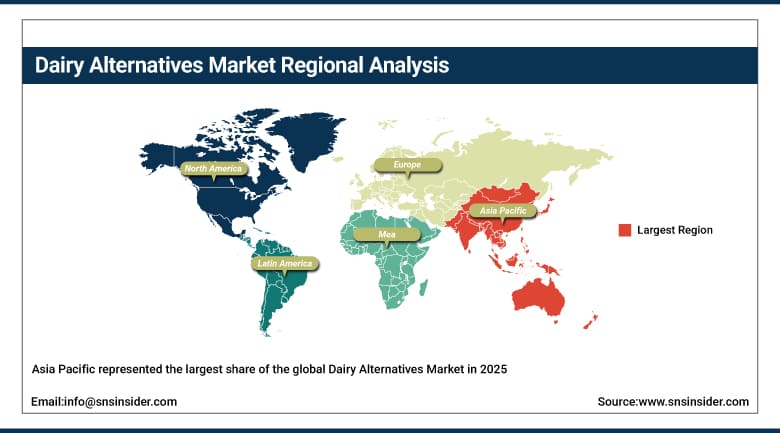
Asia Pacific represented the largest share of the global Dairy Alternatives Market in 2025, accounting for approximately 52.83% of global revenue, supported by high rates of lactose intolerance across the region, ranging from 58% in Pakistan to 100% in South Korea, driving structural demand for dairy alternatives. Rising urban incomes, growing vegetarianism, and increasing health consciousness across the region continue to reinforce demand for plant-based milk, yogurt, and other dairy alternative products. Leading regional manufacturers are expanding production capacity to meet sustained domestic demand across China, Japan, and India. Well-established food processing infrastructure across the region is also improving product accessibility and sustaining regional market development.
China accounted for approximately 39.20% of the Asia Pacific market in 2025, supported by its expanding food processing base and rising domestic demand for plant-based nutrition. Japan, India, and South Korea are also contributing meaningfully to regional growth, with India benefiting from government support, technological progress, and a substantial population following vegan and vegetarian diets.
Get Customized Report as Per Your Business Requirement - Enquiry Now
North America Dairy Alternatives Market Insights
North America is expected to register the fastest CAGR in the Dairy Alternatives Market during 2026–2035, driven by the region’s transition from automatic-growth to a premium, innovation-driven market where brands compete on taste, protein content, and ingredient transparency. The United States and Canada are witnessing increased mainstream adoption of dairy alternatives beyond traditional vegan consumers into broader health-conscious and flexitarian demographics. Rising product innovation, including high-protein formulations and expanding foodservice availability, is further supporting market expansion. Rising regulatory support, including school meal program flexibility for plant-based milk, is also reinforcing North America’s above-average growth trajectory.
The United States accounted for approximately 84.80% of the North American market in 2025, reflecting plant-based milk’s approximately 15% share of total U.S. milk sales by volume and a large, sophisticated retail and foodservice distribution infrastructure. Canada is contributing to regional growth through steady demand for plant-based dairy alternative products.
Europe Dairy Alternatives Market Insights
Europe was a major player in the Dairy Alternatives Market in 2025, attributed to the presence of high consumer awareness about sustainability and successful plant-based brand portfolios present in the region. Growing preference for refrigerated, calcium-enriched dairy alternatives products in Germany, France, and the UK is driving product innovation. Retailer expansion in terms of plant-based offerings in leading grocery stores is further boosting the market position of Europe.
Germany had the largest share of 22.80% in the European region in 2025 owing to the presence of well-developed retail network and increasing consumer inclination towards plant-based nutrition. The UK and France are also making considerable contributions to regional growth owing to expanding chilled plant-based beverage categories in leading national grocery stores.
Middle East & Africa and Latin America Dairy Alternatives Market Insights
Middle East & Africa region is showing consistent growth owing to increased awareness towards health and wellness among consumers in the Gulf countries, backed by increasing presence of modern retail infrastructures. Similarly, Latin America is also experiencing growth on account of increasing health-conscious urban consumption and increased interest among consumers for plant-based nutrition products in major regions.
UAE accounted for the highest regional share of 17.90% in the Middle East & Africa market in 2025, attributed to increased health-conscious consumers and increasing presence of modern retail infrastructure. In Latin America, Brazil contributed to the largest regional share of 24.20% in 2025, attributed to increased consumption of plant-based products, while Mexico is contributing through its growing interest in dairy alternatives.
Market Dynamics
Growth Drivers: Health Consciousness and Lactose Intolerance Prevalence Driving Market Growth
Some of the key factors driving the growth of the Dairy Alternatives Market are the growing awareness about health, increased prevalence of lactose intolerance and sustainability issues associated with traditional dairy farming. Since more than 65% of the world’s consumers consume dairy alternatives, manufacturers have become aware of the fact that their products appeal to a broad range of customers beyond the vegan community, which is adding impetus to the growth of the market for these products at the global level.
Increasing popularity of flexitarian dieting is helping in expanding the customer base from strict vegans and people suffering from dairy allergies or intolerance to other consumers. Improved tastes and textures of the products are making them more similar to the traditional dairy products.
Restraints: Taste Parity Challenges and Labeling Disputes Limiting Market Expansion
Although the demand outlook seems promising, the industry is also subject to constraints relating to the difficulty in achieving the same taste and texture standards as their conventional counterparts. This is especially true for dairy alternative products that require higher sophistication in formulation and technology, such as cheese and other more complex forms. Controversies over fair labeling in terms of terms such as “milk” and “yogurt,” which are used for plant-based foods, remain sources of regulatory difficulties and need manufacturers to comply with different labeling rules in each jurisdiction. Increased market saturation in well-established products, like traditional soy and almond milk, is making competition among existing brands fiercer.
High costs related to the research on taste and texture, fortification, and regulatory compliance have also raised manufacturing costs and thus reduced competitiveness in terms of prices for smaller players. In addition, increased competition among existing food and new specialty food companies is creating further price pressures.
Opportunities: High-Protein Innovation and Institutional Market Expansion Creating New Growth Avenues
Significant opportunities exist through high-protein formulation innovation, institutional market expansion, and emerging plant-based cheese technology. Developing high-protein plant-based formulations can address the nutritional gap where plant-based sources currently account for only a fraction of total consumer protein intake. Manufacturers can capitalize on regulatory changes permitting nutritionally equivalent plant-based milk in school meal programs, opening new institutional demand channels affecting millions of students. Expanding plant-based cheese alternatives in foodservice applications provides another avenue for increasing category value and consumption occasions.
Innovation around whole-ingredient and less-processed formulations can create differentiated, trust-focused product positioning and attract consumers seeking simpler ingredient lists. Strategic venture investment in emerging plant-based brands also offers established food companies an opportunity to access innovative formulations and fast-growing niches. Additionally, expanding into emerging markets with high lactose intolerance prevalence can strengthen long-term category growth. These developments can help companies capture emerging demand, broaden consumption occasions, and support premiumization across multiple consumer segments and distribution channels.
Recent Developments:
- 2026: Danone-owned Silk extended its Silk Protein line with additional plant-based yogurt and shelf-stable protein shake products formulated around complete soy protein.
- 2025: U.S. regulatory amendments gave schools flexibility to serve nutritionally equivalent plant-based milk, impacting approximately 30 million students annually.
Dairy Alternatives Market key players are:
- Danone S.A.
- Oatly Group AB
- Blue Diamond Growers
- SunOpta Inc.
- The Hain Celestial Group, Inc.
- Califia Farms, LLC
- Ripple Foods
- Eden Foods, Inc.
- Daiya Foods Inc.
- Organic Valley (CROPP Cooperative)
- Archer Daniels Midland Company
- Vitasoy International Holdings Limited
- Freedom Foods Group Limited
- Nestlé S.A.
- Chobani, LLC
- Forager Project
- Elmhurst 1925
- Malk Organics
- Kite Hill
- Perfect Day, Inc.
Dairy Alternatives Market Report Scope:
| Report Attributes | Details |
|---|---|
| Market Size in 2025 | USD 33.81 Billion |
| Market Size by 2035 | USD 99.72 Billion |
| CAGR | CAGR of 11.42% From 2026 to 2035 |
| Base Year | 2025 |
| Forecast Period | 2026-2035 |
| Historical Data | 2022-2024 |
| Report Scope & Coverage | Market Size, Segments Analysis, Competitive Landscape, Regional Analysis, DROC & SWOT Analysis, Forecast Outlook |
| Key Segments | • By Source (Soy, Almond, Oat, Coconut, and Others) • By Product (Milk, Cheese, Yogurt, Ice Cream, and Others) • By Distribution Channel (Supermarkets & Hypermarkets, and Online) • By Formulation (Non-Fortified, and Fortified) |
| Regional Analysis/Coverage | North America (US, Canada), Europe (Germany, UK, France, Italy, Spain, Russia, Poland, Rest of Europe), Asia Pacific (China, India, Japan, South Korea, Australia, ASEAN Countries, Rest of Asia Pacific), Middle East & Africa (UAE, Saudi Arabia, Qatar, South Africa, Rest of Middle East & Africa), Latin America (Brazil, Argentina, Mexico, Colombia, Rest of Latin America). |
| Company Profiles | Danone S.A.; Oatly Group AB; Blue Diamond Growers; SunOpta Inc.; The Hain Celestial Group, Inc.; Califia Farms, LLC; Ripple Foods; Eden Foods, Inc.; Daiya Foods Inc.; Organic Valley (CROPP Cooperative); Archer Daniels Midland Company; Vitasoy International Holdings Limited; Freedom Foods Group Limited; Nestlé S.A.; Chobani, LLC; Forager Project; Elmhurst 1925; Malk Organics; Kite Hill; Perfect Day, Inc. |
Frequently Asked Questions
Key players include Danone S.A., Oatly Group AB, Blue Diamond Growers, SunOpta Inc., and The Hain Celestial Group, Inc., among others.
Key opportunities include high-protein formulation innovation, institutional market expansion through school meal program access, plant-based cheese technology advancement, whole-ingredient product positioning, and expansion into emerging markets with high lactose intolerance prevalence.
The market is driven by rising health consciousness, increasing prevalence of lactose intolerance, and growing environmental sustainability concerns surrounding conventional dairy farming.
The Soy segment dominated the Dairy Alternatives Market in 2025, accounting for 38.00% of revenue share.
The Asia Pacific region dominated the Dairy Alternatives Market in 2025, accounting for approximately 52.83% of global market share, driven by high rates of lactose intolerance across the region.
