
Dental Imaging Market Report Scope & Overview:
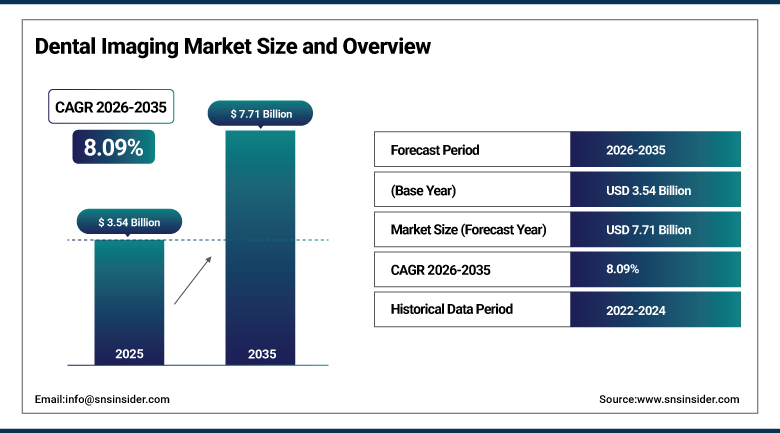
The Dental Imaging Market was valued at USD 3.54 Billion in 2025 and is expected to reach USD 7.71 Billion by 2035, growing at a CAGR of 8.09% from 2026-2035.
The Dental Imaging Market is expanding as dental practices replace film and analog systems with digital radiography and three-dimensional scanning. Rising demand for dental implants and clear aligner treatment supports equipment purchases. Artificial intelligence now helps clinicians detect caries and bone loss. Cone beam computed tomography units are moving from specialist offices into general practices. Intraoral scanners are replacing physical impressions. Dental service organizations are adding equipment across large practice networks. High equipment prices and training needs still limit adoption among small practices. Radiation concerns also shape purchasing decisions. Suppliers are responding with lower dose sensors, compact units and connected software. The market is expected to grow as digital workflows become standard.
⮞For instance, in March 2025, the World Health Organization reported that nearly 3.7 billion people are affected by oral diseases worldwide. The burden sustains demand for radiographic diagnosis and screening in dental practices.
To Get more information Dental Imaging Market - Request Free Sample Report
Dental Imaging Market Trends
-
Adoption of artificial intelligence for automated caries, bone loss and anatomy detection on radiographs
-
Shift from physical impressions to wireless intraoral scanners in everyday restorative workflows
-
Wider use of compact cone beam computed tomography units in general dental practices
-
Replacement of film and phosphor plate systems with low dose digital sensors
-
Integration of imaging with cloud software, treatment planning and chairside manufacturing
U.S. Dental Imaging Market Outlook
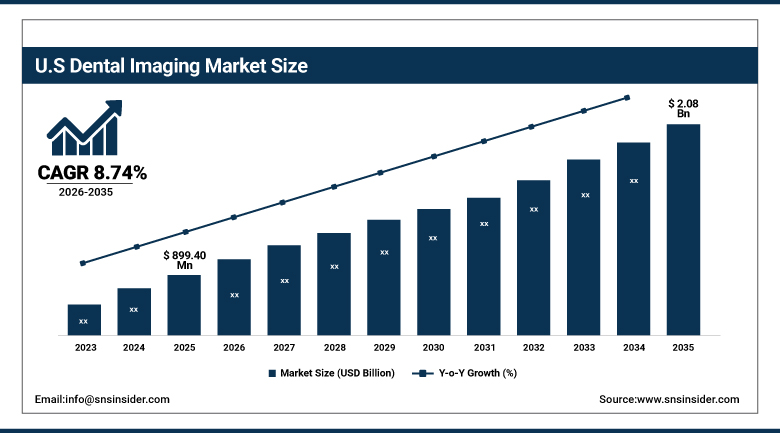
The U.S. Dental Imaging Market was valued at USD 899.40 Million in 2025 and is expected to reach USD 2.08 Billion by 2035, growing at a CAGR of 8.74% from 2026-2035.
The U.S. Dental Imaging Market is the largest national market and benefits from a large base of private practices and group networks. Most adults visit a dentist each year and receive routine radiographs. Dental insurance covers many diagnostic images. Implant placement and aligner treatment drive demand for three-dimensional imaging. Group practices standardize equipment across locations. Practices with older film or early digital systems continue to upgrade to newer sensors and scanners. Equipment costs and a limited supply of trained staff moderate purchases among small offices. Leasing programs and software subscriptions are lowering the entry cost. Demand is therefore expected to rise as digital and AI-assisted imaging spreads across general practices.
⮞For example, in 2025, the National Center for Health Statistics reported that 66.7% of U.S. adults aged 18 and older had a dental exam or cleaning in the past year. Regular visits create the recurring radiographic demand that supports equipment sales.
Dental Imaging Market Segment Analysis
-
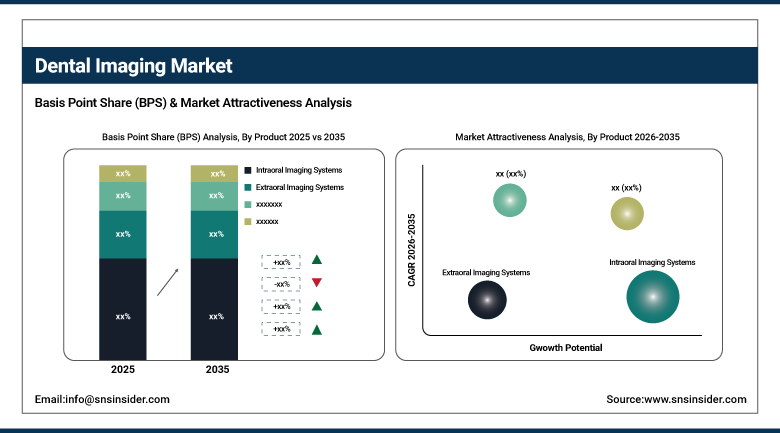
By Product, the Intraoral Imaging Systems segment dominated the Dental Imaging Market with approximately 58.83% share in 2025, while the Extraoral Imaging Systems segment is the fastest growing with a CAGR of approximately 9.37%.
-
By Technology, the 2-D Imaging segment dominated the Dental Imaging Market with approximately 48.10% share in 2025, while the 3-D Imaging segment is the fastest growing with a CAGR of approximately 8.11%.
-
By Application, the Implantology segment dominated the Dental Imaging Market with approximately 34.95% share in 2025, while the Orthodontics segment is the fastest growing with a CAGR of approximately 9.49%.
-
By End User, the Solo Practices segment dominated the Dental Imaging Market with approximately 43.94% share in 2025, while the Dental Service Organizations and Group Practices segment is the fastest growing with a CAGR of approximately 9.54%.
By Product, Intraoral Imaging Systems Dominates the Dental Imaging Market and Extraoral Imaging Systems Grows Fastest
Intraoral imaging systems remain the foundation of daily dental diagnosis, supported by bitewing, periapical and occlusal images taken at routine examinations. Sensors, phosphor plate scanners and intraoral cameras are present in almost every operatory, and their low unit price allows frequent replacement. Digital sensors have lowered radiation exposure and give instant images that dentists can show to patients. Intraoral scanners are also gaining use as practices replace physical impressions with digital models for crowns and aligners. Many practices pair sensors with intraoral cameras so that clinicians can document decay, fractures and restorations during the same visit, which raises the number of images stored for each patient over time.
Extraoral systems are emerging rapidly as practices add panoramic and cone beam units for implants, impacted teeth and airway assessment. Compact cone beam machines now fit smaller rooms and offer selectable fields of view that reduce dose. Manufacturers are bundling automated segmentation software that shortens planning time. Referral to radiology centers is declining as general dentists invest in their own units, which positions extraoral equipment as the main source of new revenue for imaging suppliers. Dental schools and public clinics are also upgrading classroom and clinic equipment, and this institutional demand adds a steady flow of orders that does not depend on private practice cycles.
⮞In March 2025, 3Shape introduced the TRIOS 6 wireless intraoral scanner, which weighs 308 grams. The launch shows how intraoral vendors are competing on portability and workflow speed.
By Technology, 2-D Imaging Dominates the Dental Imaging Market and 3-D Imaging Grows Fastest
Two-dimensional imaging continues to account for most examinations because bitewing and panoramic images are sufficient for routine caries and periodontal checks. Practices value the low cost per image, the short exposure time and the simple storage of digital files. Insurers reimburse these images widely, which keeps utilization stable. Software that annotates radiographs and flags suspected lesions is extending the useful life of existing sensors and panoramic units without requiring new hardware. Practices also rely on these systems for orthodontic records and surgical follow-up, so the same unit serves several specialties and can be justified more easily when owners review purchases.
Three-dimensional imaging is advancing faster as implant planning, endodontic retreatment and orthodontic assessment increasingly depend on volumetric data. Cone beam units have become smaller and less expensive, which widens their reach into general practices. Optical impression systems add digital surface models that can be merged with volumetric scans for guided surgery. Vendors are also adding motion artifact correction and low dose modes, which respond to concerns about repeated exposure. Better image quality is making panoramic units useful for screening at new patient visits, and software upgrades can be applied through the cloud without replacing the machine itself.
⮞For example, at IDS in March 2025, Acteon presented the X-MIND Optima 3D, a wall-mounted cone beam unit that weighs 69 kilograms. The unit reflects the push toward compact three-dimensional equipment.
By Application, Implantology Dominates the Dental Imaging Market and Orthodontics Grows Fastest
Implantology leads application demand because implant placement requires precise measurement of bone volume, nerve position and sinus anatomy before surgery. Cone beam scans and digital impressions support guided surgery and immediate loading protocols. Growth in tooth replacement among older adults keeps referral and in-office volumes high. Imaging also supports follow-up checks of bone integration, so each implant case generates several scans over its treatment course. Cases involving full arch restoration need several scans, including planning images, surgical guide checks and final verification, so a single treatment course produces more imaging revenue than most other procedures.
Orthodontics is growing quickly as clear aligner treatment spreads among adults and teenagers. Cases begin with intraoral scans and cephalometric or panoramic images, and they are monitored with repeated scans. General dentists have entered aligner treatment, which adds new imaging buyers beyond specialist orthodontists. Software that automates cephalometric tracing and tooth movement simulation is shortening planning time and supporting wider adoption of imaging in this segment. Training programs from manufacturers and professional societies are teaching general dentists to place implants, which broadens the number of offices that purchase volumetric scanners and planning software.
⮞In May 2025, Pearl received FDA 510(k) clearance for Second Opinion 3D, an AI tool that analyzes cone beam scans and identifies seven anatomical structures. The clearance shows that AI is extending from two-dimensional to volumetric dental images.
By End User, Solo Practices Dominates the Dental Imaging Market and Dental Service Organizations and Group Practices Grows Fastest
Solo practices account for the largest share of installed equipment because most dentists still own or lead a single office. These practices buy intraoral sensors, panoramic units and, increasingly, compact cone beam machines to keep referrals in house. Purchasing decisions are driven by the owner and depend on cost, ease of use and service support. Financing offers from distributors and manufacturers help small offices upgrade older systems. Practice owners usually decide quickly and prefer proven brands, so manufacturers focus on demonstrations, chairside training and local service teams to win purchases in this segment.
Dental service organizations and group practices are expanding fastest as private equity backed networks acquire independent offices. These groups buy equipment in volume and standardize on one vendor to simplify training and data management. Centralized purchasing gives them greater bargaining power over price and service terms. Networks also favor cloud software that shares images across locations, which supports demand for connected sensors, scanners and AI analysis tools. Growth in this segment is also supported by software that connects imaging with electronic records and insurance claims, which saves administrative time and helps keep operating costs under control.
⮞For instance, in November 2025, the American Dental Association's Health Policy Institute reported that more than 1 in 4 dentists up to 10 years out of dental school were affiliated with a dental service organization in 2024. The share shows the growing weight of group buyers in equipment purchasing.
Regional Analysis
|
Region |
Major Country |
Share within Region, 2025 (%) |
|---|---|---|
|
North America |
U.S. |
69.04 |
|
Europe |
Germany |
25.95 |
|
Asia Pacific |
China |
28.37 |
|
Latin America |
Brazil |
49.37 |
|
Middle East & Africa |
Saudi Arabia |
24.18 |
North America Dental Imaging Market Insights
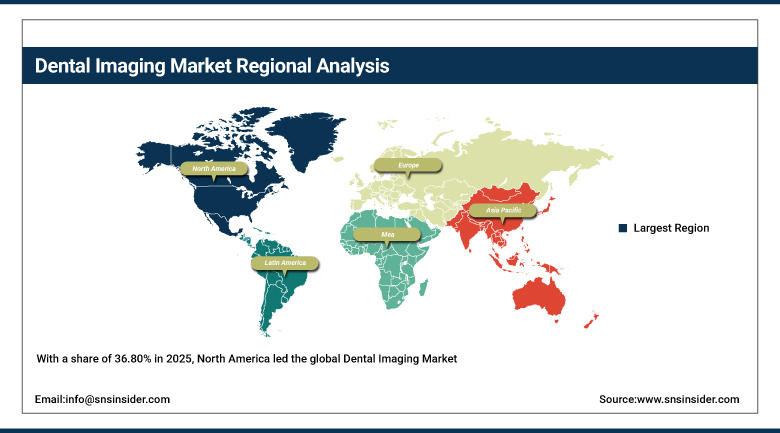
With a share of 36.80% in 2025, North America led the global Dental Imaging Market. The United States contributes most regional demand through a dense network of private practices, group networks and dental schools, while Canada adds steady purchases through provincial and private plans. Dental insurance covers routine radiographs, which supports replacement of aging sensors. Dentists use cone beam equipment for implants, and corporate groups buy intraoral scanners across many locations. Local suppliers such as Align Technology, Dentsply Sirona and Envista have deep dealer networks that support service and training across the region. Educational programs at dental schools introduce students to digital workflows, which prepares future owners to buy connected equipment at the start of their careers.
Regional growth is moderated by the maturity of digital radiography, since most offices already use sensors or phosphor plates. Future demand is therefore tied to upgrades toward three-dimensional imaging, AI analysis and cloud software. Rising adult aligner treatment and tooth replacement among older patients add scanning volume. Canadian practices are adopting digital impressions for restorative work, and Mexican clinics serving dental tourists invest in cone beam units to support implant care. Financing programs from dealers help smaller offices manage equipment costs. Large organizations in the region also use imaging data for quality programs and audits, which gives managers a reason to retain a single vendor across offices.
⮞In 2025, the American Dental Association's Health Policy Institute counted 205,088 professionally active dentists in the United States. The large dentist base shows the scale of the practice market that imaging suppliers address.
Get Customized Report as per Your Business Requirement - Enquiry Now
Europe Dental Imaging Market Insights
Europe is the second largest region and benefits from universal dental coverage in several countries and a long tradition of dental device manufacturing. Germany, the United Kingdom, France, Italy and Spain lead demand, and many leading equipment makers are headquartered in the region. Germany has a large network of private practices and strong laboratory integration. The United Kingdom is seeing growth in private dentistry as National Health Service access remains limited. Italy and Spain have rising implant volumes, which supports cone beam adoption. Government oversight of radiation safety is strong, and operators must keep dose records and maintain shielding, which encourages purchases of newer low dose equipment.
The European Union Medical Device Regulation raises documentation and certification requirements, which favors established suppliers with regulatory teams. Dentists in Nordic countries and the Netherlands are early adopters of digital workflows and AI-assisted diagnosis. Eastern European markets are replacing film based systems and offer growth for entry level sensors and panoramic units. Dental chains in Spain and the United Kingdom are consolidating purchasing, which increases demand for connected software and service contracts. Regional trade shows and a large base of dental laboratories speed the diffusion of new products, and dealers use them to introduce scanners and software upgrades each year.
⮞For instance, in September 2025, Lifco agreed to acquire a majority stake in Citodent Imaging, a Dutch developer of X-ray image software, which had net sales of about EUR 1.2 million in 2024. The deal shows continued consolidation of imaging software in Europe.
Asia Pacific Dental Imaging Market Insights
Asia Pacific is projected to be the fastest growing region, with a CAGR of 9.02% during 2026-2035. China, Japan, India, South Korea and Australia lead demand. Rising incomes, a growing middle class and expanding private dental chains are lifting spending on implants and orthodontics. South Korea is home to major scanner and cone beam manufacturers that export across the region. Japan has an older population with high tooth replacement needs. China is adding digital equipment through private clinic groups in large cities. Chains such as those in Japan and South Korea use standardized imaging protocols, so new equipment launches can reach many offices through a single purchasing decision.
India offers a large base of independent clinics that are moving from film to digital sensors, and local assembly of panoramic units is lowering prices. Australia has a mature market with strong adoption of cone beam and intraoral scanning. Dental tourism in Thailand, Vietnam and Malaysia drives purchases of implant planning equipment. Governments are improving oral health programs, which widens access to basic radiography. Lower priced domestic brands compete with imports and widen the buyer base. Telehealth rules are also evolving, and several countries are testing remote review of dental images to support clinics outside major cities.
⮞In August 2025, Medit announced the i900 Mobility intraoral scanner with a scan depth of 30 millimeters. The launch from a Korean maker highlights the region's role in scanner innovation.
MEA & Latin America Dental Imaging Market Insights
In Latin America, Brazil is the largest market because of its large number of dentists and active implant and orthodontic sectors. Mexico, Argentina, Colombia and Chile follow, with private clinics purchasing digital sensors and panoramic units. Import costs and currency swings affect pricing, so local distributors offer financing. Dental tourism in Mexico and Costa Rica supports investment in cone beam units. Public programs in Brazil provide basic dental care and add steady demand for entry level radiography. Training gaps persist in smaller cities, so suppliers combine equipment sales with courses and technical support to build confidence among general dentists.
In the Middle East and Africa, Saudi Arabia and the United Arab Emirates lead through new private hospitals, dental centers and health tourism. Government healthcare programs encourage digital adoption in the Gulf. South Africa has a developed private dental sector, while other African countries rely on basic equipment and donor programs. Limited budgets and gaps in trained staff slow adoption outside the Gulf, yet portable and low cost sensors are widening access to digital imaging. Public and private hospitals in the Gulf are building dental departments, and procurement tenders in those projects often specify cone beam units and digital sensors from established brands.
⮞In 2024, Saudi Arabia had 33,751 dentists according to Ministry of Health data compiled by the Gulf Labour Markets and Migration program. The workforce shows the size of the Gulf dental sector that buys imaging equipment.
Market Dynamics
Growth Drivers: AI-Assisted Diagnosis and Digital Workflows
Artificial intelligence is the strongest driver of dental imaging demand because it makes each image more useful. Software now flags caries, bone loss, calculus and periapical lesions on radiographs and highlights anatomy on cone beam scans. Dentists use these outputs as a second opinion and to explain findings to patients, which improves case acceptance. Vendors sell AI as a subscription, which creates recurring revenue and encourages practices to buy compatible sensors and scanners. Clinical studies show that AI assistance can raise the detection of early lesions, which supports its wider use by general dentists.
Digital workflows add further demand by connecting imaging to treatment planning and chairside manufacturing. A scan can feed a crown design, a surgical guide or an aligner plan without a physical impression. Cloud platforms share images among general dentists, specialists and laboratories. Insurers also accept digital images for claims. These links make imaging equipment part of a connected system and support steady replacement and upgrade cycles across practices of every size. Practices that adopt AI often upgrade their sensors and cone beam units at the same time to obtain image quality suited to the software.
⮞In December 2025, Overjet received FDA 510(k) clearance for CBCT Assist, its tenth FDA clearance. The clearance shows that AI vendors are widening regulated image analysis from radiographs to volumetric scans.
Restraints: High Equipment Cost and Radiation Concerns
High acquisition cost restrains adoption, especially for cone beam units and premium intraoral scanners. A single practice must also pay for installation, shielding, software licenses and training. Small and independent offices have limited capital and may delay replacement of working equipment. Service contracts and software subscriptions add recurring cost. In emerging markets, import duties and currency effects raise prices further and extend payback periods beyond what many clinics accept. Replacement of equipment is usually postponed until a unit fails, which lengthens the sales cycle for manufacturers.
Radiation exposure is a second constraint, particularly for children and for repeated imaging. Professional guidelines call for images only when clinically justified, and some patients refuse routine radiographs. Regulators require dose records, shielding and operator training. Complex approval rules under regional medical device laws add cost for new products. Suppliers are responding with low dose sensors and selectable fields of view, but concerns still moderate the frequency of imaging. Dealers therefore offer leasing and pay per use plans to reduce the barrier, although these plans lower initial revenue for suppliers.
⮞For example, in January 2026, the American Dental Association issued its first dental X-ray recommendations in more than a decade. The guidance replaces the 2012 version and covers both two-dimensional and cone beam imaging.
Opportunities: Emerging Markets and Portable Imaging
Emerging markets offer large unserved demand because many clinics still rely on film or no imaging at all. Rising incomes, private dental chains and health tourism are lifting investment in digital sensors, panoramic units and cone beam machines. Governments are also improving oral health programs. Suppliers can reach these buyers with lower priced models, local assembly and financing through distributors, and can build service networks that create long term customer relationships. Mobile dental programs and school screening projects in several countries are creating new demand for light and rugged equipment.
Portable and handheld devices create another opening. Compact X-ray sources and wireless sensors allow imaging in school programs, long term care homes and mobile clinics. Teledentistry platforms combine these images with remote review by specialists. Subscription models for software and equipment lower upfront cost for small practices. Companies that combine compact hardware with AI analysis and cloud storage are well placed to serve these new settings. Early partnerships between device makers and software firms are already bringing integrated offers to market, which should shorten adoption cycles.
⮞In August 2026, Dentsply Sirona reported that its Connected Technology Solutions segment grew 8.8% in Asia Pacific in the second quarter. The result shows demand for digital dentistry equipment in the region.
Recent Developments:
-
In March 2025, Planmeca introduced the Viso G1 cone beam computed tomography unit with a field of view of up to 11 x 11 centimeters. The unit includes motion artifact correction and expands the company's three-dimensional range for general practices.
-
In June 2026, Vatech completed EU Medical Device Regulation certification across its imaging portfolio. The certification supports continued sales of its cone beam and panoramic systems in European markets.
-
In December 2024, Owandy Radiology launched the compact I-Max 3D XPro cone beam system at the Greater New York Dental Meeting. The system targets practices that need three-dimensional imaging in a small footprint.
-
In March 2025, DEXIS previewed DTX Studio Clinic features that produce an automated chairside surgical template in under three minutes. The company also showed the Imprevo intraoral scanner, which was in development, to extend its digital workflow offering.
Dental Imaging Market Key Players
-
Align Technology, Inc.
-
Planmeca Oy
-
Dentsply Sirona Inc.
-
Envista Holdings Corporation (DEXIS)
-
3Shape A/S
-
Medit Corp.
-
Vatech Co., Ltd.
-
Acteon Group
-
Owandy Radiology
-
Carestream Dental
-
Dürr Dental SE
-
Air Techniques, Inc.
-
Shining 3D Tech Co., Ltd.
Dental Imaging Market Report Scope:
| Report Attributes | Details |
|---|---|
| Market Size in 2025 | USD 3.54 Billion |
| Market Size by 2035 | USD 7.71 Billion |
| CAGR | CAGR of 8.09% From 2026 to 2035 |
| Base Year | 2025 |
| Forecast Period | 2026-2035 |
| Historical Data | 2022-2024 |
| Report Scope & Coverage | Market Size, Segments Analysis, Competitive Landscape, Regional Analysis, DROC & SWOT Analysis, Forecast Outlook |
| Key Segments | • By Product (Intraoral Imaging Systems and Extraoral Imaging Systems) • By Technology (2-D Imaging, 3-D Imaging, and Optical Impression Systems) • By Application (Implantology, Orthodontics, Endodontics, Diagnostics, and Other Applications) • By End User (Solo Practices, Dental Service Organizations and Group Practices, Hospitals, and Other End Users) |
| Regional Analysis/Coverage | North America (US, Canada), Europe (Germany, UK, France, Italy, Spain, Russia, Poland, Rest of Europe), Asia Pacific (China, India, Japan, South Korea, Australia, ASEAN Countries, Rest of Asia Pacific), Middle East & Africa (UAE, Saudi Arabia, Qatar, South Africa, Rest of Middle East & Africa), Latin America (Brazil, Argentina, Mexico, Colombia, Rest of Latin America). |
| Company Profiles | Align Technology, Inc., Planmeca Oy, Dentsply Sirona Inc., Envista Holdings Corporation (DEXIS), 3Shape A/S, Medit Corp., Vatech Co., Ltd., Acteon Group, Owandy Radiology, Carestream Dental, Dürr Dental SE, Air Techniques, Inc., Shining 3D Tech Co., Ltd. |

Frequently Asked Questions
Key players include Align Technology, Planmeca, Dentsply Sirona, Envista (DEXIS), 3Shape, Medit, Vatech, Acteon Group, Owandy Radiology, Carestream Dental, Dürr Dental, Air Techniques and Shining 3D.
Key opportunities include expansion in emerging markets, portable and handheld imaging, subscription based software and AI-assisted diagnosis that links imaging to treatment planning and chairside manufacturing.
Adoption of digital and AI-assisted imaging is the main growth factor, supported by rising demand for implants and clear aligner treatment and by dental service organizations that standardize equipment across practices.
By Product, the Intraoral Imaging Systems segment dominated the market in 2025 with an estimated 58.83% share, supported by routine bitewing and periapical examinations and low unit prices.
North America dominated the market with a share of 36.80% in 2025, driven by a large base of private practices, insurance coverage for radiographs and early adoption of cone beam and AI tools.
