
DER Interconnection Management Market Report Scope and Overview:
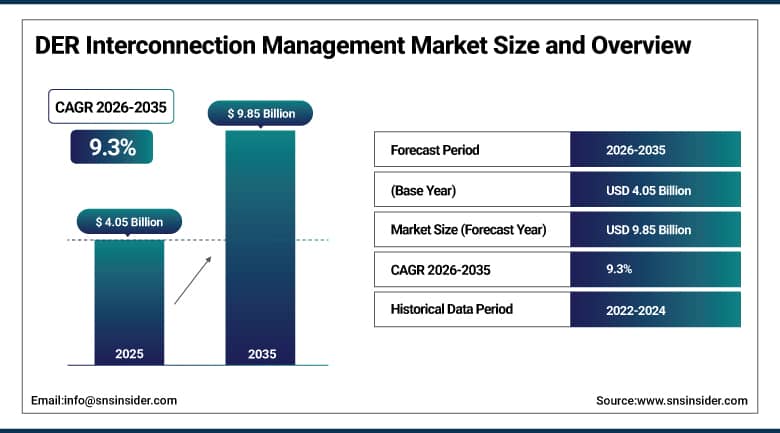
The DER Interconnection Management Market was valued at USD 4.05 Billion in 2025 and is projected to reach USD 9.85 Billion by 2035, registering a CAGR of 9.3% from 2026 to 2035.
Utilities and independent power producers are under growing pressure to bring order to a grid that now hosts thousands of rooftop solar arrays, battery systems, and small wind installations, and DER interconnection management platforms are how that coordination actually happens. Rather than treating each new solar application or storage unit as a one-off engineering exercise, these systems let grid operators screen, approve, and monitor distributed assets from a single console. Regulatory pressure from standards such as IEEE 1547-2018 in the United States, the EU's Clean Energy Package, and China's grid-connection policies has turned what used to be a discretionary upgrade into something closer to a compliance requirement.
Much of the recent momentum traces back to utilities racing to keep pace with rooftop solar, community solar projects, and virtual power plants that are growing faster than most distribution networks were originally designed to handle. Vendors such as Schneider Electric and Siemens AG have poured resources into forecasting and automation tools precisely because manual review processes simply cannot scale to the volume of interconnection requests utilities now receive.
To Get More Information On DER Interconnection Management Market - Request Free Sample Report
DER Interconnection Management Market Trends
-
Utilities are shifting interconnection approvals from manual engineering review to automated, standards-based screening.
-
Cloud-native platforms are pulling ahead of on-premises systems as utilities look to cut upfront infrastructure costs.
-
Smart inverters are taking on active grid-support roles once handled entirely by centralized generation.
-
Battery storage optimization is becoming a distinct revenue line for platforms managing charge and discharge cycles.
-
Virtual power plant aggregation is opening wholesale market access to small, behind-the-meter resources.
U.S. DER Interconnection Management Market Outlook
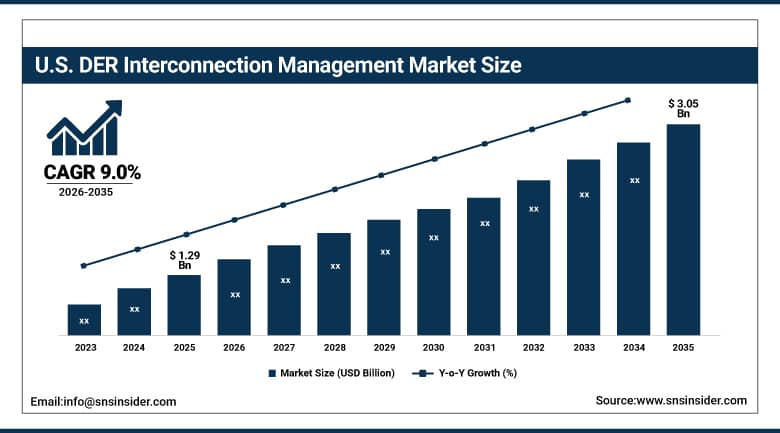
The U.S. DER Interconnection Management Market was valued at approximately USD 1.29 Billion in 2025 and is projected to reach approximately USD 3.05 Billion by 2035, registering a CAGR of approximately 9.0% from 2026 to 2035.
A lot of what's driving U.S. demand traces back to state-level interconnection reform, particularly updates to California's Rule 21 and New York's Standardized Interconnection Procedures, which have effectively made software-based review the only practical way to keep up with application volumes. FERC Order 2222, which opened wholesale markets to distributed resources, added another layer of urgency, since grid operators now need platforms capable of aggregating and dispatching thousands of small assets with sub-second response times.
Utilities including NextEra Energy, Duke Energy, and American Electric Power have leaned on vendors like Opus One Solutions and Smarter Grid Solutions to handle this complexity, and that trend shows no sign of slowing as rooftop solar, community solar, and battery deployments continue climbing across California, Texas, and the Northeast.
DER Interconnection Management Market Segment Analysis
-
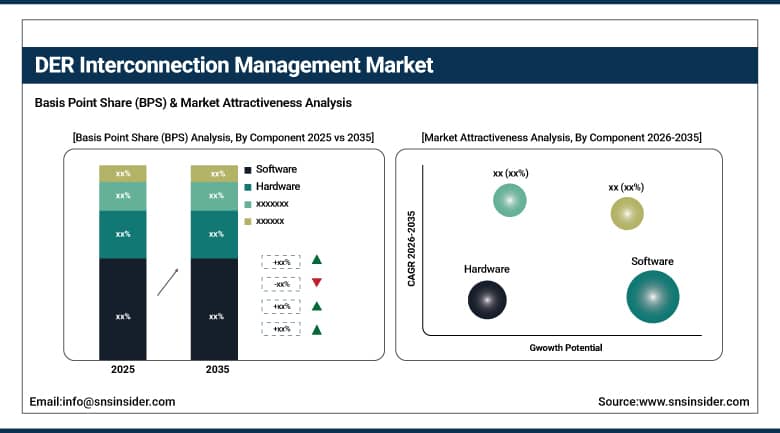
By Component, Software led the market in 2025 with 44.1% share; Hardware and Services follow, with Services growing fastest at 9.8% CAGR.
-
By Application, Utilities dominated the market in 2025 with 39.6% share; Industrial applications are the fastest growing segment.
-
By Deployment Mode, Cloud held 58.4% share in 2025 and is expected to reach 67.1% by 2035 as utilities move away from on-premises systems.
-
By End-User, Grid Operators led the market in 2025 with 36.9% share; Independent Power Producers is the fastest growing segment among core categories.
By Component, Software Leads, Services Close the Gap
Software captured the largest slice of this market in 2025, and it isn't hard to see why. DER management platforms, upgraded SCADA layers, and advanced distribution management systems form the intelligence layer that actually makes sense of thousands of scattered assets, and that layer keeps getting more valuable as the number of connected devices grows. Vendors like Opus One Solutions, Smarter Grid Solutions, and PowerHub have benefited from utilities wanting faster interconnection processing without adding headcount, and the shift toward subscription-based licensing has made these platforms easier for utilities to budget for even when capital spending is tight.
Hardware still matters, of course, particularly as smart inverters take on grid-support duties that used to be the job of large power plants. But Services is the component quietly picking up steam, growing at 9.2% CAGR as implementation complexity rises. Integrators such as Doosan GridTech and Indra Sistemas are increasingly called in not just to install software but to redesign workflows, retrain staff, and stitch new platforms into legacy utility systems that were never built with modern APIs in mind. That kind of hands-on integration work tends to generate long-term service contracts, which is part of why this segment keeps growing faster than hardware.
By Application, Utilities Lead, Industrial Sites Are Catching Up Fast
Utilities remain the anchor customer for DER interconnection management, holding 39.6% of the market in 2025. That makes sense given the scale of the problem they're facing: a single distribution utility might be fielding thousands of individual interconnections requests a year, each one needing a technical compliance check that used to take an engineer days to complete manually. Companies like Duke Energy, American Electric Power, and Southern Company Electric have turned to platforms from EnergyHub and Clean Power Research specifically to compress those review timelines and keep pace with growing renewable penetration.
Industrial and commercial facilities are the segment to watch, though. As corporations including Apple, Google, and Microsoft push toward fully renewable operations, and as battery storage costs keep falling, more industrial sites are installing solar-plus-storage systems not for sustainability optics but because it's becoming the cheaper option. AutoGrid Systems and Spirae have built out platforms specifically for this crowd, helping industrial operators manage peak demand charges and, in some cases, join virtual power plant arrangements that monetize spare capacity behind the meter.
Regional Analysis:
|
Region |
Major Country |
Share within Region, 2025 (%) |
|---|---|---|
|
North America |
United States |
79.80% |
|
Europe |
Germany |
26.50% |
|
Asia Pacific |
China |
39.90% |
|
Middle East and Africa |
Saudi Arabia |
31.60% |
|
Latin America |
Brazil |
33.80% |
North America DER Interconnection Management Market Insights
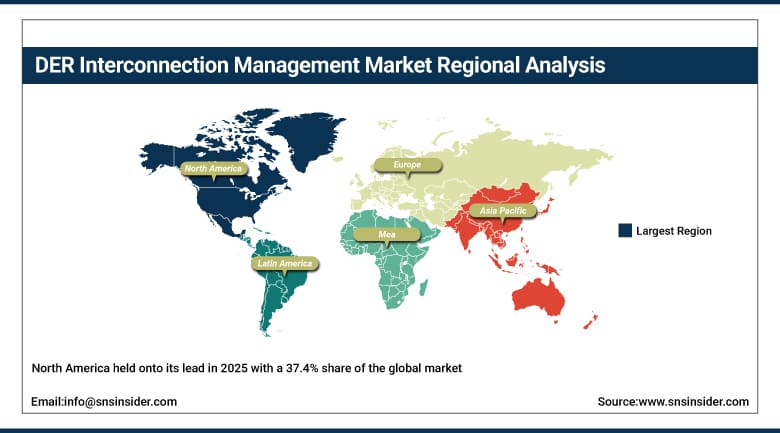
North America held onto its lead in 2025 with a 37.4% share of the global market, and the reasons are fairly straightforward: aggressive renewable portfolio standards in states like California, Texas, and New York, combined with federal incentives under the Inflation Reduction Act, have created sustained demand for interconnection tools. The region also happens to have some of the oldest and most complex distribution infrastructure in the world, which means utilities here were forced to modernize their management systems earlier than most.
The United States accounts for the overwhelming majority of North American revenue, at roughly 79.80%, largely because utilities such as NextEra Energy, Duke Energy, and American Electric Power have been early and consistent buyers of platforms from Opus One Solutions and Smarter Grid Solutions. Canada contributes a smaller but steady share, driven mostly by provincial utilities working through similar renewable integration challenges on a smaller scale.
Get Customized Report as Per Your Business Requirement - Enquiry Now
Europe DER Interconnection Management Market Insights
Europe's share of the market, at roughly a quarter of global revenue, is closely tied to the EU's renewable electricity targets, which call for 42.5% renewable generation by 2030 and net-zero emissions by 2050. Those targets aren't optional for member states, which is part of why countries like Germany, Denmark, and Spain have moved fairly aggressively on DER management adoption, particularly as offshore wind and virtual power plant networks become bigger pieces of the regional energy mix.
Germany represents the largest single national market in Europe, supported by a mix of research institution collaboration and industrial decarbonization pilot programs. Vendors such as Indra Sistemas and CyanConnode have found particular traction here, partly because their platforms were built from the outset around CENELEC grid codes and distribution network operator requirements that differ meaningfully from North American standards.
Asia Pacific DER Interconnection Management Market Insights
Asia Pacific is the region to watch over the next decade, with growth running somewhere in the 12 to 14% range annually as China, India, and Australia add solar and wind capacity faster than their grid infrastructure can naturally absorb it. China's stated ambition to reach 1.2 terawatts of renewable capacity by 2030 essentially forces the issue; without sophisticated DER management, that kind of build-out risks serious grid stability problems. India's competitive renewable auction system is pushing similar adoption among independent power producers, while Australia's unusually high rooftop solar penetration has created its own distinct set of integration headaches.
China is the largest single national market in the region, based not only on the scale of its renewable installations but also on the level of concern among utility companies to prevent grid instability. The other two countries that play an important role in Asia are Japan and South Korea, although for different reasons. In the case of Japan, the main priority is energy security after decades of relying on imports.
Latin America and Middle East & Africa DER Interconnection Management Market Insights
Latin America and the Middle East & Africa together made up around 16% of the global market in 2025, and what's interesting here is how differently growth is playing out in each region. In Latin America, falling battery storage costs are making hybrid renewable systems viable for the first time in off-grid and rural electrification projects, particularly in Brazil, where distributed residential solar is beginning to disrupt utilities' traditional business models.
In the Middle East, Saudi Arabia's Vision 2030 initiative, which targets 50% renewable electricity generation by 2030, is creating real demand for platforms that can integrate distributed solar and storage into grids that were built almost entirely around centralized generation. The UAE and South Africa are moving in a similar direction, though more gradually, as young, fast-urbanizing populations push electricity demand higher and make distributed generation an increasingly attractive way to meet it.
Market Dynamics:
Growth Drivers: Renewable Growth, Regulatory Mandates, and Battery Storage Optimization
The single biggest driver here is simply the pace at which distributed solar and storage are being deployed. Global rooftop solar capacity has already crossed 285 GW, and battery energy storage systems at the distribution level are growing north of 25% a year. That kind of growth doesn't leave utilities much choice; traditional SCADA systems were never designed to track thousands of individuals, variable, non-dispatchable resources in real time, which is exactly why vendors like Schneider Electric and ABB Ltd. have been investing heavily in analytics platforms built specifically for this problem.
Regulation is doing just as much work as market forces. Standards such as IEEE 1547-2018, CENELEC EN 50160, and IEC 61850 are no longer optional guidelines, and FERC Order 2222's requirement that DERs be allowed to participate in wholesale markets has effectively made sophisticated management platforms a legal necessity for grid operators. Layer in battery storage systems growing at 30-35% annually, each one needing its charge and discharge cycles optimized for multiple revenue streams, and it becomes clear why demand for these platforms keeps climbing faster than the broader grid modernization market.
Restraints: Integration Complexity and Legacy System Constraints
The honest challenge for a lot of utilities isn't buying a DER management platform, it's getting that platform to actually talk to everything already in place. Legacy SCADA systems, advanced metering infrastructure, and distribution automation equipment were built over decades using different data formats, different communication protocols, and, frankly, different assumptions about how utilities would operate. Add in organizational silos where distribution operations, market participation, and customer service each run their own systems, and integration projects can drag on far longer than utilities budget for.
Data quality tends to be the quieter problem underneath all of this. Inconsistent device naming, missing geographic information, and incomplete equipment specifications routinely undermine the accuracy of even well-designed DER management systems. Vendors like Spirae and Doosan GridTech have built entire service lines around exactly this kind of data harmonization and master-data cleanup, which says something about how common the problem actually is across the industry.
Opportunities: Virtual Power Plants, EV Integration, and Emerging Market Expansion
Virtual power plants represent probably the clearest growth opportunity in this market right now. Aggregators are increasingly deploying sophisticated DER management systems to coordinate thousands of behind-the-meter resources at once, optimizing dispatch across multiple revenue streams in a way that individual homeowners or small businesses could never do on their own. That model is only getting more attractive as electric vehicle charging infrastructure, heat pump demand response, and behind-the-meter thermal storage start expanding what counts as a manageable distributed resource in the first place.
There's also real opportunity building in markets that skipped over traditional grid infrastructure altogether. Utilities across Latin America and parts of Africa need DER management systems built for low-cost deployment and unreliable connectivity, conditions that most Western-market platforms weren't designed to handle. Vendors willing to build for those constraints, rather than simply exporting their existing product, stand to capture meaningful share as rural electrification programs continue expanding.
Recent Developments:
-
February 2026: The GE Vernova has come up with GridOS for Distribution, which is an integrated software platform encompassing real-time operations, DER management, network models, and field operations.
-
February 2026: Siemens Energy debuted Noedra, an advanced platform for grid intelligence using digital twin technology, at DistribuTECH 2026, allowing transmission companies to track power flows and grid assets in real time.
-
April 2026: Schneider Electric emerged as a Leader in Verdantix Green Quadrant for Distributed Energy Resource Management Systems, on the strength of its EcoStruxure DERMS solution that scores high on forecasting precision, constraint management, and interoperability.
-
February 2026: GridBeats APS from GE Vernova is an automated software-defined protection system that aims at integrating substation devices and making the process of DER grid digitalization simpler.
-
2026: Schneider Electric has introduced its One Digital Grid Platform by incorporating the Grid AI Assistant into EcoStruxure ADMS and DERMS for utilities to troubleshoot problems and tune the network model in real time in response to higher DERs.
DER Interconnection Management Market key players are:
-
Schneider Electric
-
Siemens AG
-
GE Vernova
-
ABB Ltd.
-
Eaton Corporation
-
Opus One Solutions
-
Open Systems International (OSI)
-
Smarter Grid Solutions
-
AutoGrid Systems
-
Generac Grid Services (Enbala)
-
Doosan GridTech
-
Spirae, Inc.
-
Indra Sistemas
-
PowerHub
-
Advanced Control Systems (ACS)
-
OSGP Alliance
-
CyanConnode
-
EnergyHub
-
Itron, Inc.
-
Clean Power Research
DER Interconnection Management Market Report Scope:
| Report Attributes | Details |
|---|---|
| Market Size in 2025 | USD 4.42 Billion |
| Market Size by 2035 | USD 9.52 Billion |
| CAGR | 9.3% from 2026 to 2035 |
| Base Year | 2025 |
| Forecast Period | 2026-2035 |
| Historical Data | 2022-2024 |
| Report Scope & Coverage | Market Size, Segments Analysis, Competitive Landscape, Regional Analysis, DROC & SWOT Analysis, Forecast Outlook |
| Key Segments | •By Component, Software led the market in 2025 with 44.1% share; Hardware and Services follow, with Services growing fastest at 9.8% CAGR. •By Application, Utilities dominated the market in 2025 with 39.6% share; Industrial applications are the fastest growing segment. •By Deployment Mode, Cloud held 58.4% share in 2025 and is expected to reach 67.1% by 2035 as utilities move away from on-premises systems. •By End-User, Grid Operators led the market in 2025 with 36.9% share; Independent Power Producers is the fastest growing segment among core categories. |
| Regional Analysis/Coverage | North America (US, Canada), Europe (Germany, UK, France, Italy, Spain, Russia, Poland, Rest of Europe), Asia Pacific (China, India, Japan, South Korea, Australia, ASEAN Countries, Rest of Asia Pacific), Middle East & Africa (UAE, Saudi Arabia, Qatar, South Africa, Rest of Middle East & Africa), Latin America (Brazil, Argentina, Mexico, Colombia, Rest of Latin America). |
| Company Profiles |
Schneider Electric, Siemens AG, GE Vernova, ABB Ltd., Eaton Corporation, Opus One Solutions, Open Systems International (OSI), Smarter Grid Solutions, AutoGrid Systems, Generac Grid Services (Enbala), Doosan GridTech, Spirae, Inc., Indra Sistemas, PowerHub, Advanced Control Systems (ACS), OSGP Alliance, CyanConnode, EnergyHub, Itron, Inc., Clean Power Research. |

Frequently Asked Questions
Key players in the DER Interconnection Management Market include Schneider Electric, Siemens AG, GE Vernova, ABB Ltd., and Eaton Corporation, among others.
Key opportunities include the growth of virtual power plant business models, integration with electric vehicle charging and demand response programs, and expansion into emerging markets where distributed generation is replacing traditional grid buildout.
Growth is being driven largely by the sheer pace of distributed solar and battery storage deployment, combined with regulatory mandates such as IEEE 1547-2018 and FERC Order 2222 that require utilities to modernize how they manage interconnected assets.
The Software segment dominated the DER Interconnection Management Market, accounting for approximately 44.1% market share in 2025.
North America dominated the DER Interconnection Management Market in 2025 with a 37.4% share, supported by aggressive renewable portfolio standards and federal clean energy incentives.
