
Die Bonder Equipment Market Report Scope & Overview:
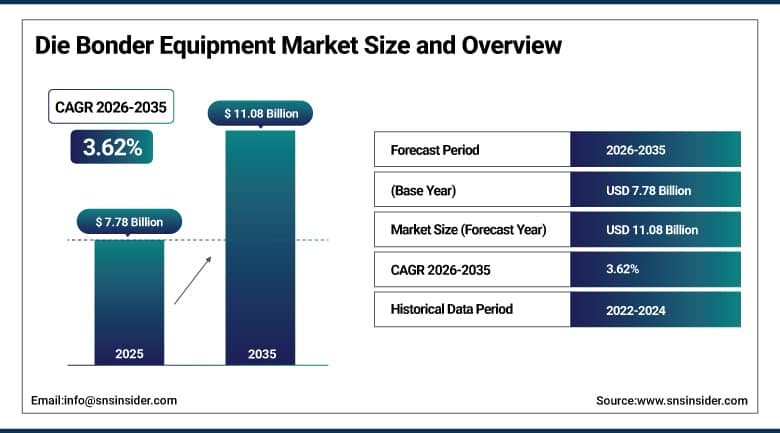
The Die Bonder Equipment Market was valued at USD 7.78 billion in 2025 and is expected to reach USD 11.08 billion by 2035, growing at a CAGR of 3.62% from 2026–2035.
The die bonder equipment market is witnessing steady growth in the global market owing to rising semiconductor manufacturing investments. Increasing demand for advanced chip packaging is supporting equipment adoption. Growing automotive electronics and AI semiconductor production are accelerating market expansion. Manufacturers are focusing on high precision automation technologies. Rising demand for miniaturized and high-performance electronic devices is driving innovation. Increasing use in advanced packaging and heterogeneous integration is further accelerating market adoption.
As per the SIA 2025 industry data and SEMI World Fab Forecast, global semiconductor manufacturing capacity will surpass 42 million 200-mm equivalent wafers per month by 2025, thanks to the growing capacity expansion at fabrication plants around the world. As per WSTS 2025 forecast, the shipments of semiconductors have increased consistently in advanced packaging applications. More than 20 semiconductor manufacturing and packaging projects have been initiated in the United States under the U.S. CHIPS Program Office, and there is an increase in demand for precision die bonders that are utilized in the assembly and advanced packaging operations of chips.
To Get More Information On Die Bonder Equipment Market - Request Free Sample Report
Die Bonder Equipment Market Trends:
-
Growing use of AI, IoT, and HPC is leading to increased demand for high precision die bonding machines within advanced semiconductor packaging environment.
-
Small size electronic products are making the manufacturers to look towards ultra precise die bonder machines that would accommodate small chip architecture.
-
Development of 5G and AI chip products is resulting in increased demand for advanced packaging technologies within various semiconductor manufacturing facilities across the world.
-
Increased use of heterogeneous integration and multi-chip modules is adding complexities to the process and increasing the need for automation in die bonding equipment.
-
Growing usage of data centers and cloud computing systems is raising the demand for semiconductor packaging which in turn is leading to adoption of packaging equipment.
-
Growing advancements in semiconductor technology is encouraging developments within die bonding equipment.
U.S. Die Bonder Equipment Market Outlook:
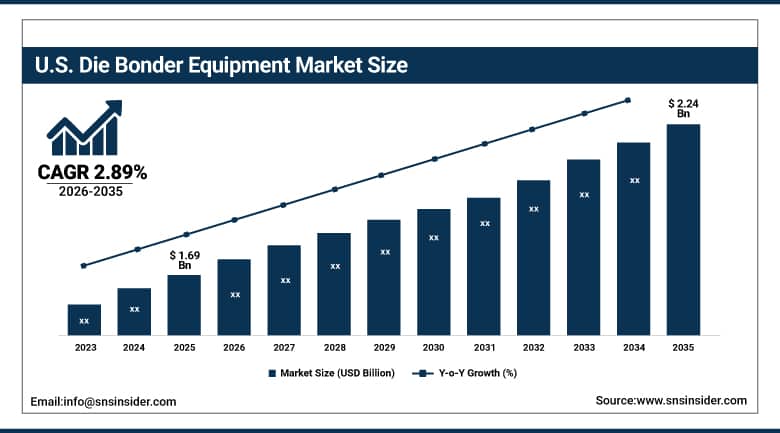
The U.S. Die Bonder Equipment Market was valued at USD 1.69 billion in 2025 and is expected to reach around USD 2.24 billion by 2035, growing at a CAGR of 2.89% from 2026–2035.
The U.S. die bonder equipment market is expanding steadily owing to strong demand for advanced semiconductor packaging solutions. Increasing investments in domestic chip manufacturing are supporting market growth. Rising adoption of AI, automotive, and high-performance computing devices is driving equipment demand. Growth in advanced packaging facilities is further accelerating market expansion. Manufacturers are focusing on precision automation and high-speed die bonding technologies. Increasing government support for semiconductor production is strengthening long term market development.
According to the U.S. Department of Commerce CHIPS for America Program, the U.S. is carrying out its biggest semiconductor manufacturing build-out effort in many years, with 34 CHIPS incentive awards being negotiated in 22 states by early 2025 to improve semiconductor fabrication, assembly, testing, advanced packaging, and semiconductor equipment manufacturing capacity. The Department also estimates private investment in semiconductors at nearly $450 billion, with the National Semiconductor Technology Center setting up advanced packaging research and development facilities to expedite domestic chip packaging technologies that will support the demand for precise die bonder equipment.
Die Bonder Equipment Market Segment Analysis:
-
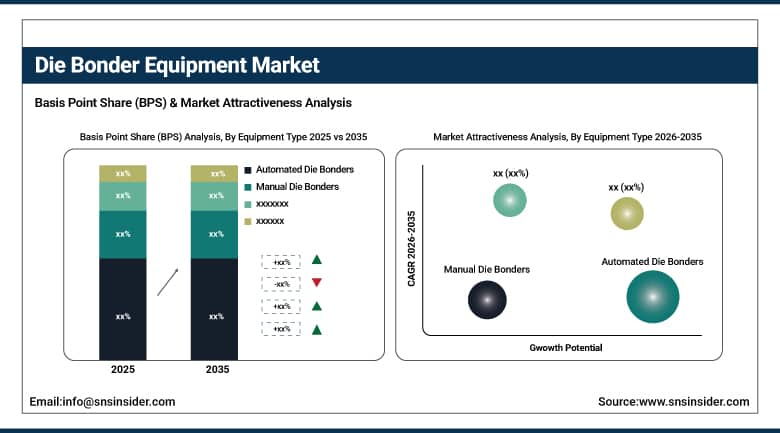
By Equipment Type, automated die bonders dominated the market with 58.40% share in 2025; while manual die bonders are the fastest growing segment with CAGR of 5.23% during 2026 to 2035.
-
By Application, semiconductor packaging dominated the market with 56.80% share in 2025; while LED manufacturing is the fastest growing segment with CAGR of 8.54% during 2026 to 2035.
-
By Material Compatibility, gold wire dominated the market with 54.30% share in 2025; while copper wire is the fastest growing segment with CAGR of 6.78% during 2026 to 2035.
-
By Production Capacity, high volume production dominated the market with 49.60% share in 2025; while low volume production is the fastest growing segment with CAGR of 5.72% during 2026 to 2035.
-
By Technology Adoption, conventional technology dominated the market with 57.90% share in 2025; while advanced technology is the fastest growing segment with CAGR of 7.94% during 2026 to 2035.
By Equipment Type, automated die bonders dominated the die bonder equipment market, while manual die bonders are the fastest growing segment.
The Automated Die Bonder segment captured the dominated market share with the most prominent revenues generated in 2025. It was due to the increased use across high-volume manufacturing plants in the semiconductor industry across the globe. Such systems ensure high accuracy, faster processing, and improved consistency in bonding for advanced packaging of chips. Increased funding in automated equipment in the production of semiconductors fueled the demand.
The Manual Die Bonders segment will witness the fastest CAGR during 2026-2035. Increased demand from research laboratories, prototype development, and low-volume semiconductor productions will fuel the demand. Such die bonders have more flexibility in use and low costs compared to other systems. Increased academic research, startup companies, and specific electronic devices manufacture will propel the segment's growth in the forecast period.
By Application, semiconductor packaging dominated the die bonder equipment market, while LED manufacturing is the fastest growing segment.
Semiconductor Packaging segment has dominated the die bonder equipment market by holding the largest revenue share in 2025. High demand for semiconductor packaging technologies in consumer electronics and automotive industry segments is boosting the demand for equipment globally. High demand and production of processors, memories, and power semiconductors is further adding to the growth in the global market. The consistent investments made in packaging technology and high-volume production is contributing towards dominance in the segment.
LED Manufacturing segment is likely to witness the fastest CAGR from 2026 to 2035. Rising demand for energy-efficient lighting technologies is leading to high adoption of advanced die bonder equipment in the market. Increasing production of mini-LED and micro-LED displays is fueling the investments being made in the equipment.
By Material Compatibility, gold wire dominated the die bonder equipment market, while copper wire is the fastest growing segment.
Gold Wire segment accounted for the dominated revenue share in the die bonder equipment market in 2025. The widespread use of this material can be attributed to its good conductive properties, reliability of bonds, and effectiveness in precise semiconductor packaging. Gold wire is favored for its high corrosion resistance and reliable interconnect properties. Its well-established use in the latest and older types of integrated circuits has helped maintain its dominance in the market.
The Copper Wire segment is projected to register the fastest CAGR from 2026-2035 owing to increasing need for cost-efficient and high-performance interconnects in advanced semiconductors. It is less expensive than gold wire while offering similar good electrical and thermal performance. Increasing use in smaller devices, AI chips, and automotive sector has driven its growth. Improvements in its oxidation resistance and bonding techniques have contributed to its growing acceptance in next generation packaging.
By Production Capacity, high volume production dominated the die bonder equipment market, while low volume production is the fastest growing segment.
High Volume Production held the dominated revenue share in the die bonder equipment market in 2025. Factors such as the high demand for large-scale semiconductor production and continuous demand from the consumer electronics and automotive sectors drive its dominance. The high-volume production market is driven further by the need for high throughputs and efficiencies in advanced packaging lines. Manufacturers require automated machines that help improve efficiencies and yield management in the global semiconductor production units.
Low Volume Production is estimated to register the fastest CAGR from 2026-2035 owing to the growing demand for prototyping and customized semiconductors. Growth is being supported by the increasing adoption in research and development activities. The expanding adoption in MEMS devices, specialty chips, and advanced packaging applications is driving the demand. The flexibility associated with small-batch manufacturing and design iterations is fueling the adoption across startup semiconductor firms globally.
By Technology Adoption, conventional technology dominated the die bonder equipment market, while advanced technology is the fastest growing segment.
The Conventional Technology segment accounted for the dominated revenue share of the die bonder equipment market in 2025 owing to its large installation base in existing semiconductor fabrication facilities. It provides cost efficiency, reliability and ease of maintenance. The use of conventional technology systems remains favorable amongst mid-scale manufacturers because of low capital investments. It also ensures stable production processes in existing packaging lines. High compatibility with existing industrial facilities is yet another factor driving the dominance of the Conventional Technology segment in the market.
The Advanced Technology segment is anticipated to witness the fastest CAGR during 2026-2035. This can be attributed to increasing demand for small sized and high-performance semiconductor devices. The growing need for AI, 5G and automotive electronic products is fuelling the need for more precise die bonding solutions. Advanced technology systems offer higher speed and accuracy levels along with greater automation features. The trend of moving towards smart factories and Industry 4.0 adoption among manufacturers is further propelling their use.
Regional Analysis:
|
Region |
Major Country |
Share within Region, 2025(%) |
|---|---|---|
|
North America |
United States |
87.60% |
|
Europe |
Germany |
28.30% |
|
Asia Pacific |
China |
44.20% |
|
Middle East & Africa |
UAE |
18.70% |
|
Latin America |
Brazil |
48.10% |
Asia Pacific Die Bonder Equipment Market Insights.
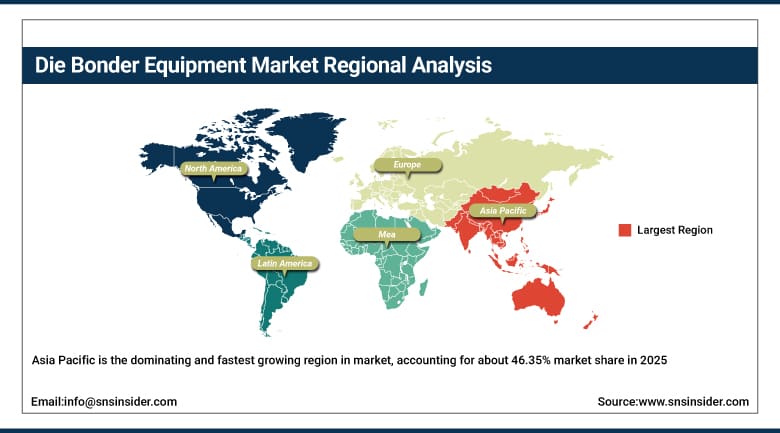
Asia Pacific is the dominating and fastest growing region in the die bonder equipment market, accounting for about 46.35% market share in 2025 and registering a CAGR of about 4.36% during 2026–2035. Rapid expansion of semiconductor fabrication hubs in China, Taiwan, South Korea, and Japan is driving strong demand. Increasing electronics manufacturing and export activities are boosting market growth. Rising adoption of advanced packaging technologies is further accelerating equipment deployment. Strong government support for semiconductor self-sufficiency is strengthening regional expansion.
According to the World Semiconductor Trade Statistics forecast for 2025, there is steady growth in global semiconductor unit shipments, with advanced packaging accounting for more than 30% of the overall assembly process. According to the OECD report on digital economy, over 80% of advanced electronics manufacturing takes place in the Asia Pacific region, and this has contributed to heavy usage of die bonders in flip chip, wire bonding, and advanced packaging processes.
Get Customized Report as Per Your Business Requirement - Enquiry Now
North America Die Bonder Equipment Market Insights.
North America die bonder equipment market is a key region in 2025, driven by strong semiconductor manufacturing and advanced packaging demand. The region benefits from high adoption of automation technologies and strong R&D capabilities. Increasing investments in AI chips and automotive electronics is strengthening market growth. Expansion of fabless semiconductor companies is further accelerating demand. Presence of leading equipment manufacturers reinforces the region’s strong position in the market.
As per the U.S. CHIPS and Science Act implementation and SIA 2025 workforce and capacity indicators, North America is increasing its advanced packaging capacity, with over 30 announcements of fabrication and advanced packaging facilities in the U.S. As per the data from the International Semiconductor Industry Association, advanced packaging processes, which include processes such as flip-chip and wafer-level where die bonder machinery plays an important role, account for over 70% of high-performance computing and artificial intelligence chips manufacturing in 2025.
Europe Die Bonder Equipment Market Insights.
Europe die bonder equipment market is characterized by steady growth in 2025, supported by strong automotive and industrial electronics demand. Key countries include Germany, France, United Kingdom, and Italy. Increasing focus on electric vehicles and advanced microelectronics is driving adoption. Strong semiconductor R&D ecosystem is supporting technology development. Growing emphasis on automation in manufacturing is further boosting demand. Sustainability-driven production upgrades are also encouraging modern equipment adoption across the region.
As per the European Commission's Semiconductor Strategy and Eurostat's High-tech Manufacturing Indicators, the European Union targets to achieve 20% of global semiconductor production capacity by 2030, with advanced packaging and assembly being one of the focal points. According to SEMI Industry Capacity Data and OECD's Science and Technology Indicators, Europe accounts for over 25% of global semiconductor R&D expenditures share in advanced economies. Additionally, the European Chips Act is designed to encourage the establishment of pilot and volume manufacturing capabilities, where over 70% of semiconductor production in Europe is located in Germany, France, and Netherlands.
Middle East & Africa and Latin America Die Bonder Equipment Market Insights.
The Middle East & Africa along with Latin America regions are witnessing gradual growth due to emerging electronics manufacturing and increasing industrial diversification. Key countries include Brazil, Mexico, UAE, Saudi Arabia, and South Africa. Rising investments in semiconductor packaging and assembly activities are supporting market expansion. Growth in telecommunications and automotive electronics is further driving demand. Increasing government initiatives to develop technology infrastructure are also boosting regional adoption of die bonder equipment.
According to the World Bank’s digital infrastructure indices, internet coverage is above 75% for Latin America and 70% in some Middle Eastern regions, hence promoting slow growth of electronics assembly networks. In addition, according to industrial policy monitoring by the OECD, only 10% of total worldwide investment in advanced semiconductor packaging goes to the developing Middle Eastern/African and Latin American regions.
Market Dynamics:
Growth Drivers: Rising demand for advanced semiconductor packaging and miniaturized electronic devices
Increasing use of highly advanced packaging technologies for semiconductors is leading to an increased demand for die bonders. With the continued miniaturization of electronic devices, there is growing need for precise bonding tools. Increased usage of artificial intelligence chips, 5G gadgets, and high-performance computing devices has led to rapid adoption of the technology. There is rising demand for heterogeneous integration and multiple chip modules, which is fueling the growth in the market. There are efforts being made to improve the accuracy and speed of the process.
In accordance with the SIA 2025 global semiconductor manufacturing indicators and digital economy data from OECD, global semiconductor unit shipments have crossed 1 trillion devices, boosted by demand for more advanced packaging and heterogeneous integration. In line with the latest updates of U.S. CHIPS and Science Act implementation and European Chips Act policies, more than 70% of the investments for new semiconductor manufacturing are in sub-10nm and advanced packaging technologies.
Restraints: Supply chain disruptions and dependency on semiconductor ecosystem fluctuations
The reliance of semiconductors on global supply chain networks makes die bonders vulnerable due to shortages in parts and raw materials, which will result in delays in production cycle time. Moreover, geopolitical issues and trade constraints also influence the distribution and cost of the equipment. Changes in the cycles of semiconductor demand have a direct effect on capital equipment investment. Also, low local manufacturing capabilities in certain areas lead to increased dependence on imports, thus making the equipment more vulnerable to supply.
Opportunities:Growth opportunities from AI, IoT, and advanced computing applications
The growing use of AI, IoT, and HPC systems is presenting good business prospects for the die bonder machine manufacturers. The increasing need for better chips used in data centers, cloud computing, and edge applications is fueling innovations in the field of packaging. The expanding ecosystem of smart electronics industry is adding to the need for accurate bonding technology. New applications are emerging in the field of 3D packaging and heterogeneous integration. Continuous improvement in semiconductor technology is sustaining the demand for machines in various growing industries.
As indicated by the IDC 2025 indicators for semiconductor manufacturing and the U.S. Department of Commerce progress reports on CHIPS program, there is an increase in the global semiconductor fabrication capabilities with over 70% of advanced node fabrication happening in Asia-Pacific plants, whereas the U.S. aims at increasing its domestic fabrication capabilities through federal fabrication projects. From the OECD Digital Economy Outlook 2025, more than 90% of industrial verticals have deployed AI-based automation solutions, and IoT-based manufacturing units have surpassed 15 billion across the globe.
Recent Developments:
-
2026: Kulicke and Soffa Industries expanded digitalized die bonding portfolio with cloud-enabled predictive maintenance and next-generation wafer-level packaging systems for AI chips.
-
2025: ASMPT announced expansion of hybrid bonding and C2S thermo-compression bonding orders driven by AI computing and high-performance packaging demand.
-
2025: SUSS MicroTec SE launched XBC300 Gen2 die-to-wafer hybrid bonding platform enabling high precision sub-200 nm alignment for next-generation semiconductor manufacturing.
-
2024: BE Semiconductor Industries advanced hybrid bonding and die attach systems strengthened adoption in high bandwidth memory packaging applications.
Die Bonder Equipment Market Key Players are:
-
ASMPT
-
BE Semiconductor Industries
-
Kulicke and Soffa Industries
-
Shinkawa Ltd
-
Fuji Corporation
-
Panasonic Factory Solutions
-
Yamaha Motor Co., Ltd
-
Hanwha Precision Machinery
-
Finetech GmbH & Co. KG
-
EV Group (EVG)
-
SUSS MicroTec SE
-
Palomar Technologies
-
West-Bond Inc
-
Hesse Mechatronics
-
SET Corporation (Smart Equipment Technology)
-
Mycronic AB
-
Hitachi High-Tech Corporation
-
Toray Engineering Co., Ltd
-
Shibaura Machine Co., Ltd
-
Nordson Corporation
Die Bonder Equipment Market Report Scope:
| Report Attributes | Details |
|---|---|
| Market Size in 2025 | USD 7.78 Billion |
| Market Size by 2035 | USD 11.08 Billion |
| CAGR | CAGR of 3.62% From 2026 to 2035 |
| Base Year | 2025 |
| Forecast Period | 2026-2035 |
| Historical Data | 2022-2024 |
| Report Scope & Coverage | Market Size, Segments Analysis, Competitive Landscape, Regional Analysis, DROC & SWOT Analysis, Forecast Outlook |
| Key Segments | • By Equipment Type (Automated Die Bonders, Semi-Automated Die Bonders, Manual Die Bonders) • By Application (Semiconductor Packaging, Microelectronics, LED Manufacturing, MEMS (Micro-Electro-Mechanical Systems)) • By Material Compatibility (Gold Wire, Copper Wire, Silver Wire) • By Production Capacity (Low Volume Production, Medium Volume Production, High Volume Production) • By Technology Adoption (Conventional Technology, Advanced Technology, Hybrid Technology) |
| Regional Analysis/Coverage | North America (US, Canada), Europe (Germany, UK, France, Italy, Spain, Russia, Poland, Rest of Europe), Asia Pacific (China, India, Japan, South Korea, Australia, ASEAN Countries, Rest of Asia Pacific), Middle East & Africa (UAE, Saudi Arabia, Qatar, South Africa, Rest of Middle East & Africa), Latin America (Brazil, Argentina, Mexico, Colombia, Rest of Latin America). |
| Company Profiles | ASMPT, BE Semiconductor Industries, Kulicke and Soffa Industries, Shinkawa Ltd, Fuji Corporation, Panasonic Factory Solutions, Yamaha Motor Co., Ltd, Hanwha Precision Machinery, Finetech GmbH & Co. KG, EV Group (EVG), SUSS MicroTec SE, Palomar Technologies, West-Bond Inc, Hesse Mechatronics, SET Corporation (Smart Equipment Technology), Mycronic AB, Hitachi High-Tech Corporation, Toray Engineering Co., Ltd, Shibaura Machine Co., Ltd, Nordson Corporation |
Frequently Asked Questions
The die bonder equipment market is expected to grow at a CAGR of 3.62% from 2026 to 2035.
The Major growth factors include rising semiconductor investments, demand for advanced packaging, AI, 5G, automotive electronics growth, heterogeneous integration expansion, and increasing need for miniaturized high performance electronic devices globally.
The automated die bonders segment dominated the market in 2025 due to high precision, faster processing, consistency, and high-volume adoption.
Asia Pacific dominated the die bonder equipment market in 2025 due to semiconductor fabrication growth, electronics manufacturing, packaging adoption, government support.
The die bonder equipment market was valued at USD 7.78 billion in 2025.
