
Substance Use Disorder Treatment Market Report Scope & Overview:
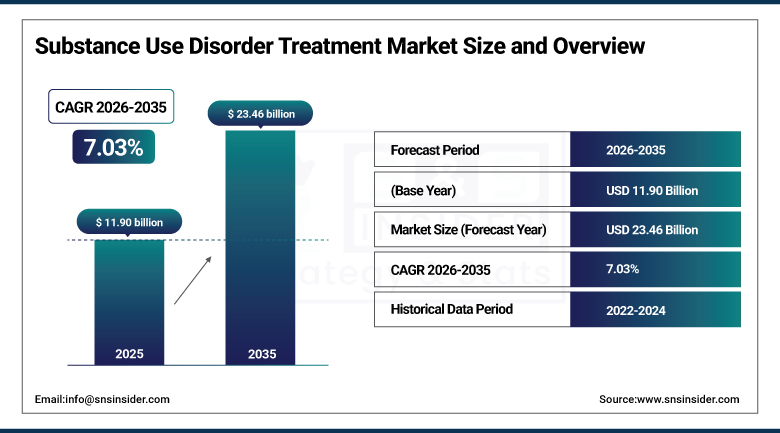
The Substance Use Disorder Treatment Market was valued at USD 11.90 Billion in 2025 and is projected to reach USD 23.46 Billion by 2035, expanding at a CAGR of 7.03% during the forecast period 2026–2035.
The substance use disorder treatment market is currently experiencing a profound shift because healthcare facilities are gradually recognizing that addiction is a complex, relapsing disease requiring prolonged treatment. The growing incidence of opioid use disorder, alcohol use disorder, misuse of stimulants, and multiple drug use disorder fuels demand for an integrated approach to treating such disorders through the combination of pharmacological intervention, behavioral treatments, and constant recovery assistance. Governments are broadening reimbursement policies, allocating more financial resources for addiction services within communities, and developing national programs for reducing overdoses and providing better access to effective therapy.
Along with that, healthcare organizations are developing multidisciplinary pathways to provide psychiatric, general practitioners', digital therapeutic, and social services to improve patients' adherence and results of treatment. The growing pace of innovation in the area of digital infrastructure is also revolutionizing the competitive environment due to telehealth-assisted counseling, remote patient monitoring, AI-assisted behavioral assessment, and mobile recovery platforms which provide better treatment opportunities beyond rehabilitation centers. Drug manufacturers are continuously conducting research to produce long-acting medications, new drugs for treating addiction, and personalized therapy for overcoming multiple substance use disorders.
Market Size and Forecast
-
Market Size 2026E: USD 12.73 Billion
-
Market Size 2035: USD 23.46 Billion
-
CAGR: 7.03% from 2026 to 2035
-
Fastest Growing Region: Asia Pacific
-
Largest Region: North America
To Get more information Substance Use Disorder Treatment Market - Request Free Sample Report
Substance Use Disorder Treatment Market Trends
-
Increasing adoption of medication-assisted treatment for opioid dependence management.
-
Expansion of telehealth-enabled addiction counseling and behavioral therapy platforms.
-
Rising integration of AI-driven patient monitoring and relapse prediction technologies.
-
Growing government investments supporting community-based addiction recovery programs.
-
Increasing adoption of value-based, integrated behavioral healthcare delivery models.
The U.S. Substance Use Disorder Treatment Market Size Outlook
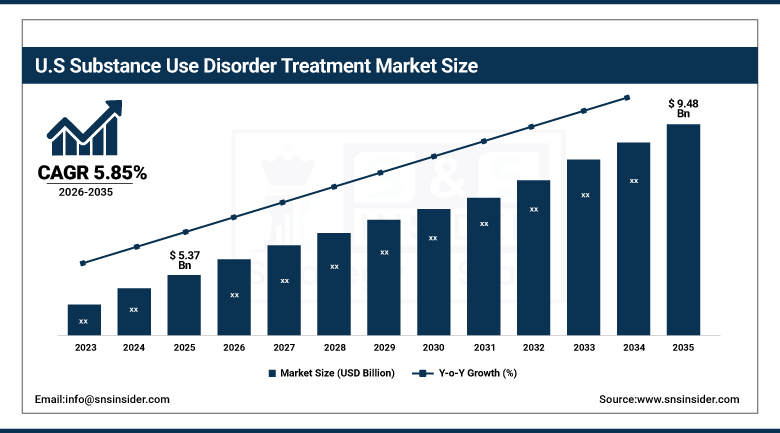
The U.S. Substance Use Disorder Treatment Market was valued at USD 5.37 billion in 2025 and is expected to reach approximately USD 9.48 billion by 2035, expanding at a CAGR of 5.85% during 2026–2035.
The US remains to be the biggest national market in terms of substance use disorder treatment because of the significant level of prevalence of opioid use disorder, alcohol dependency, and associated mental illnesses. Various initiatives at both the federal and state levels are aimed at extending access to medication-assisted treatment, behavioral healthcare services, and community recovery solutions along with the improvement of insurance coverage of addiction care solutions.
The healthcare facilities continue developing an integrated treatment approach based on the use of primary healthcare, psychiatric services, technology, and recovery management in order to achieve better results. Outpatient care infrastructure development, virtual addiction treatment solutions, and specialized addiction treatment facilities will ensure future growth in the market.
Substance Use Disorder Treatment Market Segmentation Analysis
-
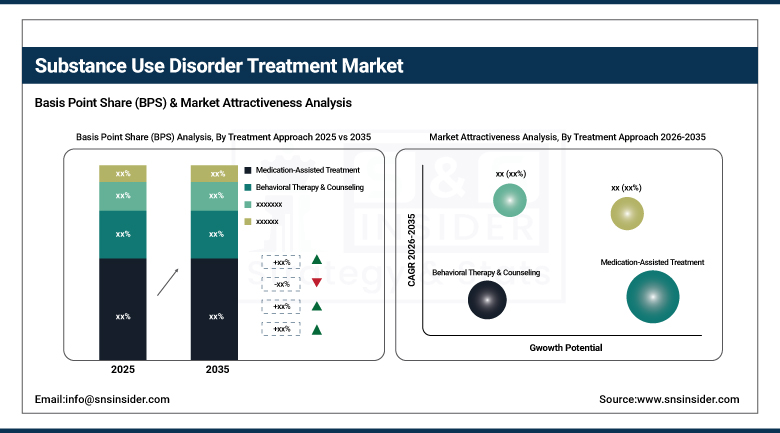
By Treatment Approach, medication-assisted treatment dominated the market with 42.00% share in 2025, while behavioral therapy & counseling is projected to witness the fastest growth with 8.06% CAGR during the forecast period.
-
By Disorder Type, alcohol use disorder dominated the market with 36.00% share in 2025, while stimulant use disorder is projected to witness the fastest growth with 8.69% CAGR during the forecast period.
-
By Care Setting, outpatient treatment centers dominated the market with 35.00% share in 2025, while home-based & virtual care is projected to witness the fastest growth with 12.18% CAGR during the forecast period.
-
By End User, specialty addiction treatment providers dominated the market with 38.00% share in 2025, while physician practices & mental health clinics are projected to witness the fastest growth with 12.18% CAGR during the forecast period.
By Treatment Approach, medication-assisted treatment dominated, while behavioral therapy & counseling grows fastest.
MAT segment held a market share of 42.00% in 2025, thus being the most used treatment approach. Increasing use of medications such as buprenorphine, methadone, and extended-release naltrexone for treating opioid and alcohol use disorders contributes to the growth of the segment. Expansion of government reimbursement, prescribing authority for MAT drugs among qualified healthcare professionals, and awareness of MAT being the standard of care promote treatment accessibility among hospitals, specialist addiction clinics, and outpatient clinics. In 2025, SAMHSA started several programs focusing on improving the availability of medication-assisted treatment through increasing behavioral health service delivery and using the recovery-oriented approach to healthcare.
Behavioral therapy & counseling is forecasted to have the fastest compound annual growth rate (CAGR) of 8.06% for the period between 2026 and 2035. In healthcare organizations, the significance of using cognitive behavioral therapy, motivational interviewing, contingency management, family therapy, and trauma-informed care approaches in the process of treating substance abuse problems is highlighted. The development of tele-counseling services, AI-based assessment tools for behavioral health, and psychotherapy via telehealth is rapidly growing. In February 2026, some healthcare providers launched digital behavioral health care programs including virtual counseling and recovery monitoring via telehealth.
By Disorder Type, alcohol use disorder dominated, while stimulant use disorder grows fastest.
Alcohol use disorder was the largest market share holder in 2025, accounting for 36.00% of the global market. Alcohol addiction is amongst the most common substance use disorder worldwide, thereby generating an ever-lasting need for medications, detoxification, psychological counseling, and rehabilitation services. Greater awareness about the risks of morbidity caused by alcohol addiction, increasing coverage of addiction insurance and screening programs are boosting market adoption. A number of public health authorities launched alcohol screening and early intervention programs in 2025, which have proved very beneficial in terms of diagnosing and treatment referrals.
Stimulant use disorder segment is expected to record the highest CAGR of 8.69% during the forecast period. Misuse of stimulants including methamphetamine and cocaine in various regions has boosted the demand for new treatment methods such as behavioral therapy, electronic monitoring technologies, contingency management programs, and research on pharmaceuticals. Recovery programs for stimulants in addition to psychiatric care are being offered in hospitals owing to the high prevalence of co-morbid mental disorders. Public health authorities of the U.S. increased funding for research programs for stimulant use disorder and contingency management programs.
By Care Setting, outpatient treatment centers dominated, while home-based & virtual care grows fastest.
Outpatient treatment centers held a market share of 35.00% in the global substance use disorder treatment market in 2025. The dominance of this segment is attributed to outpatient therapy as being affordable, flexible and sustainable method of addiction treatment without hospitalization. Rising preference for community treatment, increased insurance coverage for outpatient behavioral care and medication assisted treatment along with counseling have contributed towards increased patient enrollment. In 2025, various healthcare providers across U.S. developed outpatient addiction therapy network involving behavioral specialists, medication assisted treatment programs and recovery programs.
The fastest growth of 12.18% CAGR is projected for the home-based & virtual care segment during the forecast period. The development of telehealth, recovery application using smartphones, remote patient monitoring and counseling facilities is facilitating continuous addiction treatment outside conventional care setting. Development of digital therapies, wearables, AI driven predictive tools for relapse and medication adherence platforms for remote patients is increasing accessibility to the population residing in rural areas. In February 2026, several digital behavioral health companies upgraded AI driven remote addiction management platform.
Regional Analysis
|
Region |
Major Country |
Share within Region, 2025 (%) |
|---|---|---|
|
North America |
United States |
94.00% |
|
Europe |
Germany |
26.00% |
|
Asia Pacific |
China |
17.00% |
|
Middle East & Africa |
UAE |
5.00% |
|
Latin America |
Brazil |
4.00% |
North America Substance Use Disorder Treatment Market Insights
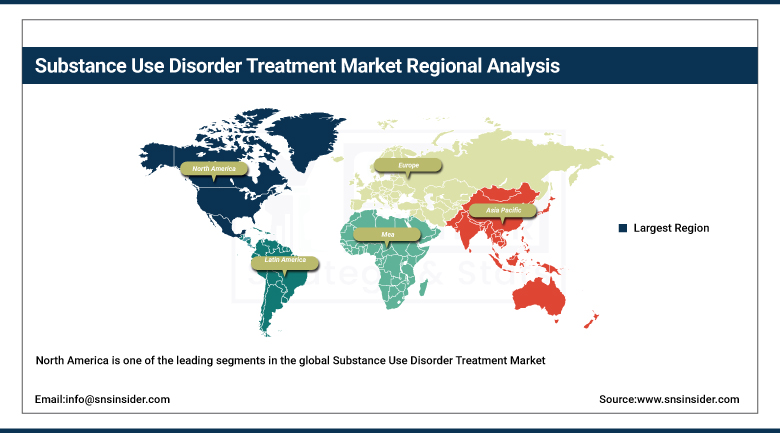
North America is one of the leading segments in the global Substance Use Disorder Treatment Market, contributing up to 48.00% towards the total market value in 2025. The North American region features established healthcare infrastructure, supportive reimbursement models, high level of awareness of addiction treatment, and numerous government-driven efforts that address opioids and alcohol addictions. In addition, the USA and Canada constantly work on the development of their medication assisted treatment program, integration of behavioral healthcare, drug overdose prevention measures, and online tools for the management of addiction. Additional investments in community treatment services, recovery communities, and telemedicine can increase access to treatment facilities in the long run and promote the use of evidence-based practice among hospitals, clinics, and specialists.
Further attention is paid to the issue of integrated behavioral healthcare, use of artificial intelligence for monitoring patients, electronic medical records, and approaches to recovery combining the treatment of psychological disorders and addiction. Many players on the market, including pharmaceutical companies, IT companies developing health-related applications and specialists in this field, make constant innovations in medications and treatment technologies. In February 2026, U.S. federal authorities expanded the funding for the opioid response programs and community-based behavioral health efforts to increase the access to evidence-based treatment of substance use disorders.
Get Customized Report as per Your Business Requirement - Enquiry Now
Europe Substance Use Disorder Treatment Market Insights
Region of Europe is driven by the development of public healthcare systems, positive reimbursement policies, and country-wide strategies for addiction treatment. The countries such as Germany, the United Kingdom, France, Italy, and the Nordic countries are further developing early intervention programs, opioid substitution therapy, alcohol dependency treatment, and combined psychiatric care. The development of the investment in the rehabilitation services in the community, mental health services online, and multifaceted approach to the addiction treatment will increase the accessibility and decrease the long-term healthcare cost from untreated substance dependency.
The coordinated care pathways involving pharmacotherapy, psychotherapy, social rehabilitation, and telemonitoring of the patients are introduced by the healthcare providers in Europe. Regulatory support and collaboration of the hospitals and community health organizations on the harm reduction approaches will ensure continued regional market growth through the forecast period. Several European countries have extended their national behavioral health initiatives promoting integrated addiction treatment and recovery services in the community through 2025.
Asia Pacific Substance Use Disorder Treatment Market Insights
The region of Asia Pacific is anticipated to demonstrate the fastest CAGR of 10.78% during the forecast period. Urbanization, increasing awareness about addiction as a medical problem, increase in healthcare spending, and improved access to behavioral health are boosting the demand in the region. Countries such as China, India, Japan, South Korea, and Australia are spending on rehabilitation centers, telehealth services, community mental health programs, and public education programs for substance dependence problems. Increasing government support in terms of modernization of the healthcare sector and adoption of digital therapeutics will further boost the market growth in the region.
The inclusion of behavioral assessment using artificial intelligence, mobile recovery apps, remote counseling, and integrated psychiatry into the treatment programs is gaining importance among the healthcare providers. Increased insurance coverage and public-private partnerships are helping to increase the accessibility of the treatment services. In March 2026, several Asia Pacific countries boosted their national mental health and addiction treatment programs by increased investments in digital healthcare and community rehabilitation programs.
Middle East & Africa and Latin America Substance Use Disorder Treatment Market Insights
The Middle East & Africa: Market expansion will be facilitated by increasing government awareness of mental health conditions and addictions, increased funding of behavioral healthcare facilities, and better quality of rehabilitation services. Governments such as the United Arab Emirates, Saudi Arabia, and South Africa have been focusing on increasing their capacities in treating addiction through specialized rehabilitation centers, psychiatric facilities, and other awareness measures. Greater collaborations between public health authorities and private healthcare providers have helped patients gain access to evidence-based treatment and adoption of digital health tools for managing long-term rehabilitation needs.
Latin America led mainly by Brazil, Mexico, Argentina, and Chile. Governments in the region have been expanding public health care programs covering problems associated with alcoholism, opioids, and other substances. Investments in treatment centers, telemedicine platforms, and comprehensive mental health care services have ensured continuous market expansion. The public education regarding the chronic nature of addiction is increasing early diagnoses and treatment participation among urban and rural populations. In March 2026, several governments in Latin American and Middle Eastern regions developed their national mental health and addiction programs through investments in community rehabilitation programs and behavioral healthcare.
Growth Drivers: Increasing prevalence of substance use disorders and growing availability of medication-assisted treatments.
The ongoing rise in the global burden of opioid addiction, alcohol use disorders, substance abuse, and polydrug addictions remains the major factor that drives the market growth. Public health authorities are making efforts to expand availability of medication-assisted treatments, behavioral interventions, and comprehensive rehabilitation programs by implementing favorable reimbursement programs and providing additional funding for public health services.
Hospitals are using the multidisciplinary approach to treatment, which combines drug therapy, mental health services, digital health tools, and recovery management in order to improve treatment outcomes and reduce the rate of recidivism and drug overdoses among patients. The increased understanding that addictions represent chronic conditions requiring constant treatment is driving the wider adoption of evidence-based treatment methods. In 2025, U.S. federal health authorities were continuing increasing funding for the evidence-based opioid treatment, recovery support, and overdose prevention services.
Restraints: Inaccessibility of addiction treatments, shortage of skilled workforce and social stigmatization.
While there is an increasing level of investments being made for addiction treatment services, there are still a number of obstacles that prevent the market growth in several regions. Shortages of addiction medicine specialists, behavioral health practitioners, psychiatrists and counselors create the problem of accessibility of addiction treatment services, especially in rural and other disadvantaged areas. The problem of social stigmatization of people suffering from substance use disorders often leads to the postponement of diagnosis and seeking any professional help.
There are also differences in reimbursement policies, regulation and healthcare infrastructure, which also make the services inaccessible. In January 2026, healthcare organizations and public health organizations have been continuing developing their initiatives related to workforce and telehealth services to resolve the issue of shortage of skilled professionals in addiction treatment sector.
Opportunities: Development in digital therapeutics, AI-based behavioral healthcare, and comprehensive recovery management.
The swift uptake of digital technologies in healthcare has presented immense business opportunities for companies operating in the market dealing with substance use disorder treatments. AI technology, predictive analytics, remote monitoring, mobile recovery apps, and digital therapeutics are enhancing treatment accessibilities, engagement of patients, prevention of relapse, and comprehensive recovery management. The healthcare professionals are incorporating technologies such as virtual therapy, electronic health records, wearable devices, and AI clinical decision support tools in the process of treatment of patients. More investments by the government and digital health companies will facilitate innovation and development of personalized treatment strategies in the future.
Recent Developments
-
2026: Indivior PLC announced continued expansion of its addiction treatment portfolio and commercialization strategy supporting long-acting therapies for opioid use disorder.
-
2026: Alkermes plc continued advancing research and commercial initiatives focused on long-acting therapies addressing alcohol and opioid dependence while strengthening its neuroscience portfolio.
-
2025: Otsuka Pharmaceutical expanded digital mental health and behavioral healthcare collaborations supporting integrated treatment approaches for psychiatric and substance use disorders.
-
2025: Camurus AB reported continued expansion of its long-acting buprenorphine portfolio across international markets to improve treatment adherence for opioid dependence.
Substance Use Disorder Treatment Market Key Players are:
-
Camurus AB
-
Orexo AB
-
Braeburn Inc.
-
Titan Pharmaceuticals, Inc.
-
BioCorRx Inc.
-
Adial Pharmaceuticals, Inc.
-
Emergent BioSolutions Inc.
-
Dr. Reddy's Laboratories Ltd.
-
Viatris Inc.
-
Mallinckrodt Pharmaceuticals
-
BayMark Health Services
-
Acadia Healthcare
-
Universal Health Services
-
Hazelden Betty Ford Foundation
-
American Addiction Centers
-
Pyramid Healthcare
-
Hikma Pharmaceuticals PLC
Substance Use Disorder Treatment Market Report Scope:
| Report Attributes | Details |
|---|---|
| Market Size in 2025 | USD 11.90 Billion |
| Market Size by 2035 | USD 23.46 Billion |
| CAGR | CAGR of 7.03% From 2026 to 2035 |
| Base Year | 2025 |
| Forecast Period | 2026-2035 |
| Historical Data | 2022-2024 |
| Report Scope & Coverage | Market Size, Segments Analysis, Competitive Landscape, Regional Analysis, DROC & SWOT Analysis, Forecast Outlook |
| Key Segments | • By Treatment Approach (Medication-Assisted Treatment, Behavioral Therapy & Counseling, Residential & Inpatient Rehabilitation, Digital Telehealth & Remote Treatment, Others) • By Disorder Type (Alcohol Use Disorder, Opioid Use Disorder, Stimulant Use Disorder, Cannabis Use Disorder, Other Substance Use Disorders) • By Care Setting (Outpatient Treatment Centers, Residential Treatment Centers, Hospitals & Inpatient Facilities, Home-Based & Virtual Care, Community & Correctional Programs) • By End User (Specialty Addiction Treatment Providers, Hospitals & Health Systems, Government & Community Health Programs, Physician Practices & Mental Health Clinics, Employers, Payers & Digital Health Platforms, Others) |
| Regional Analysis/Coverage | North America (US, Canada), Europe (Germany, UK, France, Italy, Spain, Russia, Poland, Rest of Europe), Asia Pacific (China, India, Japan, South Korea, Australia, ASEAN Countries, Rest of Asia Pacific), Middle East & Africa (UAE, Saudi Arabia, Qatar, South Africa, Rest of Middle East & Africa), Latin America (Brazil, Argentina, Mexico, Colombia, Rest of Latin America). |
| Company Profiles | Indivior PLC, Alkermes plc, Camurus AB, Orexo AB, Braeburn Inc., Titan Pharmaceuticals, Inc., BioCorRx Inc., Adial Pharmaceuticals, Inc., Emergent BioSolutions Inc., Dr. Reddy's Laboratories Ltd., Viatris Inc., Mallinckrodt Pharmaceuticals, BayMark Health Services, Acadia Healthcare, Universal Health Services, Hazelden Betty Ford Foundation, American Addiction Centers, Pyramid Healthcare, Teva Pharmaceutical Industries Ltd., Hikma Pharmaceuticals PLC |
Frequently Asked Questions
The market is projected to reach USD 23.46 Billion by 2035.
The market is anticipated to expand at a CAGR of 7.02% during the forecast period.
North America dominated the global Substance Use Disorder Treatment Market in 2025.
Medication-Assisted Treatment accounted for the largest revenue share of 42.00% in 2025.
