
Digital Asset Custody Market Report Scope & Overview:
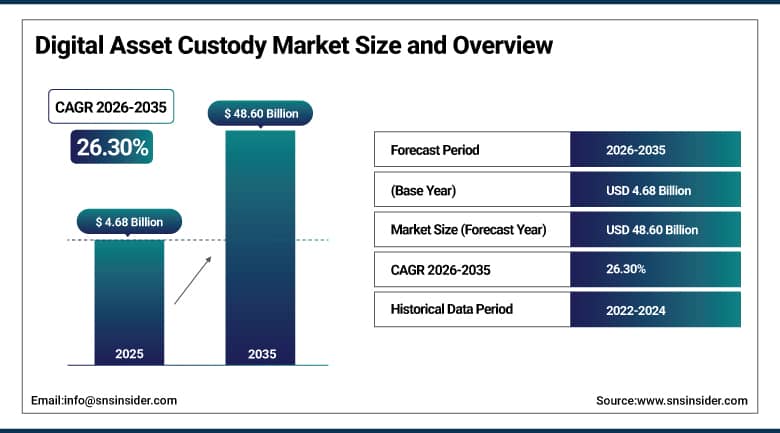
The Digital Asset Custody Market was valued at USD 1,090.14 Billion in 2025 and is expected to reach USD 11,259.40 Billion by 2035, growing at a CAGR of 26.30% from 2026 to 2035.
The Digital Asset Custody Market is expanding rapidly as institutional investors, banks, hedge funds, and asset managers rushing to invest in cryptocurrencies, stablecoins, and tokenized physical assets that create a constant need for secure, insured, and compliant asset storage solutions. The custodians utilize a combination of cold storage, multi-party computation (MPC), and hardware security module (HSM) to safeguard private cryptographic keys from theft, cyber attacks, and operational errors, as well as providing audit reports to meet fiduciary and compliance requirements. The spot approval of Bitcoin and Ethereum exchange-traded funds, the expansion of trust charters in the United States states and at the federal level, and the regulatory guidance in European Union, United Kingdom, and Asia Pacific markets has incentivized the traditional custodian banks to form digital asset custody departments together with crypto-specific custody firms.
Coinbase and Fidelity Digital Assets both expanded their institutional custody platforms in 2026 to support spot Bitcoin and Ethereum ETF settlement and tokenized real-world asset safekeeping, amid rising demand from banks, hedge funds, and asset managers for insured, regulation-compliant digital asset storage infrastructure worldwide.
To Get More Information On Digital Asset Custody Market - Request Free Sample Report
Digital Asset Custody Market Trends:
-
Rising institutional adoption of spot Bitcoin and Ethereum ETFs is accelerating demand for regulated custody infrastructure.
-
Growing integration of multi-party computation (MPC) and hardware security module (HSM) technology is strengthening key management security.
-
Expanding tokenization of real-world assets such as bonds, real estate, and private equity is broadening custody service scope.
-
Increasing entry of global banks into digital asset safekeeping is reshaping competitive dynamics across the custody landscape.
-
Growing demand for insured, audit-ready custody solutions is supporting compliance-driven institutional adoption.
U.S. Digital Asset Custody Market Outlook:
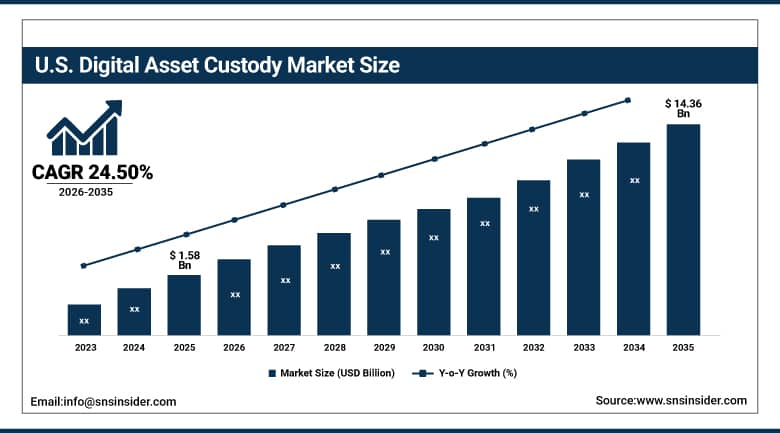
The U.S. Digital Asset Custody Market was valued at USD 368.19 Billion in 2025 and is projected to reach USD 4,085.92 Billion by 2035, growing at a CAGR of 27.21% during 2026–2035.
The United States remains at the forefront of custody adoption as state chartered trust companies, national banks, and native cryptocurrency custodians offer qualified custody solutions to institutional customers amid regulatory scrutiny by SEC, OCC, and state banks regulations. The rise in the amount of AUMs in spot Bitcoin and Ethereum ETFs, the rise in corporation treasury allocations to crypto-assets and the emergence of staking custody products have contributed to the increased domestic demand. On the other hand, the entrance of traditional custodians like BNY Mellon, State Street and Northern Trust in digital asset custody has led to stiff competition and the expansion of custody services to new institutions.
In 2026, Anchorage Digital expanded its U.S. federally chartered trust operations with a new staking-integrated custody offering, enabling institutional clients to earn yield on custodied Ethereum and other proof-of-stake assets while maintaining segregated, insured cold storage protection.
Digital Asset Custody Market Segment Analysis:
-
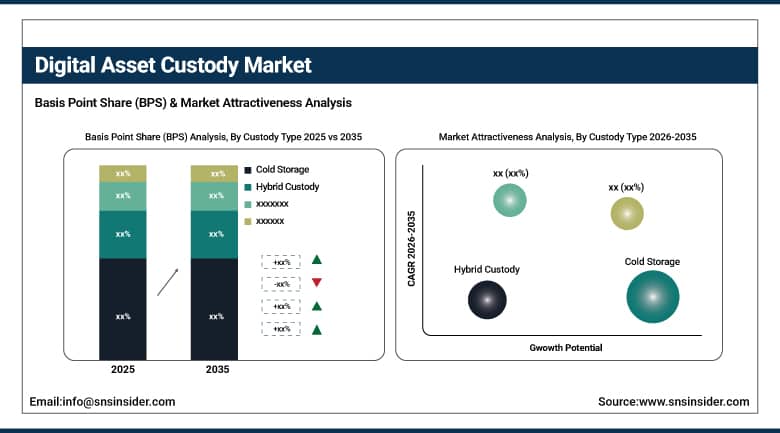
By Custody Type, Cold Storage dominated the Digital Asset Custody Market with a 52.30% share in 2025, while Hybrid Custody is the fastest-growing custody type segment with a CAGR of 29.80% from 2026–2035.
-
By Provider Type, Cryptocurrency Exchanges dominated the Digital Asset Custody Market with a 36.70% share in 2025, while Independent Custodians is the fastest-growing provider type segment with a CAGR of 28.90% from 2026–2035.
-
By Asset Type, Cryptocurrencies dominated the Digital Asset Custody Market with a 58.40% share in 2025, while Tokenized Assets & Security Tokens is the fastest-growing asset type segment with a CAGR of 32.60% from 2026–2035.
-
By End Use, Institutional Investors dominated the Digital Asset Custody Market with a 47.20% share in 2025, while Hedge Funds & Asset Managers is the fastest-growing end use segment with a CAGR of 27.80% from 2026–2035.
By Custody Type, Cold Storage led the market while Hybrid Custody is the fastest-growing segment.
The Cold Storage segment held the leading position in the Digital Asset Custody Market in 2025. Cold storage technologies involve keeping the private keys offline using air-gapped hardware systems, thereby ensuring that there is no exposure to online cyberattacks and hence they are considered a safer way of safeguarding digital assets for institutional investors, hedge funds, and banks which hold large value portfolios of digital assets. Regulatory policies in the U.S., European Union, and Singapore are giving preference to cold storage solutions in determining a qualified custodian, thus supporting the dominance of this segment among fiduciaries who have to adhere to stringent risk management policies.
The Hybrid Custody segment is expected to register the fastest CAGR during the forecast period 2026–2035. Hybrid systems are built on a model that involves storing the vast majority of custodied assets off-line, while hot wallets are used in smaller amounts, thus allowing custodians to provide their customers with the best possible security and, at the same time, sufficient liquidity to be able to trade. The increasing interest of institutions in decentralized finance systems, exchange traded funds (ETFs) and real-time settlements is resulting in the growing need for the custody systems that offer security without compromising on speed, which makes hybrid custody a better solution.
By Provider Type, Cryptocurrency Exchanges led while Independent Custodians is the fastest-growing segment.
Cryptocurrency Exchanges held the largest share in the Digital Asset Custody Market in 2025 owing to the ongoing preference of several institutional as well as individual customers towards exchange-based custody due to ease of trading and convenience. Several top exchanges have set up institutional custody departments in order to provide segregated cold wallets, insurance as well as reporting compliance and keep the big customers loyal to the exchanges rather than making them move away to independent custody companies. The exchange based custody continues to be appealing to customers who require seamless transition between custody and trading, especially the institutional ones involved in trading high frequency and derivatives products.
Independent Custodians are projected to expand at the fastest CAGR through 2026-2035, as institutions increasingly separate custody from trading following heightened counterparty risk concerns after past exchange failures. Dedicated custodians such as BitGo, Anchorage Digital, and Komainu offer conflict-free safekeeping, purpose-built compliance infrastructure, and multi-jurisdictional trust licensing that appeal to pension funds, asset managers, and corporates seeking clear custodial separation from exchange or trading counterparties. This shift toward independent, insured, non-affiliated custody providers is reshaping institutional risk management practices and accelerating adoption across regulated financial institutions worldwide, particularly among clients bound by strict fiduciary segregation-of-duties requirements.
By Asset Type, Cryptocurrencies led while Tokenized Assets & Security Tokens is the fastest-growing segment.
Cryptocurrencies accounted for the largest share in the digital asset custody market in 2025 due to consistent institutional investments in Bitcoin, Ethereum, and other digital currencies via spot exchange-traded funds, corporate treasuries, and even in hedge funds. The advanced infrastructure of Bitcoin and Ethereum for custodial services, insurance cover, and their security history make cryptocurrencies the preferred custodied asset category for institutional investors. Increasing investments in exchange-traded funds and growing markets of derivatives tied to major cryptocurrencies will be furthering the need for institutions providing custodial services to have advanced infrastructure that can deal with heavy workloads of rebalanced digital currency portfolios.
Tokenized Assets & Security Tokens are expected to post the fastest CAGR during 2026–2035, as issuers increasingly tokenize bonds, private equity, real estate, and other real-world assets on blockchain rails to improve settlement efficiency and fractional ownership access. Custodians are developing dedicated infrastructure to secure tokenized securities with their own set of regulatory compliance, transfer restrictions, and corporate actions different from native cryptocurrencies. Regulatory sandbox expansion in countries such as Singapore, the United Arab Emirates, and the European Union through the Markets in Crypto-Assets regulation is boosting pilot initiatives with institutional tokenization, thereby increasing custodians' interest in this new asset class.
By End Use, Institutional Investors led while Hedge Funds & Asset Managers is the fastest-growing segment.
Institutional Investors held the leading share in the Digital Asset Custody Market in 2025, owing to the increasing involvement of pension funds, sovereign wealth funds, insurance companies, and corporate treasuries in allocating their portfolios in digital assets. It is necessary for these customers to have their funds stored by the custodian firms that provide audited security controls, insurance, and licensing requirements. The increased adoption of digital assets as a means of portfolio diversification among institutional investors, along with rising access to spot exchange-traded funds ensures that institutional investors continue to be the biggest demand drivers.
Hedge Funds & Asset Managers are projected to expand at the fastest CAGR through the forecast period, as active trading strategies, arbitrage funds, and multi-strategy managers increase allocations to digital assets and require custody solutions that support frequent rebalancing, staking, and prime brokerage-style settlement. Growing availability of custody-integrated trading and lending services is enabling hedge funds to execute complex strategies without sacrificing asset security, while expanding regulatory clarity is easing compliance barriers to broader digital asset fund launches, sustaining above-average segment growth relative to the rest of the market.
Regional Insights:
|
Region |
Major Country |
Share within Region, 2025 (%) |
|---|---|---|
|
North America |
United States |
87.50% |
|
Europe |
United Kingdom |
24.80% |
|
Asia Pacific |
Singapore |
26.40% |
|
Middle East & Africa |
UAE |
41.20% |
|
Latin America |
Brazil |
33.60% |
North America Digital Asset Custody Market Insights
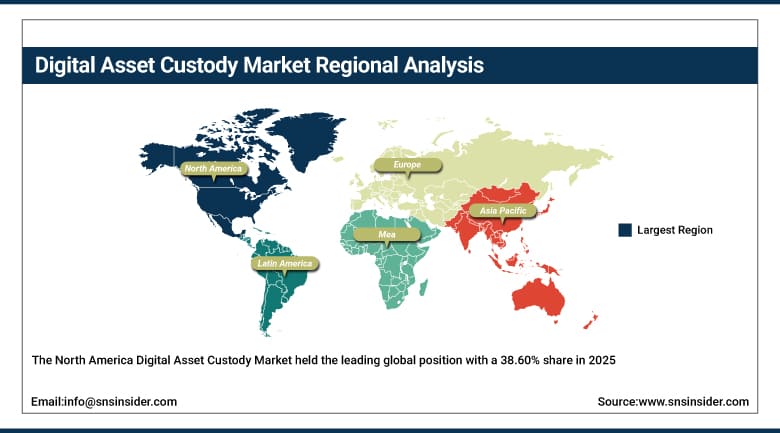
The North America Digital Asset Custody Market held the leading global position with a 38.60% share in 2025 on account of the presence of sophisticated regulation in the region, wider adoption of spot Bitcoin and Ethereum exchange traded funds in institutions, and robust capitalization of custodians from crypto native trusts to legacy custodian banks in the region. The regulatory guidance issued by the Office of the Comptroller of the Currency which enables national banks to offer cryptocurrency custody services, along with the development of trust charters at the state level in Wyoming, South Dakota, and New York, has created an attractive operational environment for both specialized as well as traditional custodians.
The US was the leading country within the North America Digital Asset Custody Market in 2025 of the regional market, driven by extensive qualified custodian infrastructure, deep spot exchange-traded fund custody relationships, and strong institutional investor concentration. Canada is contributing to regional growth through its own expanding digital asset trust licensing framework and growing institutional interest in regulated cryptocurrency exchange-traded products, supported by federal securities regulators establishing clearer custody and disclosure requirements for digital asset investment funds operating within the Canadian market.
Get Customized Report as Per Your Business Requirement - Enquiry Now
Europe Digital Asset Custody Market Insights
The Europe Digital Asset Custody Market was a significant contributor to global market share in 2025, aided by the phased implementation of the Markets in Crypto-Assets (MiCA) regulation. MiCA regulations helped in laying down standards and licensing for crypto assets custodianship within all EU member countries. The clarity provided through regulations has encouraged both local and foreign custodians to increase their licensing operations in the region. The increase in institutional demand from asset management firms, private banks, and family offices for custodianship solutions has helped support continuous growth in the market.
The United Kingdom is one of the major markets in Europe, owing to its concentration of digital asset custodians, favorable Financial Conduct Authority registration pathways, and strong institutional investor base seeking regulated custody solutions. Other countries such as Germany, Switzerland, and France, home to leading crypto custody licenses and growing tokenized securities markets, are also contributing to regional growth through expanding institutional custody partnerships and continued investment in compliant digital asset infrastructure across the broader European financial services ecosystem.
Asia Pacific Digital Asset Custody Market Insights
The Asia Pacific Digital Asset Custody Market is expected to witness the fastest growth rate during the forecast period 2026–2035, registering a CAGR of 29.40%. Market growth is driven by expanding institutional cryptocurrency adoption across Singapore, Hong Kong, and Japan, progressive regulatory licensing frameworks established by the Monetary Authority of Singapore and Hong Kong's Securities and Futures Commission, and rapidly growing digital asset exchange infrastructure across the region's major financial hubs. Rising participation from regional banks and asset managers seeking regulated custody partnerships, combined with growing retail and institutional demand for tokenized asset exposure, continues to position Asia Pacific as the fastest-expanding regional custody market globally.
Singapore is one of the main growth drivers in the Asia Pacific Digital Asset Custody Market, owing to its comprehensive Payment Services Act licensing framework and concentration of leading digital asset custodians serving both regional and international institutional clients. Hong Kong and Japan, both advancing dedicated virtual asset service provider licensing regimes, are also contributing to regional growth through expanding institutional custody partnerships and growing exchange-traded product custody demand across their respective domestic financial markets.
Middle East & Africa and Latin America Digital Asset Custody Market Insights
Middle East & Africa and Latin American regions are gradually expanding digital asset custody adoption as regulatory frameworks mature and institutional investment interest grows across both regions. The United Arab Emirates' Virtual Assets Regulatory Authority and Latin America's evolving national digital asset licensing regimes are supporting expanded custodian operations, encouraging both regional and international custody providers to establish licensed presence to serve growing institutional and high-net-worth client bases seeking regulated digital asset safekeeping solutions.
Brazil is set to be a prominent Latin American market, fueled by its expanding regulated cryptocurrency exchange ecosystem and growing institutional interest in digital asset investment products following the country's comprehensive virtual assets framework. The Middle East & Africa region has the UAE and Saudi Arabia investing heavily in digital asset infrastructure and licensing frameworks, gradually increasing demand for institutional-grade custody services across their expanding banking, asset management, and sovereign wealth fund sectors.
Market Dynamics
Growth Drivers: Rising institutional adoption of digital assets and expanding regulatory clarity driving market growth
The increasing adoption of cryptocurrencies, stable coins and tokenized forms of real assets in addition to the listing of exchange-traded funds for spot bitcoin and Ethereum is one of the leading factors influencing the Digital Asset Custody market. The custodian serves as the mechanism through which banks, hedge funds, asset management firms and corporate treasuries can safely custody digital assets under fiduciary and regulatory requirements in an effort to phase out less secure means of self-custody that increase the level of risks. Regulatory certainty in regions such as the U.S., Europe, the UK and Asia Pacific, specifically, in terms of MiCA and the emergence of state and national trust charters, is making it easier for institutions to enter the market and develop custody solutions.
Technological advancements in multi-party computation, hardware security modules, and multi-signature authorization protocols have significantly strengthened custody security standards, reducing the operational risk historically associated with digital asset safekeeping following high-profile exchange and custodian failures. Rising demand for insured custody solutions as institutions seek to mitigate counterparty and cybersecurity risk, growing integration of staking-enabled custody products allowing clients to earn yield on custodied proof-of-stake assets, and continued investment in geographically distributed vault and key management infrastructure are further supporting demand across the forecast period. Expanding real-world asset tokenization initiatives are also creating new custody requirements beyond native cryptocurrencies, broadening the addressable market for specialized custodians.
Restraints: Regulatory fragmentation and cybersecurity risk limiting market expansion
Some of the most critical obstacles to market growth are the constantly changing regulatory environment around the custody of digital assets in various jurisdictions, which leads to complexities in ensuring compliance on the part of custodians operating in different jurisdictions. This is because the regulatory requirements of US federal, US states, European Union MiCA regulations, and various Asia Pacific virtual assets are different from each other, thus making it difficult for custodians to build compliant operations in various jurisdictions, thereby making expansion in the international market expensive and slow for new custodians.
Furthermore, continued cybersecurity concerns in terms of complex hacks, social engineering attacks, and smart contracts' weaknesses remain major reputational and financial exposures to custodians in spite of having made significant investments in their security infrastructure. The relatively high premium costs of securing coverage against digital assets' theft due to the low claims frequency of the industry and high level of risk involved constitute another major financial burden to custodians that seek full asset protection of their clients. Moreover, the technical challenges associated with supporting various blockchain networks, token standards, and staking systems represent another burden to custodians dealing with diversified institutional portfolios.
Opportunities: Expansion of real-world asset tokenization and institutional staking services creating new growth avenues
Increasing tokenization of assets like bonds, private equities, real estate, and commodities offers significant opportunities for expansion of the Digital Asset Custody Market due to the fact that issuers and institutions need custody services that will allow them to store these tokenized assets along with meeting the compliance, restrictions, and corporate actions management issues related to these assets. An increasing number of institutions seeking staking facilities where the custodians will allow their clients to earn income from their proof of stake assets in a segregated cold storage environment creates further opportunities for custodians.
There is substantial potential for growth in the area of custody solutions supporting decentralized finance integration, enabling institutional clients to access lending, yield generation, and liquidity provision opportunities directly from custodied assets without compromising security standards. The expansion of digital asset adoption among banks, asset managers, and pension funds across emerging economies in Asia Pacific, Latin America, and the Middle East, combined with continued government efforts toward establishing clear digital asset regulatory frameworks, will drive sustained growth in institutional custody demand, particularly as central bank digital currency pilots and tokenized deposit initiatives create additional custody infrastructure requirements globally.
Recent Developments:
-
2026: Coinbase launched an expanded institutional custody platform integrating multi-party computation wallet infrastructure to support tokenized real-world asset safekeeping for asset managers entering the tokenization market.
-
2026: Fidelity Digital Assets expanded its qualified custody platform to support dedicated spot Ethereum exchange-traded fund settlement services for institutional clients amid rising ETF-driven custody demand.
-
2025: Anchorage Digital launched Anchorage Digital Bank Custody Plus, a staking-integrated custody product enabling institutional clients to earn yield on custodied Ethereum and other proof-of-stake assets.
-
2025: BitGo introduced BitGo Go-Network, a cross-chain settlement infrastructure enabling instant custody-integrated settlement across multiple blockchain networks for institutional trading desks.
Digital Asset Custody Market Key Players are:
-
Coinbase Custody Trust Company, LLC
-
BitGo, Inc.
-
Fidelity Digital Assets
-
Anchorage Digital
-
Copper Technologies Limited
-
Fireblocks Inc.
-
Ledger SAS
-
Bakkt Holdings, Inc.
-
Komainu Holdings Limited
-
Zodia Custody Limited
-
State Street Corporation
-
Northern Trust Corporation
-
Hex Trust Limited
-
Cactus Custody (Matrixport Technologies)
-
Paxos Trust Company, LLC
-
Taurus SA
-
Metaco SA
-
Cobo Global
Digital Asset Custody Market Report Scope:
| Report Attributes | Details |
|---|---|
| Market Size in 2025 | USD 1,090.14 Billion |
| Market Size by 2035 | USD 11,259.0 Billion |
| CAGR | CAGR of 26.30% From 2026 to 2035 |
| Base Year | 2025 |
| Forecast Period | 2026-2035 |
| Historical Data | 2022-2024 |
| Report Scope & Coverage | Market Size, Segments Analysis, Competitive Landscape, Regional Analysis, DROC & SWOT Analysis, Forecast Outlook |
| Key Segments | • By Custody Type (Cold Storage, Hot Storage, Hybrid Custody) • By Provider Type (Banks & Financial Institutions, Cryptocurrency Exchanges, Independent Custodians & Trust Companies) • By Asset Type (Cryptocurrencies, Stablecoins, Tokenized Assets & Security Tokens & NFTs) • By End Use (Institutional Investors, Hedge Funds & Asset Managers, Retail Investors & Banks & Financial Institutions) |
| Regional Analysis/Coverage | North America (US, Canada), Europe (Germany, UK, France, Italy, Spain, Russia, Poland, Rest of Europe), Asia Pacific (China, India, Japan, South Korea, Australia, ASEAN Countries, Rest of Asia Pacific), Middle East & Africa (UAE, Saudi Arabia, Qatar, South Africa, Rest of Middle East & Africa), Latin America (Brazil, Argentina, Mexico, Colombia, Rest of Latin America). |
| Company Profiles | Coinbase Custody Trust Company, LLC, BitGo, Inc., Fidelity Digital Assets, Anchorage Digital, Gemini Trust Company, LLC, Copper Technologies Limited, Fireblocks Inc., Ledger SAS, Bakkt Holdings, Inc., Komainu Holdings Limited, Zodia Custody Limited, State Street Corporation, BNY Mellon, Northern Trust Corporation, Hex Trust Limited, Cactus Custody (Matrixport Technologies), Paxos Trust Company, LLC, Taurus SA, Metaco SA, Cobo Global. |

Frequently Asked Questions
The market is driven by rising institutional adoption of cryptocurrencies and tokenized assets, expanding regulatory clarity, and continued advancement in custody security technology such as multi-party computation and hardware security modules.
The Cryptocurrencies segment dominated the Digital Asset Custody Market in 2025, accounting for approximately 58.40% market share.
The North America region dominated the Digital Asset Custody Market in 2025, driven by advanced regulatory clarity and extensive institutional adoption of spot Bitcoin and Ethereum exchange-traded funds.
