
Digital Bioprocessing Market Report Scope & Overview:
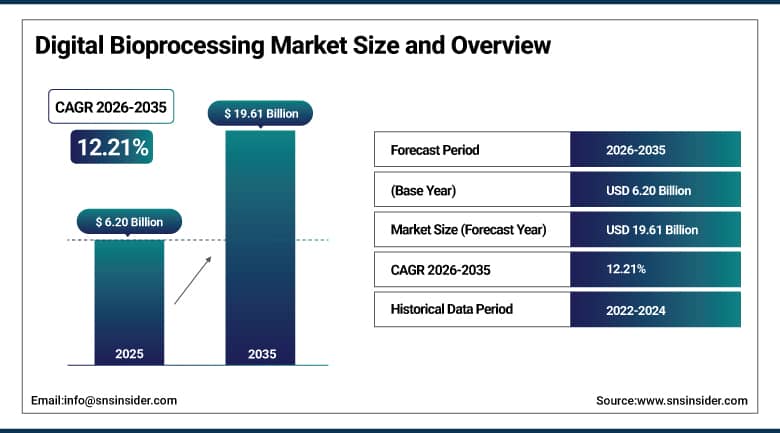
The Digital Bioprocessing Market was valued at USD 6.20 Billion in 2025 and is projected to reach USD 19.61 Billion by 2035, expanding at a CAGR of 12.21% during the forecast period 2026–2035.
Strong momentum is building in the digital bioprocessing market as biopharmaceutical firms turn more to digital to drive improvements in manufacturing efficiency, consistency, and compliance. Bioprocessing is adding new levels of complexity with all the upstream and downstream processes to monitor continuously and systems to control. The market is calling for integrated intelligent software platforms, process analytical technologies, automation systems, and real-time data integration. It is also aiding in optimizing resources and enhancing product quality while enabling the continued commercialization of monoclonal antibodies, vaccines, and cell and gene therapies. Growing investments in smart bio manufacturing capabilities and digital transformation programs are also fueling growth on a global scale.
Pharma companies are rapidly deploying predictive analytics, autonomic process control, electronic batch records, and digital manufacturing execution systems to support continuous manufacturing, reduce operational risks, and enhance regulatory preparedness. By 2025, the Advanced Research Projects Agency for Health maintained investments in next-generation bio manufacturing technology (including AI-enabled manufacturing and digital manufacturing capabilities), strengthening the U.S. Biotechnology manufacturing ecosystem.
To Get More Information On Digital Bioprocessing Market - Request Free Sample Report
Digital Bioprocessing Market Trends
-
Increasing adoption of AI-powered predictive bioprocess monitoring platforms.
-
Rising implementation of digital twin technologies across biologics manufacturing.
-
Growing utilization of cloud-enabled manufacturing execution and data management systems.
-
Expansion of smart automation integrating PAT sensors and real-time analytics.
-
Increasing investments in continuous bioprocessing and Industry 4.0 bio manufacturing facilities.
The U.S. Digital Bioprocessing Market Size Outlook
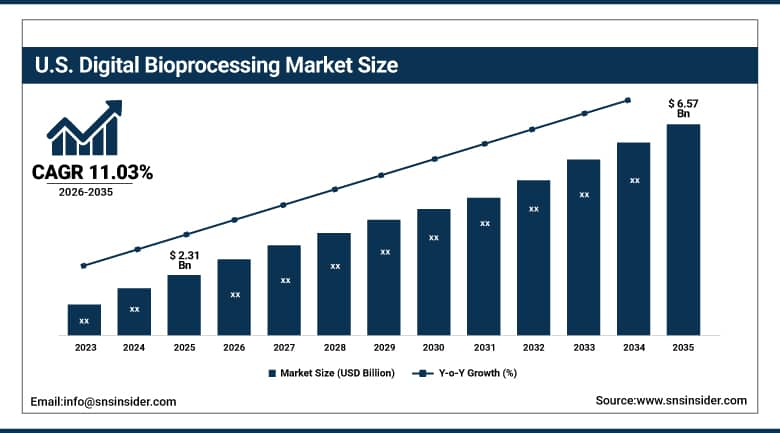
The U.S. Digital Bioprocessing Market was valued at USD 2.31 billion in 2025 and is expected to reach approximately USD 6.57 billion by 2035, expanding at a CAGR of 11.03% during 2026–2035.
The United States, with its well-established biologics manufacturing infrastructure, robust pipeline of new medicines, and rapid adoption of technologies, is the leader among North American nations in the digital bioprocessing industry. Large biopharmaceutical manufacturers are channeling significant capital into a variety of smart manufacturing tools and digital workflows for biologics, including AI powered manufacturing platforms, intelligent process monitoring solutions, automation software tools, cloud-based manufacturing execution systems, and sophisticated process analytical technologies-all to boost production efficiency to comply with regulatory expectations, while taking full advantage of these technologies.
Similarly, a series of cooperative agreements between pharmaceutics organizations, automation hardware vendors, cloud providers, and drug development firms is speeding the utilization of digital twin solutions, predictive analytics tools, and smarter production machinery across America’s facilities and plants, this year, in 2025, Thermo Fisher Scientific enhanced digital capabilities for bio processing and biologics production with sustained investment in advanced manufacturing solutions.
Digital Bioprocessing Market Segmentation Analysis
-
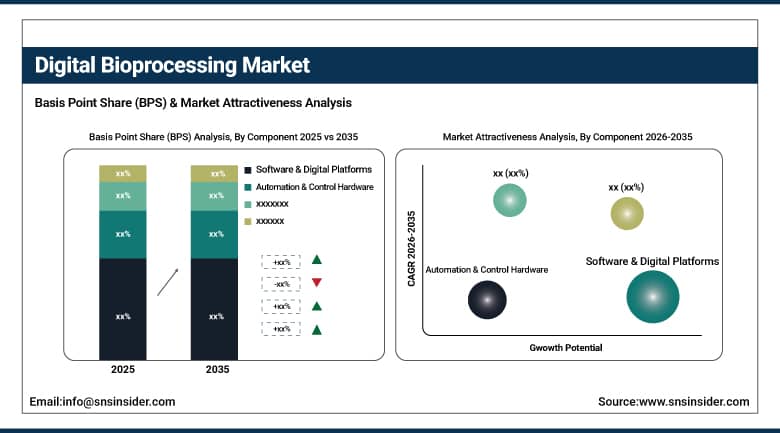
By Component, software & digital platforms dominated the market with 35.00% share in 2025, while process analytical technology & sensors are projected to witness the fastest growth with 14.26% CAGR during the forecast period.
-
By Technology, process automation & SCADA dominated the market with 32.00% share in 2025, while digital twins & process modeling are projected to witness the fastest growth with 17.40% CAGR during the forecast period.
-
By Application, upstream bioprocessing dominated the market with 35.00% share in 2025, while quality, compliance & batch release are projected to witness the fastest growth with 13.72% CAGR during the forecast period.
-
By End User, biopharmaceutical manufacturers dominated the market with 42.00% share in 2025, while contract development & manufacturing organizations are projected to witness the fastest growth with 13.89% CAGR during the forecast period.
By Component, software & digital platforms dominated, while process analytical technology & sensors grows fastest.
Software & digital platforms held a major share of 35.00% of the digital bioprocessing market in 2025 as they represent a confluence of technologies such as Manufacturing Execution Systems (MES), process visualization, production scheduling, data historians, Digital quality management (DQM) system, and advanced analytics that empower biologics manufacturing facilities. These sophisticated platforms aid in real-time decision-making, automated workflow management, regulatory documentation and enables a connective environment at the enterprise level. Cytiva, in 2025, added to its vast and growing repertoire of digital bioprocessing solutions focused on boosting software powered automation, enhanced data flow and optimal process execution capabilities in facilities that manufactures biological goods.
Process analytical technology (PAT) & sensors, will be expanding at the highest CAGR of 14.26% from 2026 to 2035 due to rising inclination of the biopharmaceutical industry towards ensuring continuous process, Quality by Design, and real-time product quality. Regulatory agencies encourage more use of inline Spectroscopy, biosensors, automated samplers, intelligent monitoring &control systems within upstream as well as downstream operations of bioprocessing. Sartorius AG in2025, launched extra digital analytical, process, and monitoring platforms that helps with process control to support automatic biologics process.
By Technology, process automation & SCADA dominated, while digital twins & process modeling grows fastest.
Process automation and SCADA had the dominant share of 32.00% in 2025 and have a substantial application range to operate commercial bioprocess facilities efficiently by the centralized supervision and management of equipment automation, monitoring, alarms, and production of biopharmaceutical drug products. SCADA gives a higher production workflow consistency to enable manufacturer access to end to end process from upstream (fermentation process and cell culture) to downstream (purification equipment) and cleanroom. In 2025, Emerson Electric Co increased their digital automation technologies capabilities for biopharmaceutical facilities with advanced industrial software.
Digital twins & process modeling estimated to grow with the fastest CAGR of 17.40% during the forecast period, due to pharmaceutical corporations creating virtual replicate of process that can simulate manufacturing environment, optimum parameter, forecast result, and test a modification of the process without physically build. In 2025, Siemens AG increased digital Twin technologies enabling their clients for pharmaceutical manufacturing innovation and also for advancing and simulating an entire pharmaceutical process.
By Application, upstream bioprocessing dominated, while quality, compliance & batch release grows fastest.
Upstream bioprocessing garnered a dominant share of 35.00% in the digital bioprocessing market by 2025 owing to the ubiquitous adoption of digital technologies in cell culture, fermentation, media preparation, inoculation, and process monitoring phases of bioprocessing activities. In addition, these operations generate bulk quantities of process data which are imperative to monitor consistently to yield efficient product quantity and maintain consistent batches. Automating processes using AI, Digital Sensors, and Cloud monitoring platforms in upstream operations enhance Productivity while minimizing contamination and process variation. In 2025, Merck Kgaa expanded its’ Bio continuum Platform of innovative digital tools designed to optimize productivity in upstream biologics process.
Quality, compliance and batch release expected to register fastest CAGR of 13.72% during 2026-2035 the requirement of enhanced data integrity, e documentation, audit readiness, and online verification of product Quality is being promoted across regions globally which has spurred digital transformation in quality operations management. Companies are deploying EHRs and automated Deviation Management & Real-time Quality Analytics and Cloud Digital Compliance Platforms which enhance Data and Batch Reliability and ensure speedier batch release cycles. In 2025, The U.S Food and Drug Association were encouraging to use technology enabled ‘Advance manufacturing’ including the digital quality and process monitoring and cloud computing platform.
Regional Analysis
|
Region |
Major Country |
Share within Region, 2025 (%) |
|---|---|---|
|
North America |
United States |
93.00% |
|
Europe |
Germany |
29.00% |
|
Asia Pacific |
China |
24.00% |
|
Middle East & Africa |
UAE |
4.00% |
|
Latin America |
Brazil |
3.00% |
North America Digital Bioprocessing Market Insights
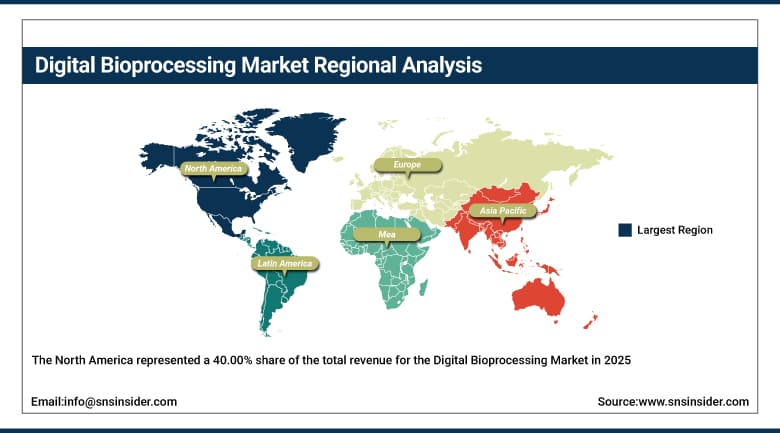
The North America represented a 40.00% share of the total revenue for the Digital Bioprocessing Market in 2025 and holds a prominent position due to a sophisticated biopharmaceutical manufacturing sector in North America, premature adoption of Industry 4.0 technologies, and large-scale expenditure made by the biopharmaceutical manufacturing sector on adopting digital technologies in the biologics manufacturing plants. Pharmaceutical companies across the US and Canada continue to integrate artificial intelligence (AI), manufacturing execution systems (MES), process analytical technologies (PAT), digital twin, cloud computing, and industrial automation in commercial manufacturing plants.
Growing application of real-time process monitoring, predictive maintenance, electronic batch record, and intelligent manufacturing platforms helps organizations increase operational efficiency while minimizing the manufacturing risks and production costs. Cytiva enhanced its digital bioprocessing business offering by adding connectivity of data acquisition, process analytics, and automation capabilities for improving biologics manufacturing in May 2025.
Get Customized Report as Per Your Business Requirement - Enquiry Now
Europe Digital Bioprocessing Market Insights
Europe remains one of the most technologically advanced markets for digital bioprocessing driven by its strong pharmaceutical manufacturing infrastructure, vast biotechnology research market as well as its well established regulatory system around biologic manufacturing processes. Countries like Germany, Switzerland, France, United Kingdom, Belgium and Ireland continue to invest in smart manufacturing facilities with automation, industrial data analysis and intelligent control systems for the digital bioprocess market.
Sustainable manufacturing, process intensification and digital quality assurance are priorities among European biopharmaceutical manufacturing facilities to optimize performance and adapt to dynamic GMP requirements. Further collaboration is prevalent between biotechnology enterprises, automation providers and academic and regulatory bodies driving innovation around digital manufacturing technologies. In 2025 Sartorius AG innovated its digital bioprocess automation solutions, with intelligent manufacturing, advanced analytics and end-to-end production work flow automation, enabling European biopharmaceutical manufacturers.
Asia Pacific Digital Bioprocessing Market Insights
The Asia Pacific digital bioprocessing market is projected to grow at the highest CAGR of 15.12% over the forecast period. An increase in the biologics manufacturing capabilities, rise in biotech investment, favorable government policies, and growth in pharma outsourcing activities are contributing to the increased growth of market across China, India, Japan, South Korea, Singapore and Australia regions. The regional players are increasing the implementation of the digital manufacturing solutions, cloud-based production management software, AI-based solutions, and advanced Process analytical technologies (PAT) to enhance manufacturing efficiency while adapting to the international regulatory standards and norms.
A rise in number of new biologic manufacturing sites and their digital manufacturing capability expansion is carried out by multinational life sciences companies across the Asia Pacific region to sustain the rising global biologics demand. In 2025, Thermo fisher scientific expanded its biologics manufacturing capacity and their digital manufacturing capability across Asia Pacific region, to sustain the increased pharmaceutical demands of the global market.
Middle East & Africa and Latin America Digital Bioprocessing Market Insights
The Middle East & Africa’s growing investments for technological upgrades by healthcare and governmental sectors are gradually fuelling adoption of the bioprocessing market. Countries like the U.A.E., Saudi Arabia & South Africa are ramping up their domestic biologic manufacturing capacities via implementation of modern automation techniques & advanced quality & manufacturing management solutions. Factors such as the rise in private-public partnerships, setting up of biologic and pharmaceutical manufacturing zones and country’s biotechnology initiatives are anticipated to significantly influence the digital adoption in the regional bio manufacturing units.
Bophirima companies in Latin America’s digital space are observing increased reliance towards adoption of automated biologic manufacturing to meet higher demand and enhance efficiencies in production processes across regions like Brazil, Argentina, Chile & Mexico. Rising investments in production & infrastructure modernization to keep up with country's biologic demands, increase in automated & intelligent manufacturing management solution deployments in biologic facilities and in biologic product & vaccine production, will create additional growth opportunity for digital bioprocessing. In 2025, Emerson Electric Co announced its global expansion for life sciences Automation and digital manufacturing products and capabilities across the developing pharmaceutical nations in order to strengthen the biologic manufacturing facilities across such countries.
Growth Drivers: Rise in the uptake of AI-enabled digital manufacturing, smart bioprocess automation.
The quick shift toward intelligent bio manufacturing has proved to be one of the prime contributors to the Digital Bioprocessing Market. Biopharmaceutical companies all over the world are leveraging the use of artificial intelligence, machine learning, process analytical technology, digital twin and cloud-connected manufacturing platform to improve processes, minimize batch failure and optimize quality output. They allow constant real-time monitoring of critical process parameters, predictive maintenance of equipment, automated adjustment of various process parameters.
The rise in complexity for biopharmaceutical industry such as production of monoclonal antibodies, vaccine, recombinant protein, cell therapy and gene therapy require digitally connected manufacturing facility. In 2025 Siemens AG upgraded the digital bioprocessing capability in the market by developing digital twin technology, AI-powered analytics, industrial software that increase pharmaceutical manufacturing performance and efficiency.
Restraints: High cost of implementation and difficult integration in traditional manufacturing sites.
Even though the long term gains were enormous, the upfront costs associated with implementation of digital bioprocessing technologies are immense: capital intensive acquisition of hardware, industrial software solutions, cloud based services, cyber security systems, and employee trainings. Traditional biopharmaceutical manufacturing plants utilize older manufacturing systems that do pose challenges in integration of advanced digital solutions.
The migration of data from legacy production, validation of new software solution, inter-operation of multiple equipment from diverse suppliers, and staying compliant with regulatory requirements are complicated and time-consuming during digital transformation projects. In the mean-time, budget constraint is a common issue faced by small biotech companies and manufacturers, hence retarding the widespread use of advanced digital manufacturing technologies. ISPE continued to advance industry guidance supporting the secured digital transformation process, system interoperability and validated deployment of smart pharmaceutical manufacturing systems in 2025.
Opportunities: Increasing usage of digital twins, and continuous bioprocessing manufacturing ecosystems.
Increasing commercialization of advanced biologics and personalized medicines offers attractive growth opportunities for the digital bioprocessing solutions vendors. The increasing investments from the pharmaceutical companies in digital twins and predictive simulation, as well as cloud based manufacturing execution systems (MES), automated quality management systems (QMS), and AI-driven process optimizing solutions, to faster the product development cycle and enhancing flexibility and reliability of drug manufacturing, is propelling the growth. Further adoption of continuous bioprocessing technology is resulting in the demand of intelligent monitoring systems to support for autonomous environment requiring less human interventions. In April 2026, Rockwell Automation expanded its Digital manufacturing solution portfolio to life sciences with enhancement in cloud connectivity, advanced industrial analytics, and smart automation for pharmaceuticals production.
Recent Developments
-
2026: Siemens AG expanded its industrial AI and digital twin capabilities for pharmaceutical manufacturing, enabling enhanced simulation, predictive process optimization, and intelligent production control.
-
2026: Thermo Fisher Scientific continued expanding advanced biologics manufacturing capacity while strengthening digitally integrated production workflows supporting commercial-scale bioprocessing.
-
2025: Sartorius AG introduced expanded digital bioprocess analytics and automation capabilities supporting real-time manufacturing optimization and intelligent process monitoring across biologics production.
-
2025: Cytiva strengthened its digital bioprocess portfolio through enhanced automation, process analytics, and software-driven manufacturing solutions designed for next-generation biologics facilities.
Digital Bioprocessing Market Key Players are:
-
Danaher Corporation
-
Merck KGaA
-
Repligen Corporation
-
Emerson Electric Co.
-
Rockwell Automation, Inc.
-
ABB Ltd.
-
Schneider Electric SE
-
Honeywell International Inc.
-
Eppendorf SE
-
Agilent Technologies, Inc.
-
Bio-Rad Laboratories, Inc.
-
Waters Corporation
-
Applied Materials, Inc.
-
Yokogawa Electric Corporation
-
Beckman Coulter Life Sciences
-
GEA Group AG
-
KROHNE Group
Digital Bioprocessing Market Report Scope:
| Report Attributes | Details |
|---|---|
| Market Size in 2025 | USD 6.20 Billion |
| Market Size by 2035 | USD 19.61 Billion |
| CAGR | CAGR of 12.21% From 2026 to 2035 |
| Base Year | 2025 |
| Forecast Period | 2026-2035 |
| Historical Data | 2022-2024 |
| Report Scope & Coverage | Market Size, Segments Analysis, Competitive Landscape, Regional Analysis, DROC & SWOT Analysis, Forecast Outlook |
| Key Segments | • By Component (Software & Digital Platforms, Automation & Control Hardware, Process Analytical Technology & Sensors, Implementation, Integration & Support Services) • By Technology (Process Automation & SCADA, Data Analytics & AI/ML, Digital Twins & Process Modeling, MES, Electronic Batch Records & Data Management, Others) • By Application (Upstream Bioprocessing, Downstream Bioprocessing, Process Development & Scale-up, Quality, Compliance & Batch Release, Others) • By End User (Biopharmaceutical Manufacturers, Contract Development & Manufacturing Organizations, Biotechnology Companies, Academic & Research Institutes, Others) |
| Regional Analysis/Coverage | North America (US, Canada), Europe (Germany, UK, France, Italy, Spain, Russia, Poland, Rest of Europe), Asia Pacific (China, India, Japan, South Korea, Australia, ASEAN Countries, Rest of Asia Pacific), Middle East & Africa (UAE, Saudi Arabia, Qatar, South Africa, Rest of Middle East & Africa), Latin America (Brazil, Argentina, Mexico, Colombia, Rest of Latin America). |
| Company Profiles | Thermo Fisher Scientific Inc., Danaher Corporation, Sartorius AG, Merck KGaA, Repligen Corporation, Siemens AG, Emerson Electric Co., Rockwell Automation, Inc., ABB Ltd., Schneider Electric SE, Honeywell International Inc., Eppendorf SE, Agilent Technologies, Inc., Bio-Rad Laboratories, Inc., Waters Corporation, Applied Materials, Inc., Yokogawa Electric Corporation, Beckman Coulter Life Sciences, GEA Group AG, KROHNE Group |
Frequently Asked Questions
The Digital Bioprocessing Market was valued at USD 6.20 Billion in 2025.
The market is projected to reach USD 19.61 Billion by 2035.
The market is anticipated to expand at a CAGR of 12.21% during the forecast period.
Software & Digital Platforms accounted for the largest revenue share of 35.00% in 2025.
