
Bioprocess Digital Twins Market Report Scope & Overview:
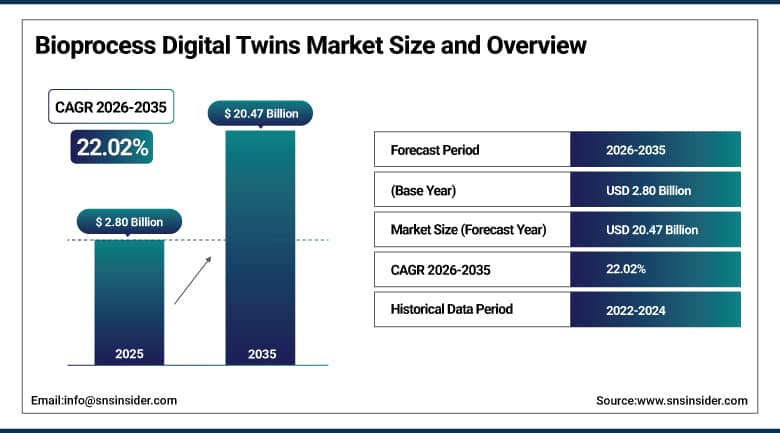
The Bioprocess Digital Twins Market was valued at USD 2.80 Billion in 2025 and is projected to reach USD 20.47 Billion by 2035, expanding at a CAGR of 22.02% during the forecast period 2026–2035.
Biopharmaceutical companies are now deploying virtual process models-digital bioprocess twin-to improve the efficiency of both upstream and downstream bio manufacturing, minimize development time, and enhance consistent manufacturing. Such solutions provide enhanced visibility across the challenging bioprocessing workflow through real-time tracking, simulation and prediction for process reliability, reduced risk of batch failures and streamlined commercialization for biologics such as vaccines, monoclonal Antibodies, cells & genes and continuous processes to bring forth growing demand for AI enhanced smart digital manufacturing platform integrating PAT, IoT, sensors. Such high growing investment towards these products helps fueling the digital twin market.
Rapid digital, machine learning, and automation process advances help strengthen growth in the digital twin in bioprocess market by building advanced cloud infrastructure and hybrid modeling technique. In May 2025, The U.S. Pharmacopeia expanded its partnerships that focus on enhancing advancement manufacturing and digital quality approaches for the biopharmaceutical industry. This comes to strengthen digital process and real-time process analytics approach.
To Get More Information On Bioprocess Digital Twins Market - Request Free Sample Report
Bioprocess Digital Twins Market Trends
-
Increasing adoption of AI-powered predictive bioprocess digital twin platforms.
-
Growing deployment of cloud-native digital manufacturing environments.
-
Rising implementation of continuous bioprocessing and real-time process optimization.
-
Expansion of digital twins supporting cell and gene therapy manufacturing.
-
Increasing integration of PAT, IoT sensors, and advanced analytics.
The U.S. Bioprocess Digital Twins Market Size Outlook
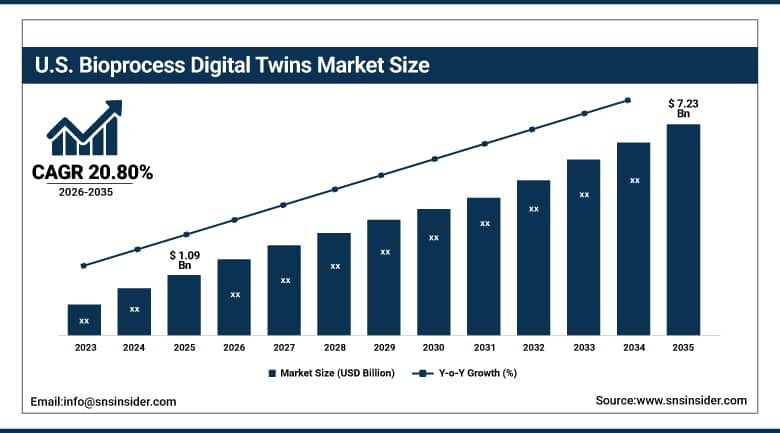
The U.S. Bioprocess Digital Twins Market was valued at USD 1.09 billion in 2025 and is expected to reach approximately USD 7.23 billion by 2035, expanding at a CAGR of 20.80% during 2026–2035.
The United States still controls the North America bioprocess digital twins market due to mature biopharmaceutical manufacturing industry, robust biologics pipeline, significant industry 4.0 adoption and huge investments in digital manufacturing facilities. Several large pharmaceutical and biologics manufacturers along with many small biotech companies and contract development and manufacturing organizations (CDMOs) are implementing digital twin models across their commercial manufacturing sites & process development & transfer stages to gain better batch control, mitigation of risks and accelerate transfer activities. Continuous governmental drive on advance manufacturing & high levels of industry adoption on IoT, Artificial intelligence, industrial automation, cloud computing and predictive modeling is further propelling its commercialization in the US.
Also, constant investments from software and hardware manufacturers such as Emerson, Siemens etc. in digital solutions are leading into greater innovations across hybrid process models, digital simulations, cloud based manufacturing execution and AI led optimization strategies. High interoperability and seamless integration of MES, LIMS, EHR, digital twins to increase visibility during production. During 2025, Emerson Electric is strategically enhancing the life sciences portfolio by investing more into industrial automation with improved AI capabilities for more digitalized pharma manufacturing capabilities.
Bioprocess Digital Twins Market Segmentation Analysis
-
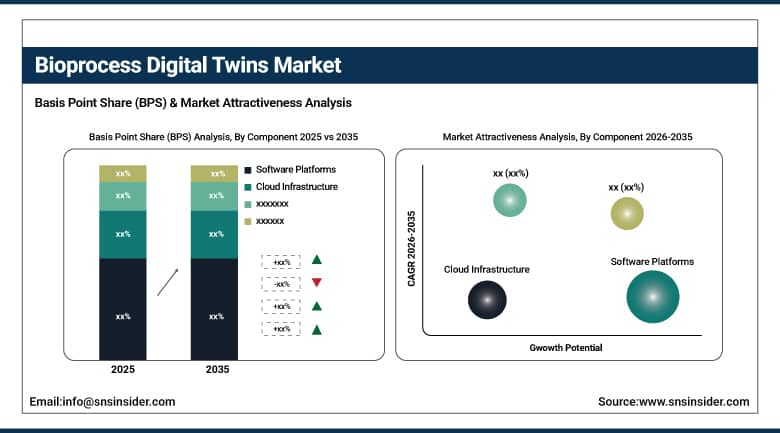
By Component, software platforms dominated the market with 39.00% share in 2025, while cloud infrastructure is projected to witness the fastest growth with 23.46% CAGR during the forecast period.
-
By Deployment, cloud-based dominated the market with 48.00% share in 2025 and is also projected to witness the fastest growth with 24.35% CAGR during the forecast period.
-
By Application, upstream bioprocessing dominated the market with 34.00% share in 2025, while process development & scale-up is projected to witness the fastest growth with 24.49% CAGR during the forecast period.
-
By End User, biopharmaceutical manufacturers dominated the market with 43.00% share in 2025, while CDMOs are projected to witness the fastest growth with 23.91% CAGR during the forecast period.
By Component, software platforms dominated, while cloud infrastructure grows fastest.
The software platforms held a share of 39.00% in the bioprocess digital twins market in 2025, thereby constituting the largest component segment, owing to their importance in managing, running and establishing a virtual bioprocess environment in the bio manufacturing plants. They combine process simulation, mechanistic modeling, AI, MES, LIMS, IAs within a single integration hub facilitating real-time monitoring and decision-making based on predicted scenarios. The March 2025 saw Siemens Digital Industries introducing expanded industrial software solutions as a part of its digital enterprise portfolio to aid pharmaceutical manufactures, enhancing industrial software that supports model based manufacturing, digital simulation and AI enabled process optimizations.
Cloud infrastructure is expected to grow at the highest CAGR of 23.46% in the forecast period of 2026-2035, with bioprocess digital twins migrating to cloud native, scalable platforms due to enormous storage requirements of the manufacturing data. Cloud deployment provides ease in managing high-volume manufacturing data, enabling seamless access, collaboration between globally placed manufacturing plants and real-time computational modeling on large datasets, integrated with AI and ML applications. In 2025, the cloud support for the regulated life sciences organizations was enhanced by Microsoft on its existing cloud infrastructure, with augmented services on AI and industrial data solutions on Azure supporting industrial engineering and advanced pharmaceutical manufacturing.
By Application, upstream bioprocessing dominated, while process development & scale-up grows fastest.
Upstream bioprocessing contributed 34.00% of market share in 2025 because it is a key step in biologics production to optimize cell culture conditions, media formulation, bioreactor operations and fermentation parameters which impacting directly to production efficiency and product yield. Digital twin models the biological responses under different conditions of operation in order to anticipate before the loss of product production during their usage and enables to be more reproducible between manufacturing campaigns. Continuous real-time monitoring coupled with predictive analytical solutions to facilitate experimentation to be reduced and production to be more effectively improved, enhancing reliable production runs. In 2025, Sartorius AG continued to advance digital capabilities in its bioprocess offering through the growth of advanced analytics and digital solutions coupled together to manage a robust suite of upstream bioprocessing operations for high productivity automated workflows of biologics.
Process development & scale-up expected grow the fastest at a CAGR of 24.49% during the projection period of research as pharma wants to speed up product to the market and want to achieve risk-free production to the commercial run. Physical implementation process can be substituted using a digital twin by simulating the operation run in order to understand the various scenarios.
By End User, biopharmaceutical manufacturers dominated, while CDMOs grows fastest.
By 2025 biopharmaceutical manufacturers represented 43.00% of the total revenue share as the growing adoption of biologics manufacturing technologies, digitization processes, and the deployment of Industry 4.0 solutions across the commercial production facilities contribute toward business expansion. Major pharmaceutical firms implement digital twin solutions to enhance upstream and downstream bioprocessing capabilities, standardize processes, eliminate manufacturing errors, and faster attain regulatory approvals through real-time monitoring of manufacturing processes and predictive analyses. In April 2025, Merck KGaA strengthened biologics manufacturing competencies with Bio Continuum digital bioprocessing by adding an array of data-driving advanced analytics services designed for enhancing production process for biologics.
Top CDMO’s is anticipated to show fastest growth at a CAGR of 23.91 % over the 2026 – 2035 time frame. Contract development and manufacturing organizations are rapidly developing and manufacturing biologics processes for a multitude of clients, and these complex projects require significant capabilities in flexible manufacturing, technology transfer processes and process control across biologics manufacturing. CDMOs’ can develop sophisticated digital twin modelling and simulation to analyze and evaluate complex and costly manufacturing processes, hence reducing process development time and resource usage for new products. In 2025 Lonza Group maintained to deploy further digital manufacturing in production facilities with the incorporation of modern advanced analytical tools for streamlining of biologic manufacturing process through efficient analytics.
Regional Analysis
|
Region |
Major Country |
Share within Region, 2025 (%) |
|---|---|---|
|
North America |
United States |
93.00% |
|
Europe |
Germany |
30.00% |
|
Asia Pacific |
China |
22.00% |
|
Middle East & Africa |
UAE |
3.50% |
|
Latin America |
Brazil |
2.00% |
North America Bioprocess Digital Twins Market Insights
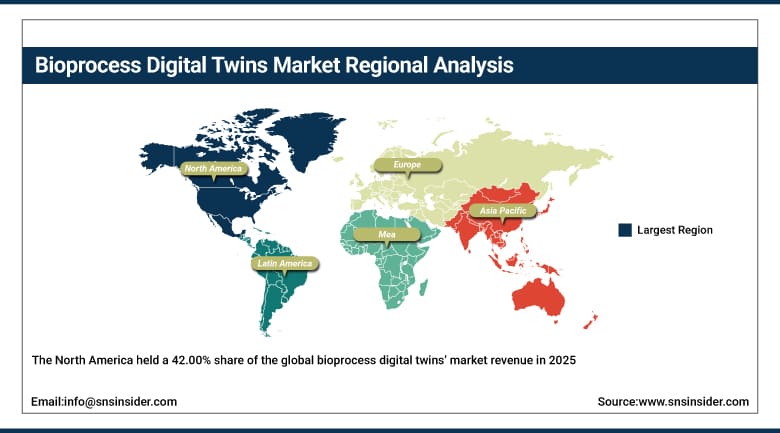
The North America held a 42.00% share of the global bioprocess digital twins’ market revenue in 2025, and is expected to remain the most dominant region on account of advanced biopharmaceutical manufacturing infrastructure presence, tremendous biologics research activities, and early adoption of digital manufacturing technologies. Many of the world's major pharmaceutical firms, biotechnology pioneers, automation vendors and life sciences software firms are located in this region and continuously make significant investments in AI-based manufacturing, Industrial IoT, cloud computing, process analytical technologies, among others. Growing importance of Quality by Design (QbD) and Process Analytical Technology (PAT) in conjunction with continuous manufacturing support, are promoting the wide usage of digital twin solutions across commercial biologics facilities.
Moreover, rising demand for increased production of monoclonal antibodies, biosimilars, vaccines and cell/gene therapies are driving an accelerated demand for advanced predictive manufacturing technologies to enhance process robustness and lower process variation. In 2025, Thermo Fisher Scientific was constantly adding new digital manufacturing capabilities to its biopharmaceutical and pharmaceutical services business with advanced process analytical technologies and digital production technologies to enhance its manufacturing capabilities.
Get Customized Report as Per Your Business Requirement - Enquiry Now
Europe Bioprocess Digital Twins Market Insights
Europe was largely helped by its advanced pharmaceutical manufacturing process, favorable regulatory environment, and booming investment in digital bio manufacturing. Individual companies within Germany, Switzerland, the UK, France and Ireland continue to build on the growth in their adoption of Industry 4.0 technologies within their biologics manufacturing sites to boost process efficiency and product variability, while adhering to regulatory requirements. The adoption of digital twins has become prevalent in the operations of European pharmaceutical manufacturing companies for optimization in fermentation, purification, process validation, and technology transfer and to aid in sustainable manufacturing processes.
Government backed innovation schemes, joined-up research, and the robust digital infrastructure throughout Europe are continuing to enable rapid commercialization of advanced bioprocess simulation technologies across the continent. In 2025, Dassault Systems enhance their life sciences digital twins by extending the Virtual Manufacturing and simulation solutions for optimal pharmaceutical processes and biologics production planning.
Asia Pacific Bioprocess Digital Twins Market Insights
The Asia Pacific bioprocess digital twins market is expected to witness the highest compound annual growth rate (CAGR) of 25.44% from 2026-2035. With exponential growth in the biopharmaceutical production capacity, a surge in biotech funding, and robust government support for advanced pharmaceutical manufacturing operations, Asia Pacific (including China, Japan, South Korea, India, Singapore and Australia) will continue to gain share in the global market. Extensive investment in the development of vaccine production, biologics, biosimilars, monoclonal antibodies, and cell and gene therapy programs by pharmaceutical companies in the region has amplified the demand for adoption of bioprocess digital twin to optimize the product manufacturing process.
With its cost effective manufacturing, expansive contract development and manufacturing capabilities (CDMO) and foreign direct investments in Life Science Industry Infrastructure, Asia Pacific has emerged as the primary destination for biologic drugs manufacturing. By 2025, Wuxi Biologics further invested and enhanced its intelligent manufacturing system including digital manufacturing techniques and AI capability on process optimization and control in their biologics product network.
Middle East & Africa and Latin America Bioprocess Digital Twins Market Insights
The Middle East & Africa (MEA) market is growing incrementally with governments as well as the private sector pushing investments towards building pharmaceutical manufacturing, biotech research, and the development of the digital health infrastructure. While Countries like the UAE, Saudi Arabia, and South Africa are investing to boost domestic production capability of the biologics segment and build the capability to introduce advanced manufacturing processes that can enhance efficient production and product quality.
The Latin America region is also seeing incremental growth driven by increased manufacturing of biologic products , rising investments in pharmaceutical research and technology adoption by most of the country’s such as; brazil , Mexican , argentine and Chile. The expansion of regional CDMO capacities are playing the central role in increasing digital adoption. By 2025, Emerson Electric has set a vision to increase collaboration around the existing Industrial automation as well as its digital transformation services to promote the modernization in of pharmaceutical manufacturing facilities in many new markets, such as Middle Eastland Latin America.
Growth Drivers: Increasing uptake of Industry 4.0 and AI enabled digital bio manufacturing.
Increasing adoption of Industry 4.0 has been a major growth driver for the bioprocess digital twins market. The trend for biopharmaceutical companies to widely implement intelligent digital manufacturing solutions for streamlining production, reducing batch failures and speeding up commercialization of sophisticated biologics is the major factor contributing to growth in the market. Digital twins in manufacturing are a virtualization of the processes incorporating AI, mechanistic models, IoT sensors, PAT and cloud services into the production environment, through which manufacturing output can be constantly monitored, predicted, adjusted and improved to maintain product quality and cut down expenses, driven by an evolving market demand.
In 2025, Siemens launched enhanced AI driven industrial software solutions within its Industrial AI portfolio to enable predictive manufacturing, intelligent automation, and digital twins in biopharmaceutical production facilities.
Restraints: Significant investment and integration with traditional manufacturing infrastructure.
There are significant potential upsides in the long-term implementation of bioprocess digital twins; however, significant investments in both capital and integration with traditional manufacturing systems prevent broader adoption today. “A bioprocess digital twin ecosystem requires a number of distinct software types: a simulation tool, an automation solution for the manufacturing workflow, complex sensing technologies, a cloud computing platform, cyber security systems and the availability of a team comprised of biologists, engineers, computer science specialists, and data scientists. This may need to work with the traditional plant automation and information technology that most pharma companies still depend upon in legacy systems to be successfully adopted,” say industry analyst firm IDC. Rockwell Automation continued to grow their life sciences consulting and digital engineering services in 2025 aimed at streamlining digital industrial transformations for life sciences clients and facilitating integration of its intelligent manufacturing solutions.
Opportunities: Biologics production, outsourcing to CDOs, and AI-optimized processes.
The surge in biologics production and the rise in contract development and manufacturing (CDMO) outsourcings is the primary opportunity leading to long term growth within the global Bioprocess Digital Twins Market. With the rising demand in clonal antibodies, recombines, biosimilars, cell therapy, gene therapy, and mRNA Therapeutics, it becomes necessary to produce within highly data driven as well as extremely controlled facilities. The ability of a digital twin to emulate real manufacturing environments while optimizing operational conditions, mitigate the scaling risks, and better assure consistent batches, allows for quicker market entry while significantly impacting cost and time in biologics production within pharmaceutical organizations.
In 2025, Cytiva enhanced its data collection offerings by growing its integrated data analytics, data collection and model based process advancement features within the digital biologic space to reduce lead time and streamline production.
Recent Developments
-
2026: Siemens Digital Industries expanded its Industrial AI portfolio with enhanced digital twin and simulation capabilities supporting pharmaceutical manufacturing optimization, predictive process control, and intelligent factory operations.
-
2025: Merck KGaA strengthened its Bio Continuum Platform by expanding digital bioprocessing technologies that integrate automation, advanced analytics, and real-time manufacturing data for biologics production.
-
2025: Sartorius AG enhanced its digital bioprocess portfolio by introducing advanced software capabilities supporting data integration, predictive analytics, and intelligent upstream bioprocess optimization for biopharmaceutical manufacturers.
-
2025: Cytiva expanded its digital manufacturing ecosystem through enhanced automation, process analytics, and connected bioprocess technologies designed to accelerate biologics development and commercial manufacturing.
Bioprocess Digital Twins Market Key Players are:
-
Merck KGaA
-
Cytiva
-
Thermo Fisher Scientific Inc.
-
Emerson Electric Co.
-
Aspen Technology, Inc.
-
ABB Ltd.
-
AVEVA Group plc
-
GEA Group AG
-
Rockwell Automation, Inc.
-
Körber AG
-
Microsoft Corporation
-
Amazon Web Services, Inc.
-
Honeywell International Inc.
-
Schneider Electric SE
-
Lonza Group AG
-
WuXi Biologics
-
PTC Inc.
Bioprocess Digital Twins Market Report Scope:
| Report Attributes | Details |
|---|---|
| Market Size in 2025 | USD 2.80 Billion |
| Market Size by 2035 | USD 20.47 Billion |
| CAGR | CAGR of 22.02% From 2026 to 2035 |
| Base Year | 2025 |
| Forecast Period | 2026-2035 |
| Historical Data | 2022-2024 |
| Report Scope & Coverage | Market Size, Segments Analysis, Competitive Landscape, Regional Analysis, DROC & SWOT Analysis, Forecast Outlook |
| Key Segments | • By Component (Software Platforms, Simulation & Modeling Engines, Cloud Infrastructure, Implementation & Consulting, Others) • By Deployment (Cloud-Based, On-Premise, Hybrid) • By Application (Upstream Bioprocessing, Downstream Bioprocessing, Process Development & Scale-up, Quality & Process Optimization, Others) • By End User (Biopharmaceutical Manufacturers, CDMOs, Biotechnology Companies, Academic & Research Institutes, Others) |
| Regional Analysis/Coverage | North America (US, Canada), Europe (Germany, UK, France, Italy, Spain, Russia, Poland, Rest of Europe), Asia Pacific (China, India, Japan, South Korea, Australia, ASEAN Countries, Rest of Asia Pacific), Middle East & Africa (UAE, Saudi Arabia, Qatar, South Africa, Rest of Middle East & Africa), Latin America (Brazil, Argentina, Mexico, Colombia, Rest of Latin America). |
| Company Profiles | Siemens Digital Industries, Merck KGaA, Sartorius AG, Cytiva, Thermo Fisher Scientific Inc., Emerson Electric Co., Dassault Systèmes SE, Aspen Technology, Inc., ABB Ltd., AVEVA Group plc, GEA Group AG, Rockwell Automation, Inc., Körber AG, Microsoft Corporation, Amazon Web Services, Inc., Honeywell International Inc., Schneider Electric SE, Lonza Group AG, WuXi Biologics, PTC Inc. |
Frequently Asked Questions
The Bioprocess Digital Twins Market was valued at USD 2.80 Billion in 2025.
The market is projected to reach USD 20.47 Billion by 2035.
The market is anticipated to expand at a CAGR of 22.02% during the forecast period.
North America dominated the global Bioprocess Digital Twins Market in 2025 with a 42.00% revenue share.
Software Platforms accounted for the largest revenue share of 39.00% in 2025.
