
Digital Sovereignty Technologies Market Report Scope & Overview:
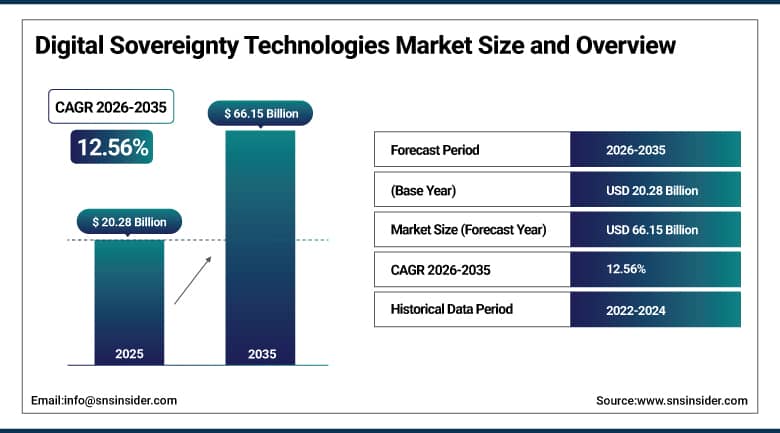
The Digital Sovereignty Technologies Market was valued at USD 20.28 Billion in 2025 and is expected to reach USD 66.15 Billion by 2035, growing at a CAGR of 12.56% from 2026–2035.
The digital sovereignty technologies market is experiencing consistent growth due to the increasing need for data protection, regulatory compliance, and greater control over digital infrastructure. The growing adoption of cloud computing, artificial intelligence, data localization, and cross-border digital services has increased the demand for technologies that enable organizations to maintain control over data, infrastructure, and critical digital operations. Investments in advanced digital sovereignty technologies such as data localization, data sovereignty compliance, cloud sovereignty, regulatory compliance, and data privacy solutions have increased across enterprises and government organizations. The focus of companies has been on data control, regulatory adherence, infrastructure independence, security, and operational resilience. Growing demand for secure and compliant digital infrastructure is propelling technological advancements.
In February 2026, Google Cloud expanded its sovereign cloud capabilities, emphasizing data control, regulatory compliance, operational resilience, and customer control over unencrypted data to support organizations with growing digital sovereignty requirements.
To Get More Information On Digital Sovereignty Technologies Market - Request Free Sample Report
Digital Sovereignty Technologies Market Trends
-
Growing adoption of cloud computing and digital infrastructure is driving demand for digital sovereignty technologies that enable greater control over data, infrastructure, and critical workloads.
-
Rising implementation of data localization and data sovereignty regulations is increasing demand for technologies that support regulatory compliance, secure data management, and jurisdictional control.
-
Increasing demand for cloud sovereignty, data privacy, and secure digital operations is supporting the growth of specialized digital sovereignty technology solutions.
-
Growing focus on improving data control, regulatory compliance, operational resilience, infrastructure independence, and cybersecurity is creating opportunities for digital sovereignty technology providers.
-
Advancements in data localization, cloud sovereignty, regulatory compliance, data privacy, and sovereign infrastructure technologies are improving digital control and supporting market adoption.
The U.S. Digital Sovereignty Technologies Market Outlook
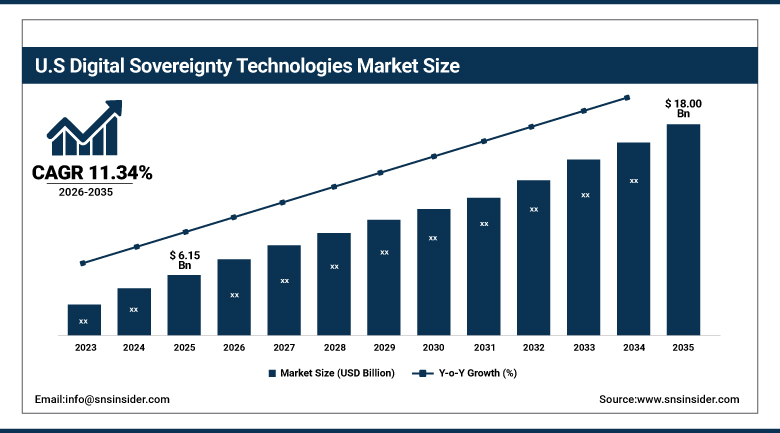
The U.S. Digital Sovereignty Technologies Market was valued at USD 6.15 Billion in 2025 and is expected to reach around USD 18.00 Billion by 2035, growing at a CAGR of 11.34% from 2026–2035.
The U.S. digital sovereignty technologies market is expanding steadily as organizations and government agencies increase investments in technologies that strengthen national control over data, digital infrastructure, cloud environments, cybersecurity, and critical technology systems. Growing concerns over foreign technology dependencies, cybersecurity risks, regulatory compliance, and protection of sensitive government and enterprise information are accelerating demand for sovereign cloud platforms, data localization solutions, trusted digital infrastructure, encryption technologies, and sovereign cybersecurity solutions. Increased federal initiatives to strengthen domestic technology capabilities and secure critical digital infrastructure are supporting market growth. Technology providers are focusing on secure data environments, domestic cloud infrastructure, privacy-enhancing technologies, identity and access management, and solutions that enable organizations to maintain greater control over data and digital operations within U.S. jurisdiction.
In 2026, the U.S. government continued strengthening policies and investments aimed at reducing dependence on foreign technology providers and enhancing domestic control over critical digital infrastructure, data, cloud services, and cybersecurity. These initiatives are expected to accelerate adoption of digital sovereignty technologies across government agencies, critical infrastructure operators, and enterprises, supporting demand for sovereign cloud, secure data management, cybersecurity, encryption, and trusted digital infrastructure solutions.
Digital Sovereignty Technologies Market Segment Analysis
-
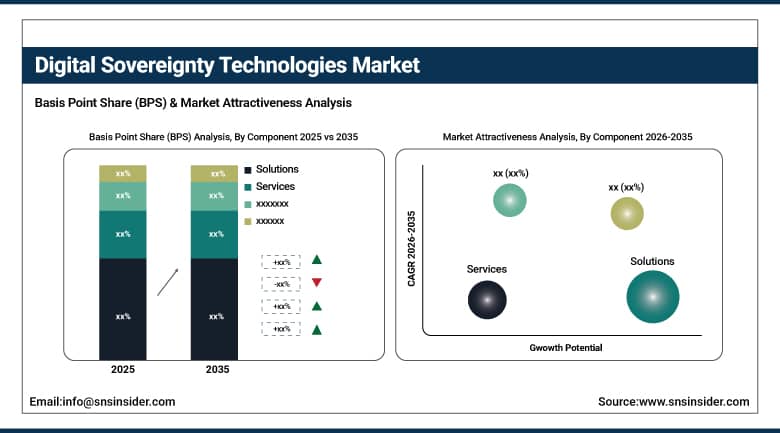
By Component, solutions dominated the digital sovereignty technologies market with a 76.43% share in 2025, while services are projected to be the fastest-growing segment, registering a 14.04% CAGR during 2026–2035.
-
By Technology, cloud sovereignty dominated the digital sovereignty technologies market with a 28.47% share in 2025, while data sovereignty compliance is projected to be the fastest-growing segment, registering a 15.63% CAGR during 2026–2035.
-
By Deployment, cloud-based solutions dominated the digital sovereignty technologies market with a 43.68% share in 2025, while cloud-based solutions are projected to be the fastest-growing segment, registering a 13.79% CAGR during 2026–2035.
-
By Functionality, data sovereignty dominated the digital sovereignty technologies market with a 39.27% share in 2025, while technical sovereignty is projected to be the fastest-growing segment, registering a 14.46% CAGR during 2026–2035.
-
By Organization Size, large enterprises dominated the digital sovereignty technologies market with a 47.36% share in 2025, while SMEs are projected to be the fastest-growing segment, registering a 15.26% CAGR during 2026–2035.
-
By End-Use Industry, government & defense dominated the digital sovereignty technologies market with a 25.83% share in 2025, while healthcare is projected to be the fastest-growing segment, registering a 16.90% CAGR during 2026–2035.
By Component, solutions dominated the digital sovereignty technologies market, while services are expected to grow fastest.
Solutions held the dominant position in the market in 2025, driven by increasing demand for technologies that enable organizations to maintain control over data, digital infrastructure, cloud environments, cybersecurity, and regulatory compliance. The growing adoption of data localization, cloud sovereignty, data privacy, and sovereignty compliance solutions is supporting the leading position of solutions in the market.
Services are anticipated to register the highest during the forecast period of 2026–2035. Rising demand for consulting, implementation, integration, compliance management, and managed services is encouraging organizations to strengthen their digital sovereignty strategies and deploy sovereignty-focused technologies across increasingly complex IT environments.
By Technology, cloud sovereignty dominated the digital sovereignty technologies market, while data sovereignty compliance is expected to grow fastest.
Cloud sovereignty held the dominant position in the market in 2025, accounting for a share, driven by growing demand for greater control over cloud infrastructure, data residency, jurisdiction, and access to sensitive information. Increasing adoption of sovereign cloud environments by government agencies and enterprises is supporting demand for cloud sovereignty technologies.
Data sovereignty compliance is projected to register the highest CAGR during the forecast period of 2026–2035. Increasing regulatory requirements concerning data residency, cross-border data transfers, privacy, and jurisdictional control are encouraging organizations to adopt technologies that support compliance with evolving data sovereignty requirements.
By Deployment, cloud-based solutions dominated the digital sovereignty technologies market, while cloud-based solutions are expected to grow fastest.
Cloud-based deployment held the dominant position in the market in 2025, owing to the increasing adoption of scalable cloud infrastructure and sovereign cloud environments. Organizations are increasingly seeking flexible digital infrastructure that provides stronger control over data location, access, security, and jurisdiction.
Cloud-based solutions are projected to register the highest CAGR during the forecast period of 2026–2035. Growing investments in sovereign cloud infrastructure, secure cloud platforms, and jurisdiction-specific data environments are expected to accelerate the adoption of cloud-based digital sovereignty technologies.
By Functionality, data sovereignty dominated the digital sovereignty technologies market, while technical sovereignty is expected to grow fastest.
Data sovereignty held the dominant position in the market in 2025, driven by increasing concerns regarding data residency, jurisdictional control, privacy, and cross-border data transfers. Government regulations and enterprise requirements for greater control over sensitive and critical data are contributing to the strong demand for data sovereignty solutions.
Technical sovereignty is projected to register the highest CAGR of 14.46% during the forecast period of 2026–2035. Growing efforts to reduce dependence on foreign technology providers, strengthen domestic digital infrastructure, and improve control over critical technologies are expected to support the rapid adoption of technical sovereignty solutions.
Regional Analysis
|
Region |
Major Country |
Share within Region, 2025(%) |
|---|---|---|
|
North America |
United States |
82.40% |
|
Europe |
Germany |
34.30% |
|
Asia Pacific |
China |
48.54% |
|
Middle East & Africa |
Saudi Arabia |
23.50% |
|
Latin America |
Brazil |
23.00% |
North America digital sovereignty technologies market insights
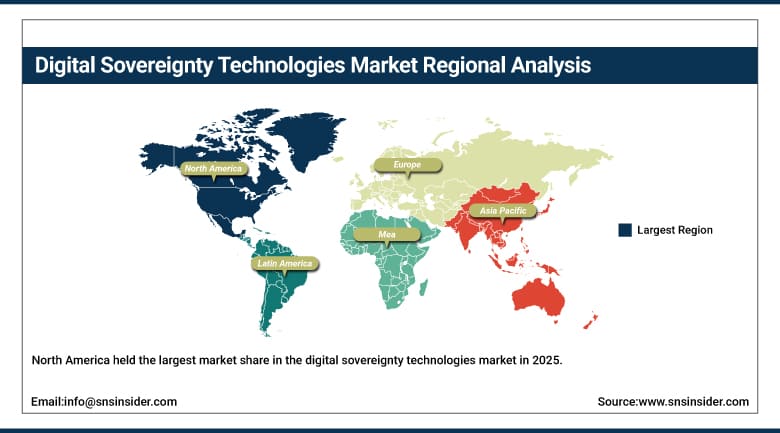
North America held the largest market share of around 36.78% in the digital sovereignty technologies market in 2025. This was due to increasing demand for secure digital infrastructure, data localization, sovereign cloud environments, cybersecurity, and technologies that provide greater control over critical data and digital operations. Government initiatives, regulatory requirements, investments in domestic technology infrastructure, and growing concerns regarding foreign technology dependencies are expected to further support market expansion.
The United States is expected to dominate the North American market, supported by its strong technology ecosystem, substantial investments in cybersecurity and cloud infrastructure, government initiatives focused on digital resilience, and increasing adoption of data sovereignty, privacy, and compliance solutions. Canada is also expected to contribute to regional growth through investments in secure digital infrastructure, cloud technologies, data protection, and regulatory compliance.
Get Customized Report as Per Your Business Requirement - Enquiry Now
Europe digital sovereignty technologies market insights
Europe is expected to experience steady growth in the digital sovereignty technologies market during the forecast period, supported by stringent data protection regulations, increasing emphasis on data residency, cybersecurity requirements, cloud sovereignty, and efforts to strengthen technological independence. Growing investments in sovereign cloud infrastructure, secure data environments, and digital compliance solutions are expected to drive regional demand.
Germany is anticipated to remain one of the key national markets in Europe, supported by its strong industrial base, advanced digital infrastructure, cybersecurity investments, and increasing focus on technological resilience and data protection. The UK, France, Italy, and other European countries are also expected to contribute to regional market growth through investments in sovereign digital infrastructure, cloud services, data governance, and cybersecurity technologies.
Asia Pacific digital sovereignty technologies market insights
Asia Pacific is expected to witness the fastest growth in the digital sovereignty technologies market during 2026–2035, driven by rapid digital transformation, increasing cloud adoption, expanding data infrastructure, cybersecurity concerns, regulatory developments, and growing efforts to strengthen control over critical digital assets and technologies. Rising investments in domestic cloud infrastructure, data localization, privacy technologies, and secure digital ecosystems are expected to create significant market opportunities.
China will remain a major market in Asia Pacific, supported by its large digital economy, extensive technology infrastructure, cloud ecosystem, and increasing emphasis on domestic control of critical technologies and data. Japan and South Korea are also expected to maintain significant positions due to their advanced technology industries, cybersecurity capabilities, and strong digital infrastructure. India is expected to experience increasing demand as digitalization, cloud adoption, data protection requirements, and investments in domestic digital infrastructure continue to expand.
Middle East & Africa and Latin America digital sovereignty technologies market insights
The Middle East & Africa and Latin America regions are expected to experience consistent growth in the digital sovereignty technologies market during 2026–2035, supported by digital transformation initiatives, expanding cloud infrastructure, cybersecurity investments, data protection requirements, and efforts to develop more resilient domestic digital ecosystems. Increasing government and enterprise investments in secure data management, sovereign cloud environments, and digital infrastructure are expected to create new opportunities across these regions.
Saudi Arabia is expected to remain an important market in the Middle East & Africa, supported by investments in digital transformation, cloud infrastructure, cybersecurity, smart government initiatives, and economic diversification. In Latin America, Brazil is expected to remain a key country-level market due to its large digital economy, expanding cloud adoption, cybersecurity investments, and increasing focus on data protection and digital infrastructure. Other countries across Latin America are also expected to contribute to regional growth as digital transformation and data governance requirements continue to advance.
Market Dynamics
Growth Driver: Increasing demand for data sovereignty and secure digital infrastructure is driving market growth
One of the key factors driving the growth of the global digital sovereignty technologies market is the increasing need for organizations and governments to maintain greater control over data, digital infrastructure, cloud environments, and critical technologies. Growing concerns regarding data privacy, cybersecurity threats, cross-border data transfers, foreign technology dependencies, and regulatory compliance are encouraging enterprises and government agencies to adopt digital sovereignty solutions. The expansion of cloud computing, digital services, and data-intensive applications is further increasing the need for secure and jurisdiction-controlled digital environments.
In addition, growing investments in sovereign cloud infrastructure, data localization, cybersecurity, privacy-enhancing technologies, and regulatory compliance solutions are supporting market growth. Government initiatives aimed at strengthening domestic technology capabilities and protecting critical digital assets are also encouraging organizations to adopt technologies that provide greater control over data and digital operations.
Restraint: High implementation complexity and interoperability challenges can limit market adoption
The complexity of integrating digital sovereignty technologies with existing IT environments can pose a significant challenge to market adoption. Organizations often operate across multiple cloud platforms, data centers, applications, and technology providers, making it difficult to establish consistent data residency, access controls, security policies, and jurisdictional requirements across their entire digital ecosystem.
Moreover, implementing sovereign cloud infrastructure, data localization capabilities, cybersecurity controls, and compliance management solutions can require significant investments in technology, skilled personnel, and system integration. The lack of standardized frameworks across jurisdictions and interoperability challenges between different technology platforms can further increase implementation complexity, particularly for smaller organizations with limited resources.
Opportunity: Growing adoption of sovereign cloud and data localization technologies creates new market opportunities
The increasing emphasis on national control over data and digital infrastructure presents significant opportunities for digital sovereignty technology providers. Governments and enterprises are increasingly seeking sovereign cloud environments, domestic data storage, secure digital infrastructure, and technologies that provide greater control over sensitive information and critical digital operations. These requirements are creating opportunities for providers of data localization, cloud sovereignty, data privacy, cybersecurity, and sovereignty compliance solutions.
Furthermore, the expansion of digital transformation initiatives, increasing regulatory requirements, and growing investments in domestic technology infrastructure are expected to create additional opportunities. The development of sovereign cloud platforms, privacy-enhancing technologies, secure data environments, and locally controlled digital infrastructure can further support market growth across government, defense, financial services, healthcare, telecommunications, and other data-intensive industries.
Recent Developments
-
2026: Amazon Web Services launched the AWS European Sovereign Cloud with infrastructure physically and logically separated within the European Union, strengthening data residency, operational autonomy, and regulatory compliance for highly regulated organizations.
-
2026: Microsoft hosted its Digital Sovereignty Summit, highlighting growing enterprise and government demand for greater control over data, cloud infrastructure, AI, cybersecurity, and operational resilience amid evolving regulations and geopolitical risks.
-
2026: Google Cloud expanded its sovereign cloud strategy with enhanced options including Data Boundary, Dedicated, and Air-Gapped environments, supporting governments and regulated organizations seeking stronger control over data and digital operations.
-
2026: The European Commission awarded an €180 million sovereign cloud procurement contract to four providers and introduced a Cloud Sovereignty Framework using 48 criteria to assess data, technology, operational, legal, security, and resilience sovereignty.
Digital Sovereignty Technologies Market key players are:
-
Microsoft Corporation
-
Amazon Web Services, Inc. (AWS)
-
Google Cloud
-
IBM Corporation
-
Oracle Corporation
-
Hewlett Packard Enterprise
-
Cisco Systems, Inc.
-
Dell Technologies Inc.
-
SAP SE
-
Thales Group
-
OVHcloud
-
T-Systems International GmbH
-
Orange Business
-
Huawei Technologies Co., Ltd.
-
Atos SE / Eviden
-
IONOS SE
-
Scaleway
-
Capgemini SE
-
Deutsche Telekom AG
-
Alibaba Cloud.
Digital Sovereignty Technologies Market Report Scope:
| Report Attributes | Details |
|---|---|
| Market Size in 2025 | USD 20.28 Billion |
| Market Size by 2035 | USD 66.15 Billion |
| CAGR | CAGR of 12.56% From 2026 to 2035 |
| Base Year | 2025 |
| Forecast Period | 2026-2035 |
| Historical Data | 2022-2024 |
| Report Scope & Coverage | Market Size, Segments Analysis, Competitive Landscape, Regional Analysis, DROC & SWOT Analysis, Forecast Outlook |
| Key Segments | • By Component (Solutions, Services) • By Technology (Data Localization, Data Sovereignty Compliance, Cloud Sovereignty, Regulatory Compliance, Data Privacy) • By Deployment (On-Premises, Cloud-Based, Hybrid) • By Functionality (Data Sovereignty, Technical Sovereignty, Operational Sovereignty) • By Organization Size (Large Enterprises, SMEs, Government & Public Sector) • By End-Use Industry (Government & Defense, IT & Telecommunications, BFSI, Healthcare, Energy & Utilities, Manufacturing, Others) |
| Regional Analysis/Coverage | North America (US, Canada), Europe (Germany, UK, France, Italy, Spain, Russia, Poland, Rest of Europe), Asia Pacific (China, India, Japan, South Korea, Australia, ASEAN Countries, Rest of Asia Pacific), Middle East & Africa (UAE, Saudi Arabia, Qatar, South Africa, Rest of Middle East & Africa), Latin America (Brazil, Argentina, Mexico, Colombia, Rest of Latin America) |
| Company Profiles | Microsoft Corporation, Amazon Web Services, Inc. (AWS), Google Cloud, IBM Corporation, Oracle Corporation, Hewlett Packard Enterprise, Cisco Systems, Inc., Dell Technologies Inc., SAP SE, Thales Group, OVHcloud, T-Systems International GmbH, Orange Business, Huawei Technologies Co., Ltd., Atos SE / Eviden, IONOS SE, Scaleway, Capgemini SE, Deutsche Telekom AG, Alibaba Cloud. |

Frequently Asked Questions
The Digital Sovereignty Technologies Market is expected to grow at a CAGR of 12.56% from 2026 to 2035.
The Digital Sovereignty Technologies Market was valued at approximately USD 20.28 Billion in 2025.
The market is primarily driven by increasing demand for data sovereignty, secure digital infrastructure, sovereign cloud environments, data localization, cybersecurity, regulatory compliance, and greater control over critical digital technologies and data.
Solutions dominated the digital sovereignty technologies market in 2025, accounting for a 76.43% share.
