
Digital Freight Brokerage Market Report Scope & Overview:
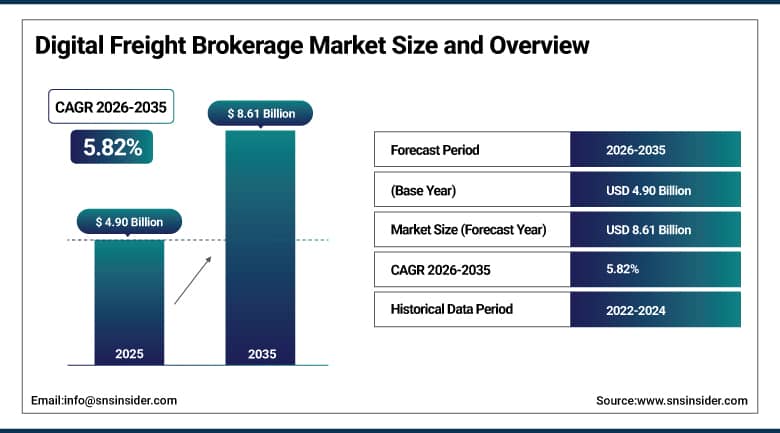
The Digital Freight Brokerage Market was valued at USD 4.90 Billion in 2025 and is expected to reach USD 8.61 Billion by 2035, growing at a CAGR of 5.82% from 2026–2035.
Some of the key factors that will drive the growth of the global digital freight brokerage market include the increasing adoption of digital logistics platforms, increasing demand for real-time visibility of freight, rise in the trend of e-commerce and cross-border business, and increasing need for efficient transportation management systems. Increasing adoption of artificial intelligence, machine learning, and data analytics in freight matching, routing optimization, predictive pricing, and shipment tracking will help boost the growth of the global digital freight brokerage market. The adoption of digital freight brokerage solutions by organizations will help cut down operational costs and improve carrier connectivity.
In November 2024, Uber Freight launched its Broker Access program, enabling freight brokers to efficiently book and manage loads through Uber Freight’s carrier platform while maintaining control of their brokerage operations. The program provides a self-service portal that helps automate freight booking processes, improve carrier connectivity, and enhance operational efficiency. The launch highlights the growing adoption of digital freight brokerage platforms focused on automation, real-time freight management, and improved supply chain visibility.
To Get More Information On Digital Freight Brokerage Market - Request Free Sample Report
Digital Freight Brokerage Market Trends:
-
Rising adoption of digital freight platforms, cloud-based logistics solutions, and automated freight management systems is driving demand for digital freight brokerage solutions across industries.
-
Increasing demand for real-time shipment tracking, freight visibility, automated carrier matching, and efficient transportation management is accelerating investments in digital freight brokerage technologies.
-
Digital freight brokerage solutions enable real-time freight matching, pricing optimization, route planning, shipment monitoring, and improved connectivity between shippers and carriers.
-
Advancements in artificial intelligence, machine learning, predictive analytics, and automation are fostering innovation in digital freight brokerage platforms.
-
Growing adoption across retail & e-commerce, manufacturing, automotive, healthcare & pharmaceuticals, and other industries is supporting sustained growth of the digital freight brokerage market.
U.S. Digital Freight Brokerage Market Outlook:
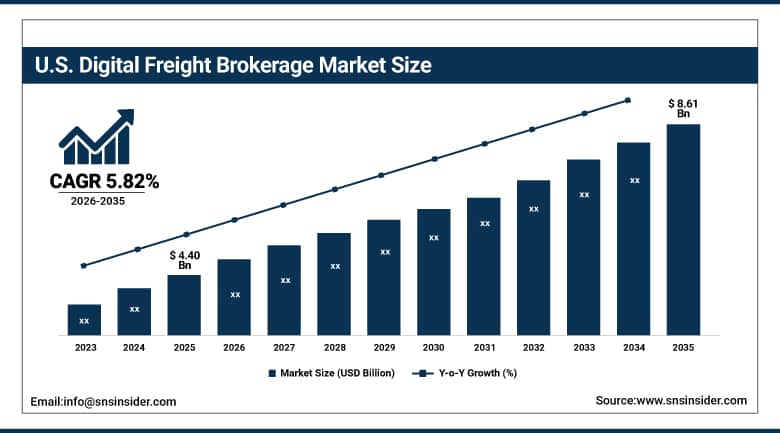
The U.S. Digital Freight Brokerage Market was valued at USD 4.40 Billion in 2025 and is expected to reach around USD 8.61 Billion by 2035, growing at a CAGR of 5.82% from 2026–2035.
The usage of digital freight brokerage software services has seen significant growth in the US due to the digitalization of logistics processes, increase in e-commerce, and the need for real-time visibility of freight. Increasing knowledge about inefficiency in supply chains, freight cost optimization, carrier capacity management, and the need for automated transportation systems has led companies to implement digital freight platforms. Some of the industries that have increased the implementation of digital freight brokerage software include the retail & e-commerce industry, manufacturing, automotive, healthcare & pharmaceuticals, and logistics industry.
In November 2024, Uber Freight launched its Broker Access program, enabling freight brokers to book and manage loads through Uber Freight’s carrier platform while maintaining control over their brokerage operations. The program introduced a self-service portal that helps automate freight booking, improve carrier connectivity, and streamline brokerage workflows. The launch highlights the growing adoption of digital freight brokerage platforms focused on automation, real-time freight matching, and enhanced supply chain efficiency.
Digital Freight Brokerage Market Segment Analysis:
-
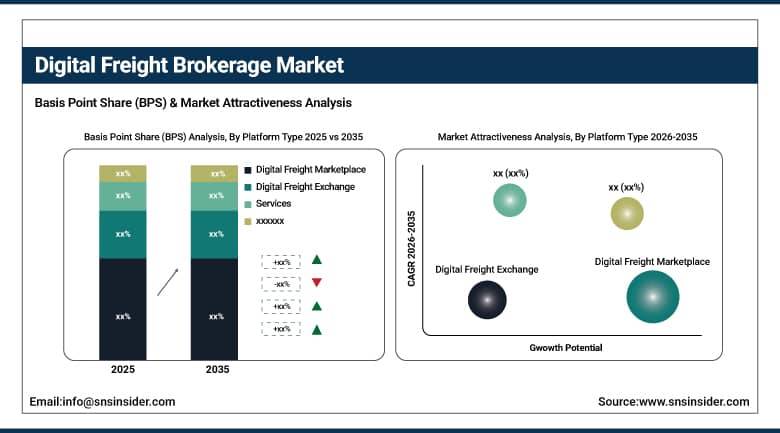
By platform type, digital freight marketplace dominated the digital freight brokerage market with a 34.50% share in 2025, while ai-based freight matching platform is projected to be the fastest-growing segment, registering a CAGR of 8.27% during 2026–2035.
-
By service type, full-truckload (FTL) brokerage dominated the digital freight brokerage market with a 42.80% share in 2025, while refrigerated freight brokerage is projected to be the fastest-growing segment, registering a CAGR of 9.08% during 2026–2035.
-
By transportation mode, road freight dominated the digital freight brokerage market with a 73.60% share in 2025, while air freight is projected to be the fastest-growing segment, registering a CAGR of 10.20% during 2026–2035.
-
By customer type, business-to-business (B2B) dominated the digital freight brokerage market with a 78.20% share in 2025, while business-to-consumer (B2C) is projected to be the fastest-growing segment, registering a CAGR of 21.80% during 2026–2035.
-
By end-use industry, retail & e-commerce dominated the digital freight brokerage market with a 28.60% share in 2025, while healthcare & pharmaceuticals is projected to be the fastest-growing segment, registering a CAGR of 9.69% during 2026–2035.
By platform type, digital freight marketplace dominated the digital freight brokerage market, while ai-based freight matching platform is expected to grow fastest.
The digital freight marketplace segment accounted for the largest share of the digital freight brokerage market in 2025 due to the increasing adoption of online platforms that connect shippers with carriers in real time. These platforms improve freight visibility, simplify booking processes, reduce transportation costs, and enhance carrier utilization through automated load management. Their ability to streamline logistics operations has made them the preferred choice across industries.
The ai-based freight matching platform segment is projected to register the highest CAGR during the forecast period, driven by the growing use of artificial intelligence for dynamic pricing, predictive demand forecasting, automated carrier selection, and route optimization. AI-powered platforms also help reduce empty miles and improve operational efficiency, making them increasingly attractive for modern freight management.
By transportation mode, road freight dominated the digital freight brokerage market, while air freight is expected to grow fastest.
Road freight held the largest market share in 2025 owing to its extensive transportation network, cost-effectiveness, and critical role in domestic freight movement, regional distribution, and last-mile delivery. The widespread availability of trucking fleets, flexible routing capabilities, and ability to serve a broad range of industries, including retail, manufacturing, consumer goods, agriculture, and construction, have reinforced its market leadership. Growing e-commerce activity, increasing demand for same-day and next-day deliveries, and rising adoption of digital freight brokerage platforms for real-time shipment tracking, automated load matching, route optimization, and carrier management have further accelerated the use of road freight services. Additionally, improvements in telematics, GPS tracking, AI-driven dispatching, and predictive analytics are enhancing fleet utilization and reducing transportation costs.
The air freight segment is expected to witness the fastest CAGR during the forecast period due to the rapid growth of cross-border e-commerce, increasing international trade, and rising demand for time-sensitive and high-value shipments. Industries such as healthcare, pharmaceuticals, electronics, automotive components, and perishables are increasingly relying on air freight for faster and more reliable transportation.
By end-use industry, retail & e-commerce dominated the digital freight brokerage market, while healthcare & pharmaceuticals is expected to grow fastest.
Retail & e-commerce emerged as the leading end-use industry in 2025 due to the rapid growth of online shopping, increasing shipment volumes, and rising demand for fast, reliable, and cost-efficient deliveries. Digital freight brokerage platforms help retailers optimize carrier selection, improve shipment visibility, automate load matching, and enhance supply chain efficiency. The continued expansion of omnichannel retailing and same-day delivery services has further strengthened the adoption of digital freight solutions across the sector.
The healthcare & pharmaceuticals segment is expected to register the highest CAGR during the forecast period, driven by the growing demand for secure, compliant, and temperature-controlled transportation of medicines, vaccines, biologics, and other sensitive healthcare products. The expansion of cold-chain logistics, stricter regulatory requirements, and increasing pharmaceutical trade are accelerating the adoption of digital freight brokerage platforms that provide real-time tracking, shipment monitoring, and improved logistics coordination.
Regional Insights
|
Region |
Major Country |
Share within Region, 2025(%) |
|---|---|---|
|
North America |
United States |
89.70% |
|
Europe |
Germany |
26.80% |
|
Asia Pacific |
China |
41.80% |
|
Middle East & Africa |
Saudi Arabia |
28.50% |
|
Latin America |
Brazil |
47.20% |
North America Digital Freight Brokerage Market insights
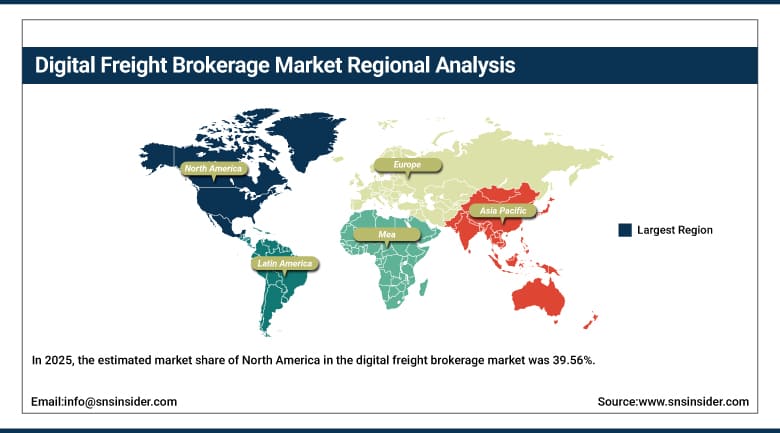
In 2025, the estimated market share of North America in the digital freight brokerage market was 39.56%. This dominance can be attributed to the advanced logistics infrastructure in the region, the adoption of digital freight technology, the presence of major freight brokerage firms, and the increasing investments in artificial intelligence and automation technologies. Firms in various industries such as retail and e-commerce, manufacturing, automotive and logistics are increasingly adopting digital freight brokerage technologies in order to gain better control over their freight and reduce costs. In 2025, the share of the United States in the digital freight brokerage market in North America was 89.70%.
Get Customized Report as Per Your Business Requirement - Enquiry Now
Europe Digital Freight Brokerage Market insights
The digital freight brokerage in Europe is seen as an attractive opportunity due to the rising digitalization of the supply chain, cross-border transactions, developed transport network, and the growing demand for digital freight brokerage solutions.
Germany is estimated to hold 24.60% share of the Europe digital freight brokerage market in 2025 due to its developed manufacturing industry, strong logistics infrastructure, and high freight volumes.
Asia Pacific Digital Freight Brokerage Market insights
The digital freight brokerage market in the Asia Pacific region is expected to show high growth during the forecast period due to the fast growth of e-commerce, rising trade activities, increasing digitization in logistics, and rising investments in smart transportation systems.
In 2025, the China digital freight brokerage market in the Asia Pacific region occupied a market share of 41.80% due to the country’s extensive freight transportation system, its manufacturing sector, the presence of a large number of e-commerce companies, and increased usage of logistics platforms that are AI-driven. The increased adoption of artificial intelligence, predictive analytics, automated freight matching, and digital supply chain management solutions is creating high demand for digital freight brokerage services.
Middle East & Africa and Latin America insights
Moderate growth in the Middle East & Africa digital freight brokerage market can be attributed to growing logistics modernization, increase in the number of e-commerce activities, developments in infrastructure, and increased adoption of digital supply chain solutions in various industries. Saudi Arabia accounted for the largest market share of 32.80% in 2025 due to major investments in the logistics infrastructure, transportation programs, and digitalization programs through the national economic strategies.
The digital freight brokerage market in Latin America is growing owing to rising logistics digitalization, e-commerce activities, and rising need for effective freight management solutions. In 2025, Brazil accounted for the largest market share of 47.20% owing to its huge transportation networks, rising trade activities, high demands from agriculture and industrial sectors for freight, and adoption of digital logistics solutions. Growing demand for real-time shipment tracking, automation of freight matching process, and cost-effective transportation solutions is likely to drive the market in the future.
Growth Driver: Rising adoption of digital logistics platforms and increasing demand for supply chain efficiency accelerating digital freight brokerage market growth
Rapid adoption of digital freight platforms, artificial intelligence (AI), automation, and real-time analytics are among the major driving factors of the global digital freight brokerage market. There is a growing trend of adoption of digital freight solutions in sectors such as retail & e-commerce, manufacturing, automotive, and logistics that helps optimize freight matching and route optimization to lower transportation cost and increase shipment visibility. Growth in e-commerce, increase in cross-border trading, demand for real-time tracking, adoption of AI for freight optimization, and carrier management are among the major trends set to boost the growth of the digital freight brokerage market in the coming years.
Restraints: Integration challenges and market fragmentation may restrain digital freight brokerage market growth
The intricacies involved in integrating the digital freight broker platform with the traditional transportation management systems, enterprise resource planning system, and logistics networks pose significant challenges in the digital freight brokerage industry. This could result in issues arising from data integration, adoption of the technology, security issues, and operational changes during the process. Further, low digital adoption rates by small logistics providers, demand volatility, regional differences in regulations, and security of data could be factors limiting market growth.
Opportunities: Growing adoption of AI-powered logistics and automated freight management creating new growth opportunities
The increasing use of artificial intelligence-driven freight matching, prediction, automatic pricing, and intelligent logistics management systems is driving tremendous growth potential for the digital freight brokerage industry. Businesses are deploying sophisticated digital tools to optimize transportation processes, increase visibility into the supply chain, and facilitate timely decision making. Furthermore, increasing investment in intelligent logistics infrastructure, development of e-commerce channels, increasing use of cloud-based transportation platforms, and increasing demand for sustainable freight solutions are some factors that will offer growth opportunities in the future.
Recent Developments:
-
2026: Uber Freight expanded its digital freight brokerage platform with enhanced AI-powered freight matching and logistics optimization capabilities, helping shippers and carriers improve load visibility, automate freight operations, and increase transportation efficiency.
-
2026: C.H. Robinson strengthened its digital freight platform by introducing advanced analytics, automation, and real-time shipment visibility features to improve freight management, pricing optimization, and supply chain efficiency.
-
2025: J.B. Hunt enhanced its digital logistics solutions with improved transportation management and freight visibility capabilities, enabling customers to optimize routing, track shipments, and improve operational performance.
-
2025: Loadsmart expanded its digital freight brokerage solutions with AI-driven automation, instant pricing, and real-time carrier matching capabilities, helping businesses streamline freight booking and improve logistics efficiency.
Digital Freight Brokerage Companies are:
-
Uber Freight
-
C.H. Robinson Worldwide, Inc.
-
J.B. Hunt Transport Services, Inc.
-
Coyote Logistics, LLC (RXO, Inc.)
-
Echo Global Logistics, Inc.
-
Transfix, Inc.
-
Loadsmart, Inc.
-
Full Truck Alliance Co., Ltd.
-
Cargomatic, Inc.
-
Total Quality Logistics, LLC
-
Schneider National, Inc.
-
Landstar System Holdings, Inc.
-
RXO, Inc.
-
WWEX Group
-
Flexport Inc.
-
Freight Technologies, Inc.
-
BNSF Logistics, LLC
-
DB Schenker (Schenker AG).
Digital Freight Brokerage Market Report Scope:
| Report Attributes | Details |
|---|---|
| Market Size in 2025 | USD 4.90 Billion |
| Market Size by 2035 | USD 8.61 Billion |
| CAGR | CAGR of 5.82% From 2026 to 2035 |
| Base Year | 2025 |
| Forecast Period | 2026-2035 |
| Historical Data | 2022-2024 |
| Report Scope & Coverage | Market Size, Segments Analysis, Competitive Landscape, Regional Analysis, DROC & SWOT Analysis, Forecast Outlook |
| Key Segments | • By Platform Type (Digital Freight Marketplace, Digital Freight Exchange, AI-Based Freight Matching Platform, Tender Platform, Others) • By Service Type (Full-Truckload (FTL) Brokerage, Less-than-Truckload (LTL) Brokerage, Intermodal Brokerage, Refrigerated Freight Brokerage, Others) • By Transportation Mode (Road Freight, Rail Freight, Air Freight, Ocean Freight, Others) • By Customer Type (Business-to-Business (B2B), Business-to-Consumer (B2C)) • By End-use Industry (Retail & E-commerce, Manufacturing, Automotive, Healthcare & Pharmaceuticals, Others) |
| Regional Analysis/Coverage | North America (US, Canada, Mexico), Europe (Eastern Europe [Poland, Romania, Hungary, Turkey, Rest of Eastern Europe] Western Europe] Germany, France, UK, Italy, Spain, Netherlands, Switzerland, Austria, Rest of Western Europe]), Asia Pacific (China, India, Japan, South Korea, Vietnam, Singapore, Australia, Rest of Asia Pacific), Middle East & Africa (Middle East [UAE, Egypt, Saudi Arabia, Qatar, Rest of Middle East], Africa [Nigeria, South Africa, Rest of Africa], Latin America (Brazil, Argentina, Colombia, Rest of Latin America) |
| Company Profiles | Uber Freight, C.H. Robinson Worldwide, Inc., J.B. Hunt Transport Services, Inc., Coyote Logistics, LLC (RXO, Inc.), Echo Global Logistics, Inc., Convoy, Inc., Transfix, Inc., Loadsmart, Inc., Full Truck Alliance Co., Ltd., Cargomatic, Inc., Total Quality Logistics, LLC, Schneider National, Inc., Landstar System Holdings, Inc., RXO, Inc., WWEX Group, Mode Global, Flexport Inc., Freight Technologies, Inc., BNSF Logistics, LLC, DB Schenker (Schenker AG) |
Frequently Asked Questions
The digital freight marketplace segment dominated the digital freight brokerage market in 2025 with a 34.50% share.
Increasing digital freight adoption, AI-powered matching, and e-commerce growth drive market expansion.
The digital freight brokerage market is expected to grow at a CAGR of 5.82% from 2026 to 2035.
The digital freight brokerage market was valued at USD 5.18 billion in 2025.
North America dominated the digital freight brokerage market in 2025 with a 40.56% share.
