
Document AI Market Report Scope & Overview:
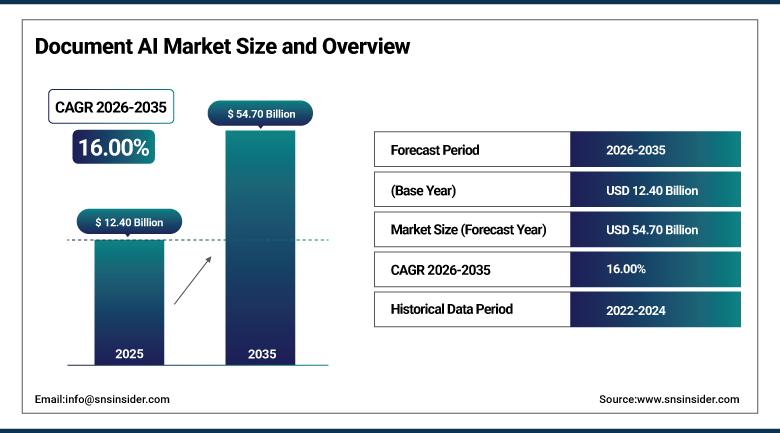
The Document AI Market was valued at USD 12.40 Billion in 2025 and is expected to reach USD 54.70 Billion by 2035, growing at a CAGR of 16.00% from 2026-2035.
The Document AI Market is expanding as enterprises use machine learning, optical character recognition, natural language processing and generative AI to extract, classify, summarize and generate information from invoices, contracts, forms, medical records and correspondence. Growth is driven by the volume of unstructured content, pressure to automate finance, compliance and customer service workflows, and the arrival of large language models that can read complex layouts and answer questions about documents. Vendors range from hyperscale cloud providers to automation specialists and start-ups. Published valuations differ because definitions vary, with 2025 estimates of roughly USD 14.7 billion for document AI broadly and USD 3.1 billion to USD 3.3 billion for narrower intelligent document processing.
⮞Agentic automation is moving into regulated document workflows. On February 6, 2026, UiPath announced the acquisition of WorkFusion, a provider of pre-built AI agents for financial crime compliance, with the transaction closing in UiPath's fiscal first quarter of 2027 and terms not disclosed. UiPath plans to combine the agents with its automation and orchestration platform so that banks can automate customer screening and investigation work that depends on reading and reconciling documents, routing cases that need judgment to human experts.
To Get more information Document AI Market - Request Free Sample Report
Document AI Market Trends
- Large language models and multimodal AI reading complex document layouts
- Retrieval-augmented generation connecting documents to enterprise knowledge bases
- Agentic workflows that act on extracted data in banking and insurance
- Cloud-based and API-first document processing services
- Domain-tuned models for finance, healthcare and legal documents
- Privacy-preserving approaches such as federated learning and on-premise deployment
U.S. Document AI Market Outlook
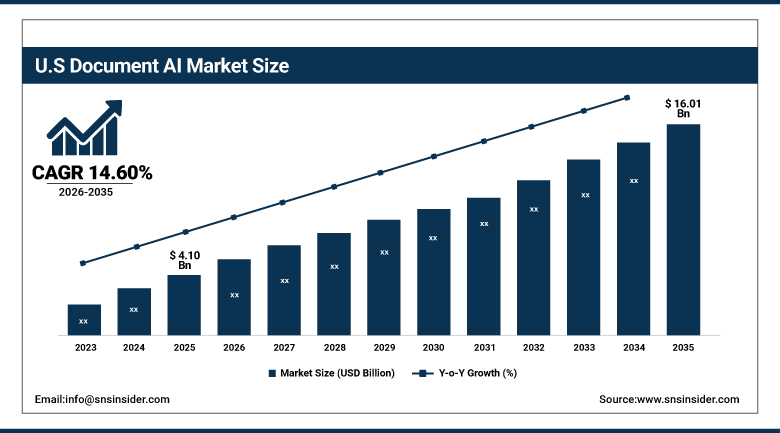
The U.S. Document AI Market was valued at USD 4.10 Billion in 2025 and is expected to reach USD 16.01 Billion by 2035, growing at a CAGR of 14.60% from 2026-2035.
The U.S. Document AI Market is the largest national market, supported by a concentration of cloud and software vendors, heavy enterprise spending on automation and regulatory requirements such as SOX, HIPAA and SEC reporting that create demand for accurate document handling. Banks, insurers, hospitals and government agencies process very large volumes of forms, claims and contracts, and they are adopting generative AI to summarize and search them. Procurement favors platforms that integrate with existing enterprise systems and meet strict security and compliance expectations.
⮞Established vendors are deepening ties with AI infrastructure providers. In March 2026, IBM expanded its collaboration with NVIDIA on intelligent document processing, combining IBM's document and enterprise software with NVIDIA's accelerated computing to process large, complex document sets faster. The expansion shows how U.S. technology companies are pairing proprietary document pipelines with specialized hardware to support multimodal models and meet enterprise latency and cost requirements.
Document AI Market Segment Analysis
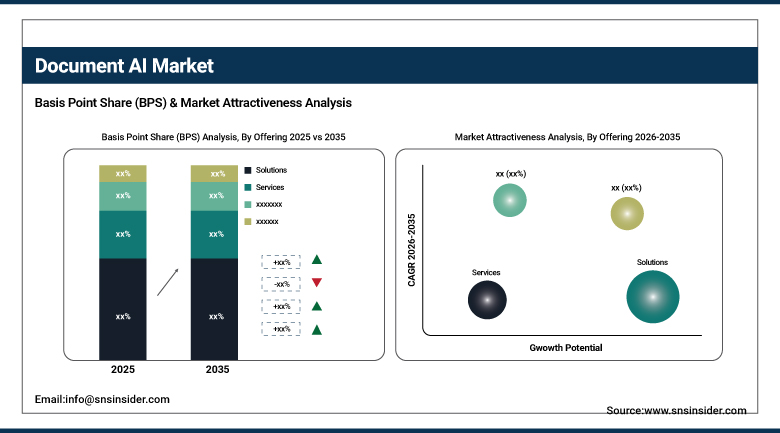
- By Offering, the Solutions segment dominated the Document AI Market with approximately 64.20% share in 2025, while the Services segment is the fastest growing with a CAGR of approximately 17.40%.
- By Document Type, the Unstructured Documents segment dominated the Document AI Market with approximately 56.30% share in 2025, while the Multimodal Documents segment is the fastest growing with a CAGR of approximately 18.20%.
- By Use Case, the Finance and Accounting segment dominated the Document AI Market with approximately 27.40% share in 2025, while the Marketing and Sales segment is the fastest growing with a CAGR of approximately 17.20%.
- By Vertical, the BFSI segment dominated the Document AI Market with approximately 29.35% share in 2025, while the Healthcare and Life Sciences segment is the fastest growing with a CAGR of approximately 18.10%.
- By Deployment, the Cloud-Based segment dominated the Document AI Market with approximately 66.40% share in 2025, while the Hybrid segment is the fastest growing with a CAGR of approximately 19.30%.
By Offering, Solutions Dominates the Document AI Market and Services Grows Fastest
Solutions continue to dominate in the Document AI Market, which is distinguished by enterprises adopting a solution that combines capturing, classifying, extracting, validating, and workflow management under one platform. The solutions that provide pre-trained models for document types, configurability of review interface, and integration with enterprise resource planning and customer relationship management systems are preferred by customers. These solutions gain strength due to ongoing enhancement of models by hyperscalers and domain experts, pay-per-use model that scales with volume, and increasing usage of generative capabilities like summarization and document creation.
Services are emerging as the fastest-growing offering, driven by the complexity of deploying document intelligence in regulated enterprises. Organizations need help with data preparation, model tuning on proprietary documents, integration with legacy systems, change management and ongoing monitoring of accuracy. System integrators, consultancies and vendor professional services teams are building practices around these needs, and managed services are attractive to companies lacking in-house data science teams. Rapid adoption of generative AI is also increasing demand for governance, evaluation and security advisory work.
⮞In May 2026, HCLTech launched its Autonomous Finance Platform using Google Cloud’s Gemini Enterprise to automate invoice-to-pay, order-to-cash, financial planning, and record-to-report workflows, highlighting demand for implementation and integration services around AI-enabled document processes.
By Document Type, Unstructured Documents Dominates the Document AI Market and Multimodal Documents Grows Fastest
Unstructured documents lead because most enterprise information sits in free-form contracts, emails, reports, correspondence and scanned images that conventional rules-based tools cannot interpret. Language models allow organizations to extract entities, obligations and sentiment from this content at scale, unlocking value that was previously accessible only through manual reading. Legal, insurance and financial services teams account for a large share of use, and the breadth of unstructured material gives vendors a sizable addressable base for classification and search applications. Legal and insurance teams remain the heaviest users of these capabilities.
Multimodal documents are growing fastest as models learn to interpret text, tables, charts, handwriting, stamps and images together within a single page. Real-world documents such as claims packets, engineering drawings and medical records mix these elements, and multimodal approaches improve accuracy and reduce the need for template-specific configuration. Vendors are releasing models that process layout and visual context natively, and enterprises are investing in pipelines that combine vision and language capabilities to automate more complex, previously manual document tasks. Accuracy on handwritten and stamped content continues to improve with each model generation.
⮞In September 2026, Google Cloud made its Document AI custom extractor foundation-model version powered by Gemini 3.1 Flash Lite available in preview, expanding options for extracting structured information from complex business documents.
By Use Case, Finance and Accounting Dominates the Document AI Market and Marketing and Sales Grows Fastest
Finance and accounting is the leading use case, reflecting the heavy document burden of invoice processing, accounts payable and receivable, expense management, reconciliation and financial close. The tasks involve high volumes, clear return on investment and well-defined fields, which suits automation. Companies reduce processing cost and cycle time while improving auditability, and many finance leaders adopt document AI as an early use of machine learning, which creates a large and stable base of enterprise deployments. Shared services centers further concentrate demand within large enterprises.
Marketing and sales is the fastest-growing use case, supported by AI-assisted proposal generation, contract management, personalization and content summarization. Sales teams use generative tools to draft responses to requests for proposals, extract terms from contracts and populate customer relationship systems from emails and meeting notes. Integration with customer relationship management platforms makes these capabilities easy to deploy, and measurable gains in response time and win rates are encouraging adoption in revenue organizations that were previously minor buyers of document technology.
⮞In March 2025, Google Cloud published a Gemini 2.0 document-extraction approach combining large language models with externalized business rules to convert complex PDFs into structured information and connect extracted results with downstream validation and workflow processes.
By Vertical, BFSI Dominates the Document AI Market and Healthcare and Life Sciences Grows Fastest
Banking, financial services and insurance dominate because the sector handles enormous volumes of applications, know-your-customer files, loan documents, claims and regulatory reports under strict compliance obligations. Document AI supports automated onboarding, underwriting, claims adjudication and reporting, reducing errors and processing time. Institutions have mature automation programs and budgets, and vendors tailor solutions for financial documents, which keeps the sector the largest source of demand and a primary target for new agentic offerings. Regulatory change management and anti-money-laundering reviews add further document workloads for these institutions, and the sector's tolerance for multi-year automation programs supports sustained spending.
Healthcare and life sciences is the fastest-growing vertical, driven by the need to extract information from clinical notes, referral letters, prior authorization requests, claims and regulatory submissions. Providers and payers face administrative burden and staffing shortages, while pharmaceutical firms must manage large volumes of trial and quality documentation. Advances in domain-tuned language models and privacy controls make it possible to process sensitive records safely, and interoperability mandates are increasing the volume of electronic documents that organizations need to interpret. Payers and providers are piloting ambient and documentation tools.
⮞In February 2026, India's Ministry of Health and Family Welfare launched the SAHI and BODH initiatives to strengthen responsible healthcare AI adoption, including evidence-based evaluation and benchmarking that can support the development of reliable AI systems handling clinical information.
By Deployment, Cloud-Based Dominates the Document AI Market and Hybrid Grows Fastest
Cloud-based deployment remains the dominant mode within the Document AI Market, characterized by easy access to the large language and vision models offered by hyperscale providers through application programming interfaces. Organizations value rapid implementation, elastic capacity for processing peaks, regular model updates and consumption-based pricing that avoids large capital outlays. This segment benefits from marketplaces where automation vendors and cloud providers distribute document processing tools, and from the growing library of pre-trained models for invoices, identity documents and contracts that can be deployed with limited configuration.
Hybrid deployment is emerging as the fastest-growing mode, driven by regulated enterprises that wish to use cloud intelligence while keeping sensitive records within their own environments. Banks, hospitals and government agencies often process confidential documents locally and send only extracted or anonymized data to the cloud, or they run smaller models on private infrastructure. Vendors are therefore offering containerized models, private cloud options and federated approaches, which address residency requirements and cybersecurity concerns while preserving access to advanced capabilities and vendor innovation.
⮞In April 2025, Google Cloud announced plans to bring Gemini models to Google Distributed Cloud, including connected and air-gapped environments, enabling organizations to analyze documents and extract information using AI capabilities within controlled infrastructure.
Regional Insights
|
Region |
Major Country |
Share within Region, 2025 (%) |
|---|---|---|
|
North America |
United States |
87.32 |
|
Asia Pacific |
China |
35.64 |
|
Europe |
Germany |
28.91 |
|
Middle East & Africa |
United Arab Emirates |
38.27 |
|
Latin America |
Brazil |
51.76 |
North America Document AI Market Insights
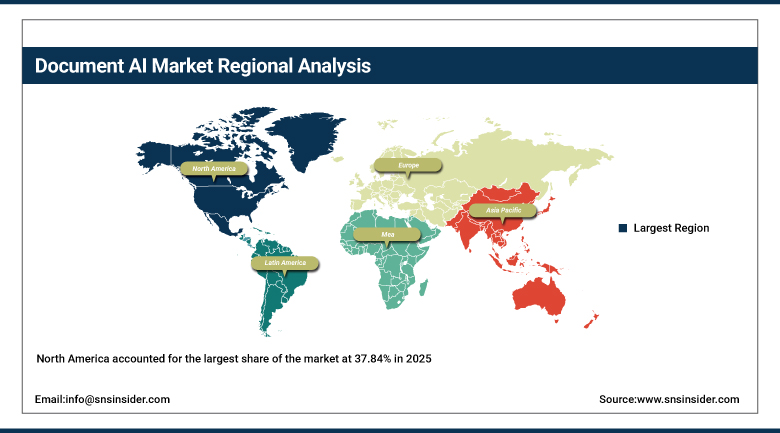
North America accounted for the largest share of the market at 37.84% in 2025, supported by the concentration of hyperscale cloud providers and enterprise software vendors, heavy investment in automation and regulatory mandates such as SOX, HIPAA and SEC reporting that make accurate document processing a compliance priority. The United States dominates regional revenue, and Canada adds adoption through banks and government, where privacy and data residency rules shape deployments. Federal and state agencies also procure document AI for benefits, tax and immigration processing.
Companies including Google, Microsoft, Amazon Web Services, IBM, UiPath, Automation Anywhere and Appian are headquartered in the region, and they continually launch generative AI capabilities for document workflows. Large enterprises are moving from pilots to production deployments, with attention on accuracy, security and governance. High implementation costs, scarcity of AI talent and concerns about data privacy and model reliability moderate the pace, but competition among vendors keeps innovation and adoption strong. Venture funding for specialist document AI start-ups remains concentrated in the region, which sustains a continuous stream of new entrants and acquisitions.
⮞In January 2026, Box launched Box Extract, an AI-powered capability combining large language models, optical character recognition, and agentic extraction to convert unstructured enterprise content into structured metadata for business applications and automated workflows.
Get Customized Report as per Your Business Requirement - Enquiry Now
Asia Pacific Document AI Market Insights
Asia Pacific is the fastest-growing region, advancing at a CAGR of 18.90% during 2026-2035. China, Japan, India, South Korea and Australia lead, supported by large banking, manufacturing and government sectors that process high document volumes. India's outsourcing and fintech industries are significant adopters, and Japanese companies such as Toshiba Tec are partnering with AI specialists to automate paper-heavy business processes. Singapore and Australia add demand through banking and government digital services programs.
The programs involving digitization, such as the national identification and taxation system, are producing vast amounts of documents that have to be read by machines, and multilingual needs lead to the creation of models in local languages and scripts. The regional start-ups and cloud providers develop models for particular domains, while international suppliers establish local data centers to comply with the residency laws. However, regulations that differ, diversity of document formats, and disparities in digital literacy across nations limit the adoption, but prospects for development are the best globally.
⮞In September 2026, India's Digital India BHASHINI Division and the Comptroller and Auditor General launched CAG-BHASHINI Anuvaad, an AI-powered translation solution for official documents and audit reports, advancing multilingual document processing in public administration.
Europe Document AI Market Insights
Europe held significant share of the market in 2025 and is projected to grow at a steady rate through 2035. Germany leads, followed by the United Kingdom, France, the Netherlands and Italy, with strong demand from banking, insurance, manufacturing and public administration. European vendors such as SAP, ABBYY's European operations, LightOn and Docbyte compete with the large US platforms, and Belgian start-ups such as Metamaze have attracted acquirers focused on banking and insurance. Nordic countries and Switzerland add early adoption in banking, insurance and public services.
Regulation shapes purchasing decisions, including the General Data Protection Regulation and the EU Artificial Intelligence Act, which require transparency, data protection and risk management for AI systems. Buyers therefore favor vendors that offer regional hosting, explainable outputs and on-premise options. Multilingual operations across many countries increase the value of models that handle several languages, while stringent compliance requirements lengthen sales cycles but also create steady demand for governance-focused document solutions. Public funding for sovereign AI capabilities is also encouraging regional model providers and local hosting.
⮞In May 2026, Deutsche Telekom and SAP secured first place in Germany's federal procurement process for a sovereign AI platform, with planned applications including intelligent document processing, knowledge management, text summarization, and faster administrative procedures.
MEA & Latin America Document AI Market Insights
The Middle East and Africa is projected to experience robust growth during the forecast period. The United Arab Emirates and Saudi Arabia lead through national digital government strategies, banking digitization and investment in AI infrastructure, while South Africa adds demand through financial services. Arabic-language document processing is an emerging requirement that vendors are beginning to address with tailored models. Government digital transformation programs in the Gulf, including e-government and smart city initiatives, create large volumes of citizen documents that require automated processing and verification.
Latin America held significant share of the market in 2025. Brazil leads with its large banking and fintech sector and heavy use of electronic invoicing, while Mexico, Colombia, Chile and Argentina add adoption in finance and government. Spanish and Portuguese models are available from global vendors, but budget limits, legacy systems and a shortage of skilled personnel restrain the pace of enterprise deployments in the region. Central bank regulation of digital banking in several countries is encouraging banks to adopt automated onboarding and document verification tools.
⮞In July 2026, Abu Dhabi Government expanded Microsoft 365 Copilot deployment to 35,000 licenses across its public sector, supporting AI-assisted work, document processing, and administrative workflows while maintaining UAE-based data processing through advanced data residency controls.
Growth Drivers: Document Volume Growth and Generative AI Capabilities
The growth in document volume is a primary driver of demand. Enterprises produce and receive large quantities of invoices, contracts, claims, forms and correspondence, and manual handling is slow, costly and error-prone. Regulatory requirements for accurate records and audit trails add pressure, while labor shortages in back-office functions encourage automation. Document AI offers measurable savings in processing time and cost, making it a practical early investment for finance, insurance and public sector organizations.
Generative AI capabilities strengthen this demand. Large language models can read complex layouts, answer questions about documents, summarize long contracts and generate drafts, extending document AI beyond extraction into knowledge work. Retrieval-augmented generation connects models to enterprise repositories, improving accuracy, and agentic frameworks allow systems to act on extracted data. Cloud APIs reduce the effort needed to deploy these features, enabling smaller firms to adopt capabilities that were formerly accessible mainly to large enterprises.
⮞In June 2025, Box introduced its Enhanced Extract Agent, using advanced AI reasoning to extract more than 20 metadata fields from complex documents exceeding 50 pages, extending automated document understanding to content that can challenge conventional extraction systems.
Restraints: Accuracy, Data Privacy and Integration Complexity
Accuracy and reliability issues limit adoption. Language-based solutions may output inaccurate or made-up responses, and such an approach cannot be tolerated in the legal, finance, and health care fields, where organizations will need additional human oversight and validation that will diminish some of the gains from automation. In addition, scanning quality, handwriting, and document formatting issues impact data extraction, as does determining accuracy on a varied set of documents.
Data privacy and integration complexity create further barriers. Documents often contain personal, financial or health information subject to strict regulation, and sending them to external models raises security and residency concerns. Integrating document AI with legacy enterprise systems, workflows and approval processes requires significant effort, and organizations may lack skills to tune models and manage change. Costs of high-volume model inference can also limit the economics of some use cases.
Opportunities: Agentic Automation, Domain-Specific Models and Emerging Markets
Agentic automation provides a significant opportunity, as vendors combine document understanding with agents that perform multistep tasks such as onboarding customers, resolving claims or screening transactions. Acquisitions like UiPath's purchase of WorkFusion indicate strategic interest in bundling document intelligence with domain-specific agents. Suppliers that deliver measurable reductions in handling time and error rates can expand from document capture into end-to-end process ownership, raising revenue per customer.
Domain-specific models and emerging markets offer additional opportunity. Models tuned for finance, healthcare, insurance or legal text deliver higher accuracy than general-purpose systems and can be sold at premium prices. Growth in Asia Pacific, the Middle East and Latin America, where digitization programs are generating new document flows, creates demand for multilingual solutions. Privacy-preserving techniques such as federated learning and on-premise deployments can unlock regulated customers that currently hesitate to use cloud-based models.
⮞In September 2025, Box announced Box Extract and Box Automate, introducing AI-powered data extraction and agentic workflow automation designed to transform enterprise content into actionable information and coordinate document-driven business processes across applications and teams.
Recent Developments:
-
2026: Toshiba Tec partnered with AIDA on AI-powered document and process automation. The partnership targets paper-heavy business processes for enterprise customers.
-
2026: Automation Anywhere announced platform enhancements for agentic process automation, including context intelligence and workflow orchestration capabilities that connect enterprise documents, systems, and AI-driven business processes.
-
2026: OpenText expanded Core Content Management with Content Aviator AI features, including natural-language search and AI-assisted metadata extraction, strengthening document discovery and content management workflows.
Document AI Market Key Players are:
-
Google LLC
-
Microsoft Corporation
-
Amazon Web Services, Inc.
-
International Business Machines Corporation
-
UiPath, Inc.
-
Open Text Corporation
-
Hyland Software, Inc.
-
Tungsten Automation Corporation
-
Automation Anywhere, Inc.
-
Appian Corporation
-
SAP SE
-
Oracle Corporation
-
Rossum Ltd.
-
Parascript
-
Mindee
-
Docbyte
-
Mphasis Limited
-
Datamatics Global Services Limited
Document AI Market Report Scope :
| Report Attributes | Details |
|---|---|
| Market Size in 2025 | USD 12.40 Billion |
| Market Size by 2035 | USD 54.70 Billion |
| CAGR | CAGR of 16.00% From 2026 to 2035 |
| Base Year | 2025 |
| Forecast Period | 2026-2035 |
| Historical Data | 2022-2024 |
| Report Scope & Coverage | Market Size, Segments Analysis, Competitive Landscape, Regional Analysis, DROC & SWOT Analysis, Forecast Outlook |
| Key Segments | • By Offering (Solutions, Services) • By Document Type (Unstructured Documents, Semi-Structured Documents, Structured Documents, Multimodal Documents) • By Use Case (Finance and Accounting, Marketing and Sales, Legal and Compliance, Customer Service, Others) • By Vertical (BFSI, Healthcare and Life Sciences, Government, Retail, Manufacturing, Others) • By Deployment (Cloud-Based, On-Premise, Hybrid) |
| Regional Analysis/Coverage | North America (US, Canada), Europe (Germany, UK, France, Italy, Spain, Russia, Poland, Rest of Europe), Asia Pacific (China, India, Japan, South Korea, Australia, ASEAN Countries, Rest of Asia Pacific), Middle East & Africa (UAE, Saudi Arabia, Qatar, South Africa, Rest of Middle East & Africa), Latin America (Brazil, Argentina, Mexico, Colombia, Rest of Latin America). |
| Company Profiles | Google LLC, Microsoft Corporation, Amazon Web Services, Inc., International Business Machines Corporation, ABBYY Software Ltd., UiPath, Inc., Open Text Corporation, Hyland Software, Inc., Tungsten Automation Corporation, Automation Anywhere, Inc., Appian Corporation, SAP SE, Oracle Corporation, Adobe Inc., Rossum Ltd., Parascript, Mindee, Docbyte, Mphasis Limited, Datamatics Global Services Limited |

Frequently Asked Questions
Key players include Google, Microsoft, Amazon Web Services, IBM, ABBYY, UiPath, OpenText, Hyland, Tungsten Automation, Automation Anywhere, Appian, SAP, Oracle and Adobe.
Key opportunities include agentic automation, domain-specific models for finance and healthcare, privacy-preserving deployments and growth in Asia Pacific, the Middle East and Latin America.
The major growth factor is the rapid growth in document volumes combined with the capabilities of large language models, which automate extraction, summarization and generation in finance, compliance and customer service.
By Offering, the Solutions segment dominated the market with approximately 64.20% share in 2025, supported by enterprise demand for integrated capture, extraction and workflow platforms.
North America dominated the market with a share of 37.84% in 2025, supported by leading cloud and software vendors, strong enterprise automation spending and regulatory compliance requirements.
