
Enterprise Flash Storage Market Report Scope & Overview:
The Enterprise Flash Storage market is witnessing continuous growth owing to the increase in the number of cases associated with data centers handling huge amounts of data around the globe. Moreover, the growth can be attributed to the rising adoption of cloud services coupled with the advancements made in NVMe-based storage with improved performance and lower latency. The enterprise flash storage systems are high-performance storage devices used in data centers to handle massive data volumes. The storage obtained supports AI applications and performance-critical workloads without the use of traditional hard drives that can hinder the process.
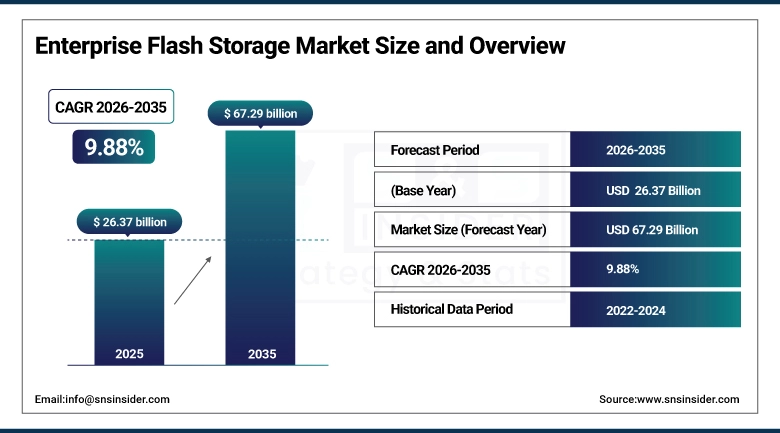
The Enterprise Flash Storage Market was valued at USD 26.37 Billion in 2025 and is expected to reach USD 67.29 Billion by 2035, growing at a CAGR of 9.88% from 2026 to 2035.
To Get more information on Enterprise Flash Storage Market - Request Free Sample Report
Enterprise Flash Storage Market Trends:
-
Companies are switching from hybrid to all-flash systems and care more about speed.
-
More companies use cloud storage instead of storing everything in their own offices.
-
NVMe protocol is becoming popular in regular business storage, not just special systems.
-
Software-based storage is getting attention from companies wanting flexibility and fewer vendor ties.
-
AI programs need very fast storage, creating new demand beyond traditional database uses.
Key Market Highlights
|
Market Parameter |
Market Highlight / Data |
Key Growth Driver |
|---|---|---|
|
Largest Storage Technology |
All-Flash Arrays – 46.52% share in 2025 |
Lowest wait times and best speed for performance-critical workloads. |
|
Fastest-Growing Storage Technology |
NVMe-Based Storage – 10.99% CAGR |
More servers include NVMe and companies replace old equipment. |
|
Largest Application |
Performance-Critical Applications – 35.28% share in 2025 |
Transaction systems and analytics need fast storage for operations. |
|
Fastest-Growing Application |
Cloud Infrastructure – 11.12% CAGR |
Cloud companies add more storage constantly for expanding services. |
|
Largest End-User Industry |
Information Technology – 31.28% share in 2025 |
Tech companies spend the most on storage infrastructure and services. |
|
Fastest-Growing End-User Industry |
Healthcare – 11.10% CAGR |
Hospitals use it for images and patient files management. |
|
Largest Organization Size |
Large Enterprises – 70.16% share in 2025 |
Big companies spend big money on many storage systems. |
|
Fastest-Growing Organization Size |
SMEs – 11.07% CAGR |
Small companies grow faster because cloud helps them afford it. |
|
Largest Region |
North America – 42.36% share in 2025 |
American companies spend lots upgrading data centers and cloud systems. |
|
Fastest-Growing Region |
Asia Pacific – 11.20% CAGR |
China leads with huge data centers and cloud providers expand. |
U.S. Enterprise Flash Storage Market Size Outlook
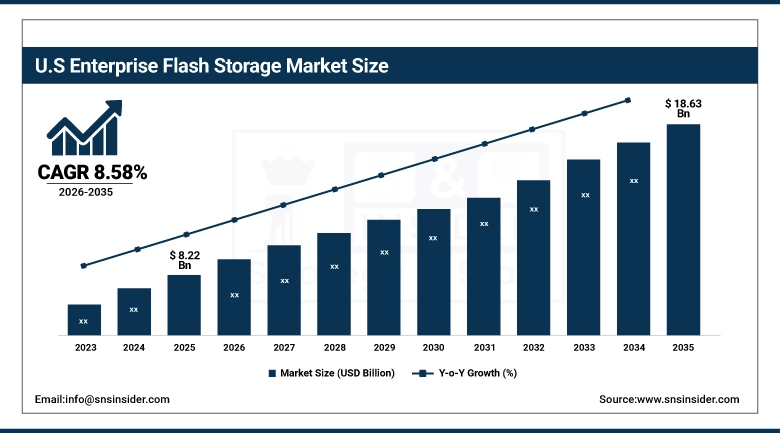
The U.S. market was worth USD 8.22 Billion in 2025. It should reach USD 18.63 Billion by 2035. Growth rate is 8.58% yearly. American companies spend a lot on upgrading their data centers. Banks use flash storage to process transactions fast. Tech companies build cloud services using flash storage. Federal agencies need fast storage for important systems. Competition between vendors keeps prices fair. Cloud companies are expanding their storage nationwide. American companies like new technology, so they buy new equipment often.
Enterprise Flash Storage Market Growth Drivers:
-
Cloud Computing Adoption, Data Volume Growth, and AI Workload Deployment Are Generating Sustained Demand for High-Performance Flash Storage Systems
Cloud services need reliable storage that can grow. Big cloud providers use flash everywhere. Data centers handle massive amounts of data now. Machine learning needs consistent speed. Companies transforming digitally need new storage. Budgets support buying infrastructure. Cloud systems need isolated, reliable storage. Laws and regulations push companies to upgrade storage.
Enterprise Flash Storage Market Restraints:
-
Vendor Concentration, High Capital Equipment Costs, and Complex Integration Requirements Present Challenges to Market Expansion
Flash storage costs a lot of money upfront. Small companies can't always afford it. Many different vendors make setup complicated. Moving from old systems is hard and takes time. Using products from different makers creates problems. Supply chains sometimes have issues. Testing performance takes skill and knowledge. Old systems don't work well with new storage.
Enterprise Flash Storage Market Opportunities:
-
Artificial Intelligence Integration, Edge Computing Expansion, and Emerging Market Development Are Creating Growth Pathways for Storage Suppliers
Storage at the edge of networks is becoming common. AI training needs very fast storage. Developing countries are starting to buy more tech. Mid-sized companies want storage like big companies have. Cloud providers work with storage makers. Storage services attract customers. Companies prefer efficient technology. New storage designed for AI creates advantages.
Enterprise Flash Storage Market Segment Analysis:
By Storage Technology: All-Flash Arrays Lead While NVMe-Based Storage Drives Fastest Growth Through 2035
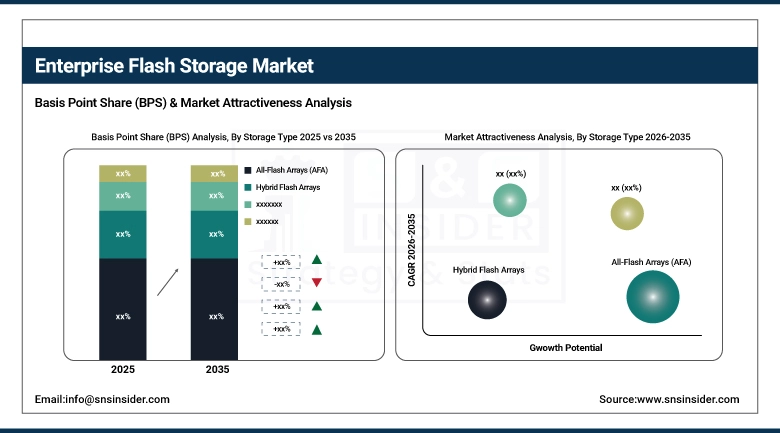
All-flash arrays had 46.52% of the market in 2025. That equals USD 12.27 Billion. NVMe storage is growing fastest at 10.99% yearly. Companies choose all-flash because they want the fastest performance. All-flash gives the lowest wait times and best speed. NVMe is growing because more servers have it. New computers already include NVMe. Companies replace old equipment because NVMe is better. Hybrid storage stays popular with cost-conscious companies. Software-based storage appeals to those wanting freedom from vendors.
By Application: Performance-Critical Applications Lead While Cloud Infrastructure Drives Fastest Growth Through 2035
Critical apps held 35.28% in 2025 worth USD 9.31 Billion. Cloud infrastructure grows fastest at 11.12% yearly. Transaction systems and analytics need fast storage. All-flash is the only choice for these. Cloud companies add more storage constantly. Regular computing stays steady. Data analysis grows because companies want insights.
By End-User Industry: Information Technology Leads While Healthcare Drives Fastest Growth Through 2035
Tech and telecom companies led with 31.28%, USD 8.25 Billion in 2025. Healthcare grows fastest at 11.10% yearly. Tech companies spend the most on storage. Banks need fast storage for rules and transactions. Hospitals use it for images and patient files. Government needs secure, fast storage. Stores buy storage for online shopping. Factories use storage for factory technology.
By Organization Size: Large Enterprises Lead While SMEs Drive Fastest Growth Through 2035
Big companies held 70.16% in 2025, USD 18.50 Billion. Small companies grow fastest at 11.07% yearly. Big companies spend big money on many storage systems. Small companies grow faster because cloud helps them afford it. Medium companies want storage like big companies. Vendors sell subscriptions to smaller companies now.
Enterprise Flash Storage Market Report Analysis
North America Enterprise Flash Storage Market Insights
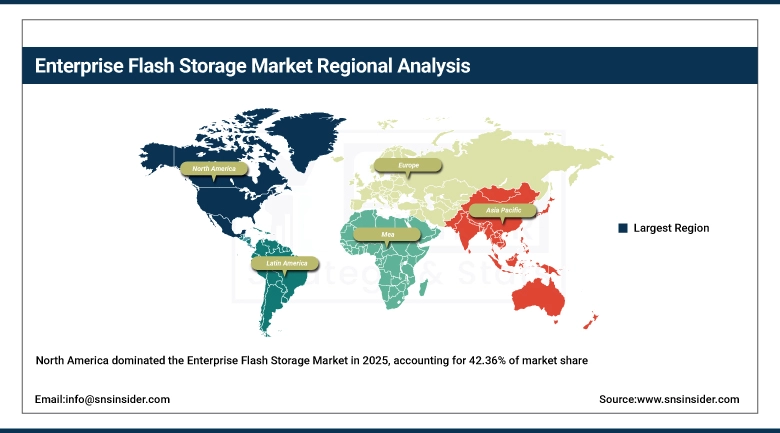
North America controlled 42.36% of the market in 2025. The United States had 73.58% of the region. American companies spend lots upgrading data centers. Big banks use flash storage. Tech firms build cloud systems on flash. Federal government buys storage. Many vendors compete, keeping prices reasonable. Cloud companies expand storage across the country. Americans adopt new technology. Advanced makers support innovation. This region leads and will keep growing.
Get Customized Report as per Your Business Requirement - Enquiry Now
Europe Enterprise Flash Storage Market Insights
Europe had 22.17% of global market in 2025. Germany leads Europe through factory investments. UK banks buy storage. France is tech leader. Italy modernizes factories. Spain and Poland buy more. Laws like GDPR push upgrades. Companies trust vendors that support them long-term. Green technology matters to them. Growth is steady but slower than Asia.
Asia Pacific Enterprise Flash Storage Market Insights
Asia Pacific had 25.89% in 2025. It grows fastest at 11.20% yearly. China leads with huge data centers. Chinese tech firms deploy massive storage. India is big opportunity with IT services growing. Japan keeps high standards. South Korea innovates. Australia buys steadily. Southeast Asia invests. Cloud providers expand. Growth outpaces global average.
Latin America Enterprise Flash Storage Market Insights
Latin America had 5.74% in 2025. Brazil is the region's largest market. Mexico modernizes factories. Argentina adopts selectively. Colombia pursues digital change slowly. Local cloud companies expand. Economic growth brings gradual adoption. International vendors dominate. Growth is steady but slower than developed regions.
Middle East & Africa Enterprise Flash Storage Market Insights
Middle East and Africa had 3.84% in 2025. UAE leads through Dubai tech growth. Saudi Arabia builds data centers for Vision 2030. South Africa adopts most. Finance sector buys storage. Tech talent attracts companies. Government projects support sector. Growth is moderate. Major cities have vendor support.
Competitive Landscape for Enterprise Flash Storage Market:
Dell Technologies delivers enterprise flash storage through its PowerStore and PowerMax all-flash arrays, serving mission-critical workloads across data centers and hybrid cloud environments. Its strength lies in integrated hardware-software ecosystems, automation, and multicloud data services, enabling scalable performance and reliability for large enterprises.
In October 2024, Dell Technologies introduced enhanced NVMe/TCP support in PowerStore, improving workload flexibility and reducing latency for enterprise hybrid cloud deployments
NetApp specializes in data-centric enterprise flash storage with its AFF (All-Flash FAS) and ONTAP software, enabling unified data management across on-premises and cloud environments. The company focuses on simplicity, automation, and strong cloud integration with hyperscalers, positioning itself as a leader in hybrid multicloud storage solutions.
In November 2024, NetApp launched new AFF A-series systems with improved NVMe performance and integrated ransomware protection, targeting high-performance enterprise workloads.
Enterprise Flash Storage Market Key Players:
-
Dell Technologies
-
NetApp
-
Pure Storage
-
IBM
-
Hewlett Packard Enterprise (HPE)
-
Hitachi Vantara
-
Huawei Technologies
-
Western Digital
-
Samsung Electronics
-
Intel
-
Micron Technology
-
SanDisk
-
Oracle
-
Kaminario
-
Nimbus Data Systems
-
Tegile Systems
-
Violin Memory
-
LSI Corporation
-
Skyera
-
Toshiba
| Report Attributes | Details |
|---|---|
| Market Size in 2025 | USD 26.37 Billion |
| Market Size by 2035 | USD 67.29 Billion |
| CAGR | CAGR of 9.88% From 2026 to 2035 |
| Base Year | 2025 |
| Forecast Period | 2026-2035 |
| Historical Data | 2022-2024 |
| Report Scope & Coverage | Market Size, Segments Analysis, Competitive Landscape, Regional Analysis, DROC & SWOT Analysis, Forecast Outlook |
| Key Segments | • By Storage Type (All-Flash Arrays (AFA), Hybrid Flash Arrays, NVMe-Based Storage, and Software-Defined Flash Storage) • By End-User/Industry (IT & Telecom, Banking Financial Services & Insurance (BFSI), Healthcare, Government & Defense, Retail & e-Commerce, and Manufacturing & Automotive) • By Deployment Mode (On-Premises, Cloud/Hosted (Public, Private, Hybrid), and Managed Services) • By Organization Size (Small & Medium Enterprises (SMEs) and Large Enterprises) |
| Regional Analysis/Coverage | North America (US, Canada), Europe (Germany, UK, France, Italy, Spain, Russia, Poland, Rest of Europe), Asia Pacific (China, India, Japan, South Korea, Australia, ASEAN Countries, Rest of Asia Pacific), Middle East & Africa (UAE, Saudi Arabia, Qatar, South Africa, Rest of Middle East & Africa), Latin America (Brazil, Argentina, Mexico, Colombia, Rest of Latin America). |
| Company Profiles | Dell Technologies, NetApp, Pure Storage, IBM, Hewlett Packard Enterprise (HPE), Hitachi Vantara, Huawei Technologies, Western Digital, Samsung Electronics, Intel, Micron Technology, SanDisk, Oracle, Kaminario, Nimbus Data Systems, Tegile Systems, Violin Memory, LSI Corporation, Skyera, Toshiba. |
Frequently Asked Questions
North America dominated the Enterprise Flash Storage Market in 2025
All-Flash Arrays dominated the Enterprise Flash Storage Market capturing 46.52% market share in 2025
Cloud computing adoption, exponential data volume growth, artificial intelligence workload deployment, and digital transformation initiatives drive expansion in the Enterprise Flash Storage Market.
The Enterprise Flash Storage Market size was USD 26.37 Billion in 2025 and is expected to reach USD 67.29 Billion by 2035.
The Enterprise Flash Storage Market is expected to grow at a CAGR of 9.88% from 2026-2035.
