
Data Capture Hardware Retail Market Report Scope & Overview:
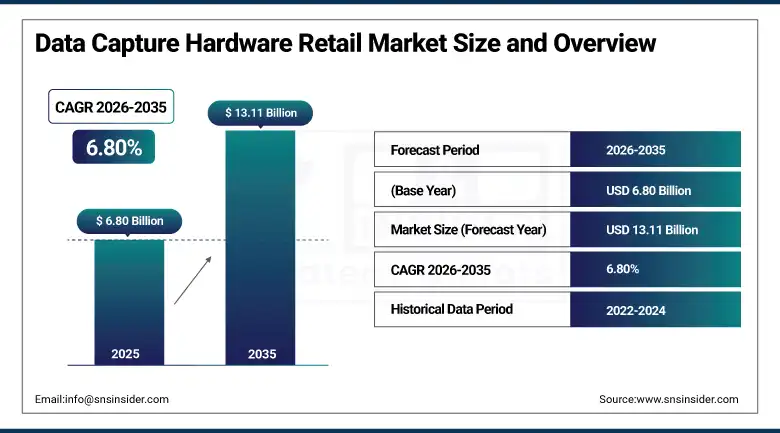
The Data Capture Hardware Retail Market was valued at USD 6.80 Billion in 2025 and is projected to reach USD 13.11 Billion by 2035, expanding at a CAGR of 6.80% during the forecast period 2026–2035.
The data capture hardware retail market is witnessing a high growth due to increasing adoption of smart retail infrastructure such as AI-enabled checkout ecosystems and real-time inventory visibility technologies across organized retail chains globally. Retailers are quickly deploying RFID-enabled scanners, wireless computing devices, self-checkout kiosks and cloud-connected POS terminals to improve workforce productivity, cut operational losses and make customer transactions more efficient. The growing investment in the automation of omnichannel retail and store management systems has only been driving the adoption of intelligent retail data collection devices even faster.
In 2026, several vendors of retail technology have ramped up efforts in deploying AI-driven automated checkout technologies that were integrated with RFID analytics and retail monitoring software.
To Get more information On Data Capture Hardware Retail Market - Request Free Sample Report
Data Capture Hardware Retail Market Trends
-
Rising deployment of AI-enabled self-checkout and automated billing systems.
-
Expansion of RFID-integrated retail inventory monitoring infrastructure.
-
Increasing adoption of cloud-based retail asset visibility platforms.
-
Growth in smart retail analytics integrated with real-time consumer tracking.
-
Rising investments in contactless NFC-enabled retail transaction systems.
U.S. Data Capture Hardware Retail Market Size Outlook
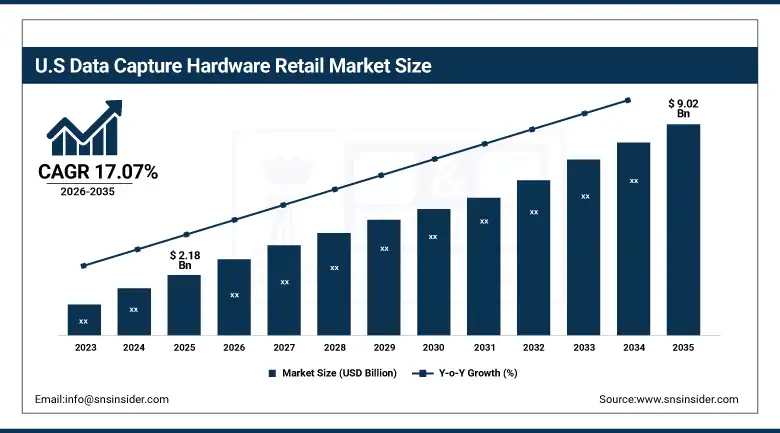
The U.S. Data Capture Hardware Retail Market was valued at USD 2.18 billion in 2025 and is expected to reach approximately USD 9.02 billion by 2035, expanding at a CAGR of 17.07% during 2026–2035.
The USA is considered the largest market for data capture equipment used in retail stores due to high levels of automation and adoption of smart retail practices, as well as cloud-based inventory management solutions in retail stores. Large-scale retailers tend to adopt RFID-equipped tracking systems along with artificial intelligence-powered point-of-sale terminals and mobile computers in order to maximize their effectiveness. The continuous investments in contactless retail operations and advanced digitization contribute to market expansion in this region.
In 2025, several U.S.-based retail technology vendors launched AI-enabled POS terminals and RFID-enabled intelligent inventory management systems for large-format retail and omnichannel commerce use cases.
Data Capture Hardware Retail Market Segment Analysis
-
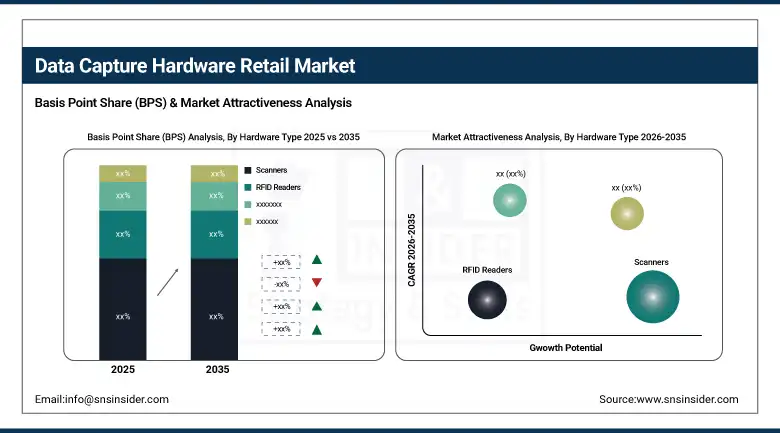
By Hardware Type, the scanners segment dominated the market with 30.00% share in 2025, while the RFID readers segment is projected to register the fastest CAGR of 9.41% during the forecast period.
-
By Data Capture Method, the barcode segment dominated the market with 38.00% share in 2025, while the RFID segment is projected to witness the fastest growth during the forecast period.
-
By Form Factor, the fixed segment dominated the market with 48.00% share in 2025, while the wearable segment is projected to witness the fastest growth during the forecast period.
-
By Application, the inventory management segment dominated the market with 32.02% share in 2025, while the asset tracking segment is projected to register the fastest CAGR of 7.74% during the forecast period.
By Hardware Type, scanners segment dominated, while RFID readers segment is fastest-growing.
The Scanners segment dominated the market with a market share of 30.00% and generated revenue of approximately USD 2.04 billion in 2025 due to its widespread deployment across supermarkets, convenience stores, warehouses, and retail checkout counters. Retail operators still use barcode scanning systems that enhance billing accuracy, reduce transaction time and support omnichannel inventory synchronization. The rising investments in organized retail spaces are also fueling the adoption of AI-enabled image recognition and cloud-connected scanning technologies.
The RFID readers segment is expected to grow at the highest CAGR of 9.41% during the forecast period, driven by the increasing adoption of real-time inventory visibility and smart shelf monitoring systems. In 2026, only a handful of retail automation companies released AI-enabled RFID readers with predictive inventory analytics and cloud-based retail management platforms for enterprise retail applications.
By Data Capture Method, barcode segment dominated, while RFID segment is fastest-growing.
The Barcode segment contributed nearly USD 2.58 billion in 2025 and held 38.00% market share due to its cost-effectiveness, high operational reliability, and widespread application in retail billing, inventory management, and warehouse operations. The commercial landscape remains dominated by barcode-based data capture technologies, because of the ease of deployment and their compatibility with the existing retail infrastructure.
The RFID segment is expected to register the highest CAGR of 9.18% during the forecast period due to increasing retailers’ focus on automated inventory tracking, theft prevention, and real-time product traceability across omnichannel retail networks. In 2025-2026, several retail chains increased the deployment of RFID-enabled inventory intelligence systems integrated with AI-supported retail forecasting platforms to improve stock optimization and reduce operational shrinkage.
By Form Factor, fixed segment dominated, while wearable segment is fastest-growing.
Fixed occupied USD 3.26 billion in 2025, accounting for the maximum market share of 48.00%, primarily because of wide use of fixed scanners, POS terminals, and self-service checkout counters at big retail stores and hypermarkets. The use of fixed retail data capture technology will still continue to handle high volume retail transactions and central operations management.
The Wearable market is anticipated to register the highest CAGR of 10.05% during the forecast period, attributed to rising demand for wearable scanners and hands-free retail productivity solutions. In 2026, various vendors of retail automation solution offered wearable scanners along with AI-based workforce analytics and cloud based retail inventory systems.
By Application, inventory management segment dominated, while asset tracking segment is fastest-growing.
The Inventory Management market segment generated revenues worth USD 2.18 billion in 2025 accounting for 32.02% of the market revenues due to rising investments made by retailers in stock visibility technology, automated warehouse management systems, and AI-based supply chain synchronization tools. Retailers are increasingly implementing mobile computing devices, RFID readers, and cloud-based scanning solutions in order to minimize errors in their inventories and streamline the process of inventory turnover optimization.
The Asset Tracking market segment is expected to experience the fastest CAGR growth of 7.74% through the forecast period. In 2025, some of the major retail technology vendors offered cloud-based asset tracking platforms for retail assets enabling predictive analysis and real-time monitoring of store assets.
Regional Insights
|
Region |
Major Country |
Share within Region, 2025 (%) |
|---|---|---|
|
North America |
United States |
79.00% |
|
Europe |
Germany |
27.00% |
|
Asia Pacific |
China |
26.00% |
|
Middle East & Africa |
UAE |
5.00% |
|
Latin America |
Brazil |
7.00% |
North America Data Capture Hardware Retail Market Insights
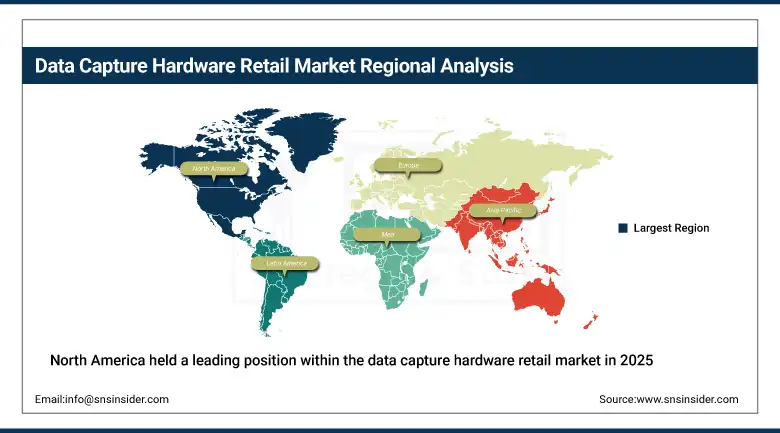
North America held a leading position within the data capture hardware retail market in 2025, capturing approximately 35.00% market share. It is due to the fast-paced development of AI-based retail automation systems, higher adoption of self-service checkout solutions, and substantial investments in upgrading omnichannel commerce solutions. Major retailers of both the US and Canada implement RFID-enabled stock control solutions, advanced POS terminals, and cloud-based retail analytics systems for increased efficiency and customer engagement. High capital flows into developing touchless retail solutions and smart retail supply chains contribute to regional market growth.
In 2025, a number of North American companies have successfully introduced AI-driven smart checkout solutions with real-time inventory tracking platforms.
Get Customized Report as per Your Business Requirement - Enquiry Now
Europe Data Capture Hardware Retail Market Insights
The Europe market contributed a share of 27.00% of the total worldwide data capture hardware retail market in 2025 due to high usage of automated retail technology, digital commerce penetration, and increased investment in intelligent retail infrastructure. The countries that include Germany, France, UK, and Italy have started adopting more cloud-based POS solutions, RFID technology for managing inventory, and AI-based analytics platforms in their retail operations.
In the year 2026, several retail automation companies in Europe introduced self-checkout kiosks powered by AI and cloud transaction analytics with RFID-assisted inventory synchronization technology.
Asia Pacific Data Capture Hardware Retail Market Insights
The revenue share of the Asia Pacific in 2025 was estimated at around 26.00% due to fast-paced digitization of retail industry, rising penetration of organized retailers, and increasing investments made in smart retail solutions in China, India, Japan, and South Korea. The Asia Pacific retail sector is making use of advanced retail computing techniques via mobile technology, RFID-based inventory tracking software, and artificial intelligence-based customer engagement initiatives in order to enhance efficiency in retail operations.
Between 2025 and 2026, some of the Asia Pacific-based retail chains made significant progress in implementing RFID-based automated warehouse systems supported by AI-based retail demand forecasting solution.
Middle East & Africa and Latin America Data Capture Hardware Retail Market Insights
Middle East and Africa will be having a high growth rate of 5.22% during the forecast period due to the rise in investment in smart retail infrastructure, development of organized retail networks, and increased adoption of digital payment solutions in the UAE and Saudi Arabia. The Latin American region is considered as the fastest growing with a CAGR of 6.80% owing to the rise in investments towards automation of retail operations, as well as the adoption of mobile POS devices in Brazil and Mexico.
During the year 2026, numerous retail technology providers based in the Middle East rolled out advanced self-service checkouts through cloud technologies combined with customer intelligence solutions powered by AI in the region.
Growth Drivers: Adoption of AI-driven retail automation and omnichannel inventory management systems.
The growing digitization of retail processes with AI-assisted automation systems, RFID-based inventory solutions, and real-time retail analytics software is expected to propel the global market for data capture hardware in retail. Retailers are quickly adopting smart scanners, RFID readers, mobile computing technology, and smart POS systems that can help them increase efficiencies in the checkouts process, manage their inventory better, and provide better experience management to customers. The integration of AI-driven retail analytics solutions into the data capture infrastructure in retail will help retailers plan their inventory needs more efficiently and manage their workforces more effectively.
In 2025, several retail firms leveraged AI-driven inventory analytics solutions along with RFID-enabled smart retail monitoring solutions.
Restraints: High costs of infrastructure modernization and cyber security issues restraining the market adoption.
Retail technology providers are still encountering issues relating to high financial costs of implementing modern infrastructure, complex integration with existing retail infrastructures, and enhanced cyber security threats. Many smaller retail operators may struggle to adopt new technologies such as RFID infrastructure, artificial intelligence-driven point-of-sale solutions, and cloud computing solutions due to cost concerns and lack of technical expertise. Privacy risks of connected retail infrastructure also affect marketing strategies.
During 2026, many retail technology providers announced investments in retail infrastructure that ensures cyber security protection for cloud-connected retail transactions management.
Opportunities: Sophisticated retail eco-systems and AI-backed asset intelligence forming long-term business potential.
Increasing focus on cashless retail stores, smart store analytics, and intelligent retail supply chain eco-systems are contributing to the creation of significant business potential in terms of hardware used for data capturing around the globe. More and more retail businesses are utilizing AI-backed retail analytics tools that are able to provide insights into predictive inventory management, customer behavior analysis, and asset monitoring services. The further proliferation of retail computing wearables and RFID-equipped smart retail solutions is likely to increase the competitiveness of the market in the future.
By 2025, many retail automation vendors started developing AI-driven retail intelligence platforms backed by real-time inventory visibility and cloud-based asset monitoring solutions.
Recent Developments
-
2026: Several retail technology providers launched AI-powered self-checkout kiosks integrated with RFID-enabled product authentication technologies.
-
2026: Multiple retail chains expanded deployment of cloud-connected inventory intelligence systems supporting predictive stock optimization analytics.
-
2025: Retail automation companies increased commercialization of wearable retail scanning technologies for warehouse and store workforce optimization.
-
2025: Multiple retailers implemented AI-assisted POS infrastructure integrated with real-time omnichannel inventory synchronization systems.
Data Capture Hardware Retail Market Key Players
-
Zebra Technologies Corporation
-
Honeywell International Inc.
-
Datalogic S.p.A.
-
NCR Voyix Corporation
-
Cognex Corporation
-
SATO Holdings Corporation
-
Bluebird Inc.
-
CipherLab Co. Ltd.
-
Newland AIDC
-
Elo Touch Solutions Inc.
-
Diebold Nixdorf Incorporated
-
Panasonic Holdings Corporation
-
Fujitsu Limited
-
Avery Dennison Corporation
-
Unitech Electronics Co. Ltd.
-
Posiflex Technology Inc.
-
Wincor Nixdorf International Gm
-
Opticon Sensors Europe B.V.
Data Capture Hardware Retail Market Report Scope:
| Report Attributes | Details |
|---|---|
| Market Size in 2025 | USD 6.80 Billion |
| Market Size by 2035 | USD 13.11 Billion |
| CAGR | CAGR of 6.80% From 2026 to 2035 |
| Base Year | 2025 |
| Forecast Period | 2026-2035 |
| Historical Data | 2022-2024 |
| Report Scope & Coverage | Market Size Analysis, Revenue Forecasting, Segment Analysis, Competitive Landscape, Regional Analysis, Retail Automation Assessment, Smart Checkout Technology Trends, AI-Enabled Retail Infrastructure Analysis, DROC & SWOT Analysis, Investment Trends, Supply Chain Evaluation, Consumer Transaction Technology Assessment, and Future Market Opportunity EvaluationChain Evaluation, Industrial Packaging Demand Analysis, Sustainability Assessment, DROC & SWOT Analysis, Regulatory Framework Analysis, Innovation Benchmarking, and Future Market Opportunity Evaluation |
| Key Segments | • By Hardware Type (Scanners, RFID Readers, Mobile Computers, Point-of-Sale (POS) Terminals, Self-Checkout Kiosks) • By Data Capture Method (Barcode, RFID, Near Field Communication (NFC), Optical Character Recognition (OCR), Magnetic Stripe) • By Form Factor (Fixed, Mobile, Wearable) • By Application (Inventory Management, Customer Check-In, Point-of-Sale (POS), Loyalty Programs, Asset Tracking) |
| Regional Analysis/Coverage | North America (US, Canada), Europe (Germany, UK, France, Italy, Spain, Russia, Poland, Rest of Europe), Asia Pacific (China, India, Japan, South Korea, Australia, ASEAN Countries, Rest of Asia Pacific), Middle East & Africa (UAE, Saudi Arabia, Qatar, South Africa, Rest of Middle East & Africa), Latin America (Brazil, Argentina, Mexico, Colombia, Rest of Latin America). |
| Company Profiles | Zebra Technologies Corporation, Honeywell International Inc., Datalogic S.p.A., Toshiba TEC Corporation, NCR Voyix Corporation, Cognex Corporation, SATO Holdings Corporation, Bluebird Inc., CipherLab Co. Ltd., Newland AIDC, Touch Dynamic Inc., Elo Touch Solutions Inc., Diebold Nixdorf Incorporated, Panasonic Holdings Corporation, Fujitsu Limited, Avery Dennison Corporation, Unitech Electronics Co. Ltd., Posiflex Technology Inc., Wincor Nixdorf International GmbH, and Opticon Sensors Europe B.V. |
Frequently Asked Questions
The Data Capture Hardware Retail Market was valued at USD 6.80 billion in 2025.
The market is projected to reach USD 13.11 billion by 2035.
The market is expected to expand at a CAGR of 6.80% during the forecast period.
North America dominated the global market owing to strong investments in retail automation infrastructure and increasing deployment of AI-enabled retail analytics systems.
Scanners accounted for the largest revenue share that is 30.00% in 2025.
