
Europe Healthcare Market Report Scope & Overview:
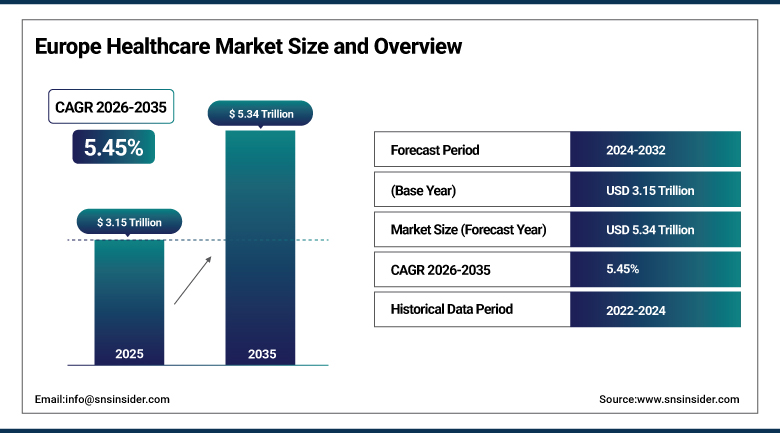
The Europe Healthcare Market was valued at USD 3.15 trillion in 2025 and is expected to reach USD 5.34 trillion by 2035, growing at a CAGR of 5.45% from 2026-2035.
The Europe Healthcare Market is witnessing steady growth Due to increased spending in healthcare, an increase in the aged population, and increased demand for advanced medical care in the region. Increased cases of chronic illnesses such as heart diseases, cancer, diabetes, and respiratory diseases have increased the demand for medicines, diagnostics, medical equipment, and healthcare services. Additionally, the increased use of digital healthcare, telemedicine, personalized medicine, and advanced diagnostics is facilitating the growth of the market. Increased investment in healthcare facilities, upgrading of hospitals, and adoption of medical technologies have also contributed to the growth of the market.
⮞December 2025: The European Commission published its State of Health in the EU 2025 Synthesis Report, identifying non-communicable disease prevention, healthcare workforce challenges, and health-system reforms as major priorities. The assessment reinforces the need for sustained investment in healthcare services, prevention, and system modernization across Europe.
To Get more information Europe Healthcare Market - Request Free Sample Report
Europe Healthcare Market Trends:
-
Rising population ageing and increasing prevalence of chronic diseases are driving demand for healthcare services, long-term care, and specialized treatments across Europe.
-
Increasing healthcare workforce shortages are encouraging investments in automation, digital technologies, integrated care models, and productivity-enhancing healthcare solutions across European systems.
-
Growing adoption of artificial intelligence, telemedicine, remote monitoring, and electronic health records is accelerating digital transformation across European healthcare systems.
-
Increasing implementation of the European Health Data Space is strengthening interoperability, cross-border health data exchange, and data-driven healthcare innovation across Europe.
Germany Europe Healthcare Market Outlook:
The Germany Europe Healthcare Market was valued at USD 0.58 Trillion in 2025 and is expected to reach USD 0.97 Trillion by 2035, growing at a CAGR of 5.28% from 2026-2035.
The Germany Healthcare Market is witnessing steady growth due to increasing healthcare expenditure, an aging population, and rising demand for advanced medical services. The rising cases of chronic diseases and age-associated diseases will continue to increase the demand for drugs, medical equipment, diagnostic tests, and specialty care services. Furthermore, the healthcare system of Germany along with its extensive use of innovative medical technologies will aid in developing the healthcare market. Rising investments in the field of digital health, telemedicine, artificial intelligence, and advanced diagnostics will improve the healthcare system. The emphasis on preventive care, early diagnosis, personalized treatments, and advanced healthcare facilities will play an important role in the development of the healthcare market.
⮞March 2025: Germany's Federal Ministry of Health confirmed the regulatory framework for a hospital transformation fund supporting modernization of hospital structures from 2026 through 2036. The initiative is intended to facilitate investment in specialized treatment capacity, hospital restructuring, and improvements in healthcare delivery.
Europe Healthcare Market Segment Analysis:
-
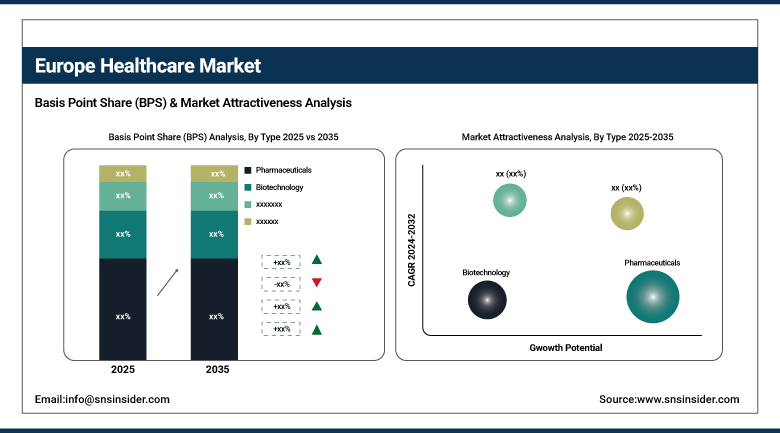
By Type, Pharmaceuticals dominate the Europe Healthcare Market with 29% share in 2025; Biotechnology is expected to grow at the fastest CAGR of 11.45% from 2026–2035.
By Type, Pharmaceuticals dominate the Europe Healthcare Market, Biotechnology grows fastest.
Pharmaceuticals segment dominated the Europe Healthcare Market with the highest revenue share of about 29% in 2025 due to high demand for prescription drugs, aging population and increasing occurrence of chronic illnesses. Strong pharmaceutical industry, well-developed healthcare sector, good research capacity and availability of medicines all contribute to pharmaceutical use and keep its market dominance in Europe.
Biotechnology segment is expected to grow at the fastest CAGR of 11.45% from 2026-2035 This is owing to increased investments in biologics, advanced therapies, personalized medicine, and innovative drugs. There is increased demand for targeted medicines, growth in biotechnology research, and innovations in the field of genomics and cellular/gene therapy. The healthcare sector is becoming more innovative and supportive for biotechnology in Europe.
⮞March 2025: The European Commission introduced its proposal for a Critical Medicines Act to strengthen the availability and security of supply of essential medicines across the European Union. The proposal highlights the strategic importance of pharmaceutical manufacturing, supply-chain resilience, and access to critical treatments.
Regional Analysis:
|
Region |
Major Country |
Share within Region, 2025 (%) |
|---|---|---|
|
Europe |
Germany |
18.4% |
|
United Kingdom |
8.3% |
|
|
France |
11.4% |
|
|
Italy |
7.1% |
|
|
Spain |
5.6% |
Germany Europe Healthcare Market Insights
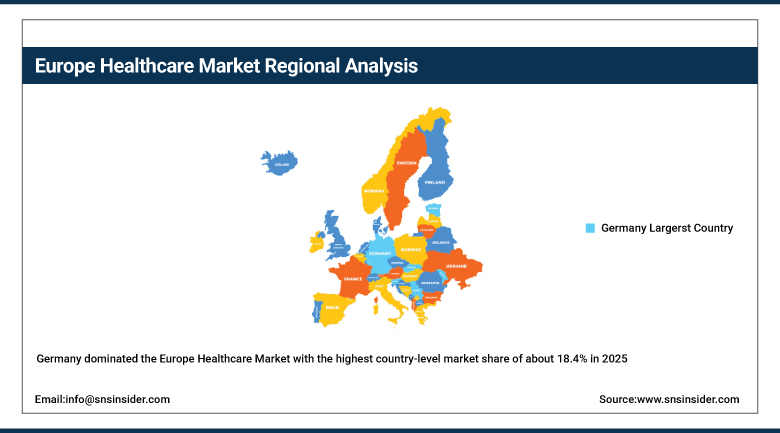
Germany dominated the Europe Healthcare Market with the highest country-level market share of about 18.4% in 2025, due to its highly developed healthcare system, high healthcare spending, large hospital networks, and well-developed pharmaceutical and medical device industries. Rising demand for health care, an aging population, technology innovations, and considerable investments into e-health and medical innovation reinforce the leadership of Germany.
⮞October 2025: Germany's Federal Cabinet approved a draft adjustment to its hospital reform legislation, introducing greater flexibility for regional hospital planning, cooperation, and exemptions intended to protect healthcare access in rural areas. The measure reflects continued restructuring of hospital services to balance specialization, quality, and accessibility.
Get Customized Report as per Your Business Requirement - Enquiry Now
United Kingdom Europe Healthcare Market Insights
The United Kingdom is expected to grow at the fastest CAGR of 10.12% from 2026–2035 Among the major European countries, stimulated by healthcare digitization, advanced medical technology adoption and healthcare service innovations. Growing government investment in healthcare modernization, rise in telemedicine usage, pharmaceutical innovation and personalization are adding fuel to the growth of this market.
⮞July 2025: The UK government published its 10 Year Health Plan for England, outlining a shift from hospital-centered care toward community services, from analogue processes toward digital healthcare, and from treatment toward prevention. The plan also proposed expanding the NHS App's role in appointments, patient records, and access to healthcare services.
France Europe Healthcare Market Insights
France Europe Healthcare Market is registering continuous growth due to its highly developed healthcare sector, highly developed public-private healthcare infrastructure, and flourishing pharmaceutical industry. Higher spending on health care, growing population age, and increased demand for medical technologies are contributing to the development of the market. The government's efforts to modernize the healthcare sector and digital health care are also helping the growth of the market.
⮞January 2026: France's Digital Health Agency reported that more than 24 million Mon espace santé profiles had been activated, with over 2.5 million monthly users and nearly 420 million healthcare documents added over the preceding year. The figures demonstrate expanding adoption of national digital health infrastructure for medical information sharing and care coordination.
Italy Europe Healthcare Market Insights
Italy Europe Healthcare Market is growing steadily as a result of its well-developed healthcare infrastructure, high demand for medical services, and increased healthcare expenditure. Aging populations and high incidences of chronic diseases are contributing to demand for healthcare products and services. Investment in healthcare modernization, digital technologies, pharmaceuticals, and medical infrastructure is helping to facilitate growth in the Italian market environment.
⮞February 2025: Italy's National Agency for Regional Healthcare Services (AGENAS) presented the National Telemedicine Platform, detailing progress in its national digital healthcare infrastructure and integration with regional systems. The initiative supports coordinated delivery of remote healthcare services and greater interoperability across Italy's healthcare system.
Market Dynamics:
Growth Drivers: Aging population and rising prevalence of chronic diseases are accelerating healthcare demand across Europe
The aging European population is a major driver of healthcare demand, as older populations generally require greater utilization of medical services, pharmaceuticals, diagnostics, long-term care, and disease-management solutions. Increasing longevity is followed by increasing incidences of chronic diseases and multimorbidity, thus generating consistent demand in hospitals, general practice, home-based care, and specialized treatment facilities. The OECD and the European Commission point to aging of the population as one of the most important challenges to the European healthcare system due to increased demand for healthcare and long-term care services as well as putting pressure on healthcare financing and the labor force. Such demographic changes create consistent demand for medicines, medical devices, diagnostics, biotechnology, and healthcare services in Europe.
⮞March 2025: France's Ministry of Health announced EUR 109.6 billion in hospital and clinic funding for 2025, representing a 3.8% increase in resources compared with the previous year. The allocation included additional support for medical research, innovation, and mental healthcare, reflecting continued investment in healthcare capacity and specialized services.
Restraints: Rising healthcare costs and budgetary pressure can constrain adoption of innovative healthcare technologies
Increasing demand for healthcare, population aging, and the growing cost of innovative medicines are placing significant financial pressure on European healthcare systems. The use of high-priced medications, especially innovative oncological drugs and biologicals, may be a problem for public payers in terms of finding a balance between affordability and access to innovations. Over 80% of all expenditures on healthcare in the EU are covered from the state budget, thus making its sustainability even more critical. The OECD estimates the increase in the share of spending on healthcare of public sector in EU countries by 0.5 percentage points of GDP until 2070 in their baseline projection, whereas the share of costs for long-term care may increase by 0.9 percentage points.
Opportunities: Rapid digital health adoption and increasing integration of AI are creating significant opportunities across European healthcare
Europe's accelerating digital transformation is creating substantial opportunities for healthcare technology providers. Incorporation of electronic health records, telemedicine, remote monitoring systems, clinical decision support systems, and AI-based healthcare systems has become common practice in the provision of healthcare services. According to the EU's 2026 Digital Decade eHealth Indicator Study, eHealth maturity level of the EU-27 region increased to 87% in 2025, rising by four percentage points compared to 2024. Furthermore, in 2026, the European Commission stated that there is an increasing trend towards incorporating AI into clinical, operational, and strategic applications in healthcare. This creates market opportunities for companies engaged in AI diagnostics, digital therapeutics, health analytics, interoperable health platforms, remote patient monitoring, and other AI-powered healthcare technologies.
⮞March 2025: The European Health Data Space Regulation entered into force, establishing a phased framework for cross-border electronic health data exchange and secure secondary use of healthcare data for research and innovation. Its implementation is expected to create opportunities for interoperable health records, digital health platforms, and data-driven healthcare technologies.
Recent Developments:
-
2026 : Roche strengthened its European healthcare presence through continued expansion of innovative medicines and diagnostics, particularly in oncology, immunology, neuroscience, and personalized healthcare.
-
2026 : Novartis advanced its European healthcare portfolio through continued launches and clinical development of innovative medicines, with strong focus on cardiovascular, immunology, neuroscience, and oncology therapies.
-
2026 : Siemens Healthineers expanded its healthcare technology portfolio in Europe through advancements in medical imaging, diagnostics, cancer care, and AI-enabled clinical technologies, supporting more efficient and personalized healthcare delivery.
-
2025 : AstraZeneca expanded its European healthcare activities through continued investment in innovative medicines, clinical research, and life-science partnerships, with major focus areas including oncology, cardiovascular, renal and metabolic diseases, and respiratory conditions.
Europe Healthcare Market key players are:
-
Sanofi
-
GSK
-
Novo Nordisk
-
Bayer
-
Merck KGaA
-
UCB
-
Siemens Healthineers
-
Fresenius
-
Philips
-
Smith+Nephew
-
Sartorius
-
QIAGEN
-
Eurofins Scientific
-
Straumann Group
-
EssilorLuxottica
-
Alcon
-
Lonza
Europe Healthcare Market Report Scope:
| Report Attributes | Details |
|---|---|
| Market Size in 2025 | USD 3.15 Trillion |
| Market Size by 2035 | USD 5.34 Trillion |
| CAGR | CAGR of 5.45% From 2026 to 2035 |
| Base Year | 2025 |
| Forecast Period | 2026-2035 |
| Historical Data | 2022-2024 |
| Report Scope & Coverage | Market Size, Segments Analysis, Competitive Landscape, Regional Analysis, DROC & SWOT Analysis, Forecast Outlook |
| Key Segments | • By Type (Pharmaceuticals, Healthcare Services, Medical Devices, Biotechnology, Pharmacy and Retail, Home Healthcare, Diagnostics) |
| Regional Analysis/Coverage | Europe (Germany, UK, France, Italy, Spain, Russia, Poland, Rest of Europe) |
| Company Profiles | Roche, Novartis, AstraZeneca, Sanofi, GSK, Novo Nordisk, Bayer, Merck KGaA, UCB, Siemens Healthineers, Fresenius, Philips, Smith+Nephew, Sartorius, QIAGEN, Eurofins Scientific, Straumann Group, EssilorLuxottica, Alcon, and Lonza. |

Frequently Asked Questions
Key players in the Europe Healthcare Market include Roche, Novartis, AstraZeneca, Sanofi, and GSK, among others.
Key opportunities in the Europe Healthcare Market include expansion of digital healthcare, increasing adoption of personalized medicine, and growing investment in biotechnology, medical devices, and healthcare infrastructure.
The market is driven by an aging population and increasing chronic disease burden, along with rising healthcare expenditure, technological advancements, and growing demand for advanced medical services.
The Pharmaceuticals segment dominated the Europe Healthcare Market, accounting for approximately 29.40% market share.
The Germany region dominated the Europe Healthcare Market in 2025 with a 18.40% share, driven by high firearm sales and strong defense procurement.
