
Healthcare Informatics Market Report Scope & Overview:
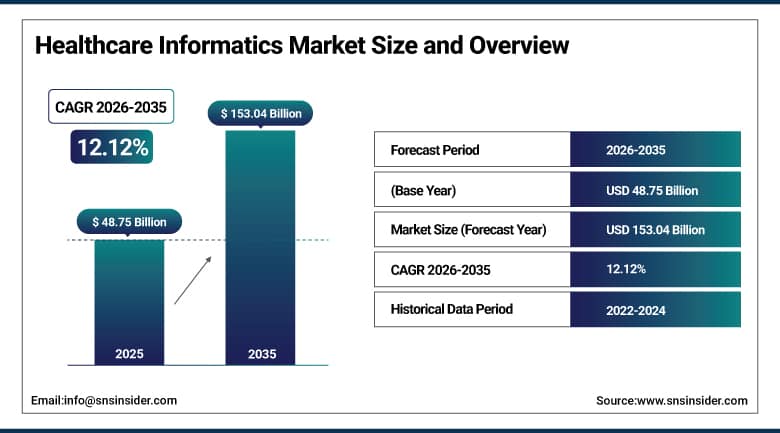
The Healthcare Informatics Market was valued at USD 48.75 Billion in 2025 and is projected to reach USD 153.04 Billion by 2035, expanding at a CAGR of 12.12% during the forecast period 2026–2035.
The healthcare informatics market witnesses robust growth owing to the increased emphasis on digitization, interoperability and data-driven clinical decisions in the healthcare sector. Adoption of EHRs, healthcare analytics solutions, clinical information systems and revenue cycle management solutions has helped providers to increase efficiency along with improved patient outcomes. Increased healthcare spending, increased prevalence of chronic diseases, ageing population and increased government initiatives for digitization of the healthcare sector have been fueling hospitals, healthcare payers and healthcare networks to adopt advanced information technology solutions. On the other hand, increasing need for secure data exchange, value-based delivery models and integrated patient management solutions will continue to offer huge opportunities in the market in the coming years.
Moreover, advancements in the field of artificial intelligence, cloud computing, predictive analysis, machine learning, IoMT, and interoperable healthcare platforms is driving the market growth of the market. Investments in digital health, regulations for interoperability, enhanced cyber security solutions and adoption of AI-powered clinical decision support systems has fueled the innovations in the healthcare industry. The U.S. Government continues expanding the number of nation-wide interoperability initiatives via the Trusted Exchange Framework and Common Agreement (TEFCA) initiative in 2025.
Market Size and Forecast
-
Market Size 2026E: USD 54.64 Billion
-
Market Size 2035: USD 153.04 Billion
-
CAGR: 12.12% from 2026 to 2035
-
Fastest Growing Region: Asia Pacific
-
Largest Region: North America
To Get More Information On Healthcare Informatics Market - Request Free Sample Report
Healthcare Informatics Market Trends
-
Increasing adoption of AI-powered clinical decision support platforms.
-
Growing investments in cloud-based healthcare informatics infrastructure.
-
Expansion of predictive healthcare analytics across provider organizations.
-
Rising interoperability initiatives supporting nationwide health information exchange.
-
Increasing utilization of population health management and value-based care platforms.
The U.S. Healthcare Informatics Market Size Outlook
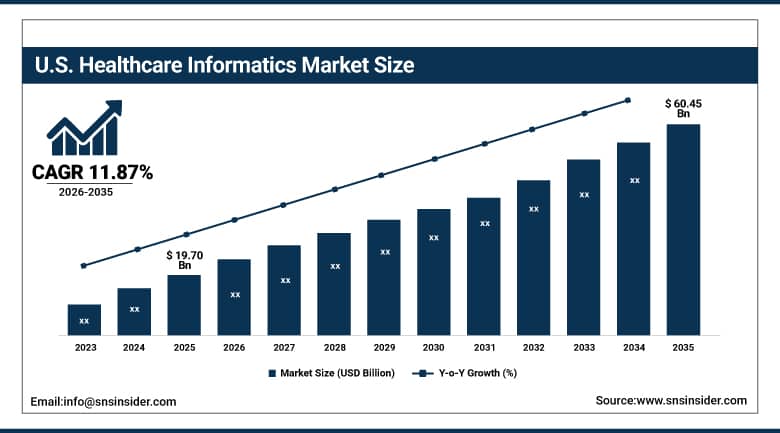
The U.S. Healthcare Informatics Market was valued at USD 19.70 billion in 2025 and is expected to reach approximately USD 60.45 billion by 2035, expanding at a CAGR of 11.87% during 2026–2035.
The USA still retains its dominance in the North American Healthcare Informatics Market, which is due to the high level of digitization of the health care sector, wide use of electronic health records, the well-developed system of payments, and the consistent development of healthcare IT. The integrated delivery networks, academic health systems, health plans, and governmental bodies keep developing digital infrastructure, ensuring interoperability, clinical analysis, implementation of telehealth technologies, and AI-supported health care services delivery. The regulatory push towards health care data interoperability, cyber security, and patient-centered care drives providers to develop scalable informatics solutions that increase operational efficiency and provide evidence-based clinical decision making.
The continuous innovation in artificial intelligence, cloud computing, predictive analytics, and real-time clinical intelligence platforms increases competitive advantages in the USA market. In 2025, nationwide adoption under TEFCA was implemented, ensuring the interoperability of hospitals, health care providers, and health information networks and the safe exchange of the electronic health information.
Healthcare Informatics Market Segment Analysis
-
By Solution, electronic health records (EHR) dominated the market with 26.00% share in 2025, while healthcare analytics is projected to witness the fastest growth with 14.77% CAGR during the forecast period.
-
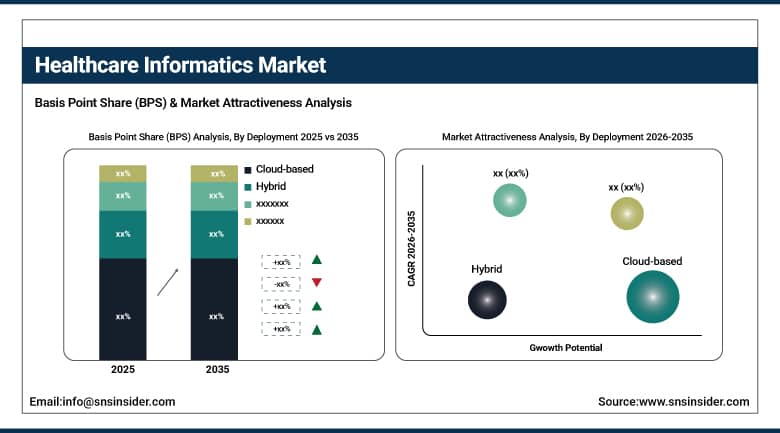
By Deployment, cloud-based dominated the market with 48.00% share in 2025, while hybrid is projected to witness the fastest growth with 17.68% CAGR during the forecast period.
-
By Application, clinical informatics dominated the market with 31.00% share in 2025, while population health management is projected to witness the fastest growth with 14.88% CAGR during the forecast period.
-
By End User, hospitals & health systems dominated the market with 39.00% share in 2025, while life sciences & pharmaceutical companies are projected to witness the fastest growth with 13.66% CAGR during the forecast period.
By Deployment, cloud-based dominated, while hybrid grows fastest.
Cloud-based deployment accounted for the maximum share of 48.00% in 2025 owing to growing inclination towards scalable healthcare IT infrastructure, reduced costs of deployment, enhanced interoperability and integration capabilities, and the ability to integrate with telehealth solutions and remote monitoring systems. Increasing movement of clinical applications, EHRs, imaging, and healthcare analytics to cloud environments to foster real-time collaboration and data management is one of the primary factors driving cloud-based deployment. Microsoft introduced cloud-based solutions for healthcare organizations through advanced Azure Health Data Services offering secure interoperability and AI-enabled healthcare applications.
Hybrid deployment is anticipated to register the highest CAGR of 17.68% during the forecast period due to increasing inclination towards flexible infrastructure that ensures security, regulatory compliance, and scalability. With a hybrid approach, healthcare providers can store sensitive clinical data on premise, and use cloud infrastructure for analytics, AI applications, disaster recovery, and collaboration. Growing concern regarding cyber security, changing regulations in the healthcare industry, and adoption of multi-cloud healthcare architecture are some of the primary factors expected to drive hybrid deployment in the near future. Google Cloud has been constantly enhancing hybrid solutions for healthcare data for interoperable health information management and AI-enabled clinical innovations.
By Solution, electronic health records (EHR) dominated, while healthcare analytics grows fastest.
EHRs made up 26.00% share of the healthcare informatics market in 2025, retaining the leading market position owing to increased digitalization of patients' records, government regulations on electronic documentation and increased interoperability requirements within healthcare institutions. Advanced EHR solutions, which optimize clinical workflow and improve patient care through reduction of medical mistakes, coordination of care and exchange of patients' data, are currently implemented by hospitals and other healthcare providers. Oracle Health continued to expand AI-enabled functions of its EHR platform with addition of AI tools to automate clinical documentation and increase physicians' productivity and workflow efficiency.
The segment of healthcare analytics is forecasted to demonstrate the highest CAGR of 14.77% during the period of 2026 – 2035 due to rising demand for predictive analysis, precision medicine, population health management and value-based delivery of healthcare. Increasing adoption of artificial intelligence, machine learning algorithms and cloud-native platforms for advanced analytics allows providers to derive insights out of big healthcare data at real time, thus driving implementation of such solutions across healthcare facilities, insurance companies and pharmaceuticals. SAS enhanced its AI and advanced analytics solution for the healthcare segment for predictive healthcare, clinical intelligence and optimization of operations of healthcare providers.
By Application, clinical informatics dominated, while population health management grows fastest.
Clinical informatics represented 31.00% share of the total healthcare informatics market share in 2025 owing to the rising implementation of digital clinical workflows, electronic prescribing, computerized physician order entry (CPOE), clinical decision support systems (CDSS), and patient management system. The healthcare providers keep focusing on clinical informatics for accurate diagnosis, efficient treatment planning, medication errors, and overall improvement of the patient safety. Oracle Health increased its capability of using AI for clinical workflows in their healthcare platform that helps in documentation, productivity, and care coordination of the physicians in the healthcare organization.
The population health management segment will experience a higher CAGR of 14.88% in the period of 2026-2035 due to the transition of the healthcare industry towards the value-based care, preventive healthcare approach, and chronic disease management. The healthcare providers as well as the insurance providers are increasingly using advanced analytical technology, artificial intelligence, and predictive risk modeling for identifying the risky population. Government initiatives for encouraging preventive healthcare, integration of social determinants of health, and remote patient monitoring are anticipated to drive the demand for population health management platform during the forecast period.
Regional Analysis
|
Region |
Major Country |
Share within Region, 2025 (%) |
|---|---|---|
|
North America |
United States |
94.00% |
|
Europe |
Germany |
27.00% |
|
Asia Pacific |
China |
22.00% |
|
Middle East & Africa |
UAE |
4.00% |
|
Latin America |
Brazil |
3.00% |
North America Healthcare Informatics Market Insights
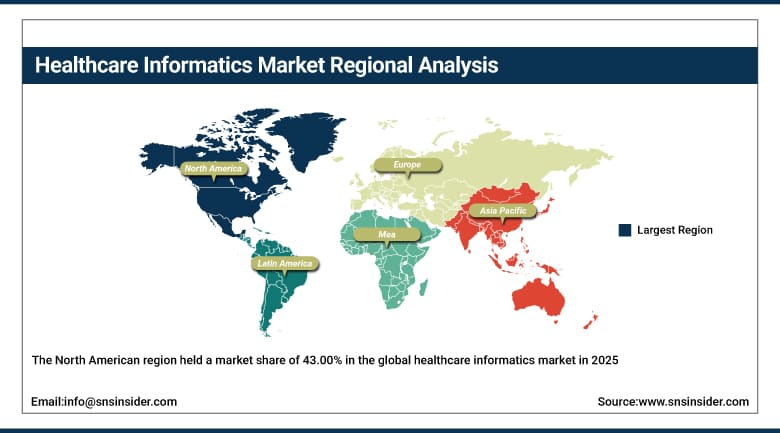
The North American region held a market share of 43.00% in the global healthcare informatics market in 2025 owing to factors such as maturity in terms of healthcare IT infrastructure, use of electronic health records, supportive regulations related to interoperability, and heavy investment in healthcare IT transformation initiatives. Providers and payers, among others, continue to invest in cloud computing, artificial intelligence, predictive analytics, and decision support systems to enhance patient outcomes through operational efficiencies. Supportive reimbursement systems, value-based care models, and modernization of healthcare infrastructure help sustain the dominant position of the region.
In addition, the region continues to experience rapid growth of AI-based healthcare applications, health information exchange systems, and cloud-native health platforms used for precision medicine and population health management. Increasing investments in digital hospitals, remote patient monitoring, and healthcare analytics platforms are anticipated to drive future growth. In February 2026, Oracle Health introduced advanced AI-based clinical workflow solutions that would help in automating documentation and improving provider productivity in healthcare systems.
Get Customized Report as Per Your Business Requirement - Enquiry Now
Europe Healthcare Informatics Market Insights
Europe remains among the biggest regional markets for the sector due to its universal healthcare systems, strong digital health policy frameworks, and growing investments in interoperable healthcare infrastructure. Countries like Germany, United Kingdom, France, Italy, and Netherlands are implementing new technologies to modernize their hospital information system, electronic patient record system, and healthcare analytics platform to improve care coordination and efficiency in healthcare sector.
There has been rapid deployment of artificial intelligence, cloud computing, and digital therapeutics in the delivery of healthcare services in the region. The continuous collaboration between healthcare organizations, technology vendors, and regulatory authorities will help to further develop the healthcare digitalization environment in Europe. In 2025, the activities related to the implementation of EHDS have continued to promote data interoperability and health information exchange in EU member states.
Asia Pacific Healthcare Informatics Market Insights
The Asia Pacific healthcare informatics market is expected to witness the highest CAGR of 15.25% in the forecast period on account of rising healthcare digitalization, growth of healthcare infrastructure, increasing government spending, and increasing adoption of cloud-based healthcare technology. Nations like China, Japan, India, South Korea, Singapore, and Australia are making huge investments in the development of electronic health records, telehealth systems, healthcare analytics, and AI-backed clinical applications.
Healthcare organizations in Asia Pacific region are increasingly adopting intelligent hospital management systems, healthcare platforms that can work together, remote patient monitoring solutions, and AI-driven decision-making tools in the clinical field. Constant innovation in cloud infrastructure and healthcare analytics is expected to drive robust growth in the coming years. In 2025, Fujitsu announced its expansion of healthcare digital transformation solutions in Asia Pacific region, enabling AI-driven hospital management and healthcare data management.
Middle East & Africa and Latin America Healthcare Informatics Market Insights
Healthcare informatics industry in Middle East & Africa region is witnessing steady growth on account of rising investments in healthcare infrastructure, digital health strategies at national level and deployment of electronic medical record in the Gulf countries and South Africa. Digital transformation in healthcare is becoming an important priority for governments in implementing smart hospital projects, creating health information system that is interoperable and delivering cloud based healthcare services. Growing investments in artificial intelligence, cyber security and connected healthcare ecosystem are likely to bring long term growth opportunities for the healthcare informatics vendors. In 2025, the UAE continued to expand its digital health initiatives in the country for electronic health records and AI enabled healthcare services.
Growing adoption of healthcare informatics solutions is being observed in Latin America as the healthcare providers are modernizing their clinical infrastructure and improving patient data management. Healthcare informatics solution deployment is taking place in Brazil, Mexico, Argentina, and Chile in areas such as electronic health records, healthcare analytics, telemedicine solutions and cloud based hospital information systems for improving healthcare delivery and administrative efficiency. In 2025, Brazil continued to expand its digital health initiatives in line with its national healthcare modernization strategy.
Growth Drivers: The rising acceptance of artificial intelligence, cloud computing, and evidence-based healthcare decision making.
The fast-paced digital transformation of healthcare systems around the globe is among the main growth drivers of the Healthcare Informatics Market. Modern hospitals and healthcare providers, as well as health insurance payers, are now using AI, cloud computing, predictive analytics, and interoperable EHRs for improving patient outcomes and achieving greater operational efficiency.
The increasing amount of healthcare data that is being produced by means of connected medical devices, telehealth systems, diagnostic equipment, and wearables is motivating the healthcare organizations to adopt advanced informatics solutions for their real-time analysis and decision making. Additionally, the initiatives launched by the governments supporting the development of interoperable, value-based, and countrywide health information exchange solutions continue driving the investment into modern healthcare IT infrastructure. Oracle Health improved its capabilities of generative AI at Oracle Clinical AI Agent.
Restraints: Increase in cyber security threats and difficulties related to healthcare interoperability.
Even in spite of the rapid market growth, there are still a number of problems related to implementation of healthcare informatics caused by cyber security risks, old healthcare systems and problems with interoperability. In the healthcare sector, there is a need to process highly sensitive information from patients, which makes the healthcare companies an object of ransom ware attacks, phishing and data breaches.
Implementation of new requirements regarding the confidentiality of the information and compliance with HIPAA and other healthcare data protection regulation in each region increases the complexity of implementation and its cost. Lack of qualified IT healthcare specialists and increase in implementation costs of the advanced digital infrastructure also impede the implementation process. Microsoft added more cyber security functions in the context of Microsoft Cloud for Healthcare.
Opportunities: Growth of population health management, precision medicine and predictive healthcare analytics.
Increased focus on prevention, precision medicine and value-based care provision provides significant long-term opportunities for the healthcare informatics market players. Healthcare organizations are applying more predictive analytics, artificial intelligence, genomics data analysis and real world evidence platforms to detect high-risk patient cohorts, deliver personalized care and enhance healthcare outcomes. Growing adoption of remote patient monitoring, wearables and IoMT ecosystems is resulting in generation of tremendous amounts of real-time healthcare data that needs to be analyzed.
Population health management solutions are also widely used in pharmaceutical companies, healthcare providers and public health agencies for chronic disease management, resource optimization and predictive healthcare planning. GE HealthCare extended its AI-driven portfolio of digital health products with advanced clinical intelligence and precision care solutions for predictive diagnostics and process optimization.
Recent Developments
-
2026: Oracle Health introduced enhanced AI-powered Clinical AI Agent capabilities that automate physician documentation, streamline clinical workflows, and improve operational efficiency across healthcare organizations.
-
2025: Microsoft expanded Microsoft Cloud for Healthcare with new AI, interoperability, and healthcare cybersecurity capabilities designed to strengthen secure digital healthcare transformation.
-
2025: GE HealthCare enhanced its digital health and AI portfolio by expanding Edison Digital Health Platform capabilities supporting clinical decision support and enterprise imaging workflows.
-
2025: Philips strengthened its HealthSuite digital health ecosystem by expanding cloud-enabled connected care, population health management, and AI-powered patient monitoring capabilities.
Healthcare Informatics Market Key Players are:
-
Veradigm Inc.
-
Koninklijke Philips N.V.
-
Siemens Healthineers AG
-
Meditech
-
athenahealth, Inc.
-
NextGen Healthcare, Inc.
-
IBM Corporation
-
SAS Institute Inc.
-
Microsoft Corporation
-
Optum, Inc.
-
McKesson Corporation
-
eClinicalWorks
-
Infor Inc.
-
Computer Programs and Systems, Inc.
-
IQVIA Holdings Inc.
-
Health Catalyst, Inc.
-
CitiusTech Inc.
Healthcare Informatics Market Report Scope:
| Report Attributes | Details |
|---|---|
| Market Size in 2025 | USD 48.75 Billion |
| Market Size by 2035 | USD 153.04 Billion |
| CAGR | CAGR of 12.12% From 2026 to 2035 |
| Base Year | 2025 |
| Forecast Period | 2026-2035 |
| Historical Data | 2022-2024 |
| Report Scope & Coverage | Market Size, Segments Analysis, Competitive Landscape, Regional Analysis, DROC & SWOT Analysis, Forecast Outlook |
| Key Segments | • By Solution (Electronic Health Records (EHR), Healthcare Analytics, Clinical Information Systems, Revenue Cycle Management, Others) • By Deployment (Cloud-based, On-premise, Hybrid) • By Application (Clinical Informatics, Administrative Informatics, Operational Informatics, Population Health Management, Others) • By End User (Hospitals & Health Systems, Healthcare Providers & Clinics, Healthcare Payers, Life Sciences & Pharmaceutical Companies, Others) |
| Regional Analysis/Coverage | North America (US, Canada), Europe (Germany, UK, France, Italy, Spain, Russia, Poland, Rest of Europe), Asia Pacific (China, India, Japan, South Korea, Australia, ASEAN Countries, Rest of Asia Pacific), Middle East & Africa (UAE, Saudi Arabia, Qatar, South Africa, Rest of Middle East & Africa), Latin America (Brazil, Argentina, Mexico, Colombia, Rest of Latin America). |
| Company Profiles | Oracle Health, Epic Systems Corporation, GE HealthCare Technologies Inc., Veradigm Inc., Koninklijke Philips N.V., Siemens Healthineers AG, Meditech, athenahealth, Inc., NextGen Healthcare, Inc., IBM Corporation, SAS Institute Inc., Microsoft Corporation, Optum, Inc., McKesson Corporation, eClinicalWorks, Infor Inc., Computer Programs and Systems, Inc., IQVIA Holdings Inc., Health Catalyst, Inc., CitiusTech Inc. |
Frequently Asked Questions
The Healthcare Informatics Market was valued at USD 48.75 Billion in 2025.
The market is anticipated to expand at a CAGR of 12.12% during the forecast period.
