
Fast Fashion Market Report Scope & Overview:
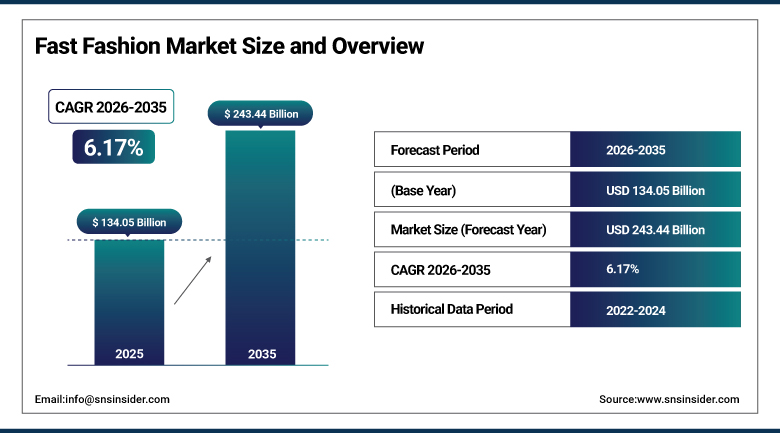
The Fast Fashion Market size was valued at USD 134.05 billion in 2025 and is expected to reach USD 243.44 billion by 2035, growing at a CAGR of 6.17% from 2026–2035.
The fast fashion market is witnessing steady growth in the global market due to rapid trend cycles and rising disposable income. Increasing demand for affordable and trend driven apparel is driving strong market expansion across global retail brands. Expanding influence of social media platforms is significantly supporting market growth. Growing adoption of online shopping and mobile commerce is further strengthening demand. Increasing urbanization and youth population are boosting consumption of fast fashion products worldwide.
According to the European Environment Agency (EEA), textile consumption in the EU is among the highest in the world, reaching about 15 kg per person annually, highlighting strong demand pressure. Governments are increasingly regulating the sector through sustainability and textile waste reduction policies, especially in the EU and India’s circular economy initiatives, to address environmental impact and promote responsible production.
To Get more information Fast Fashion Market - Request Free Sample Report
Fast Fashion Market Trends
-
-
Rapid adoption of ultra-fast digital fashion cycles is reshaping product launches. Brands use real time social media data to track trends.
-
AI driven demand forecasting is improving inventory accuracy and reducing overproduction. It also helps fast fashion retailers cut markdown losses.
-
E-commerce and mobile shopping growth is expanding global fast fashion reach. Consumers prefer online channels for convenience and wider choices.
-
Demand for sustainable and circular fashion is shaping brand strategies. Companies are launching recycling and resale programs to reduce impact.
-
Influencer marketing on Instagram and TikTok is strongly driving purchases. Viral trends quickly create spikes in apparel demand.
-
U.S. Fast Fashion Market Size Outlook
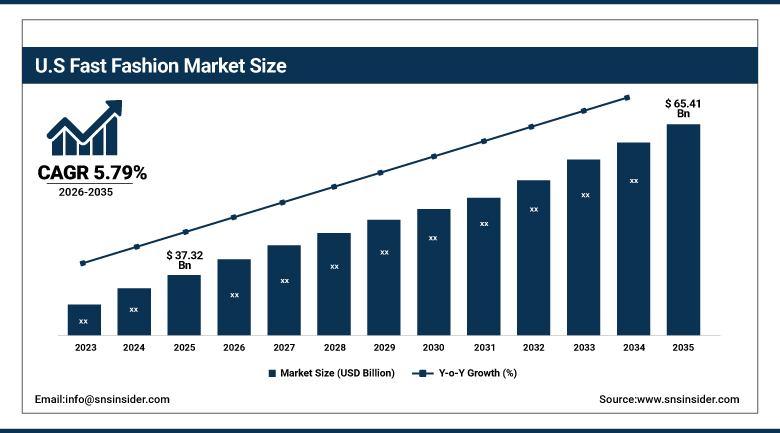
The U.S. Fast Fashion Market was valued at USD 37.32 billion in 2025 and is expected to reach around USD 65.41 billion by 2035, growing at a CAGR of 5.79% from 2026–2035.
In the U.S. the market for fast fashion has been witnessing consistent expansion owing to high demand from apparel retail, e commerce, and youth fashion consumption. Consistent purchase of affordable and trend driven clothing has been contributing to the growth observed in the fast fashion market. Expansion of digital retail platforms along with rising social media influence has been driving consistent consumption of fast fashion products. Growing demand for sustainable and recycled clothing options has led to increased adoption of eco friendly collections. Strong presence of global brands ensures continuous availability of fast fashion apparel across the country.
The U.S. fast fashion continues to see steady growth due to the high degree of adoption of e-commerce, combined with value-conscious consumers, where online shopping makes up a considerable proportion of overall clothing sales according to the U.S. Census Bureau. Even under the threat of inflation, demand for apparel stays constant in the period of 2025-2026. There is an uptick in industry consolidation, evidenced by the aggressive growth strategies employed by companies such as Shein's purchase of Everlane in 2026.
Fast Fashion Market Segment Analysis
-
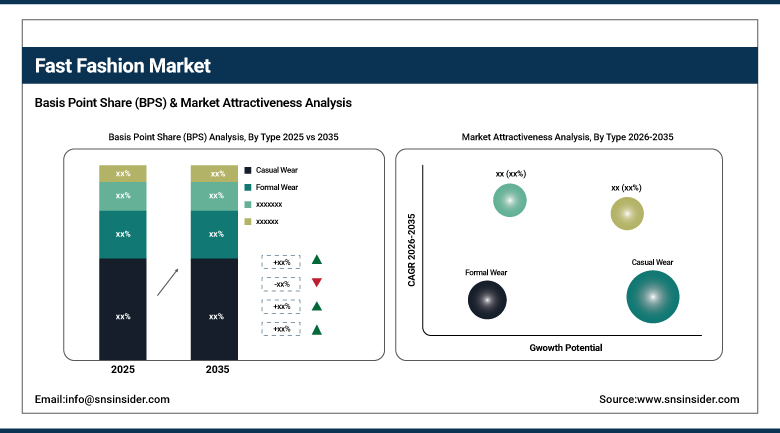
By Type, casual wear dominated the fast fashion market with 62.50% share in 2025; while casual wear is the fastest growing segment with CAGR of 8.73% during 2026 to 2035.
-
By End User, women dominated the fast fashion market with 56.40% share in 2025; while men are the fastest growing segment with CAGR of 7.55% during 2026 to 2035.
-
By Channel, offline stores dominated the fast fashion market with 61.80% share in 2025; while online stores / E-commerce is the fastest growing segment with CAGR of 9.84% during 2026 to 2035.
By Type, casual wear dominated the fast fashion market, while formal wear is the fastest growing segment.
Casual Wear segment led the fast fashion market in terms of revenue shares in 2025. The rise in demand among urban customers for fashionable, comfortable, and affordable clothing is leading to a growing demand for casual wears. The fast turnaround time and regular redesigns of designs also contribute to the growth of casual wears. Increased use of trends on social media also drives demand for casual clothes globally.
Formal Wear segment will be the fastest growing with the highest CAGR from 2026 to 2035. The rise in popularity for a hybrid work style along with dress codes is driving demand for Formal Wear. Consumers are preferring formal wear products that are affordable while retaining the stylish nature of fast fashion brand offerings. The availability of online platforms increases availability of more choices in the market.
By End User, women dominated the fast fashion market, while men are the fastest growing segment.
Women Segment accounted for the dominated share in the fast fashion market in 2025. The reason behind this is due to the higher level of involvement with fashion and more engagement in trend-driven apparel segments. Moreover, women exhibit more sensitivity towards the season and the power of influencer marketing in the fashion industry. Increasing the range of offerings, faster style adaptation, and good targeting strategies help maintain demand from both offline and online retail platforms in the fashion industry.
Men Segment is expected to have the fastest CAGR between 2026 and 2035 on account of the growing awareness about fashion as well as preference towards fashionable clothing such as casuals and formal outfits. Social media and grooming cultures contribute positively towards the rise in fashion spending in men. Furthermore, expanding menswear collections from various fashion brands and better accessibility through online retail stores fuel the growth.
By Distribution Channel, offline stores dominated the fast fashion market, while online stores/E-commerce is the fastest growing segment.
Offline stores segment accounted for the dominated market share in 2025 owing to the preference of consumers towards purchasing the products on physical basis. The established retail network, immediate purchase opportunity, and the credibility attached to testing the products physically helped in making this segment dominant. Heavy traffic in malls and branded outlets added up to its dominance. Offline purchase enables consumers to buy without any hassle while saving themselves from the risk of return.
Online stores/ e commerce segment is expected to witness the fastest growth rate during 2026 to 2035 because of increasing use of smartphones by consumers as well as increased adoption of digital payments. Growing consumer preference for home delivery and wide range of products available online have helped in making online purchase faster. Social media-based shopping as well as influencer marketing are driving fast fashion market online.
Regional Analysis
|
Region |
Major Country |
Share within Region, 2025(%) |
|---|---|---|
|
North America |
United States |
83.40% |
|
Europe |
Germany |
28.60% |
|
Asia Pacific |
China |
31.70% |
|
Middle East & Africa |
UAE |
8.55% |
|
Latin America |
Brazil |
11.55% |
North America Fast Fashion Market Insights.
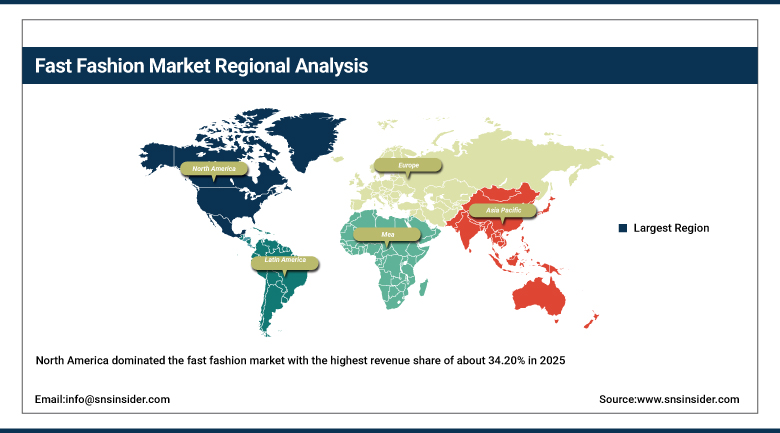
North America dominated the fast fashion market with the highest revenue share of about 34.20% in 2025 due to strong apparel retail networks and high consumer spending. The region benefits from advanced e commerce infrastructure, strong presence of global fast fashion brands, and rapid adoption of trend driven clothing. Rising influence of social media shopping and influencer marketing is further supporting market expansion across the United States and Canada. High demand for affordable and branded apparel is accelerating fast fashion consumption across the region.
The continent has a leading presence in fast fashion, with the United States alone producing around 13 million tons of textile waste per year (U.S. EPA, U.S. Government). Big names such as H&M and Zara (Inditex) cite the U.S. as a significant market for them, owing to the increasing demand from Generation Z and the development of online shopping. The GAO, a governmental body, states that there is an increase in textile waste because of the development of fast fashion within North America.
Get Customized Report as per Your Business Requirement - Enquiry Now
Europe Fast Fashion Market Insights.
Europe accounts for a considerable share in the fast fashion market in 2025 owing to strong fashion culture and high brand penetration. Countries such as Germany, France, Italy, and the United Kingdom are key contributors to market demand. Growing preference for affordable luxury fashion and sustainable clothing is supporting steady market growth across the region. Advanced retail networks and strict sustainability regulations are further strengthening adoption of fast fashion products in Europe.
The fast fashion market in Europe is witnessing growing regulatory and sustainability challenges, with the EU producing approximately 6.9 million tons of textile waste each year recycling only about 1% of its textiles back into new clothing. The recent EU-level policy initiatives from 2025 to 2026 include regulations for producer responsibility and the recycling of textiles, as well as bans on the destruction of surplus clothing.
Asia Pacific Fast Fashion Market Insights.
Asia Pacific holds a strong growth position in the fast fashion market in 2025 with a CAGR of about 7.18% due to rising disposable income and rapid urbanization. Countries such as China, India, Japan, and South Korea are major demand centers. Increasing youth population, social media influence, and expanding e commerce platforms are driving usage of fast fashion products across the region. Expanding domestic apparel manufacturing is further supporting market growth in emerging economies.
Asia-Pacific takes the lead in fast fashion industry, making up almost 65% of worldwide trade of textiles and apparels according to WTO. China is still the leading exporter accounting for around 30% of global apparel market UN Comtrade WTO. Vietnam and Bangladesh are important production sites. The increase in e-commerce adoption and Shein's ultra-fast fashion are encouraging the demand.
Middle East & Africa and Latin America Fast Fashion Market Insights.
Middle East & Africa region and Latin America region are experiencing gradual growth in the fast fashion market in 2025 due to increasing urbanization and rising fashion awareness. Countries including UAE, South Africa, Brazil, and Mexico are key contributors. Expanding retail malls, tourism industry growth, and imported fashion demand are supporting market expansion across these regions. Growth in online retail penetration is further driving fast fashion consumption.
Rising demands for fast fashion have been noted in the Middle East and Africa and Latin America due to increased apparel imports. The increase in Middle East apparel imports stands at $2.57 billion in (January-April 2025). In Latin America, apparel imports have grown by 12.9% in H1 2025 with contributions from Brazil and Mexico.
Market Dynamics
Growth Drivers: Expansion of e commerce platforms and digital retail channels driving global fast fashion accessibility
The rapid development of online shopping platforms is revolutionizing the distribution channels of the fast fashion industry. Customers are slowly migrating to the use of mobile applications and digital retail platforms when it comes to making clothing purchases. Customer convenience is boosted through easier accessibility to international brands and diversified product offering. Impulse shopping behavior is promoted through the integration of social media on the platforms used for online purchasing. Fast delivery and efficient logistical operations improve the efficiency of online retailers. Online payments support this trend and increase sales performance.
The development in the number of online retail sites has made it much easier to distribute fast fashion internationally. According to Inditex (owner of Zara), it makes €10.65 billion in revenues annually in online sales, representing 26.7% of total income earned, showing the impact of digital platforms and online sales in boosting the international spread of fast fashion as opposed to physical stores. With online retail sites, firms have been able to enter more than 200+ countries.
Restraints: Growing environmental concerns and textile waste generation limiting fast fashion market expansion
Rising consciousness about environmental pollution is posing hurdles in the expansion of fast fashion businesses. The excessive amounts of fabric waste and water usage are triggering sustainability issues across the world. Environmental guidelines have been implemented by governments and regulatory organizations in relation to the apparel sector. Consumer trends are moving towards sustainable fashion choices. There is an emphasis on lowering carbon footprint and adopting sustainable production processes by brands. Such developments are adding up to the operational costs of fast fashion firms.
Opportunities: Adoption of artificial intelligence and automation in design and supply chain enhancing operational efficiency
Integration of AI technology into operations has been contributing to accurate prediction of trends and inventory. Designing processes that are automated are helping in minimizing the development time of products. Logistics solutions that are smart are providing faster responses to any changes in the customer’s behavior. Analyzing processes are ensuring better knowledge of consumer preferences. Automation in manufacturing is reducing the costs incurred by fast fashion brands while operating on a larger scale. Optimization of logistics using digital technologies is resulting in decreased delivery time. Fast fashion companies are becoming highly efficient due to these reasons and retaining their competitiveness in an evolving market environment.
Using AI technology in the fast fashion business has proved beneficial for fast fashioning of goods. For example, Inditex, which owns Zara, utilizes AI technology for enhancing the demand and inventory forecasting, resulting in the gap between designing process and selling of product reduced from about three months to only a week. H&M uses AI for forecasting of demands and trend analysis.
Recent Developments
-
2026: Uniqlo drives stable growth through premium basics strategy, focusing on sustainability, innovation, and consistent global store expansion.
-
2025: H&M advances AI-driven forecasting and RFID-based logistics, improving speed-to-market efficiency and reducing inventory wastage significantly.
-
2024: Zara (Inditex) strengthens global dominance through omnichannel retail expansion and improved inventory management across key international markets.
-
2023: Shein rebounds strongly post-pandemic, rapidly expanding global online sales and strengthening its ultra-fast digital fashion supply chain.
Fast Fashion Companies are:
-
H&M
-
Uniqlo
-
Shein
-
Forever 21
-
Mango
-
Bershka
-
Pull&Bear
-
Stradivarius
-
ASOS
-
Boohoo
-
PrettyLittleThing
-
Missguided
-
Fashion Nova
-
C&A
-
New Look
-
GAP
-
Urban Outfitters
-
Topshop
Fast Fashion Market Report Scope:
| Report Attributes | Details |
|---|---|
| Market Size in 2025 | USD 134.05 Million |
| Market Size by 2035 | USD 243.44 Million |
| CAGR | CAGR of 6.17% From 2026 to 2035 |
| Base Year | 2025 |
| Forecast Period | 2026-2035 |
| Historical Data | 2022-2024 |
| Report Scope & Coverage | Market Size, Segments Analysis, Competitive Landscape, Regional Analysis, DROC & SWOT Analysis, Forecast Outlook |
| Key Segments | • By Type (Casual Wear, Formal Wear, Others) • By End User (Women, Men) • By Distribution Channel (Offline Stores, Online Stores/E-commerce) |
| Regional Analysis/Coverage | North America (US, Canada), Europe (Germany, UK, France, Italy, Spain, Russia, Poland, Rest of Europe), Asia Pacific (China, India, Japan, South Korea, Australia, ASEAN Countries, Rest of Asia Pacific), Middle East & Africa (UAE, Saudi Arabia, Qatar, South Africa, Rest of Middle East & Africa), Latin America (Brazil, Argentina, Mexico, Colombia, Rest of Latin America). |
| Company Profiles | Zara, H&M, Uniqlo, Shein, Primark, Forever 21, Mango, Bershka, Pull&Bear, Stradivarius, ASOS, Boohoo, PrettyLittleThing, Missguided, Fashion Nova, C&A, New Look, GAP, Urban Outfitters, Topshop |
Frequently Asked Questions
The fast fashion market is expected to grow at a CAGR of 6.17% from 2026 to 2035.
The fast fashion market was valued at USD 134.05 billion in 2025.
Rising demand for affordable trendy apparel and digital retail growth is driving the market. Social media trends and fast fashion cycles further support demand.
Casual Wear dominated in 2025 due to high demand for comfortable, affordable, and trend aligned clothing with frequent style updates.
North America dominated the market in 2025 due to strong retail infrastructure, high consumer spending, and presence of global fast fashion brands.
