
Flexible Substrates Market Report Scope & Overview:
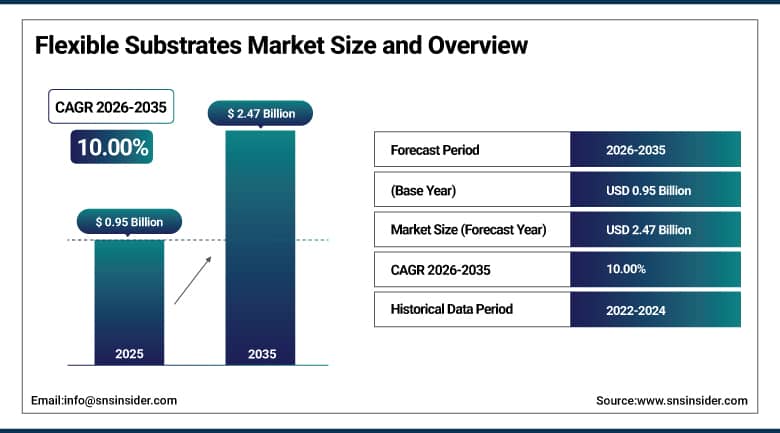
The Flexible Substrates Market was valued at USD 0.95 Billion in 2025 and is expected to reach USD 2.47 Billion by 2035, growing at a CAGR of 10.00% from 2026 to 2035.
The Flexible Substrates Market is experiencing strong growth owing to growing demand for lightweight, thin, and sturdy substrates that find use in advanced electronics applications such as flexible displays, wearables, and flexible phones. Growing use of organic photovoltaic cells and flexible solar cells is also driving the market’s growth. Constant technological advances in polyimide, PET, and flexible glass are enhancing their performance, temperature resistance, and conductivity. Moreover, growing trend of using miniaturized and energy efficient devices in consumer electronics, automobiles, and healthcare sectors is also adding to the demand for flexible substrates.
According to the International Energy Agency (IEA), global electricity demand from electronics, digital devices, and connected systems is rising steadily, with overall electricity consumption increasing at an average rate of around 2.2% annually. This trend is driving demand for energy-efficient and miniaturized electronic components that depend heavily on advanced flexible substrates.
Furthermore, the International Telecommunication Union (ITU) reports that there are now over 5.5 billion internet users worldwide, significantly fueling the adoption of IoT devices, wearable electronics, flexible sensors, and advanced display technologies, all of which are key application areas for flexible substrates.
To Get More Information On Flexible Substrates Market - Request Free Sample Report
Flexible Substrates Market Trends
-
Rising adoption of flexible electronics in wearable devices, smartphones, and foldable displays driving demand for advanced flexible substrate materials
-
Growing expansion of printed electronics and thin-film technologies enabling lightweight, bendable, and high-performance electronic components
-
Increasing use in solar photovoltaics, especially flexible solar panels, supporting applications in portable and off-grid energy solutions
-
Expanding applications in automotive electronics, healthcare devices, and IoT sensors requiring durable and heat-resistant flexible materials
-
Continuous advancements in polymer films, metal foils, and glass-based flexible substrates improving conductivity, durability, and mechanical flexibility
The U.S. Flexible Substrates Market Outlook
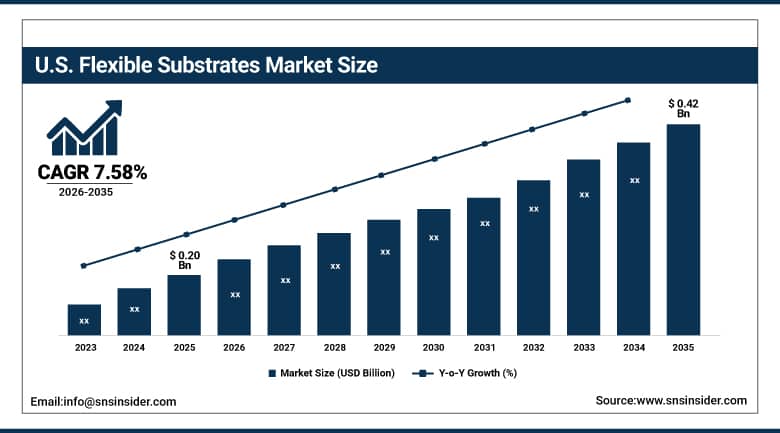
The U.S. Flexible Substrates Market was valued at approximately USD 0.20 Billion in 2025 and is expected to reach approximately USD 0.42 Billion by 2035, growing at a CAGR of approximately 7.58%.
The United States is the most commercially significant national flexible substrate market within the North American region, driven by the concentration of flexible electronics innovation at U.S. consumer electronics companies including Apple and Qualcomm whose product specifications define substrate performance requirements, the domestic aerospace and defence electronics sectors whose conformal electronics, flexible phased array radar, and stretchable soldier-worn sensor applications create specialised high-reliability flexible substrate demand distinct from consumer market requirements, and the domestic thin-film photovoltaic sector whose CIGS and perovskite solar panel production requires flexible substrates that enable lightweight and conformal installation on building facades, vehicle surfaces, and portable power applications.
According to the U.S. Department of Energy (DOE), building-integrated photovoltaics (BIPV) and next-generation solar technologies are witnessing rapid expansion, with flexible photovoltaic systems expected to play a key role in enabling distributed and decentralized energy generation. This growing adoption is further strengthening demand for advanced substrate materials that support lightweight, durable, and efficient solar designs.
Additionally, the U.S. Census Bureau reports that shipments from the U.S. electronics and computer manufacturing sector exceed USD 400 billion annually, underscoring the scale of industrial activity and the strong downstream demand for high-performance electronic materials, including advanced substrates used in next-generation devices.
Flexible Substrates Market Segment Analysis
-
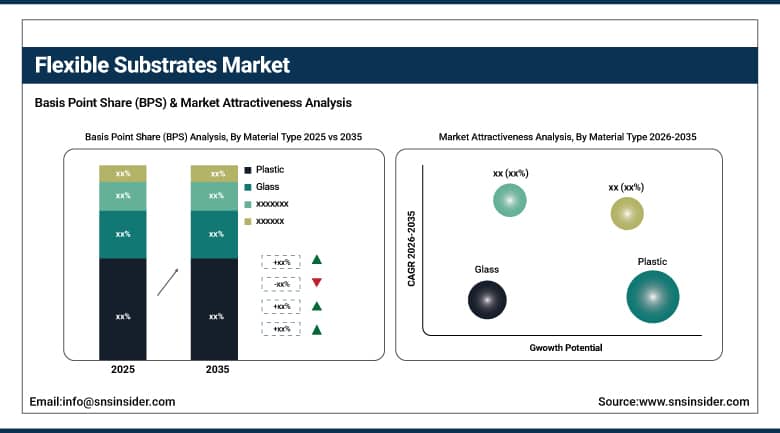
By Material Type, plastic segment dominated the Flexible Substrates Market in 2025 with 58% share; glass segment is the fastest growing segment.
-
By Form Factor, roll-to-roll segment dominated the market in 2025 with 63% share; stackable segment is the fastest growing segment.
-
By Application, displays segment dominated the market in 2025 with 32% share; photovoltaic cells segment is the fastest growing segment.
By Material Type, Plastic substrates dominate the Flexible Substrates Market, Glass segment expected to grow fastest
Plastic substrates dominate the flexible substrates market because of its low cost, light weight, and excellent mechanical flexibility. Such materials as polyimide (PI), PET, and PEN have good thermal and chemical stability as well as can be easily processed using the roll-to-roll process. Flexible displays, printed electronics, sensors, and flexible printed circuit boards contribute to the popularity of these materials. The existing supply chain and scalability of productions ensure that plastics will stay the leading material for many applications.
Glass, especially ultra-thin and flexible variants, is the fastest growing material segment owing to high optical clarity and barrier property and thermal stability as compared to plastics. Glass finds application in foldable smartphones, high-end display panels, and PV systems. The good scratch and dimensional stability are the main characteristics of this material that makes it a perfect choice for next generation electronics. Improvements in production of ultra-thin glass increase the level of flexibility of this material that allows replacing the plastic substrates in high end products.
By Form Factor, Roll-to-Roll segment dominates the Flexible Substrates Market, Stackable segment expected to grow fastest
Roll-to-roll form factor dominates the flexible substrates market because of its advantages in terms of continuous process, high efficiency, and low costs when applied in mass production. The technology allows fabrication of flexible electronics on a large scale with little waste material and shortened production time. Roll-to-roll technology is commonly employed to manufacture flexible displays, printed circuit boards, sensors, and solar films. The benefits of scalability, efficiency, and material diversity make this type of substrate form factor an attractive option for high-volume flexible electronics production.
Stackable form factors are the fastest growing segment as they helps build complex systems based on three-dimensional integration, higher density of components, and more sophisticated miniaturization of modern electronics. The use of this kind of form factor is typical for development of wearable devices, powerful batteries, and sensors. The rising need for devices that have multifunctional capabilities and are compact makes designers implement stackable form factor in their developments. Moreover, developments in multilayer assembly and heterogeneous integration improve device performance.
By Application, Displays segment dominates the Flexible Substrates Market, Photovoltaic Cells segment expected to grow fastest
Displays dominate the flexible substrates market because displays are widely used in smartphones, televisions, wearables, and upcoming foldable devices. With increasing popularity of OLEDs and flexible displays, there is an increased demand for flexible, transparent, and durable substrates. Consumer electronics industry continues to be the key application area and it benefits from technological advancements and constant product updates. Manufacturing of displays ensures stable demand, hence this application segment can be considered the most developed and profitable in the world market for flexible substrates.
Photovoltaic cells are the fastest growing application segment because of rising demand for alternative energy sources and flexible solar cells. With flexible substrates, photovoltaic cells can be embedded into portable devices, surfaces of buildings, and independent energy generation systems. Technological advances in thin film solar cell technologies fuel its adoption in residential, commercial, and industrial segments. This application segment experiences high growth rates because of the ability to manufacture flexible and lightweight solar modules.
Regional Analysis
|
Region |
Major Country |
Share within Region, 2025 (%) |
|---|---|---|
|
North America |
United States |
84.73% |
|
Europe |
Germany |
27.84% |
|
Asia Pacific |
China |
42.84% |
|
Middle East & Africa |
UAE |
22.84% |
|
Latin America |
Brazil |
43.84% |
Asia Pacific Flexible Substrates Market Insights
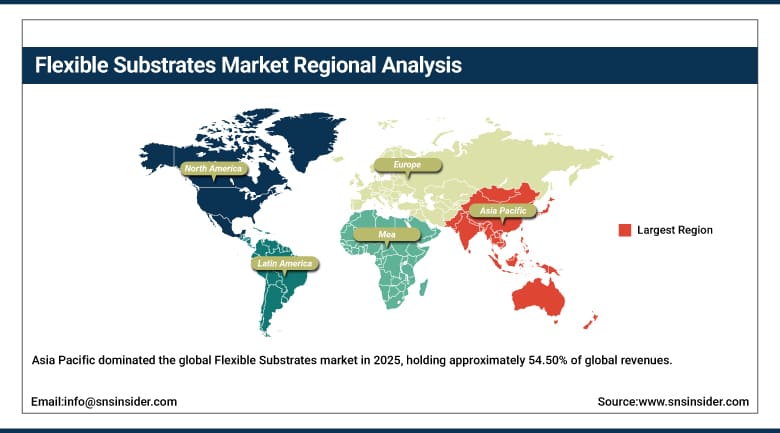
Asia Pacific dominated the global Flexible Substrates market in 2025, holding approximately 54.50% of global revenues. China accounts for approximately 42.84% of Asia Pacific revenues through its world-leading flexible OLED display panel manufacturing at BOE Technology, CSOT, and Visionox, its dominant position in global electronics contract manufacturing, and the Made in China 2025 initiative whose flexible electronics development investment is creating domestic material production capability.
South Korea is commercially critical through Samsung Display and LG Display's flexible OLED panel production whose colourless polyimide substrate specifications define the premium flexible display substrate market. Japan contributes precision flexible substrate material expertise through FUJIFILM, Toray, and Sumitomo Chemical.
Get Customized Report as Per Your Business Requirement - Enquiry Now
North America Flexible Substrates Market Insights
North America held approximately 25% of global Flexible Substrates revenues in 2025. The United States accounts for approximately 84.73% of regional revenue through the domestic presence of DuPont's Kapton polyimide film business, Corning's Willow Glass flexible glass product line, and 3M's specialty flexible films whose combined product portfolios serve the aerospace, medical, and advanced electronics markets that sustain North American flexible substrate demand.
The domestic aerospace and defence sector, whose conformal phased array radar and body-worn soldier electronics create specialised flexible substrate requirements, sustains premium application demand that is structurally separate from consumer electronics substrate market cycles.
Europe Flexible Substrates Market Insights
Europe held approximately 15.84% of global Flexible Substrates revenues in 2025. Germany accounts for approximately 27.84% of European revenues through its automotive electronics sector's growing adoption of flexible display substrates for next-generation vehicle interior applications, the domestic presence of Schott AG whose flexible glass products serve European display and photovoltaic markets, and the German electronics manufacturing ecosystem whose printed circuit board and automotive electronics supply chains create meaningful flexible substrate consumption. France, the United Kingdom, and the Netherlands contribute secondary European demand through their aerospace, pharmaceutical, and electronics manufacturing industries.
According to the European Commission, the EU electronics industry contributes over €250 billion annually to GDP, supported by strong expansion in automotive electronics, industrial IoT, and medical electronics. This highlights the region’s increasing reliance on advanced electronic systems across high-value industries.
In parallel, the EU’s Horizon Europe programme has allocated more than €95 billion for the 2021–2027 period, supporting research and innovation in advanced materials, printed electronics, and next-generation manufacturing technologies, including flexible electronics. This sustained policy and funding support is accelerating innovation and strengthening the development of advanced flexible substrates and related electronic materials across Europe.
MEA & Latin America Flexible Substrates Market Insights
Middle East and Latin America are smaller but growing Flexible Substrates markets where electronics manufacturing development and renewable energy investment are creating incremental substrate demand. The UAE leads MEA revenues at approximately 22.84% of the regional total through its electronics manufacturing investment, solar energy programme deployment requiring thin-film photovoltaic substrates, and the growing presence of electronics manufacturing facilities serving regional markets.
Brazil leads Latin American revenues at approximately 43.84% of the regional total through its domestic electronics assembly sector, thin-film solar programme, and growing medical device manufacturing industry whose products increasingly require flexible electronics components.
Market Dynamics
Growth Drivers: Foldable smartphones and flexible OLED scale-up are driving strong demand for polyimide substrates globally.
The foldable smartphone market's expansion, with Samsung, Huawei, Motorola, OnePlus, and Google each commercially shipping multiple foldable smartphone models and the category projected to exceed 50 million annual units by 2027, is creating large-volume demand for the colourless polyimide cover window films and polyimide display backplane substrates that foldable OLED panels require.
Each foldable smartphone requires multiple polyimide substrate layers including the flexible display backplane, the touch sensor film, and the colourless PI cover window, creating a per-device flexible substrate content substantially higher than equivalent non-foldable device equivalent. The automotive sector's adoption of large-format curved OLED displays in next-generation vehicle interior designs is creating new flexible substrate demand that grows with automotive electrification and premium vehicle content intensification.
Restraints: High substrate costs and technical challenges in achieving flatness and stability limit flexible substrate adoption.
High-performance flexible substrates including low-CTE polyimide films for circuit board applications, colourless polyimide for foldable display cover windows, and ultra-thin flexible glass for OLED encapsulation each carry material costs substantially above those of conventional rigid substrate alternatives. Colourless polyimide for foldable display applications commands prices of USD 80 to USD 200 per square metre depending on specification, compared to rigid glass at USD 5 to USD 15 per equivalent area, creating a cost premium that is commercially justified by the foldable device's user experience differentiation but that constrains adoption to premium product tiers where this cost premium is absorbable within overall device economics.
Opportunities: Advanced packaging and roll-to-roll perovskite solar cell manufacturing create significant high-growth opportunities for manufacturers.
Semiconductor advanced packaging's adoption of flexible interposer and redistribution layer materials whose polymer composition reduces the stress at chiplet interfaces relative to rigid organic laminate alternatives is creating a new high-value application for polyimide and liquid crystal polymer flexible substrate materials whose precision, thermal stability, and electrical characteristics satisfy semiconductor back-end process requirements.
Each next-generation AI chip using 3D chiplet integration architecture that incorporates a flexible interposer layer creates demand for flexible substrate material at higher per-square-centimetre value than conventional consumer electronics flexible circuit applications. Perovskite solar cell manufacturing on flexible metal foil or polymer substrates using roll-to-roll coating processes is approaching commercialisation at several companies, and if the stability challenges of perovskite cells can be resolved for outdoor deployment lifetime requirements, roll-to-roll flexible perovskite solar represents a transformative new application for high-volume flexible substrate consumption.
Recent Developments:
-
2025: FUJIFILM Holdings Corporation presented film-type interlayer insulation materials and polyimide-based coatings for flexible semiconductor back-end process connections at the ECTC conference in Dallas, demonstrating flexible substrate application expansion from consumer display markets into semiconductor advanced packaging.
-
2025: Merck Group announced the acquisition of Nissan Chemical's electronics materials division to expand its portfolio of advanced substrate materials for flexible display and wearable applications, strengthening Merck's semiconductor materials position.
-
2024: DuPont de Nemours launched Kapton RS polyimide film engineered for 5G antenna and 77 gigahertz automotive radar substrate applications with dielectric constant 3.2 and loss tangent below 0.003 satisfying millimetre wave signal integrity requirements for phased array antenna and radar sensor fabrication.
Flexible Substrates Market Key Players are:
-
DuPont
-
3M
-
Toray Industries
-
Teijin Limited
-
Mitsubishi Chemical Group
-
SKC Co., Ltd.
-
Covestro
-
Saint-Gobain
-
Corning Incorporated
-
Nitto Denko Corporation
-
Showa Denko
-
Sumitomo Chemical
-
Kaneka Corporation
-
Asahi Kasei
-
LG Chem
-
SK Innovation
-
Flexcon Company
-
Mativ Holdings
-
Merck Group
-
Heraeus
Flexible Substrates Market Report Scope:
| Report Attributes | Details |
|---|---|
| Market Size in 2025 | USD 0.95 Billion |
| Market Size by 2035 | USD 2.47 Billion |
| CAGR | CAGR of 10.00% From 2026 to 2035 |
| Base Year | 2025 |
| Forecast Period | 2026-2035 |
| Historical Data | 2022-2024 |
| Report Scope & Coverage | Market Size, Segments Analysis, Competitive Landscape, Regional Analysis, DROC & SWOT Analysis, Forecast Outlook |
| Key Segments | • By Material Type (Plastic, Metal Foils, Glass) • By Form Factor (Roll-to-Roll, Sheet-to-Sheet, Stackable) • By Application (Displays, Flexible Printed Circuit Boards (FPCBs), Photovoltaic Cells, Sensors, Batteries, LED & Lighting, RFID & Antennas, Others) |
| Regional Analysis/Coverage | North America (US, Canada), Europe (Germany, UK, France, Italy, Spain, Russia, Poland, Rest of Europe), Asia Pacific (China, India, Japan, South Korea, Australia, ASEAN Countries, Rest of Asia Pacific), Middle East & Africa (UAE, Saudi Arabia, Qatar, South Africa, Rest of Middle East & Africa), Latin America (Brazil, Argentina, Mexico, Colombia, Rest of Latin America). |
| Company Profiles | DuPont, 3M, Toray Industries, Teijin Limited, Mitsubishi Chemical Group, SKC Co., Ltd., Covestro, Saint-Gobain, Corning Incorporated, Nitto Denko Corporation, Showa Denko, Sumitomo Chemical, Kaneka Corporation, Asahi Kasei, LG Chem, SK Innovation, Flexcon Company, Mativ Holdings, Merck Group, Heraeus |
Frequently Asked Questions
The plastic segment dominated the Flexible Substrates Market with 51.00% share in 2025, encompassing polyimide, PET, and PEN polymer film substrates.
Foldable smartphones, automotive displays, medical wearables, cost-efficient roll-to-roll production, and semiconductor packaging drive flexible substrate market growth.
The Flexible Substrates Market is expected to grow at a CAGR of 10.00% from 2026 to 2035.
The Flexible Substrates Market was valued at USD 0.95 Billion in 2025.
