
Freeze Drying Equipment Market Report Scope & Overview:
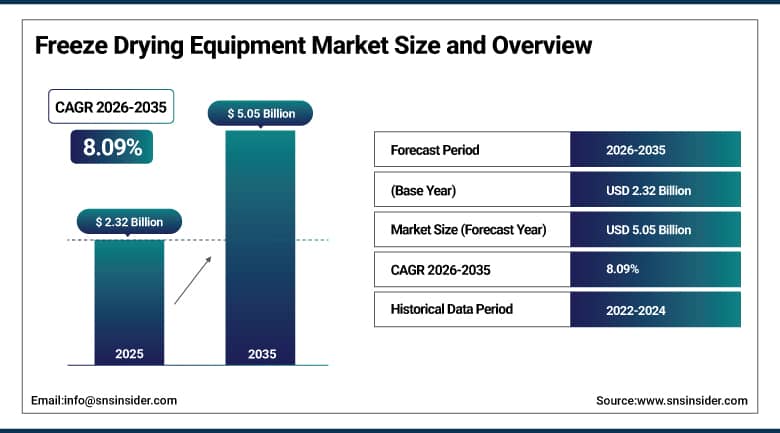
The Freeze Drying Equipment Market was valued at USD 2.32 billion in 2025 and is expected to reach USD 5.05 billion by 2035, growing at a CAGR of 8.09% from 2026–2035.
There has been an increased growth in the Freeze Drying Equipment Market due to the rise in the global demand for lyophilization, which is defined as the removal of moisture from heat-sensitive materials through sublimation using vacuum in the pharmaceuticals, biotech, food processing, and health care industries. Lyophilization or freeze drying has emerged as the industry's preferred technique for the preservation of biologicals, vaccines, enzymes, proteins, and specialized foods that deteriorate very quickly when dried through regular heating processes. Increased production of biologics such as monoclonal antibodies, cell and gene therapies, mRNA vaccines, and biosimilars has resulted in a need for large-scale lyophilization equipment used to manufacture the biological products in question. Besides, there has been a rise in consumer interest in freeze-dried foods due to their clean label, no preservatives, and nutritional content.
Moreover, the integration of automation, IoT connectivity, and real-time process analytical technology (PAT) into modern freeze drying platforms is transforming the operational landscape - enabling pharmaceutical manufacturers to achieve tighter process control, enhanced batch reproducibility, and improved regulatory compliance in GMP-regulated environments.
To Get More Information On Freeze Drying Equipment Market - Request Free Sample Report
Freeze Drying Equipment Market Trends
-
Fast-tracking the pipeline of biopharmaceuticals such as mRNA vaccines, monoclonal antibodies, cell & gene therapies, and biosimilars leading to extensive lyophilizer investments worldwide.
-
Sudden emergence of highly automated freeze dryers that incorporate robotics resulting in minimal manual handling and increased GMP compliance.
-
Creating an increasing trend for the deployment of Internet-of-Things (IoT) enabled sensor networks and Process Analytical Technology (PAT) for freeze dryers.
-
Huge increase in consumer demand for lyophilized foodstuffs ranging from fruits and vegetables to meals and beverages like coffee leading to lyophilizer investments in the food sector.
-
Surge in research and development into continuous freeze drying as an alternative approach to the existing batch-based lyophilization process.
-
Increasing preference for eco-friendly freeze dryers incorporating efficient energy management systems such as heat recovery, advanced vacuum systems, and environmentally friendly refrigerants.
-
Increase in small scale and benchtop freeze dryer installations in universities, contract research organizations, and biotechnology companies resulting in laboratory segment growth.
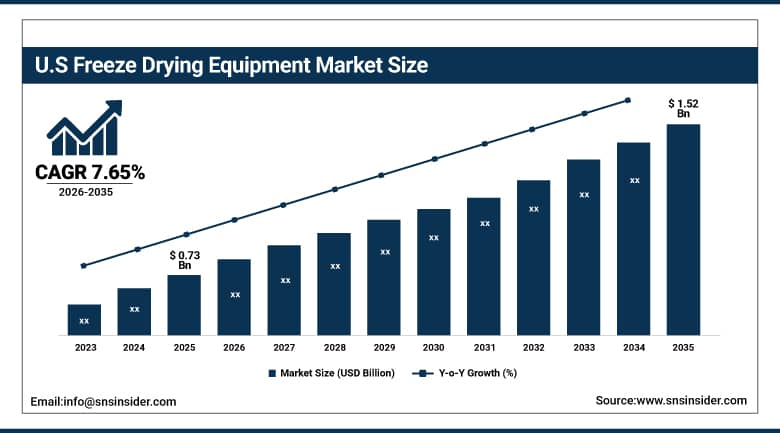
The U.S. Freeze Drying Equipment Market was valued at USD 0.73 billion in 2025 and is expected to reach USD 1.52 billion by 2035, registering a CAGR of 7.65% during 2026–2035.
United States is the most prominent market in terms of individual nations' market shares for freeze drying equipment owing to its superior pharmaceutical and biotech manufacturing capabilities, extensive academia and research-based support, and high consumption in the food, healthcare, and nutraceutical industries. Lyophilization equipment vendors based in the United States include some of the leading names such as SP Scientific, Labconco, and Millrock Technology. End-users include prominent pharmaceuticals such as Pfizer, Eli Lilly, AstraZeneca, and Abbott Laboratories that have considerable lyophilization capacity for pharmaceutical applications. Post-COVID-19 vaccine manufacturing considerations in the country have resulted in increased lyophilization equipment investments in various facilities.
Growing adoption of freeze drying in the burgeoning U.S. clean-label food sector, alongside increasing demand for freeze-dried ingredients in the military ration, outdoor recreation, and emergency preparedness markets, is broadening the application base for freeze drying equipment beyond its traditional pharmaceutical stronghold. Federal funding for advanced manufacturing R&D - including BARDA investments in vaccine production capacity - is expected to continue supporting lyophilizer procurement in the U.S. through 2035.
Freeze Drying Equipment Market Segment Insights
-
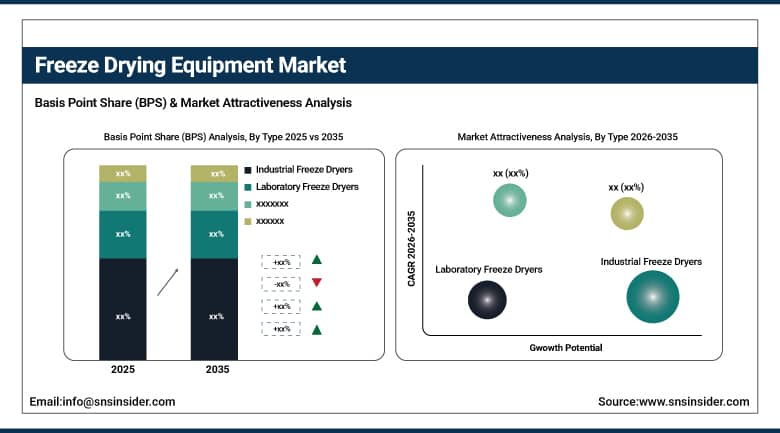
Based on Type, Industrial Freeze Dryers accounted for the largest market share (~38%) in 2025; Laboratory Freeze Dryers expected to be the fastest-growing segment (CAGR), driven by expansion of biotech R&D and contract research activity.
-
Based on Application, Food Processing accounted for the largest market share (~37%) in 2025; Pharmaceuticals expected to be the fastest-growing application segment (CAGR), driven by biologics pipeline expansion and lyophilized drug demand.
By Type, Industrial Freeze Dryers segment dominates the Freeze Drying Equipment Market, Laboratory Freeze Dryers segment expected to grow fastest
The Industrial Freeze Dryers segment maintained the largest market share in 2025, accounting for approximately 38% of total revenue. Industrial freeze dryers - characterized by large-capacity drying chambers, high throughput, fully automated loading and unloading systems, and compliance with cGMP regulatory standards - are indispensable in the pharmaceutical, food processing, and biotechnology industries where large-scale batch production is required. The pharmaceutical industry's reliance on industrial lyophilizers for the commercial-scale production of vaccines, biologics, and parenteral drug formulations is the primary demand anchor for this segment. These systems, valued at several million dollars per unit, represent significant capital investments for pharmaceutical manufacturers - investments that are being accelerated by the rapid expansion of biosimilar, mRNA vaccine, and cell therapy manufacturing capacity globally.
The Laboratory Freeze Dryers sub-segment is projected to witness the highest CAGR from 2026 to 2035, due to high and growing demand from the global start-up biotech industry, contract research organizations, research laboratories, and early-stage drug discovery programs. With the continuous expansion of the global pharma research and development pipeline, which includes a record number of biologics drugs at different stages of testing and development, the demand for freeze drying equipment that can work efficiently in the laboratory scale on small quantities of samples is expected to grow consistently.
By Application, Food Processing segment dominates the Freeze Drying Equipment Market, Pharmaceuticals segment expected to grow fastest
The Food Processing segment led the Freeze Drying Equipment market in 2025, accounting for approximately 37% of total revenue. Freeze drying is uniquely positioned as the premium food preservation technology because it preserves the natural flavor, color, aroma, texture, and nutritional content of food products far more effectively than heat-based drying or chemical preservation methods. Freeze-dried fruits, vegetables, prepared meals, coffee, dairy, herbs, and nutraceutical ingredients command significant price premiums over conventionally preserved alternatives. The rising global demand for clean-label, additive-free, and long shelf-life food products - particularly for outdoor adventure, military rations, emergency preparedness, and premium consumer goods - is driving sustained lyophilizer investments across the food processing sector. Leading food manufacturers and contract freeze-drying service providers are expanding lyophilization capacity to meet growing demand for premium freeze-dried products.
The Pharmaceuticals segment is projected to record the fastest CAGR from 2026 to 2035, Pharmaceuticals is estimated to have the highest CAGR over the forecast period of 2026-2035, owing to the extraordinary growth of the biopharmaceutical drug pipeline globally and increasing use of lyophilized formulations for drugs. It is reported that around half of all novel injectable biological drugs need lyophilization to remain stable; a percentage predicted to rise further as more complex large molecule therapies enter the market through clinical trials. The launch of new mRNA drugs, antibody-drug conjugate (ADCs), gene therapy vectors, and vaccine candidates has led to an increased demand for large-scale GMP-grade lyophilizers with state-of-the-art automation and inline inspection systems. Leading drug makers like Pfizer, Sanofi, and GSK have made major investment decisions in lyophilization technologies.
Freeze Drying Equipment Market Regional Analysis:
|
Region |
Major Country |
Share within Region (%) |
|---|---|---|
|
North America |
United States |
~85% |
|
Europe |
Germany |
~30% |
|
Asia Pacific |
China |
~46% |
|
Middle East & Africa |
UAE |
~31% |
|
Latin America |
Brazil |
~49% |
North America Freeze Drying Equipment Market Insights
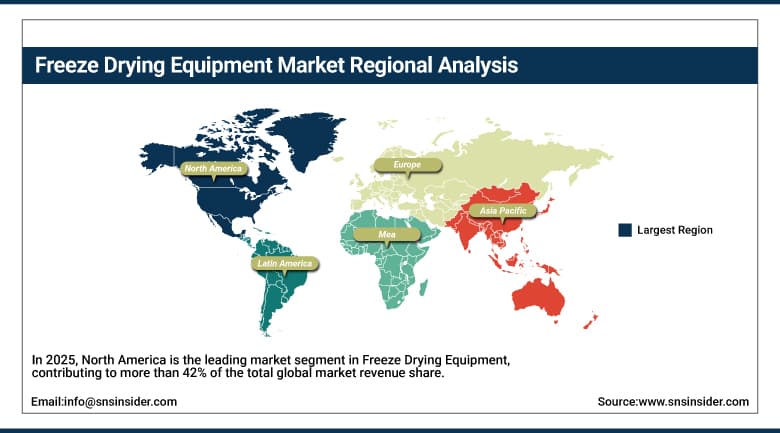
In 2025, North America is the leading market segment in Freeze Drying Equipment, contributing to more than 42% of the total global market revenue share. The United States is the market leader in this regard, owing to its leadership in the development of the pharmaceutical and biotechnological manufacturing industries, coupled with well-endowed research infrastructure and strong demand from food processing and defense applications. The United States pharmaceutical industry is currently the largest end-user of freeze drying systems, with the likes of Pfizer, Eli Lilly, AstraZeneca, and Amgen operating a huge lyophilization footprint at their domestic facilities. The post-pandemic trend towards making the U.S. self-sufficient for vaccine manufacturing will keep the market growth momentum going until 2035.
Get Customized Report as Per Your Business Requirement - Enquiry Now
Asia Pacific Freeze Drying Equipment Market Insights
The Asia Pacific region is currently considered the fastest-growing regional market for Freeze Drying Equipment and is poised for continued growth at a robust double-digit CAGR during the period between 2026 and 2035. The largest regional market is China, being both the biggest consumer and a large exporter of industrial freeze drying equipment because of the swift growth witnessed in the production capability within the country's pharmaceutical and food processing industries. The second-largest regional market will be India, which is driven by the flourishing biologics and vaccines manufacturing sector of the country where companies like the Serum Institute of India and Bharat Biotech are majorly investing in lyophilizers. Demand from the developed pharmaceuticals and advanced material industry in Japan and South Korea is also noteworthy.
Europe Freeze Drying Equipment Market Insights
In 2025, Europe accounted for a major stake of the Freeze Drying Equipment market, with Germany, France, the UK, and Italy being the top countries within Europe. Europe is characterized by its extensive presence of highly advanced pharmaceutical companies, strict GMP regulation compliance by the EMA, and high consumption of quality freeze-dried foods. German freeze drying equipment manufacturers such as GEA Group and Martin Christ have a world-renowned reputation for designing industrial lyophilizers, and their exports have already gained a position in North America, the Asia Pacific region, and other emerging regions. Adoption of the new EU GMP Annex 1 regulations regarding sterile drug production is compelling European pharmaceutical companies to incorporate advanced automated and isolator-equipped lyophilization systems.
Middle East & Africa and Latin America Freeze Drying Equipment Market Insights
While markets in the Middle East & Africa and Latin America are at early stages of maturity, they show strong growth potential backed up by increasing pharmaceutical manufacturing investments, rising levels of sophistication of food processing industries, and rising healthcare infrastructure. The UAE and Saudi Arabia drive the Middle East & Africa market by means of their pharmaceutical localization policies and the need for long shelf-life foods suitable for the climatic conditions of the region and exports. Brazil drives the Latin American market, again due to its pharmaceutical and food processing industries, and sees increased investments in lyophilization technologies, both for domestic purposes and exports to other parts of the region.
Freeze Drying Equipment Market Growth Drivers:
-
Rising demand for lyophilization in pharmaceutical biologics and vaccine manufacturing drives equipment investment
The key driver behind the growth of the Freeze Drying Equipment market is the explosive growth witnessed in the pipeline of pharmaceutical biologics and the subsequent rise in demand for lyophilization capabilities at an industrial scale. Biologics such as monoclonal antibodies, vaccines, cell/gene therapies, antibody-drug conjugates (ADCs), and protein-based therapies are sensitive to heat and need to undergo lyophilization to attain stability, increased shelf life, and reconstitution capability, which is critical for clinical and commercial applications. The success of mRNA vaccines used to fight the COVID-19 pandemic showcased how easily scalable lyophilization could be for vaccines, making future investments in lyophilization capabilities more lucrative for vaccine makers and mRNA therapeutics producers. With more than 2,000 biologic drugs in development across the globe, the forecasted demand for lyophilization is highly promising.
Analysis of the industry highlights that lyophilized drug products can generate a higher premium than liquid drug products due to their enhanced stability and reduced cold chain logistics needs – offering pharmaceutical companies’ strong economic motivation to build lyophilization capabilities. Significant capital investments being made by companies like GSK, Pfizer, Sanofi, and emerging biotechs in lyophilization facilities are expected to drive demand for freeze drying equipment.
Freeze Drying Equipment Market Restraints
-
High capital investment, lengthy cycle times, and energy-intensive operations limiting adoption among cost-sensitive manufacturers
The major limitation faced by the Freezing Drying Equipment market is the enormous cost involved in the procurement of the industrial freeze dryer equipment, the high-energy consumption in freeze drying and the difficulty associated with developing freeze cycles. The price of industrial freeze dryers equipped with automatic feeding system is usually between two to ten million US dollars per piece. Therefore, such huge initial investments make it difficult for SMEs, especially small pharmaceutical and biotech firms, as well as food processing firms in developing countries to acquire industrial freeze drying equipment. In addition, freeze drying process is not fast and its duration takes anything between 24 and 72 hours in most cases. As a result, the freeze drying process lags behind other dehydration techniques like spray drying.
Freeze Drying Equipment Market Opportunities
-
Continuous lyophilization technology, expanding CDMO capacity, and emerging food sector applications creating high-growth opportunities
The development and commercialization of continuous freeze drying technology represents one of the most transformative opportunities in the Freeze Drying Equipment market through 2035. Unlike conventional batch lyophilization - which requires lengthy loading, freezing, primary drying, and secondary drying cycles that can extend over multiple days - continuous freeze drying enables uninterrupted processing of product streams, dramatically improving throughput, equipment utilization, and production economics. Several leading equipment manufacturers and academic research institutions are actively developing continuous lyophilization platforms, with early commercial implementations in pharmaceutical manufacturing expected within the forecast period. Simultaneously, the global expansion of CDMO lyophilization capacity is creating significant equipment procurement demand as contract manufacturers invest in industrial freeze dryers to serve growing outsourcing demand from pharmaceutical and biotech companies. In the food sector, the premiumization of freeze-dried ingredients in functional foods, nutraceuticals, specialty coffee, and gourmet food products is opening new high-margin application segments for lyophilizer manufacturers targeting the food processing industry.
Recent Developments:
-
2026: Multiple global CDMOs announced capacity expansions of industrial lyophilization lines to address growing biologic drug manufacturing outsourcing demand. Leading equipment manufacturers including GEA Group and Syntegon introduced next-generation freeze drying platforms with integrated robotics, inline vial inspection, and AI-assisted cycle development tools targeting pharmaceutical GMP manufacturing applications.
-
October 2024: GEA Group unveiled a new energy-efficient industrial freeze dryer model featuring heat recovery systems and an advanced vacuum management architecture, designed to reduce operational energy consumption by up to 25% compared to prior-generation equipment - addressing growing pharmaceutical manufacturer sustainability mandates and reducing lifecycle operating costs.
-
June 2024: Syntegon completed the full acquisition of Azbil Telstar, a prominent lyophilization equipment manufacturer and subsidiary of Japan's Azbil Corporation, significantly expanding Syntegon's global freeze drying equipment portfolio, engineering capabilities, and customer base across pharmaceutical and biotechnology manufacturing markets in Europe, Asia Pacific, and the Americas.
Freeze Drying Equipment Market Key Players
-
GEA Group
-
Thermo Fisher Scientific
-
SP Scientific (SP Industries)
-
Labconco Corporation
-
Syntegon (incl. Azbil Telstar)
-
IMA Life
-
BUCHI Labortechnik
-
Martin Christ Gefriertrocknungsanlagen GmbH
-
Shanghai Tofflon Science and Technology Co., Ltd.
-
Millrock Technology
-
Optima Packaging Group GmbH
-
Cuddon Freeze Dry
-
MechaTech Systems Ltd.
-
HOF Enterprise Group
-
Harvest Right
Freeze Drying Equipment Market Report Scope:
| Report Attributes | Details |
|---|---|
|
Market Size in 2025 |
USD 2.32 Billion |
|
Market Size by 2035 |
USD 5.05 Billion |
|
CAGR |
CAGR of 8.09% From 2026 to 2035 |
|
Base Year |
2025 |
|
Forecast Period |
2026-2035 |
|
Historical Data |
2022-2024 |
|
Report Scope & Coverage |
Market Size, Segments Analysis, Competitive Landscape, Regional Analysis, DROC & SWOT Analysis, Forecast Outlook |
|
Key Segments |
• By Type (Industrial Freeze Dryers, Pilot-Scale Freeze Dryers, Laboratory Freeze Dryers, Bench Top Freeze Dryers, Mobile Freeze Dryers) |
|
Regional Analysis/Coverage |
North America (US, Canada, Mexico), Europe (Eastern Europe [Poland, Romania, Hungary, Turkey, Rest of Eastern Europe] Western Europe] Germany, France, UK, Italy, Spain, Netherlands, Switzerland, Austria, Rest of Western Europe]), Asia Pacific (China, India, Japan, South Korea, Vietnam, Singapore, Australia, Rest of Asia Pacific), Middle East & Africa (Middle East [UAE, Egypt, Saudi Arabia, Qatar, Rest of Middle East], Africa [Nigeria, South Africa, Rest of Africa], Latin America (Brazil, Argentina, Colombia, Rest of Latin America) |
|
Company Profiles |
GEA Group, Thermo Fisher Scientific, SP Scientific (SP Industries), Labconco Corporation, Syntegon (incl. Azbil Telstar), IMA Life, BUCHI Labortechnik, Martin, Christ Gefriertrocknungsanlagen GmbH, Shanghai Tofflon Science and Technology Co., Ltd., Millrock Technology, Optima Packaging Group GmbH, Cuddon Freeze Dry, MechaTech Systems Ltd., HOF Enterprise Group, Harvest Right |
Frequently Asked Questions
The Freeze Drying Equipment Market was valued at USD 2.32 billion in 2025.
The rising global demand for lyophilization in pharmaceutical biologics and vaccine manufacturing, combined with increasing adoption of automation and IoT-integrated freeze drying systems and growing consumer preference for freeze-dried, preservative-free food products.
The Industrial Freeze Dryers segment dominated the Freeze Drying Equipment Market in 2025, accounting for approximately 38% of total market revenue, driven by large-scale pharmaceutical, food processing, and biotechnology production requirements.
The Food Processing segment dominated the Freeze Drying Equipment Market in 2025 with approximately 37% revenue share, driven by rising consumer demand for freeze-dried food products with preserved nutritional value and extended shelf life.
North America dominated the Freeze Drying Equipment Market in 2025, accounting for over 42% of global market revenue, led by the United States' advanced pharmaceutical and biotechnology manufacturing ecosystem and strong food processing sector demand.
The Freeze Drying Equipment Market is expected to grow at a CAGR of 8.09% from 2026 to 2035.
