
Fusion Energy Market Report Scope and Overview:
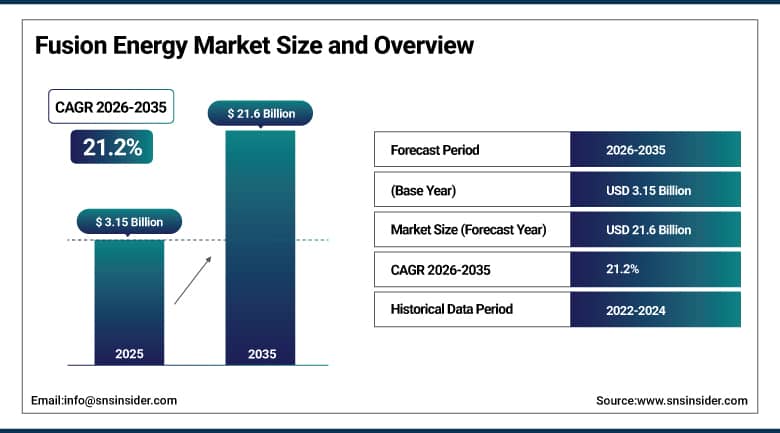
The Fusion Energy Market was valued at USD 3.15 Billion in 2025 and is projected to reach USD 21.6 Billion by 2035, registering a CAGR of 21.2% from 2026 to 2035.
The Fusion Energy Market is changing the future of renewable baseload energy through innovation in tokamak, stellarator, and laser fusion inertial confinement reactor technologies that can achieve net energy gain. The market is marked by increased private and governmental investments in the demonstration of reactors, increased use of high-temperature superconducting magnets, increased investment in fuel cycle and tritium breeding capacity, and its usage in grid electricity production, process heat, and hydrogen production.
The increase in reactor demonstration milestone, magnet commercialization, and utility power purchase agreements has been realized as a result of the large investments that have been made by the fusion developers, national laboratories, and utility companies to improve their deployment capability in response to the growing demands.
To Get More Information On Fusion Energy Market - Request Free Sample Report
Fusion Energy Market Trends
-
Expanding high-temperature superconducting magnet deployment continues improving tokamak compactness and plasma confinement performance.
-
Growing private investment in laser-driven inertial fusion continues accelerating net energy gain demonstration timelines.
-
Rising utility and hyperscaler power purchase agreements continue expanding the addressable base for commercial fusion electricity offtake.
-
Increasing government funding for fuel cycle and tritium breeding programs continues strengthening reactor fuel self-sufficiency.
-
Growing adoption of AI-driven plasma control platforms continues reducing disruption risk and operational downtime in demonstration reactors.
U.S. Fusion Energy Market Size Outlook
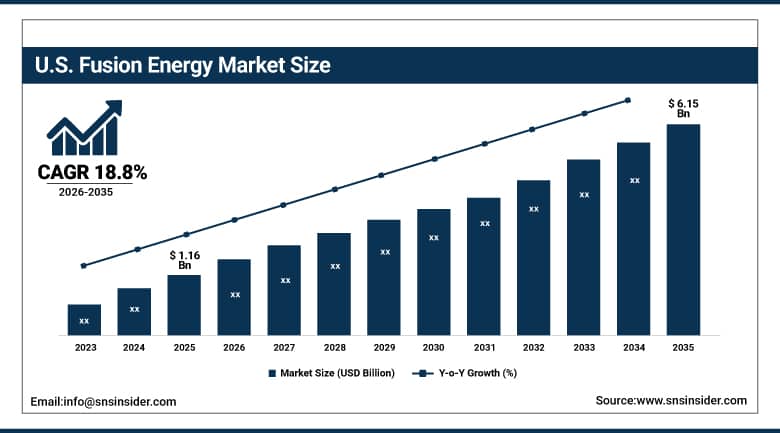
The U.S. Fusion Energy Market was valued at approximately USD 1.16 Billion in 2025 and is projected to reach approximately USD 6.15 Billion by 2035, registering a CAGR of approximately 18.8% from 2026 to 2035.
Demand for clean and reliable electricity in the US was also fueled by massive investments in the research of demonstration reactors, aggressive fundraising by local fusion energy startups working towards achieving net energy gain, and strong demand from utility and tech companies for firm commitments to buy power that is guaranteed to be emission-free.
The utilization of high-temperature superconducting magnet systems along with the implementation of AI-controlled plasma in major reactors has been crucial in raising the reputation of the United States as the largest buyer of fusion technology in the world. Apart from this, the use of fusion technology in power generation, defense-related studies, and industrial heating processes has been fueling the high domestic demand for this clean energy technology.
Fusion Energy Market Segment Analysis
-
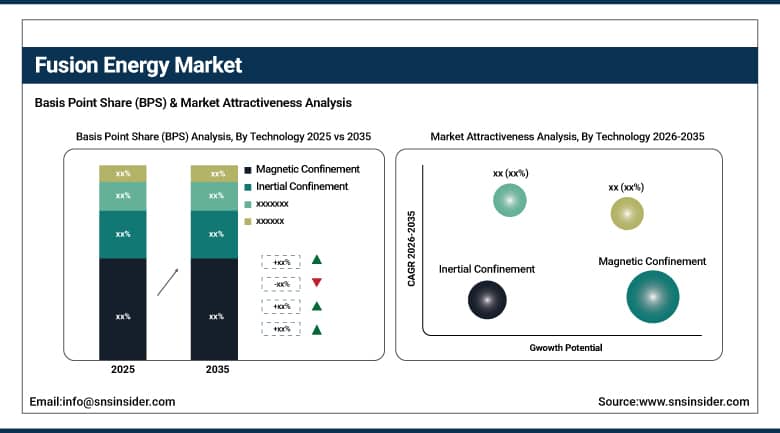
By Technology, Magnetic Confinement segment dominated the Fusion Energy Market in 2025 with 61% share; Inertial Confinement segment is the fastest growing segment.
-
By Component, Magnet & Coil Systems segment dominated the market in 2025 with 34% share; Diagnostics & Control Systems segment is the fastest growing segment.
-
By Fuel Type, Deuterium-Tritium segment dominated the market in 2025 with 68% share; Deuterium-Helium-3 segment is the fastest growing segment.
-
By Application, Electricity Generation segment dominated the market in 2025 with 57% share; Industrial Process Heat & Hydrogen Production segment is the fastest growing segment.
-
By End User, Government & Research Institutes segment dominated the market in 2025 with 49% share; Utilities segment is the fastest growing segment.
By Technology, Magnetic Confinement Leads, Inertial Confinement Grows Fastest
Magnetic Confinement dominated the Fusion Energy Market in 2025 because of the long technological history behind this approach as well as the proven capability of sustaining and controlling high-temperature plasmas within tokamaks and stellarators. This technology has been used by utilities and national labs for the longest sustained period of experimentation in this space, thereby becoming the most reliable route for the commercialization of fusion energy. Further advances made by technology companies like Commonwealth Fusion Systems with its SPARC tokamak and Tokamak Energy with its spherical tokamak system have made Magnetic Confinement more dominant than any other fusion technologies.
Inertial Confinement is expected to register the fastest growth rate amongst all types of technologies in the Fusion Energy Market owing to advancements in laser fusion based systems following the successful demonstration of net energy gain at the National Ignition Facility. Development of the laser fusion system through the company Focused Energy, which has received USD 240 Million Series A investment towards scaling of target and laser driver technologies, highlights the ongoing development of this type of technology apart from that demonstrated in laboratories under the governance of governments.
By Component, Magnet & Coil Systems Dominate, Diagnostics & Control Systems Grow Fastest
The Magnet & Coil Systems are said to contribute the largest revenue from a component point of view in the Fusion Energy Market in 2025 as the high temperature superconducting magnet systems form the backbone of any investment that should be made in the tokamak or stellarator fusion reactors for their completion. It is the emphasis of the developers on the acquisition of high-field superconducting magnet system for their demonstration reactors which makes it the dominating revenue source for the fusion supply chain despite the advancement in the diagnostic and control software segment.
The Diagnostics & Control Systems category of the Fusion Energy market is anticipated to witness the fastest growth rate during the forecast period due to the shift from manual monitoring of plasma to using AI-based predictive control that could stabilize the disruption automatically, without any human assistance. The digital twin solution jointly created by Commonwealth Fusion Systems and NVIDIA & Siemens is an example of this, as the fusion of AI with state-of-the-art plasma control software enables operators to treat the reactor as a complete system.
By Fuel Type, Deuterium-Tritium Leads, Deuterium-Helium-3 Grows Fastest
Deuterium-Tritium was the leading segment in the Fusion Energy Market in 2025 due to its considerably lower ignition temperature and greater energy output when contrasted with other fuel cycles, thus being the technically most feasible approach to prove the possibility of obtaining net energy gain. ITER and Commonwealth Fusion Systems are among the manufacturers of such reactors that use the deuterium-tritium fuel cycle, and the licensing in 2026 of the cryogenic pellet fueling technique by Oak Ridge National Laboratory to Type One Energy is a clear indicator of the further development of the fuel market.
The Deuterium-Helium-3 fuel type is set to be the fastest growing one among other fuel types in the market for Fusion Energy. This is due to the development of aneutronic fuel cycles by organizations such as Helion Energy that will result in lower neutron activation as well as less demanding reactor shielding requirements. The power purchase agreement between Helion and Microsoft, in which fusion electricity will be delivered as early as 2028, has led to increased attention towards helium-3 fuel source techniques.
By Application, Electricity Generation Leads, Industrial Process Heat Grows Fastest
The Electricity Generation segment held the leading position in the Fusion Energy Market in 2025, owing to the large number of power purchase agreements entered into by utilities and hyperscale technology firms for grid-scale electricity generation projects. The application segment has the advantage of leveraging existing transmission infrastructure and business models of utilities such as Google’s power purchase agreement with Commonwealth Fusion Systems for its proposed Fall Line Fusion Power Station in Virginia. The electricity generation application segment is the most funded application segment amongst all the fusion developers globally.
The Industrial Process Heat & Hydrogen Production application segment represents the fastest growing application segment within the Fusion Energy Market. It has been gaining a lot of attention from industries that are looking to decarbonize their high-temperature manufacturing processes, which are not feasible to be powered by renewable energy. The work done by Kyoto Fusioneering in heat capture and hydrogen co-generation for fusion power plants is a testament to the importance of the idea of industrial process heat usage in fusion development.
By End User, Government & Research Institutes Dominate, Utilities Gain Fastest Traction
The government and research institutes were at the forefront of the end-user segment share in the Fusion Energy Market in 2025 because national laboratories and multilateral projects like ITER have been sponsoring most of the major experiments carried out in reactors and plasma physics. The large-scale government investment in the United States, European Union, and China indicates that government-funded programs are considering fusion energy for securing their future energy requirements, and hence are the main driving forces in the adoption of fusion energy technology.
The utilities are expected to dominate the Fusion Energy Market as the end-users due to the fact that there have been early-stage agreements between grid operators and the technology companies for carbon-free and dispatchable capacity in preparation for the increase in energy demand by data centers and electrification in the future. It is because of the increasing trend of technology companies investing in utility-scale fusion power stations that utilities are growing faster than other end-users.
Regional Analysis:
|
Region |
Major Country |
Share within Region, 2025 (%) |
|---|---|---|
|
North America |
United States |
88.70% |
|
Europe |
Germany |
33.20% |
|
Asia Pacific |
China |
44.60% |
|
Middle East and Africa |
Saudi Arabia |
26.40% |
|
Latin America |
Brazil |
31.80% |
North America Fusion Energy Market Insights
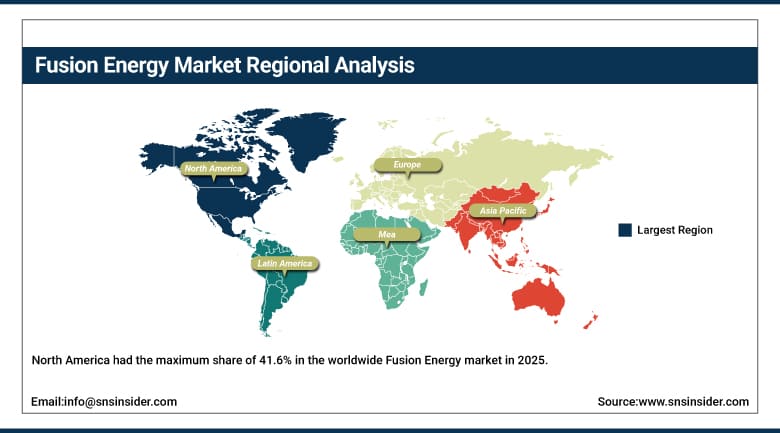
North America had the maximum share of 41.6% in the worldwide Fusion Energy market in 2025. This was possible due to the growth in investments made by the private sector into the demo reactors, presence of the best funded fusion companies globally, and consistent investments into the national labs and defense departments for research on magnetic and inertial fusion energy. A good relationship between the reactor manufacturers, superconducting magnets manufacturers, and utility companies working towards utilizing the output from the reactors in their home country has also played an important role.
The United States accounted for around 88.70% of the total revenue market share of North America because of its presence and continuous raising of funds by Commonwealth Fusion Systems, Helion Energy, and TAE Technologies, along with power purchase agreements made by technology firms like Microsoft and Google. Increased budgeting for fusion research by the Department of Energy and ARPA-E and involvement of Canada through General Fusion in fusion research contributed to North America's dominant position in the market.
Get Customized Report as Per Your Business Requirement - Enquiry Now
Europe Fusion Energy Market Insights
Europe had a sustainable market share in the global revenue generation from the Fusion Energy Market because of the availability of the international partnership known as ITER, along with the visionary national fusion strategies and considerable investments in stellarator and laser fusion research programs. The increased collaboration between the public and private sectors through agencies like the United Kingdom Atomic Energy Authority and Federal Ministry for Research, Technology and Space in Germany has encouraged the developers in Europe to focus on scalable fuel cycle and magnet technology solutions.
Germany emerged to be the most demanding market amongst all other European countries, generating almost 33.20% of Europe's total revenue because of significant investment made in lasers and magnetic fusion technology clusters and the presence of production plants of Focused Energy, Marvel Fusion, and Proxima Fusion companies in the country. Another significant contributor to market demands in the region was the United Kingdom, which is providing significant contributions to regional market demand owing to its spherical tokamak technology of Tokamak Energy and collaboration between UKAEA and Eni for fusion fuel cycle. The rising demands of fusion energy technology in Europe are expected to increase in future.
Asia Pacific Fusion Energy Market Insights
The Asia-Pacific region is experiencing the fastest growth rate among all the other regions analyzed in the market, with the expected CAGR of 25.6% for 2026-2035 owing to substantial investments made by various governments in the construction of tokamak infrastructure in China and Japan, increased governmental emphasis on ensuring sustainable energy self-sufficiency in the long run, and rapid development of manufacturing capabilities for superconducting magnets and reactors in this region. The sum effect of various factors discussed above guaranteed the fact that this region experienced the fastest growth rate compared to all other regions analyzed in the report.
This category was dominated by China owing to significant tokamak infrastructure investments such as the Burning Plasma Experimental Facility, BEST and the superconducting compact high field tokamak from Energy Singularity, making up for 44.60% of the revenues of the region. The other countries that have contributed to this result include Japan because of its collaborative research in fusion technology under Kyoto Fusioneering and South Korea because of its KSTAR-related superconducting tokamaks.
MEA and Latin America Fusion Energy Market Insights
Fusion Energy Market in the Middle East, Africa, and Latin America exhibited consistent growth due to the growing number of sovereign wealth funds investing in energy solutions technology, the involvement of governments in energy diversification projects in the long run, and the cooperation between research institutions of these regions and international fusion providers. The early adoption of future-generation clean baseload technologies was increasingly gaining importance as a strategically vital aspect for the energy diversification projects implemented in the regions due to the insufficiency of renewable generation capacities to meet future demand.
In ME&A, Saudi Arabia was the biggest country market in terms of the market because of its increased advanced energy technology investments through its sovereign wealth funds, as well as increased nuclear and fusion research partnerships. In addition, within ME&A, there were contributions from the implementation of fusion research partnerships within the UAE. Within LATAM, the biggest revenue generator was Brazil as a result of its large number of research universities and increased plasma physics research programs.
Market Dynamics:
Growth Drivers: Rising Private Investment in Demonstration Reactors and Expanding Utility Power Purchase Agreements
The market is driving because of investor confidence in the reactors approaching net gain of energy, increased usage of high-temperature superconducting magnet technology, increased investments in fuel cycle and tritium breeding independence, and an expanded set of applications, such as electricity generation, industrial process heat, and hydrogen production. As more and more technology companies are making announcements of power purchase agreements for future deliveries of fusion electricity, the need for concrete milestones and timelines for commercialization will guarantee that the ability to raise funds by developers stays high throughout the supply chain.
Increasing collaboration among reactor designers and national laboratories, along with increasing dedication from power companies to acquire baseload capacity that is carbon free in anticipation of future regulation on grid decarbonization reporting, constitute additional supporting evidence for this trend. Capital investment by venture and sovereign investors in the development of demonstration reactors is adding to the growing baseline capability, and this is all adding up to ever-increasing demand during the forecast period.
Restraints: High Capital Intensity and Technical Uncertainty in Net Energy Gain
The high level of capital expenditure remains a constraint for the further rapid development of the market since demonstration reactors cost billions of dollars in terms of superconducting magnets, vacuum vessels, and laser drivers before any profits are made from the venture. It is owing to this reason that the leading-edge reactor technology is developed only by well-funded companies that have access to venture capital or government and corporate funding as shown in the case of General Fusion in 2025.
Technical uncertainty remains a challenge because none of the existing fusion devices has achieved continuous net energy production yet; thus, investment into these technologies needs to occur several years in advance of commercialization. It is a challenge that can be solved through plasma stability studies and material sciences developments, which is a dynamic process requiring large amounts of funding from both reactor designers and research institutions within the government.
Opportunities: AI-Driven Plasma Control and Data Center Power Demand Growth
Increased funding in artificial intelligence (AI) powered plasma control and digital twin technologies becomes a major trend as developers commit to long-term reactor optimization contracts, in which the entire system is built – that includes magnet performance, plasma diagnostics and AI-based disruption mitigation. Companies that are capable of attracting early customers of their electricity, such as Commonwealth Fusion Systems with its contract with Google, will be able to claim a sizable market share as they move from single reactors demonstrations to commercial power plants.
A third potential opportunity is presented by the development of the power demands of data centers and artificial intelligence, because the hyperscale technology companies that operate in power-starved grids are actively searching for firm dispatchable carbon-free power sources and fusion technologies can deliver that capability to them via power purchase agreements. Those developers who can show credibility of time lines will get substantial market share.
Recent Developments:
-
2026: Commonwealth Fusion Systems raised USD 1 Billion in additional equity financing to advance construction of its SPARC tokamak and support planning for the 400-megawatt Fall Line Fusion Power Station in Virginia.
-
2026: Focused Energy raised USD 240 Million in a Series A funding round, the largest in fusion industry history, to scale its laser-driven inertial fusion target manufacturing and laser-driver platform.
Fusion Energy Companies are:
-
TAE Technologies, Inc.
-
Helion Energy, Inc.
-
Tokamak Energy Ltd
-
General Fusion Inc.
-
Type One Energy Group
-
Focused Energy GmbH
-
Pacific Fusion Corp.
-
Xcimer Energy Inc.
-
Proxima Fusion GmbH
-
Marvel Fusion GmbH
-
Realta Fusion, Inc.
-
Shine Technologies, LLC
-
Renaissance Fusion SAS
-
Thea Energy, Inc.
-
Avalanche Energy Designs, Inc.
-
Kyoto Fusioneering Ltd.
-
General Atomics
-
Energy Singularity (Shanghai) Co., Ltd.
Fusion Energy Market Report Scope:
| Report Attributes | Details |
|---|---|
| Market Size in 2025 | USD 3.15 Billion |
| Market Size by 2035 | USD 21.6 Billion |
| CAGR | 21.2% from 2026 to 2035 |
| Base Year | 2025 |
| Forecast Period | 2026-2035 |
| Historical Data | 2022-2024 |
| Report Scope & Coverage | Market Size, Segments Analysis, Competitive Landscape, Regional Analysis, DROC & SWOT Analysis, Forecast Outlook |
| Key Segments | •By Technology, Magnetic Confinement segment dominated the Fusion Energy Market in 2025 with 61% share; Inertial Confinement segment is the fastest growing segment. •By Component, Magnet & Coil Systems segment dominated the market in 2025 with 34% share; Diagnostics & Control Systems segment is the fastest growing segment. •By Fuel Type, Deuterium-Tritium segment dominated the market in 2025 with 68% share; Deuterium-Helium-3 segment is the fastest growing segment. •By Application, Electricity Generation segment dominated the market in 2025 with 57% share; Industrial Process Heat & Hydrogen Production segment is the fastest growing segment. •By End User, Government & Research Institutes segment dominated the market in 2025 with 49% share; Utilities segment is the fastest growing segment. |
| Regional Analysis/Coverage | North America (US, Canada), Europe (Germany, UK, France, Italy, Spain, Russia, Poland, Rest of Europe), Asia Pacific (China, India, Japan, South Korea, Australia, ASEAN Countries, Rest of Asia Pacific), Middle East & Africa (UAE, Saudi Arabia, Qatar, South Africa, Rest of Middle East & Africa), Latin America (Brazil, Argentina, Mexico, Colombia, Rest of Latin America). |
| Company Profiles |
Commonwealth Fusion Systems, TAE Technologies, Inc., Helion Energy, Inc., Tokamak Energy Ltd, General Fusion Inc., Zap Energy, Inc., Type One Energy Group, Focused Energy GmbH, Pacific Fusion Corp., Xcimer Energy Inc., Proxima Fusion GmbH, Marvel Fusion GmbH, Realta Fusion, Inc., Shine Technologies, LLC, Renaissance Fusion SAS, Thea Energy, Inc., Avalanche Energy Designs, Inc., Kyoto Fusioneering Ltd., General Atomics, Energy Singularity (Shanghai) Co., Ltd. |

Frequently Asked Questions
Key players include Commonwealth Fusion Systems, TAE Technologies, Inc., Helion Energy, Inc., Tokamak Energy Ltd, and General Fusion Inc., among others.
Key opportunities include increasing investments in fusion research, advancements in reactor technologies, rising demand for carbon-free baseload power, public-private partnerships, and growing commercialization efforts.
The major growth factor is rising private and government investment in demonstration reactors, expanding high-temperature superconducting magnet deployment, and growing utility power purchase agreements for future fusion electricity delivery.
The Magnetic Confinement segment dominated the Fusion Energy Market by technology, representing the largest share of revenue in 2025.
North America dominated the Fusion Energy Market in 2025, holding an estimated 41.6% share of total global market revenue.
