
Geophysical Services Market Report Scope & Overview:
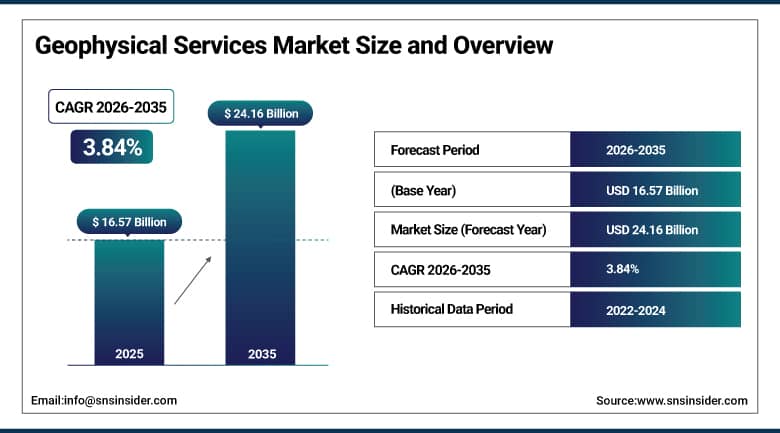
The Geophysical Services Market was valued at USD 16.57 Billion in 2025 and is projected to reach USD 24.16 Billion by 2035, expanding at a CAGR of 3.84% during the forecast period 2026–2035.
The market for geophysical services across the world is seeing consistent growth due to greater investment in the exploration of natural resources, increased use of advanced imaging technology for the subsurface, and the rising need for geological data for various uses including energy production, mining, infrastructure, and environment. Providers of geophysical services are using advanced seismic acquisition systems, AI-powered geological data analysis tools, satellite-based monitoring systems, and advanced subsurface modeling technologies to improve the efficiency of exploration process and manage the risks involved in it. The move towards energy diversification, mining of critical minerals, carbon storage, and geothermal resource development is giving rise to new business opportunities for geophysical services companies.
Several geophysical service providers during 2025-2026 have invested significantly in AI-based seismic interpretation systems, advanced marine survey vessels, autonomous survey systems, and digital subsurface modeling systems.
To Get More Information On Geophysical Services Market - Request Free Sample Report
Geophysical Services Market Trends:
-
Increasing deployment of AI-powered subsurface imaging and geological interpretation platforms.
-
Growing exploration activities for critical minerals supporting energy transition initiatives.
-
Rising investments in offshore oil and gas exploration projects globally.
-
Expanding utilization of geophysical surveys for carbon capture and storage site assessment.
-
Growing adoption of satellite-based and remote sensing geophysical technologies.
U.S. Geophysical Services Market Size Outlook:
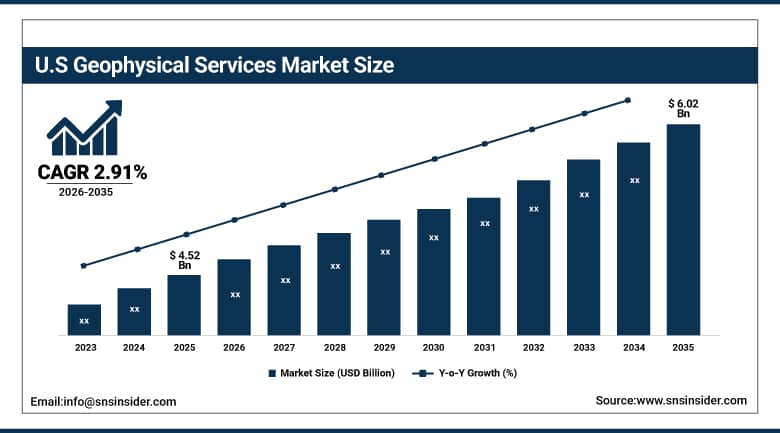
The U.S. Geophysical Services Market was valued at USD 4.52 billion in 2025 and is expected to reach approximately USD 6.02 billion by 2035, expanding at a CAGR of 2.91% during 2026–2035.
The United States still holds a strong position in the North American geophysical services industry due to extensive oil and gas exploration, large-scale unconventional resources development, sophisticated survey facilities, and investments in mineral exploration and energy transition initiatives. Large energy organizations have begun to embrace sophisticated technologies such as high-resolution seismic imaging technology, AI-based reservoir characterization solutions, sophisticated electromagnetic surveying techniques, and advanced geological modeling solutions to increase exploration efficiency and minimize drilling risks. Increased investments in carbon storage sites assessment, geothermal resources assessment, and critical minerals exploration have opened up new growth avenues for geophysical service providers in the region.
In 2026, a number of geophysical contractors based in the United States widened the deployment of AI-enabled seismic interpretation platforms and offshore surveying technologies to carry out hydrocarbons exploration, CCS site assessment, and critical minerals exploration operations.
Geophysical Services Market Segment Analysis:
-
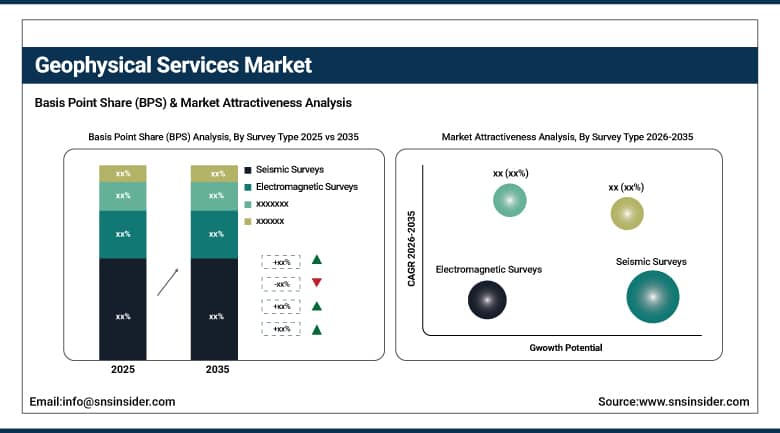
By Survey Type, seismic surveys dominated the market with 48.00% share in 2025, while electromagnetic surveys are projected to witness the fastest growth with 6.87% CAGR during the forecast period.
-
By Technology, 3D seismic imaging dominated the market with 34.00% share in 2025, while 4D seismic imaging is projected to witness the fastest growth with 7.61% CAGR during the forecast period.
-
By Application, oil & gas exploration dominated the market with 42.00% share in 2025, while carbon capture & storage (CCS) is projected to witness the fastest growth with 10.33% CAGR during the forecast period.
-
By End User, oil & gas companies dominated the market with 38.00% share in 2025, while renewable energy developers are projected to witness the fastest growth with 7.40% CAGR during the forecast period.
By Survey Type, seismic surveys dominated the market, while electromagnetic surveys are fastest-growing.
The seismic surveys segment held the highest revenue share of 48.00% in 2025 owing to the segment’s significance in exploration of hydrocarbons, reservoir evaluation, and subsurface geology mapping. The need for companies to leverage seismic acquisitions and interpretations to enhance their success rates in exploration efforts, optimization of drilling activities, and reducing geologic uncertainties is expected to remain a major factor driving the importance of this segment. The extensive use of 2D, 3D, and marine seismic surveys for exploration both offshore and onshore will drive the commercial significance of this segment. During 2025–2026, several offshore exploration organizations launched high-resolution seismic surveys in the Gulf of Mexico, North Sea, and offshore South America.
It is anticipated that the electromagnetic surveys market will experience the highest growth rate CAGR of 6.87% during the forecast period due to the rising preference for sophisticated subsurface electrical conductivity mapping, mineral exploration, groundwater studies, and environmental site assessment. Electromagnetic survey technologies are quite useful in providing geological data in scenarios where seismic surveys fail to work. The exploration of battery minerals like lithium, nickel, copper, and rare earth metals is fueling the demand for airborne and surface electromagnetic surveys technologies. In 2026, several mining companies have opted to use airborne electromagnetic surveys in order to explore critical minerals in support of the electric vehicles and renewable energy value chain.
By Technology, 3D seismic imaging dominated the market, while 4D seismic imaging is fastest-growing.
In 2025, the 3D seismic imaging segment accounted for the highest market share of 34.00% due to their capacity to offer high-resolution visualization of the subsurface structure and improve well characterization and drilling precision. Oil and gas producers rely increasingly on 3D seismic technologies to explore hydrocarbon accumulations, implement development projects and enhance recovery rates. They provide better geological imaging compared to the other technologies and enable operators to minimize the risks and make their projects more profitable. During 2025–2026, a number of international exploration firms increased investments in advanced 3D seismic reprocessing technologies based on machine learning algorithms to increase imaging resolution and interpretation results.
The 4D seismic imaging segment is expected to be the fastest-growing segment at CAGR of 7.61% during the forecast period due to rising demand for reservoir monitoring and hydrocarbon production optimization and recovery. In contrast to conventional imaging technologies, 4D seismic surveys are used to visualize time-lapse images of the reservoir and monitor fluid movements, thus making production management decisions more efficient. Increased interest in maximizing the output from current oil and gas reservoirs and minimizing expenses drives its growth. In 2026, multiple offshore operators implemented time-lapse seismic monitoring programs in mature offshore reservoirs.
Regional Analysis:
|
Region |
Major Country |
Share within Region, 2025 (%) |
|---|---|---|
|
North America |
United States |
88.00% |
|
Europe |
Germany |
21.00% |
|
Asia Pacific |
China |
24.00% |
|
Middle East & Africa |
UAE |
12.00% |
|
Latin America |
Brazil |
12.00% |
North America Geophysical Services Market Insights
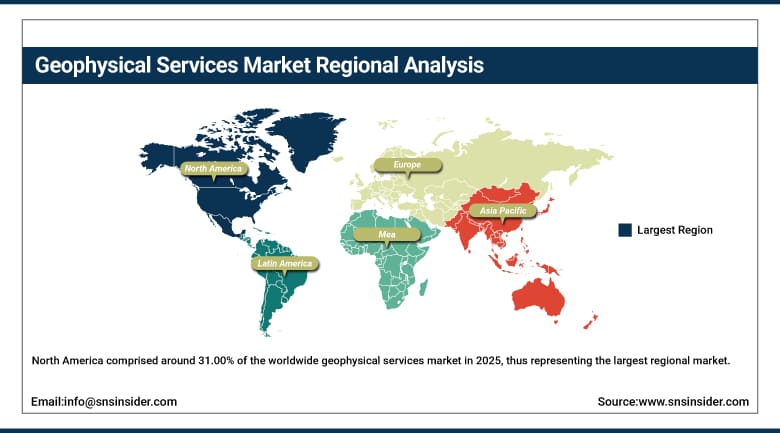
North America comprised around 31.00% of the worldwide geophysical services market in 2025, thus representing the largest regional market. The region is supported by extensive exploration activities of oil and gas, mature offshore and onshore hydrocarbon resources, highly developed geophysical surveying facilities, and substantial investments in digital exploration technologies. The United States and Canada continue to be leading regions in terms of demand for seismic acquisition services, reservoir characterization solutions, gravity surveys, and advanced subsurface imaging systems. Investments into carbon capture and storage projects, geothermal explorations, and critical mineral deposits are bringing further growth opportunities.
In 2025-2026, several exploration companies launched advanced seismic and electromagnetic surveys in North America in order to support offshore hydrocarbon projects, carbon storage projects, and critical mineral exploration.
Get Customized Report as Per Your Business Requirement - Enquiry Now
Europe Geophysical Services Market Insights
In 2025, Europe made up almost 21.00% of the total market due to increasing offshore energy exploration, carbon management projects, and investments in renewable energy infrastructure. The countries like Norway, United Kingdom, Germany, and Netherlands still invest in advanced geophysical surveys related to offshore hydrocarbon exploration, offshore wind, geothermal energy, and carbon storage evaluation. Due to the focus on decarburization policies in Europe, the demand for geological survey and long-term carbon storage monitoring will increase in the region. Advanced seismic imaging technologies, geophysical monitoring through satellites, and artificial intelligence-based geophysical interpretation systems are used in the region to enhance efficiency in exploration and compliance in energy and environmental applications.
During 2026, some of the European carbon capture and storage programs extended their seismic and geological survey programs for large-scale carbon storage projects in the North Sea area.
Asia Pacific Geophysical Services Market Insights
Asia Pacific is forecasted to witness the fastest CAGR growth rate of 6.19% during the forecast period due to high energy demands, rising investments in mineral explorations, expanding infrastructure, and supportive government policies towards securing resources. Countries such as China, India, Australia, Indonesia, and Japan have been making huge efforts in exploring hydrocarbons, critical minerals, geothermal energy, and ground water through surveys. The region has witnessed high industrialization and energy transition needs that result in increased need for advanced geophysical surveys in several industries. Airborne geophysics, electromagnetic survey instruments, geological interpretation solutions aided by AI, and subsurface imaging have been used widely by mining companies and governmental organizations for better results.
From 2025 to 2026, various governments from Asia Pacific region have launched critical minerals exploration using advanced geophysical technologies.
Middle East & Africa and Latin America Geophysical Services Market Insights
The Middle East & Africa region captured nearly 12.00% of global market revenues in 2025, owing to hydrocarbon exploration activities, offshore projects, and increased investments in the evaluation of water resources and renewables. The countries including Saudi Arabia, the UAE, Qatar, South Africa, and Egypt continue making significant investments in advanced geophysical solutions for resource development and infrastructure development. Energy companies are deploying high resolution seismic solutions, reservoir monitoring technologies, and AI-powered geological interpretation solutions for increasing exploration and production success. In 2026, several energy companies from the Middle East region expanded their digital seismic interpretation solutions combined with AI-powered reservoir characterization platforms.
Latin America represented approximately 12.00% of the global market in 2025, driven by increasing hydrocarbon exploration, mining, and infrastructure development projects. The Latin American countries such as Brazil, Chile, Peru, Argentina, and Mexico continue representing important regions in terms of geophysical services demand. Growing requirement for identifying oil fields, evaluating mineral deposits, and renewables is driving the adoption of geophysical surveys, gravity mapping, electromagnetic, and geological modeling solutions. In 2026, some mining companies in the Latin America region expanded airborne geophysical surveying campaigns for exploration of copper, lithium, and rare earth deposits required for global energy transition.
Market Dynamics:
Growth Drivers: Growing demand for energy exploration & critical mineral development.
The growing demand for energy around the globe and investments made in critical mineral exploration are key factors responsible for driving the geophysical services market. The governments, as well as mining companies and energy producers, are making huge investments in exploring hydrocarbons, lithium, copper, nickel, cobalt, and rare earth minerals required in the process of industrial expansion and clean energy transition. In addition, geophysical services offer valuable geological data necessary for decision-making and resource estimation. The complexity in the field of exploration is fueling the demand for seismic technologies, electromagnetic technologies, gravity surveys, satellite geophysics, and AI-based interpretation tools.
During 2025-2026, several critical mineral exploration projects in North America, Australia, and South America intensified their efforts to explore resources through the deployment of advanced airborne geophysical surveys.
Restraints: High operational costs and fluctuations in exploration budgets.
Even with increasing market demands, the geophysical services industry is still experiencing problems linked to high costs of conducting surveys, complicated operation processes, and the fact that the budget allocations for exploration are quite volatile. The implementation of large-scale seismic surveys, marine surveys, advanced imaging solutions, and deployment of specialized equipment needs considerable capital. Exploration programs are often affected by commodity price movements, political issues, environmental regulation, and various economic situations that delay approvals and slow down spending. The smaller exploration firms often find it difficult to have enough funds to implement advanced geophysical solutions. Moreover, increasingly strict environmental permits will add time and money to operations.
In 2026, some exploration operators made changes in their budget allocations for surveys due to volatility in the commodity market and the new capital budgeting policies in resource sectors around the world.
Opportunities: Expansion of carbon capture projects, geothermal energy projects, and renewable energy projects.
The development of carbon capture and storage infrastructure, geothermal energy projects, and renewable energy projects is creating various opportunities for the growth of geophysical service providers. Geologic characterization, subsurface imaging, reservoir management, and environmental assessment services have become significant in analyzing appropriate sites for carbon storage and renewable energy projects. Various governments and private investors are investing in infrastructure and projects that are low in carbon and sustainable, resulting in the creation of a need for the latest technology in geophysical services. The utilization of AI-powered analytics, cloud geological modeling, and satellite monitoring solutions is making the geophysical service offering more valuable.
In 2026, several carbon storage and geothermal energy projects increased geological characterization services using the latest seismic and electromagnetic survey technologies.
Recent Developments:
-
2026: SLB expanded deployment of AI-assisted geoscience and seismic interpretation platforms designed to improve subsurface imaging accuracy and exploration productivity.
-
2026: TGS strengthened its offshore seismic data acquisition and multi-client survey portfolio to support growing global energy exploration demand.
-
2025: CGG accelerated commercialization of advanced geoscience analytics solutions integrating cloud computing and machine learning for geological interpretation.
-
2025: PGS expanded high-resolution offshore seismic survey operations across key hydrocarbon exploration regions to support new field development activities.
Geophysical Services Market Key Players are:
-
SLB (Schlumberger Limited)
-
CGG SA
-
TGS ASA
-
PGS ASA
-
Halliburton Company
-
Fugro N.V.
-
Weatherford International plc
-
Geospace Technologies Corporation
-
China Oilfield Services Limited (COSL)
-
PXGEO
-
Dawson Geophysical Company
-
EON Geosciences Inc.
-
Gardline Limited
-
Getech Group plc
-
BGP Inc.
-
New Resolution Geophysics
-
Ramboll Group A/S
-
SGS SA
-
Abitibi Geophysics Inc.
-
SAExploration Holdings Inc.
Geophysical Services Market Report Scope:
| Report Attributes | Details |
|---|---|
| Market Size in 2025 | USD 16.57 Billion |
| Market Size by 2035 | USD 24.16 Billion |
| CAGR | CAGR of 3.84% From 2026 to 2035 |
| Base Year | 2025 |
| Forecast Period | 2026-2035 |
| Historical Data | 2022-2024 |
| Report Scope & Coverage | Market Size, Segments Analysis, Competitive Landscape, Regional Analysis, DROC & SWOT Analysis, Forecast Outlook |
| Key Segments | • By Survey Type (Seismic Surveys, Magnetic Surveys, Gravity Surveys, Electromagnetic Surveys, Others) • By Technology (2D Seismic Imaging, 3D Seismic Imaging, 4D Seismic Imaging, Remote Sensing & Satellite Geophysics, AI-Based Geophysical Analytics) • By Application (Oil & Gas Exploration, Mineral & Mining Exploration, Environmental & Engineering Studies, Carbon Capture & Storage (CCS), Geothermal Exploration) • By End User (Oil & Gas Companies, Mining Companies, Government & Geological Agencies, Renewable Energy Developers, Infrastructure & Construction Companies, Others) |
| Regional Analysis/Coverage | North America (US, Canada), Europe (Germany, UK, France, Italy, Spain, Russia, Poland, Rest of Europe), Asia Pacific (China, India, Japan, South Korea, Australia, ASEAN Countries, Rest of Asia Pacific), Middle East & Africa (UAE, Saudi Arabia, Qatar, South Africa, Rest of Middle East & Africa), Latin America (Brazil, Argentina, Mexico, Colombia, Rest of Latin America). |
| Company Profiles | SLB (Schlumberger Limited), CGG SA, TGS ASA, PGS ASA, Halliburton Company, Fugro N.V., Weatherford International plc, Geospace Technologies Corporation, China Oilfield Services Limited (COSL), PXGEO, Dawson Geophysical Company, EON Geosciences Inc., Gardline Limited, Getech Group plc, BGP Inc., New Resolution Geophysics, Ramboll Group A/S, SGS SA, Abitibi Geophysics Inc., SAExploration Holdings Inc. |
Frequently Asked Questions
North America dominated the global market with a 31.00% revenue share in 2025.
Asia Pacific is projected to witness the fastest growth during the forecast period, expanding at a CAGR of 6.19%.
The market is expected to expand at a CAGR of 3.84% during the forecast period.
The Geophysical Services Market was valued at USD 16.57 billion in 2025.
The market is projected to reach USD 24.16 billion by 2035.
