
Grid Edge Computing Market Report Scope and Overview:
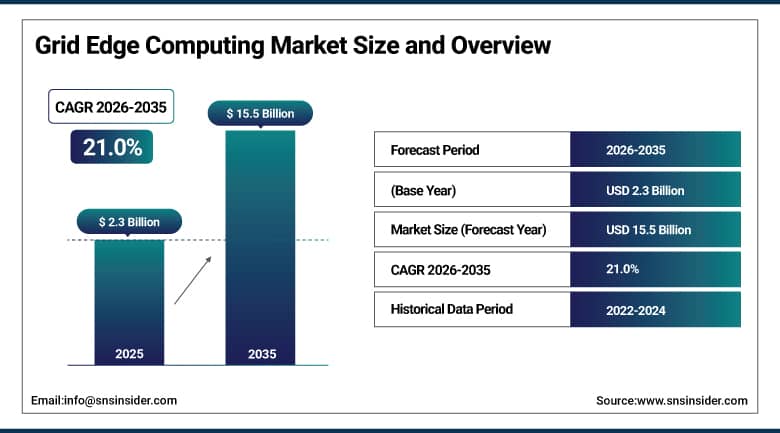
The Grid Edge Computing Market was valued at USD 2.3 Billion in 2025 and is projected to reach USD 15.5 Billion by 2035, registering a CAGR of 21.0% from 2026 to 2035.
The Grid Edge Computing Market is revolutionizing the way grids function due to innovations in edge servers, gateways, and AI-powered processors used near the distributed energy resources and smart devices. This market is characterized by increasing investments in the real-time data analytics and control solutions by utilities, growing adoption of hybrid edge-cloud infrastructures, increased integration of edge computing with SCADA/grid management systems, and growing utilization of grid edge computing in energy management and grid optimization/distributed energy resource management applications.
The trend towards grid decentralization, renewable energy integration requirements, and expansion of IoT sensors is an outcome of the massive investments undertaken by technology suppliers, utility companies, and system integrators in order to enhance grid reliability due to increasing demands.
To Get More Information On Grid Edge Computing Market - Request Free Sample Report
Grid Edge Computing Market Trends
-
Expanding deployment of AI-enabled edge processors continues improving real-time fault detection across distribution networks.
-
Growing adoption of hybrid edge-cloud architectures continues balancing local responsiveness with centralized analytics scalability.
-
Rising integration of edge computing with 5G connectivity continues enhancing predictive maintenance and grid automation.
-
Increasing convergence of operational technology and information technology continues fostering resilient, customer-centric energy networks.
-
Growing use of ruggedized edge hardware continues strengthening grid edge deployment in harsh operating environments.
U.S. Grid Edge Computing Market Outlook
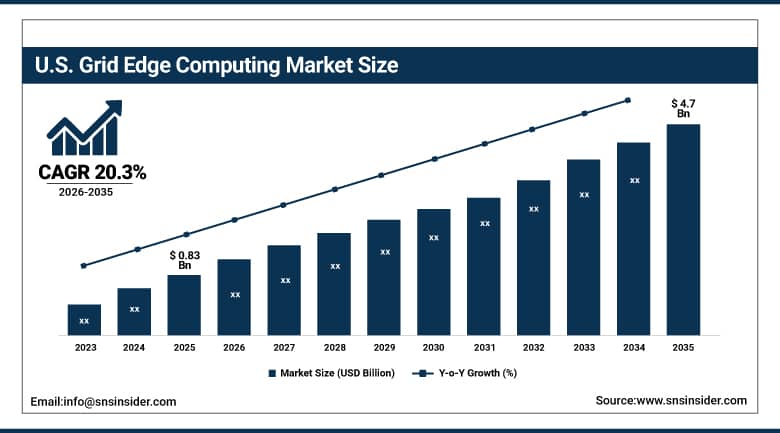
The U.S. Grid Edge Computing Market was valued at approximately USD 0.83 Billion in 2025 and is projected to reach approximately USD 4.7 Billion by 2035, registering a CAGR of approximately 20.3% from 2026 to 2035.
Demand for real-time grid intelligence in the US was also fueled by massive investments in smart grid infrastructure, aggressive rollout of distributed energy resource interconnection programs by utilities, and strong demand from grid operators for tools that reduce latency and improve bi-directional energy flow management.
The utilization of edge servers and AI-enabled processors along with the implementation of edge-cloud hybrid architectures in major utility operations has been crucial in raising the reputation of the United States as the largest buyer of grid edge computing technology in the world. Apart from this, the use of edge computing technology in renewable energy integration, smart metering, and asset management has been fueling the high domestic demand for this data-driven technology.
Grid Edge Computing Market Segment Analysis
-
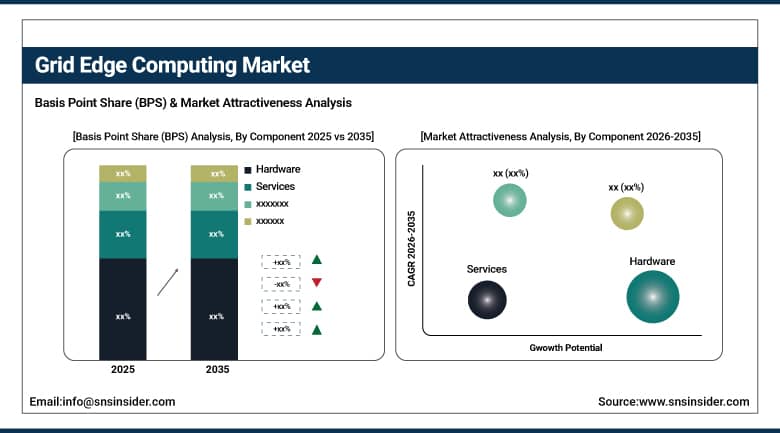
By Component, Hardware led in 2025 with 45% share; Services is fastest growing.
-
By Application, Energy Management led in 2025 with 32% share; Distributed Energy Resources Integration is fastest growing.
-
By Deployment Mode, On-Premises led in 2025 with 54% share; Hybrid is fastest growing.
-
By End-User, Utilities led in 2025 with 55% share; Residential is fastest growing.
By Component Hardware Dominates, Services Grows Fastest
Hardware dominated the Grid Edge Computing Market in 2025 because edge servers, gateways, sensors, and communication devices form the backbone of any investment that should be made in real-time grid data collection and processing for its completion. This component has been used by utilities and grid operators for the longest sustained period of operational deployment in this space, thereby becoming the most bankable route for grid edge procurement. Further advances made by technology companies like Cisco Systems with its ruggedized edge gateway platform and Siemens with its AI-enabled edge processor modules have made hardware more dominant than any other component, supported by falling sensor costs and improving computational power that keeps edge infrastructure at the center of utility technology budgets.
Services is expected to register the fastest growth rate amongst all components in the Grid Edge Computing Market owing to rising demand for consulting, integration, and managed services that support utilities deploying complex, multi-vendor edge architectures. Development of the managed services offering by the company Wipro, which has expanded its system integration capabilities for regional utilities, highlights the ongoing commercialization of this type of offering apart from that demonstrated in cybersecurity assessment and technical support programs under the governance of system integrators and specialized consulting firms seeking to accelerate long-term platform adoption.
By Application Energy Management Leads, DER Integration Grows Fastest
The Energy Management segment held the leading position in the Grid Edge Computing Market in 2025, owing to the large number of utilities, businesses, and residential customers that depend on real-time monitoring and control of energy consumption at the point of use. The application segment has the advantage of leveraging existing smart metering infrastructure and business models of developers such as Landis+Gyr's edge-enabled energy management platform. The energy management application segment is the most funded application segment amongst all the grid edge vendors globally, supported by continuing improvements in dynamic pricing and demand response participation.
The Distributed Energy Resources Integration application segment represents the fastest growing application segment within the Grid Edge Computing Market. It has been gaining a lot of attention from utilities that are looking to manage intermittent and bi-directional power flows tied to rooftop solar, wind, and battery storage, which are not feasible to coordinate without localized real-time computing capabilities. The work done by AutoGrid Systems in deploying real-time DER monitoring and virtual power plant coordination alongside its grid edge suite is a testament to the importance of the idea of edge-enabled DER integration in grid edge computing development.
By Deployment Mode On-Premises Leads, Hybrid Grows Fastest
On-Premises deployment was the leading mode in the Grid Edge Computing Market in 2025 due to the considerably larger addressable base of utilities and organizations seeking maximum control, security, and compliance over their edge computing infrastructure, thus being the technically most feasible approach for mission-critical applications such as grid protection and secure asset management. S&C Electric Company and Open Systems International are among the vendors that supply on-premises edge computing hardware and software, and the expansion in 2026 of data sovereignty requirements by regional regulators is a clear indicator of the further development of the on-premises grid edge market.
Hybrid deployment is set to be the fastest growing deployment mode in the market for Grid Edge Computing. This is due to the development of architectures that execute critical data processing locally at the grid edge while handling non-critical analytics and historical data storage in the cloud, an approach increasingly adopted by organizations such as Rockwell Automation. The platform partnership between Oracle and regional utility cooperatives, in which hybrid edge-cloud capabilities will be delivered to mid-sized utilities starting in 2027, has led to increased attention towards hybrid grid edge deployment techniques.
By End-User Utilities Dominate, Residential Gains Fastest Traction
The utility segment was at the forefront of the end-user segment share in the Grid Edge Computing Market in 2025 because utilities at the forefront of grid modernization efforts have been sponsoring most of the major edge computing procurement programs carried out for grid reliability and renewable energy integration. The large-scale utility investment in the United States, European Union, and China indicates that utility-funded programs are considering grid edge computing for securing their future grid reliability requirements, and hence are the main driving forces in the adoption of grid edge computing technology.
Residential customers are expected to gain the fastest traction in the Grid Edge Computing Market as end-users due to the fact that there have been early-stage agreements between technology companies and homeowners for real-time insights and automated control tied to smart home devices, rooftop solar, and home energy storage systems. It is because of the increasing trend of residential users investing in demand response and virtual power plant participation that this end-user segment is growing faster than other end-users, aided by falling equipment costs and expanding smart home adoption.
Regional Analysis:
|
Region |
Major Country |
Share within Region, 2025 (%) |
|---|---|---|
|
North America |
United States |
85.00% |
|
Europe |
Germany |
28.00% |
|
Asia Pacific |
China |
46.00% |
|
Middle East and Africa |
Saudi Arabia |
26.00% |
|
Latin America |
Brazil |
54.00% |
North America Grid Edge Computing Market Insights
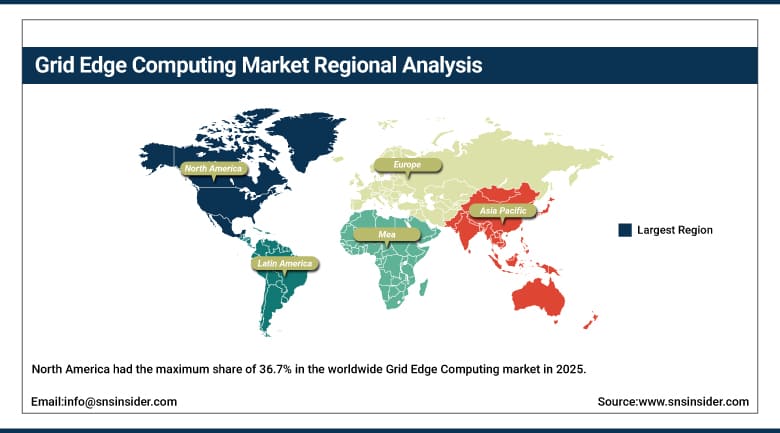
North America had the maximum share of 36.7% in the worldwide Grid Edge Computing market in 2025. This was possible due to the growth in investments made by utilities into smart grid infrastructure, presence of the best funded grid edge technology vendors globally, and consistent investments into advanced regulatory frameworks supporting grid modernization. A good relationship between the hardware manufacturers, software developers, and utility companies working towards utilizing the output from the edge computing platforms in their home country has also played an important role, alongside expanding penetration of distributed energy resources across the region.
The United States accounted for around 85.0% of the total revenue market share of North America because of its presence and continuous raising of funds by Cisco Systems, IBM, and Oracle, along with edge computing procurement agreements made by utilities like Pacific Gas & Electric and Southern California Edison. Increased budgeting for grid resilience by the Department of Energy and involvement of Canada through decarbonization initiatives contributed to North America's dominant position in the market.
Get Customized Report as Per Your Business Requirement - Enquiry Now
Europe Grid Edge Computing Market Insights
Europe had a sustainable market share in the global revenue generation from the Grid Edge Computing Market because of ambitious decarbonization targets, a strong focus on renewable energy integration, and supportive regulatory policies including the European Union's Clean Energy Package. The increased collaboration between the public and private sectors through agencies like the German Federal Network Agency and the UK's National Energy System Operator has encouraged the developers in Europe to focus on scalable edge computing solutions capable of accommodating high shares of intermittent renewables across increasingly congested transmission networks.
Germany emerged to be the most demanding market amongst all other European countries, generating almost 28.0% of Europe's total revenue because of significant investment made in grid edge adoption clusters and the presence of production facilities of Siemens, Schneider Electric, and ABB companies in the country. Another significant contributor to market demands in the region was the United Kingdom, which is providing significant contributions to regional market demand owing to its grid flexibility programs and collaboration between National Grid ESO and technology providers for grid edge deployment. The rising demands of grid edge computing technology in Europe are expected to increase in future.
Asia Pacific Grid Edge Computing Market Insights
The Asia-Pacific region is experiencing the fastest growth rate among all the other regions analyzed in the market, with the expected CAGR of 22.8% for 2026-2035 owing to rapid urbanization, expanding renewable energy capacity in China and India, and government initiatives aimed at enhancing grid reliability and energy access. The sum effect of various factors discussed above guaranteed the fact that this region experienced the fastest growth rate compared to all other regions analyzed in the report.
This category was dominated by China owing to significant investments in smart grid infrastructure and distributed energy resources to support the country's energy transition goals, making up for 46.0% of the revenues of the region. The other countries that have contributed to this result include Japan because of its digital technology development and South Korea because of its grid modernization initiatives supported by regional grid edge computing vendors.
MEA and Latin America Grid Edge Computing Market Insights
Grid Edge Computing Market in the Middle East, Africa, and Latin America exhibited consistent growth due to the growing number of energy access and digitalization initiatives gaining momentum, the involvement of governments in grid modernization and rural electrification projects in the long run, and the cooperation between utilities of these regions and international grid edge technology providers. The early adoption of decentralized clean power technologies was increasingly gaining importance as a strategically vital aspect for the energy diversification projects implemented in the regions due to the insufficiency of centralized generation and transmission capacity to meet future demand reliably.
In ME&A, Saudi Arabia was the biggest country market in terms of the market because of its increased advanced energy technology investments through its sovereign wealth funds, as well as increased grid edge computing project partnerships. In addition, within ME&A, there were contributions from the implementation of grid modernization programs within the UAE. Within LATAM, the biggest revenue generator was Brazil as a result of its large number of energy access initiatives and increased grid digitalization programs.
Market Dynamics:
Growth Drivers: Grid Decentralization and Real-Time Data Processing Requirements
The market is driving because of the increasing complexity and decentralization of modern power grids as utilities strive to accommodate a surge in distributed energy resources such as rooftop solar, wind, and battery storage, increased usage of AI-driven edge analytics platforms, increased investments in 5G connectivity and communication technologies, and an expanded set of applications, such as energy management, grid optimization, and asset management. As more and more governments are implementing stringent mandates to reduce carbon emissions, the need for concrete real-time data processing capabilities will guarantee that the ability to raise funds by developers stays high throughout the supply chain.
Increasing collaboration among grid edge technology vendors and utilities, along with increasing dedication from regulatory bodies to mandate enhanced grid integration of renewable energy in anticipation of future decarbonization targets, constitute additional supporting evidence for this trend. Capital investment by venture and infrastructure investors in the development of AI-driven and edge-enabled computing platforms is adding to the growing baseline capability, and this is all adding up to ever-increasing demand during the forecast period, particularly as the proliferation of smart devices and IoT sensors continues to amplify data volume and velocity.
Restraints: Cybersecurity Vulnerabilities and Legacy System Integration Challenges
The increasing connectivity and digitalization of grid assets creating new cybersecurity vulnerabilities remains a constraint for the further rapid development of the market since any compromise could have far-reaching consequences for grid reliability and public safety before any profits are made from the venture. It is owing to this reason that the leading-edge grid computing technology is developed only by well-funded companies that have access to venture capital or corporate funding as shown in the case of several technology vendors scaling security infrastructure in 2025.
Technical uncertainty around legacy system integration remains a challenge because the complexity of integrating aging grid infrastructure with new edge computing solutions continues to require rigorous interoperability engineering, and regulatory compliance requirements have grown more stringent following increased scrutiny of critical infrastructure protection; thus, investment into these technologies needs to occur alongside continued certification work. It is a challenge that can be solved through open, interoperable platform standards, which is a dynamic process requiring large amounts of funding from both technology vendors and utility IT departments within the industry.
Opportunities: AI Integration and Emerging Market Grid Modernization
Increased funding in artificial intelligence and machine learning integration with edge computing platforms becomes a major trend as developers commit to long-term grid optimization contracts, in which the entire system is built, that includes predictive analytics, automated decision-making, and enhanced network resilience. Companies that are capable of attracting early customers of their edge platforms, such as IBM with its contracts tied to the convergence of IT and operational technology, will be able to claim a sizable market share as they move from single project demonstrations to fleet-scale grid edge portfolios.
A third potential opportunity is presented by the expansion of grid edge computing into emerging markets, because countries in Asia Pacific, Latin America, and Africa investing in grid modernization and renewable energy integration are actively searching for scalable, cost-effective edge computing solutions that can enhance grid reliability and support energy access initiatives. Those developers who can show credibility of interoperability and affordability across rapidly modernizing utility networks will get substantial market share.
Recent Developments:
-
2026: Cisco Systems launched an expanded version of its IoT Field Network Director platform with new ruggedized edge gateway hardware designed for harsh grid-edge operating environments.
-
2026: Schneider Electric expanded its EcoStruxure Grid Edge platform with a new AI-enabled processor module for real-time distributed energy resource coordination.
Grid Edge Computing Market key players are:
-
ABB
-
Siemens
-
Schneider Electric
-
General Electric (GE)
-
Cisco Systems
-
IBM
-
Oracle
-
Honeywell
-
Eaton
-
Rockwell Automation
-
Itron
-
Landis+Gyr
-
S&C Electric Company
-
AutoGrid Systems
-
Enel X
-
Open Systems International (OSI)
-
Nokia
-
Sensus (a Xylem brand)
-
Trilliant
-
Wipro
Grid Edge Computing Market Report Scope:
| Report Attributes | Details |
|---|---|
| Market Size in 2025 | USD 2.3 Billion |
| Market Size by 2035 | USD 15.5 Billion |
| CAGR | 21.0% from 2026 to 2035 |
| Base Year | 2025 |
| Forecast Period | 2026-2035 |
| Historical Data | 2022-2024 |
| Report Scope & Coverage | Market Size, Segments Analysis, Competitive Landscape, Regional Analysis, DROC & SWOT Analysis, Forecast Outlook |
| Key Segments | • By Component (Hardware, Software, Services) • By Application (Energy Management, Grid Optimization, Distributed Energy Resources Integration, Smart Metering, Asset Management, Others) • By Deployment Mode (On-Premises, Cloud, Hybrid) • By End-User (Utilities, Industrial, Commercial, Residential, Others) |
| Regional Analysis/Coverage | North America (US, Canada), Europe (Germany, UK, France, Italy, Spain, Russia, Poland, Rest of Europe), Asia Pacific (China, India, Japan, South Korea, Australia, ASEAN Countries, Rest of Asia Pacific), Middle East & Africa (UAE, Saudi Arabia, Qatar, South Africa, Rest of Middle East & Africa), Latin America (Brazil, Argentina, Mexico, Colombia, Rest of Latin America). |
| Company Profiles | ABB, Siemens, Schneider Electric, General Electric (GE), Cisco Systems, IBM, Oracle, Honeywell, Eaton, Rockwell Automation, Itron, Landis+Gyr, S&C Electric Company, AutoGrid Systems, Enel X, Open Systems International (OSI), Nokia, Sensus (a Xylem brand), Trilliant, Wipro |

Frequently Asked Questions
Key players in the Grid Edge Computing Market include ABB, Siemens, Schneider Electric, General Electric (GE), Cisco Systems, and IBM, among others.
Key opportunities in the grid edge computing market include integration of artificial intelligence and machine learning with edge platforms and growth in emerging markets grid modernization and expansion of virtual power plant business models.
The market is driven by increasing complexity and decentralization of modern power grids, growing distributed energy resource proliferation, and rising demand for real-time data processing at the grid edge.
The Hardware segment dominated the Grid Edge Computing Market, accounting for approximately 45% market share.
The North America region dominated the Grid Edge Computing Market in 2025 with a 36.7% share, driven by substantial investments in smart grid infrastructure and high penetration of distributed energy resources.
