
Grid Flexibility Solutions Market Report Scope & Overview:
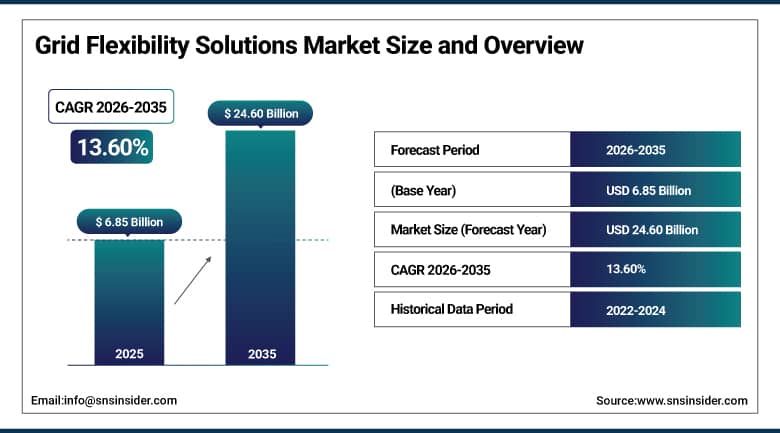
The Grid Flexibility Solutions Market was valued at USD 6.85 Billion in 2025 and is expected to reach USD 24.60 Billion by 2035, growing at a CAGR of 13.60% from 2026 to 2035.
Grid flexibility solutions market is expected to grow steadily due to the utility companies face an increasing share of renewables in their generation portfolio, aging grid infrastructure, and increasing pressure on peak demand as a result of electrification of transport and buildings. The demand response, distributed energy resources management, and virtual power plant solutions are becoming more widely used to maintain balance between supply and demand in close to real-time mode without requiring additional investments into building new peaking facilities. The regulatory changes, such as FERC Order 2222 in the U.S. and similar policies in Europe and Asia Pacific to allow participation of distributed resources in wholesale markets are unlocking additional revenue opportunities for flexibility providers.
In 2025, Uplight expanded its Grid Flexibility Suite by integrating AutoGrid's Flex platform into a unified dispatch layer, enabling participating utilities to orchestrate residential batteries, smart thermostats, and EV chargers as a single aggregated resource during system peak events.
To Get More Information On Grid Flexibility Solutions Market - Request Free Sample Report
Grid Flexibility Solutions Market Trends:
-
Rapid transition from single-purpose demand response programs toward unified DERMS-VPP orchestration platforms managing mixed asset portfolios.
-
Expanding utility participation in FERC Order 2222-style wholesale market frameworks enabling aggregated distributed resources to bid alongside conventional generation.
-
Rising use of AI-driven load forecasting and automated dispatch to shrink response latency and improve flexibility asset utilization rates.
-
Growing bundling of behind-the-meter battery storage and EV charging management within a single flexibility software subscription.
-
Increasing cross-vendor partnerships between flexibility platform providers and utility AMI/meter-data infrastructure suppliers to accelerate rollout.
U.S. Grid Flexibility Solutions Market Outlook:
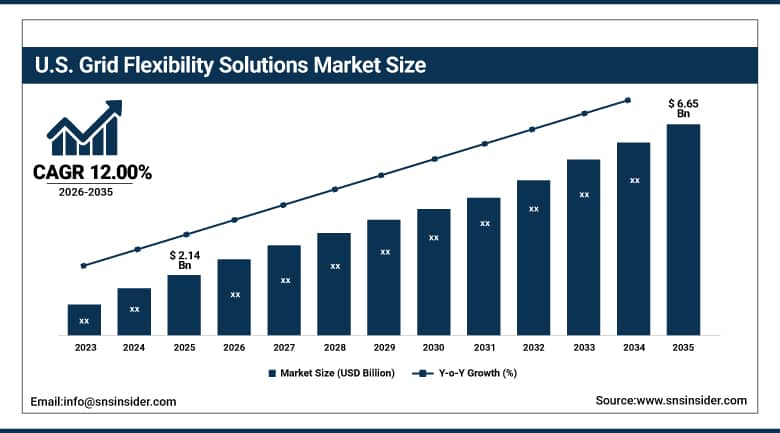
The U.S. Grid Flexibility Solutions Market was valued at USD 2.14 Billion in 2025 and is projected to reach USD 6.65 Billion by 2035, growing at a CAGR of 12.00% during 2026–2035.
In the U.S., the utilities keep expanding their demand response and distributed energy resources programs as regional transmission organizations create markets for flexibility aggregations under the mandate of FERC Order 2222, where CAISO and ISO-NE have already implemented it completely while PJM and MISO have started implementing it in phases. Peak demand problems experienced by California, Texas, and the Northeast in the summer time, along with increasing levels of rooftop solar panels and batteries in those regions, have made investor-owned utilities and co-ops to extend their flexibility platform agreements.
In 2026, Voltus expanded its flexibility marketplace into additional PJM and MISO load zones, adding automated telemetry integrations for commercial and industrial customers to allow same-day enrollment in capacity and energy demand response programs.
Grid Flexibility Solutions Market Segment Analysis:
-
By Offering, Software Platforms & Solutions dominated the Grid Flexibility Solutions Market with a 68.40% share in 2025, while Services is the fastest-growing offering segment with a CAGR of 16.20% from 2026–2035.
-
By Flexibility Source, Demand Response dominated the Grid Flexibility Solutions Market with a 34.70% share in 2025, while Virtual Power Plants is the fastest-growing flexibility source segment with a CAGR of 18.50% from 2026–2035.
-
By End User, Utilities & Grid Operators dominated the Grid Flexibility Solutions Market with a 52.60% share in 2025, while Residential is the fastest-growing end user segment with a CAGR of 17.30% from 2026–2035.
-
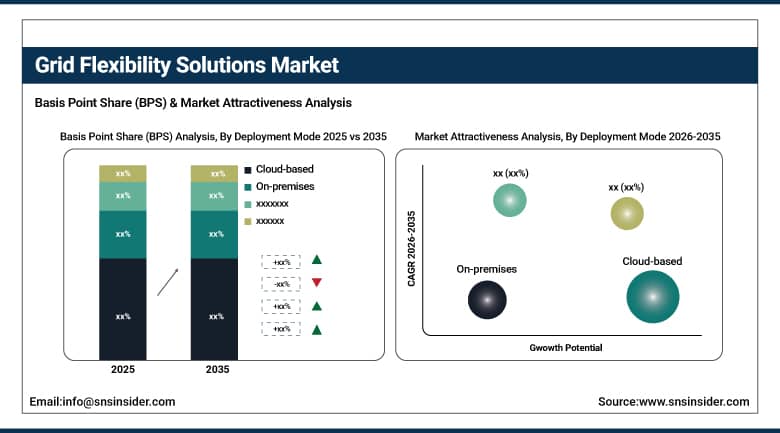
By Deployment Mode, Cloud-based dominated the Grid Flexibility Solutions Market with a 58.90% share in 2025, while Cloud-based is also the fastest-growing deployment segment with a CAGR of 15.40% from 2026–2035.
By Deployment Mode, Cloud-based Led and Grew Fastest.
Cloud-based deployment held the largest share in 2025. Increasing preference of utilities for subscription-based, cloud-deployed flexible solutions that enable quick deployment times, reduce capital investment needs, and facilitate easier integration of third-party telemetry from distributed energy resources (DERs) is driving growth of cloud-based deployment.
Also, cloud-based will be the fastest-growing deployment mode during the forecast period from 2026 to 2035. Growing adoption of cloud technology makes it possible for utilities to have scalable grid management platforms without significant on-premise deployments. In addition to this, cloud-based deployment offers features such as real-time monitoring and management, easy data integration, and flexibility to deploy distributed energy sources.
By Offering, Software Led, Services Grew Fastest
Software Platforms & Solutions accounted for majority of the offering segment of Grid Flexibility Solutions Market revenue in 2025. Utilities and aggregators are opting for integrated DERMS-VPP dispatch solutions that are capable of managing demand response, storage, and EV charging systems from a single level of control, avoiding the need for any further integration across legacy AMI/SCADA systems. Frequent software updates on telemetering protocols, market bidding logic, and compliance modules have favored the choice for licensed software than programmatic deployments.
Services is projected to expand at the fastest CAGR through 2035. Smaller municipal and cooperative utilities with less engineering expertise have started turning towards flexibility service providers to help them with designing the programs, enrolling customers, and managing asset deployment in their grids.
By Flexibility Source, Demand Response Led, Virtual Power Plants (VPPs) Grew Fastest.
Demand Response had the maximum revenue market share in 2025 owing to its long history of adoption in utility portfolios and the relatively low cost of integrating curtailment-type programs. The continued development of robust protocols and past experience with regulations ensure that demand response remains the standard first step in the adoption of flexibility procurement by utilities.
Virtual Power Plants (VPPs) are projected to have the fastest-growing CAGR between 2026 and 2035 as cheaper behind-the-meter batteries and larger numbers of electric vehicles provide aggregators with more assets to manage, aided by the changing rules in wholesale markets where aggregated DERs are recognized as capacity bid sources.
By End User, Utilities Led, Residential Grew Fastest
Utilities & Grid Operators contributed the largest end-user share in 2025, due to the fact that transmission and distribution companies will be the main consumers of the flexibility solution software for dealing with peak load management, deferred investment and renewable energy curtailment.
The Residential end-user is forecasted to have the highest growth rate, on account of the increasing number of smart thermostats, solar PVs and batteries installed in residential houses that make up a pool of quickly increasing assets which can be enrolled and automated.
Regional Analysis:
|
Region |
Major Country |
Share within Region, 2025 (%) |
|---|---|---|
|
North America |
United States |
81.30% |
|
Europe |
Germany |
24.70% |
|
Asia Pacific |
China |
37.90% |
|
Middle East & Africa |
UAE |
23.60% |
|
Latin America |
Brazil |
34.80% |
North America Grid Flexibility Solutions Market Insights
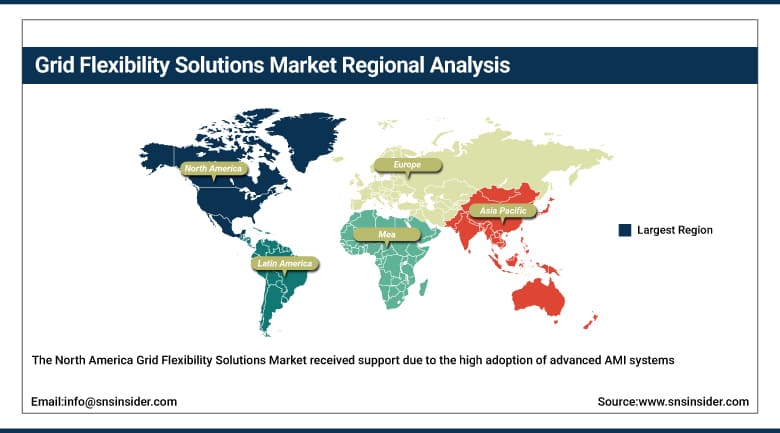
The North America Grid Flexibility Solutions Market dominated with 38.5% share in 2025. The region received support due to the high adoption of advanced AMI systems, the presence of a regulatory framework through FERC Order 2222 for aggregation of distributed resources, and peak load pressure on California, Texas, and Northeast Corridor due to the rise in load requirements of data centers and transportation electrification. Large budgets allocated by utilities towards grid modernization, an elaborate wholesale and capacity market structure, and early VPP installations by IOUs and co-operatives contributed to the region’s dominance in the market. Participation of public utility commissions and system operators in developing regulations for flexibility procurement enhanced market confidence in software-based grid balancing.
The U.S. held the largest market share in the North America Grid Flexibility Solutions Market in 2025, attributable to the maturity of the demand response mechanism, increasing number of VPPs among investor-owned utilities, and the rapid expansion in battery aggregation programs behind-the-meter. The second largest opportunity is present in Canada owing to grid modernization efforts at the provincial level and increased interest of hydro-dominated utilities in demand-side flexibility management.
Get Customized Report as Per Your Business Requirement - Enquiry Now
Europe Grid Flexibility Solutions Market Insights
Europe became a significant contributor to the Grid Flexibility Solutions Market in 2025, driven by EU decarbonization goals, capacity market reforms in various European nations, and increasing renewable energy curtailment in grids that have high proportions of wind energy. Substantial government support for smart grid projects, as well as an increasing trend of cross-border balancing activities within ENTSO-E countries, further increases the size of the addressable market for procurement of DERMS and VPP software solutions in Europe.
The leading European country in this regard is Germany due to its sizable installed distributed capacity of solar and wind energy, a Redispatch 2.0 regime that requires active management of distributed energy resources, and the presence of companies that develop flexibility technologies and conduct large-scale aggregation projects with regional distribution system operators. Other important countries in Europe are the United Kingdom, France, and Nordic countries.
Asia Pacific Grid Flexibility Solutions Market Insights
The Asia Pacific region is expected to witness rapid adoption of flexibility platforms on account of the highest CAGR of 16.90% during the forecast period of 2026-2035. This is driven by increasing renewable capacity installations in China, India, and Australia, increasing government spending on installation of smart meters, and increasing installations of rooftop solar and battery storage in residential and commercial sectors. Additionally, increasing interest of regional grid operators in minimizing curtailment loss through optimized dispatch of distributed energy resources (DERs) is driving the market.
China emerges as the fastest-growing regional market due to its significant capacity installations and development of virtual power plant projects in various provincial grids. Australia acts as an important growth driver for this region due to its higher rooftop solar installations and household battery aggregation projects. India is seeing fast-growing adoption of flexibility platforms due to the national smart grid initiative and EV charging infrastructure projects.
Middle East & Africa and Latin America Grid Flexibility Solutions Market Insights
Countries across the Middle East & Africa and Latin America regions are gradually adopting grid flexibility solutions due to increasing efforts for electrification and renewable integration projects along with the surge in private sector investments in solar and energy storage capacities and increased interest among utilities to move away from expensive peaking plants.
Brazil has emerged as one of the promising Latin American countries due to its vast distributed solar installations and recent regulatory changes that have allowed for demand-side resources to be used for system balancing. In the Middle East & Africa region, the UAE and Saudi Arabia are two of the leading countries that have initiated pilots in their state-owned utilities.
Market Dynamics:
Growth Drivers: Renewable integration and peak-demand stress accelerating grid flexibility adoption
Increasing deployment of variable generation from wind and solar sources, alongside growing electrification of transportation and heating demand, is compelling utilities to look for cost-effective solutions that do not involve construction of new peaking generation and transmission facilities. The grid flexibility platforms enable utilities to delay costly investments by using distributed demand-side management resources, energy storage, and EV charging capabilities in order to match supply and demand in real-time, especially at high-pressure peak times.
Wholesale market participation of aggregated distributed resources, especially through the FERC Order 2222 in the U.S., together with equivalent market reforms in Europe and Asia-Pacific regions, creates additional revenue opportunities for both aggregators and utilities, encouraging implementation of these technologies. Reduced costs of battery storage and increased number of electric vehicles add to the list of available flexibility resources to be used during the forecast period.
Restraints: Interoperability gaps and utility procurement cycles limiting faster deployment
The lack of telemetry standards among the various legacy AMI, SCADA, and third-party DER systems results in ongoing complications related to the adoption of flexibility platforms, forcing flexibility platform providers to have substantial compatibility standards that increase implementation costs and timelines. The long procurement cycles from utilities and approval processes associated with rate case filings to recover costs of the flexibility programs are additional impediments.
The cybersecurity issues associated with the ability to control the decentralized edge devices on the distribution network and the persistent concerns over privacy of resident smart device telemetry create challenges for utilities considering third-party flexibility platforms. In addition, there is variability in market access for aggregated distributed resources within various regional transmission organizations.
Opportunities: EV fleet growth and AI-driven orchestration creating new avenues
Increasing penetration of electric vehicles and their associated charging management systems is forming a new, important class of dispatchable flexibility resources, with software vendors incorporating EV charging control modules into their current DERMS and VPP solutions to capitalize on the opportunity. Deployment of vehicle-to-grid pilots by utilities will be an especially important revenue stream for flexibility solutions vendors during the next decade.
Further development of AI-based load forecasting and dispatching algorithms that will enable coordination of increasingly diverse sets of assets in real-time will help greatly increase the number of applications from typical peak-shaving to emergency grid stability measures. Increased demand for flexibility services from municipal and cooperative utilities in secondary markets, as well as increasing spending by grid operators on outages prevention and resilience-focused flexibility programs will help drive demand for flexibility solutions during the forecast period.
Recent Developments:
-
2026: Enel X Way partnered with a major European distribution system operator to pilot a Redispatch 2.0-compliant virtual power plant program, aggregating residential solar and battery assets across three German metropolitan networks.
-
2026: CPower Energy Management launched an upgraded version of its BennuGrid platform featuring automated bring-your-own-device asset onboarding, targeting faster commercial and industrial customer enrollment across newly Order 2222-compliant regional transmission organizations.
-
2026: Itron advanced its grid-edge intelligence and shared data capabilities with GE Vernova, supporting utilities in connecting distributed energy resources, managing increasing renewable penetration, and improving flexibility across constrained electricity networks.
Grid Flexibility Solutions Market key players are:
-
Schneider Electric SE
-
Siemens AG
-
ABB Ltd.
-
GE Vernova Inc.
-
Honeywell International Inc.
-
Itron, Inc.
-
Landis+Gyr AG
-
Eaton Corporation plc
-
Oracle Corporation
-
Enel X Way S.p.A.
-
Uplight, Inc.
-
AutoGrid Systems, Inc.
-
Bidgely Inc.
-
Stem, Inc.
-
Fluence Energy, Inc.
-
Tesla, Inc.
-
Leap Energy, Inc.
-
Voltus, Inc.
-
CPower Energy Management, LLC
-
S&C Electric Company
Grid Flexibility Solutions Market Report Scope:
| Report Attributes | Details |
|---|---|
| Market Size in 2025 | USD 6.85 Billion |
| Market Size by 2035 | USD 24.60 Billion |
| CAGR | 13.60% from 2026 to 2035 |
| Base Year | 2025 |
| Forecast Period | 2026-2035 |
| Historical Data | 2022-2024 |
| Report Scope & Coverage | Market Size, Segments Analysis, Competitive Landscape, Regional Analysis, DROC & SWOT Analysis, Forecast Outlook |
| Key Segments |
• By Offering (Software Platforms & Solutions, Services) • By Flexibility Source (Demand Response, Virtual Power Plants, Distributed Energy Resource Management, Battery Energy Storage Integration) • By End User (Utilities & Grid Operators, Residential, Industrial & Commercial) • By Deployment Mode (Cloud-based, On-premises)
|
| Regional Analysis/Coverage | North America (US, Canada), Europe (Germany, UK, France, Italy, Spain, Russia, Poland, Rest of Europe), Asia Pacific (China, India, Japan, South Korea, Australia, ASEAN Countries, Rest of Asia Pacific), Middle East & Africa (UAE, Saudi Arabia, Qatar, South Africa, Rest of Middle East & Africa), Latin America (Brazil, Argentina, Mexico, Colombia, Rest of Latin America). |
| Company Profiles | Schneider Electric SE, Siemens AG, ABB Ltd., GE, Vernova Inc., Honeywell International Inc., Itron, Inc., Landis+Gyr AG, Eaton Corporation plc, Oracle Corporation, Enel X Way S.p.A., Uplight, Inc., AutoGrid Systems, Inc., Bidgely Inc., Stem, Inc., Fluence Energy, Inc., Tesla, Inc., Leap Energy, Inc., Voltus, Inc., CPower Energy Management, LLC, and S&C Electric Company. |

Frequently Asked Questions
Key players include Schneider Electric SE, Siemens AG, ABB Ltd., GE, Vernova Inc., and Honeywell International Inc., among others.
Key opportunities include increasing renewable energy integration, rising electricity demand, grid modernization, energy storage deployment, demand-side flexibility, and growing adoption of advanced grid management technologies.
The market is driven by rising renewable integration, growing peak-demand stress from electrification, regulatory reforms enabling aggregated distributed resources in wholesale markets, and expanding AI-driven dispatch automation.
The Utilities & Grid Operators segment dominated the Grid Flexibility Solutions Market in 2025, accounting for approximately 52.60% market share.
The North America region dominated the Grid Flexibility Solutions Market in 2025, holding a 38.40% share, driven by mature demand response infrastructure and an established FERC Order 2222 regulatory pathway.
