
Grid Edge Intelligence & Analytics Market Report Scope and Overview:
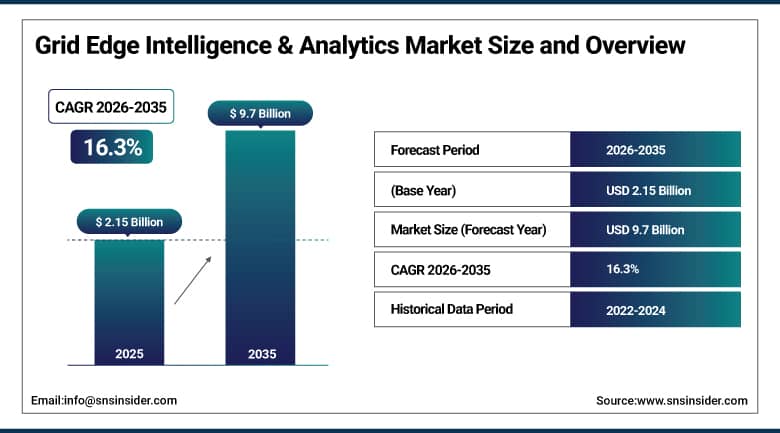
The Grid Edge Intelligence & Analytics Market was valued at USD 2.15 Billion in 2025 and is projected to reach USD 9.7 Billion by 2035, registering a CAGR of 16.3% from 2026 to 2035.
The Grid Edge Intelligence & Analytics Market is revolutionizing the way utilities manage their systems from a reactive to a proactive approach with innovations in machine learning, big data analytics, and edge computing solutions that are implemented into smart meters, sensors, and DERs. This market is characterized by the rising investments of utilities in predictive maintenance and asset condition monitoring solutions, increasing implementation of cloud-based analytics solutions due to scalability reasons, growing use of AI-based forecasting with SCADA and DERMS systems, and the application of the solution in fault detection, load forecasting, and non-technical loss recovery programs.
The growth of smart meter data volumes, budgets for utility digitalization, and distributed energy resource generation has become a reality because of the big money spent on improving grid intelligence by analytics providers, utilities, and technology firms due to increasing demand.
To Get More Information On Grid Edge Intelligence & Analytics Market - Request Free Sample Report
Grid Edge Intelligence & Analytics Market Trends
-
Expanding shift from centralized cloud analytics to distributed edge computing continues improving real-time grid response.
-
Growing adoption of AI-driven predictive maintenance continues reducing unplanned outages across aging distribution infrastructure.
-
Rising integration of analytics with SCADA and DERMS platforms continues enabling closed-loop automated grid actions.
-
Increasing deployment of analytics-as-a-service business models continues expanding access for smaller and mid-sized utilities.
-
Growing use of digital twin simulation continues strengthening scenario-based grid planning and investment decisions.
U.S. Grid Edge Intelligence & Analytics Market Outlook
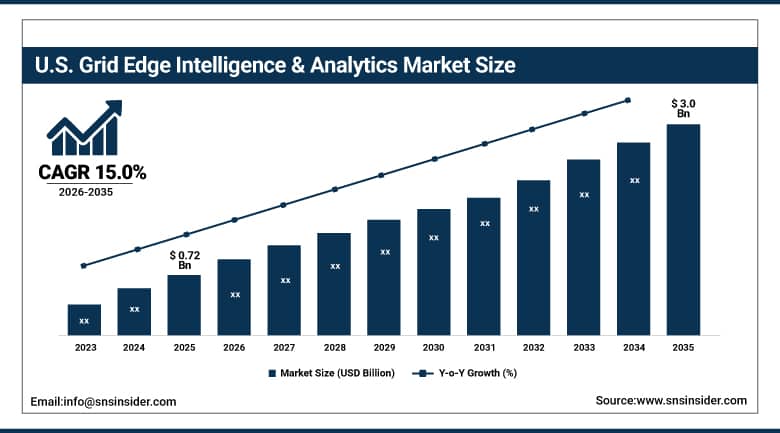
The U.S. Grid Edge Intelligence & Analytics Market was valued at approximately USD 0.72 Billion in 2025 and is projected to reach approximately USD 3.0 Billion by 2035, registering a CAGR of approximately 15.0% from 2026 to 2035.
Demand for actionable grid intelligence in the US was also fueled by massive investments in utility digital transformation strategies, aggressive rollout of advanced metering infrastructure across investor-owned utilities, and strong demand from utilities for tools that reduce maintenance costs and improve reliability metrics.
The utilization of machine learning and cloud-based analytics platforms along with the implementation of AI-controlled predictive maintenance software in major utility operations has been crucial in raising the reputation of the United States as the largest buyer of grid edge intelligence technology in the world. Apart from this, the use of analytics technology in non-technical loss detection, renewable forecasting, and distributed energy resource coordination has been fueling the high domestic demand for this data-driven technology.
Grid Edge Intelligence & Analytics Market Segment Analysis
-
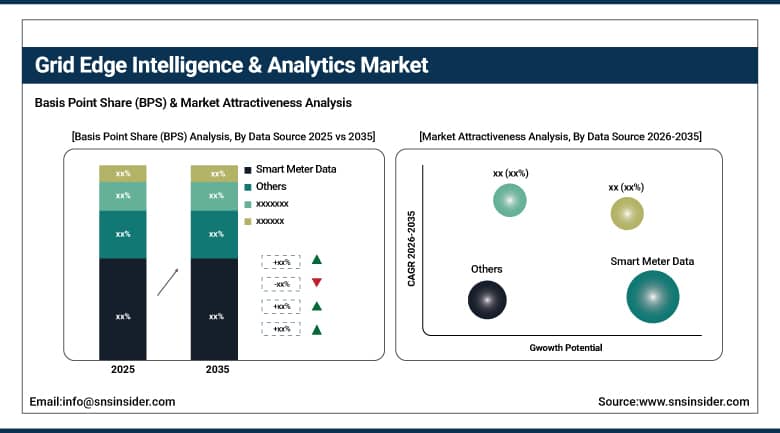
By Data Source, Smart Meter Data led in 2025 with 48% share; Distributed Energy Resource Data is fastest growing.
-
By AI/ML Capability, Predictive Analytics led in 2025 with 52% share; Prescriptive Analytics is fastest growing.
-
By Application, Load & Renewable Forecasting led in 2025 with 34% share; Asset Health Monitoring & Predictive Maintenance is fastest growing.
-
By Deployment Model, Cloud-Based led in 2025 is the fastest growing with 49% share.
By Data Source Smart Meter Data Leads, DER Data Grows Fastest
Smart Meter Data dominated the Grid Edge Intelligence & Analytics Market in 2025 because more than a billion smart meters deployed worldwide generate granular consumption data at 15-minute, hourly, or daily intervals, making this data source the foundational input on which every other analytics application is built. This data source has been used by utilities for the longest sustained period of operational deployment in this space, thereby becoming the most bankable route for grid analytics procurement. Further advances made by technology companies like Oracle with its utility analytics platform and Itron with its meter-data-management suite have made smart meter data more dominant than any other data source, supported by well-defined use cases spanning load forecasting, non-technical loss detection, and customer segmentation.
Distributed Energy Resource Data is expected to register the fastest growth rate amongst all data sources in the Grid Edge Intelligence & Analytics Market owing to the rapid proliferation of rooftop solar, battery storage, and electric vehicle charging assets that generate telemetry requiring intelligent coordination. Development of the DER forecasting and hosting-capacity analysis platform by the company AutoGrid, which has expanded its coordination capabilities for utilities managing millions of distributed assets, highlights the ongoing commercialization of this type of technology apart from that demonstrated in pilot programs under the governance of regional grid operators and DER aggregators seeking to manage reverse power flow and voltage regulation challenges.
By AI/ML Capability Predictive Analytics Dominates, Prescriptive Analytics Grows Fastest
Predictive Analytics is said to contribute the largest revenue from an AI/ML capability point of view in the Grid Edge Intelligence & Analytics Market in 2025 as machine learning models trained on historical data to forecast equipment failures, load conditions, and renewable generation form the backbone of any investment that should be made in grid analytics platforms for their completion. It is the emphasis of the developers on the acquisition of models capable of forecasting failures days to weeks in advance for their analytics platforms which makes it the dominating revenue source for the grid analytics technology stack despite the advancement in the prescriptive analytics software segment, with technology providers continuing to invest in explainable AI to secure long-term utility contracts against ongoing regulatory transparency requirements.
The Prescriptive Analytics category of the Grid Edge Intelligence & Analytics market is anticipated to witness the fastest growth rate during the forecast period due to the shift from forecasting future conditions to recommending optimal actions, such as maintenance scheduling, DER dispatch, and outage restoration priorities, automatically, without extensive manual analysis. The autonomous decision-support platform jointly deployed by C3.ai and its utility partners is an example of this, as the fusion of prescriptive AI with state-of-the-art optimization algorithms enables operators to treat grid analytics as a continuously self-optimizing system.
By Application Load & Renewable Forecasting Leads, Asset Health Monitoring Grows Fastest
The Load & Renewable Forecasting segment held the leading position in the Grid Edge Intelligence & Analytics Market in 2025, owing to the large number of utilities that depend on accurate short-term, medium-term, and long-term forecasts for unit commitment, dispatch, and capacity planning. The application segment has the advantage of leveraging existing SCADA and EMS infrastructure and business models of developers such as Landis+Gyr's forecasting-integrated meter analytics platform. The load and renewable forecasting application segment is the most funded application segment amongst all the grid analytics vendors globally, supported by continuing improvements in forecast accuracy of 10 to 20 percent.
The Asset Health Monitoring & Predictive Maintenance application segment represents the fastest growing application segment within the Grid Edge Intelligence & Analytics Market. It has been gaining a lot of attention from utility operators that are looking to reduce maintenance costs by 20 to 40 percent and cut unplanned outages tied to aging infrastructure, which are not feasible to manage without predictive analytics platforms. The work done by Hitachi Energy in deploying thermal analysis and partial discharge monitoring alongside its grid analytics suite is a testament to the importance of the idea of predictive asset health monitoring in grid edge intelligence development.
By Deployment Model Cloud-Based Deployment Dominates, Edge-Based Gains Fastest Traction
The Cloud-Based deployment model was at the forefront of the deployment model segment share in the Grid Edge Intelligence & Analytics Market in 2025 because utilities have been sponsoring most of the major analytics procurement programs carried out for scalability, cost-effective infrastructure, and advanced AI/ML capabilities across massive data volumes. The large-scale utility investment in the United States, European Union, and China indicates that cloud-funded programs are considering grid edge analytics for securing their future operational efficiency requirements, and hence are the main driving forces in the adoption of grid edge intelligence technology.
Regional Analysis:
|
Region |
Major Country |
Share within Region, 2025 (%) |
|---|---|---|
|
North America |
United States |
85.00% |
|
Europe |
Germany |
26.00% |
|
Asia Pacific |
China |
44.00% |
|
Middle East and Africa |
Saudi Arabia |
25.00% |
|
Latin America |
Brazil |
50.00% |
North America Grid Edge Intelligence & Analytics Market Insights
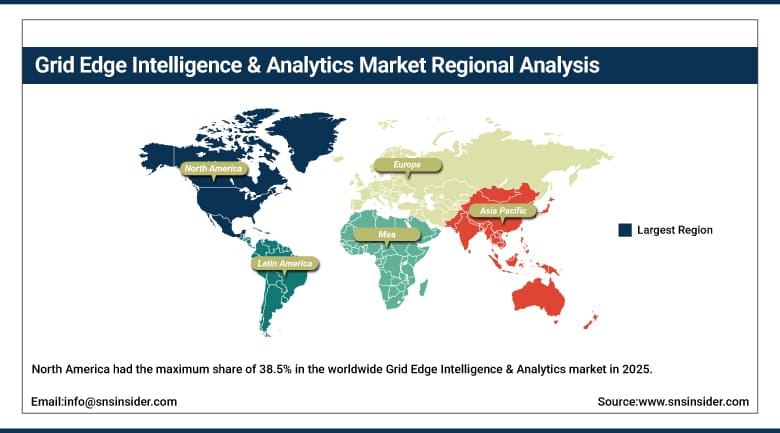
North America had the maximum share of 38.5% in the worldwide Grid Edge Intelligence & Analytics market in 2025. This was possible due to the growth in investments made by utilities into mature smart grid infrastructure generating massive data volumes, presence of the best funded grid analytics vendors globally, and consistent investments into advanced utility analytics adoption. A good relationship between the analytics software vendors, meter manufacturers, and utility companies working towards utilizing the output from the analytics platforms in their home country has also played an important role, alongside expanding regulatory frameworks that encourage grid modernization and innovation.
The United States accounted for around 85.0% of the total revenue market share of North America because of its presence and continuous raising of funds by C3.ai, Oracle, and Itron, along with analytics procurement agreements made by utilities like Pacific Gas & Electric and Southern California Edison. Increased budgeting for grid modernization by the Department of Energy and involvement of Canada through utility digital transformation projects contributed to North America's dominant position in the market.
Get Customized Report as Per Your Business Requirement - Enquiry Now
Europe Grid Edge Intelligence & Analytics Market Insights
Europe had a sustainable market share in the global revenue generation from the Grid Edge Intelligence & Analytics Market because of the need for renewable integration analytics driven by high penetration of solar and wind energy, along with the Energiewende and broader energy transition requiring sophisticated grid intelligence. The increased collaboration between the public and private sectors through agencies like the German Federal Network Agency and the UK's National Energy System Operator has encouraged the developers in Europe to focus on scalable forecasting and optimization solutions capable of managing distributed energy resource complexity across increasingly congested transmission networks.
Germany emerged to be the most demanding market amongst all other European countries, generating almost 26.0% of Europe's total revenue because of significant investment made in renewable integration analytics clusters and the presence of production facilities of Siemens AG, Schneider Electric, and ABB companies in the country. Another significant contributor to market demands in the region was Nordic utilities, which are providing significant contributions to regional market demand owing to their focus on advanced analytics for managing distributed generation and automating the grid. The rising demands of grid edge intelligence technology in Europe are expected to increase in future.
Asia Pacific Grid Edge Intelligence & Analytics Market Insights
The Asia-Pacific region is experiencing the fastest growth rate among all the other regions analyzed in the market, with the expected CAGR of 19.5% for 2026-2035 owing to massive smart meter deployments in China and India, grid modernization initiatives creating vast data infrastructure, and significant development of AI and analytics technology in the region. The sum effect of various factors discussed above guaranteed the fact that this region experienced the fastest growth rate compared to all other regions analyzed in the report.
This category was dominated by China owing to State Grid Corporation and Southern Power Grid deploying advanced analytics platforms backed by government mandates for intelligent grid management, making up for 44.0% of the revenues of the region. The other countries that have contributed to this result include India because of its Smart Grid Mission and utility modernization programs, and South Korea because of its utility digital transformation initiatives supported by regional analytics vendors.
MEA and Latin America Grid Edge Intelligence & Analytics Market Insights
Grid Edge Intelligence & Analytics Market in the Middle East, Africa, and Latin America exhibited consistent growth due to the growing number of utilities modernizing infrastructure and deploying smart meters on an unprecedented scale, the involvement of governments in smart grid promotion policies in the long run, and the cooperation between utilities of these regions and international grid analytics technology providers. The early adoption of greenfield analytics architectures was increasingly gaining importance as a strategically vital aspect for the digital transformation projects implemented in the regions due to the absence of legacy system constraints that allow for optimal analytics deployment.
In ME&A, Saudi Arabia was the biggest country market in terms of the market because of its increased advanced energy technology investments through its sovereign wealth funds, as well as increased grid analytics project partnerships. In addition, within ME&A, there were contributions from the implementation of smart grid policies within the UAE. Within LATAM, the biggest revenue generator was Brazil as a result of its large number of utility digital transformation initiatives and increased smart meter deployment programs.
Market Dynamics:
Growth Drivers: Exponential Grid Data Growth and Utility Cost Reduction Pressures
The market is driving because of the rise of smart meters, sensors, and grid monitoring devices creating huge amounts of operational data that overwhelm traditional utility analytics, increased usage of AI-based predictive analytics platforms, increased investments in big data architectures and distributed processing, and an expanded set of applications, such as asset health monitoring, load forecasting, and non-technical loss detection. As more and more utilities are making announcements of digital transformation strategies for future operational efficiency, the need for concrete data infrastructure and analytics platforms will guarantee that the ability to raise funds by developers stays high throughout the supply chain.
Increasing collaboration among grid analytics vendors and utilities, along with increasing dedication from utilities to acquire predictive maintenance capabilities that reduce emergency repair costs by 20 to 40 percent, constitute additional supporting evidence for this trend. Capital investment by venture and infrastructure investors in the development of AI-driven and cloud-based analytics platforms is adding to the growing baseline capability, and this is all adding up to ever-increasing demand during the forecast period, particularly as utilities face constant pressure to cut operational costs while maintaining service quality.
Restraints: Data Integration Complexity and Cybersecurity Concerns
The high level of complexity in integrating analytics platforms with legacy operational systems remains a constraint for the further rapid development of the market since utilities managing petabytes of data each year require sophisticated big data architectures before any profits are made from the venture. It is owing to this reason that the leading-edge grid analytics technology is developed only by well-funded companies that have access to venture capital or corporate funding as shown in the case of several analytics vendors scaling AI infrastructure in 2025.
Technical uncertainty around cybersecurity remains a challenge because grid analytics platforms handling sensitive operational and customer data continue to require rigorous security engineering, and regulatory compliance requirements have grown more stringent following increased scrutiny of utility data practices; thus, investment into these technologies needs to occur alongside continued security certification work. It is a challenge that can be solved through federated learning and explainable AI approaches, which is a dynamic process requiring large amounts of funding from both analytics vendors and utility cybersecurity teams within the industry.
Opportunities: DER Integration and Emerging Markets Digital Transformation
Increased funding in distributed energy resource forecasting and coordination platforms becomes a major trend as developers commit to long-term analytics optimization contracts, in which the entire system is built, that includes DER output forecasting, hosting capacity analysis, and aggregation and coordination. Companies that are capable of attracting early customers of their analytics platforms, such as AutoGrid with its contracts with major utilities, will be able to claim a sizable market share as they move from single project demonstrations to fleet-scale analytics portfolios.
A third potential opportunity is presented by the digital transformation of utilities in emerging markets, because greenfield deployments in Asia-Pacific, Latin America, the Middle East, and Africa that lack legacy system constraints are actively searching for comprehensive analytics platforms from the outset of deployment. Those developers who can show credibility of platform scalability across large, rapidly modernizing utility networks will get substantial market share.
Recent Developments:
-
2026: C3.ai launched an expanded version of its C3 AI Reliability application with new prescriptive maintenance-scheduling capabilities for utility-scale distribution networks.
-
2026: Itron expanded its Itron Enterprise Edition analytics suite with a new distributed energy resource forecasting module for utilities managing high solar penetration.
Grid Edge Intelligence & Analytics Market key players are:
-
C3.ai Inc.
-
Oracle Corporation
-
Itron Inc.
-
Landis+Gyr Group AG
-
AutoGrid Systems Inc.
-
Bidgely Inc.
-
Sense (Sense Labs Inc.)
-
Grid4C (Innowatts)
-
Space-Time Insight (Nokia)
-
Uplight Inc.
-
Copper Labs Inc.
-
Renew Home
-
Whisker Labs Inc.
-
Open Systems International Inc. (Emerson)
-
General Electric Company
-
Siemens AG
-
Schneider Electric SE
-
ABB Ltd.
-
Hitachi Energy Ltd.
-
Eaton Corporation
Grid Edge Intelligence & Analytics Market Report Scope:
| Report Attributes | Details |
|---|---|
| Market Size in 2025 | USD 2.15 Billion |
| Market Size by 2035 | USD 9.7 Billion |
| CAGR | 16.3% from 2026 to 2035 |
| Base Year | 2025 |
| Forecast Period | 2026-2035 |
| Historical Data | 2022-2024 |
| Report Scope & Coverage | Market Size, Segments Analysis, Competitive Landscape, Regional Analysis, DROC & SWOT Analysis, Forecast Outlook |
| Key Segments | •By Data Source (Smart Meter Data, Sensor & Monitoring Data, Distributed Energy Resource Data, Others) •By AI/ML Capability (Predictive Analytics, Prescriptive Analytics, Descriptive & Diagnostic Analytics, Others) •By Application (Asset Health Monitoring & Predictive Maintenance, Load & Renewable Forecasting, Non-Technical Loss Detection, Distributed Energy Resource Optimization, Others) •By Deployment Model (Cloud-Based, On-Premises, Hybrid) |
| Regional Analysis/Coverage | North America (US, Canada), Europe (Germany, UK, France, Italy, Spain, Russia, Poland, Rest of Europe), Asia Pacific (China, India, Japan, South Korea, Australia, ASEAN Countries, Rest of Asia Pacific), Middle East & Africa (UAE, Saudi Arabia, Qatar, South Africa, Rest of Middle East & Africa), Latin America (Brazil, Argentina, Mexico, Colombia, Rest of Latin America). |
| Company Profiles | C3.ai Inc., Oracle Corporation, Itron Inc., Landis+Gyr Group AG, AutoGrid Systems Inc., Bidgely Inc., Sense (Sense Labs Inc.), Grid4C (Innowatts), Space-Time Insight (Nokia), Uplight Inc., Copper Labs Inc., Renew Home, Whisker Labs Inc., Open Systems International Inc. (Emerson), General Electric Company, Siemens AG, Schneider Electric SE, ABB Ltd., Hitachi Energy Ltd., Eaton Corporation |

Frequently Asked Questions
Key players in the Grid Edge Intelligence & Analytics Market include C3.ai Inc., Oracle Corporation, Itron Inc., Landis+Gyr Group AG, AutoGrid Systems Inc., and Siemens AG, among others.
Key opportunities in the grid edge intelligence & analytics market include distributed energy resource integration and optimization platforms and growth in emerging markets utility digital transformation and expansion of analytics-as-a-service business models.
The market is driven by exponential grid data growth from smart meter and sensor deployments, increasing adoption of AI-based predictive analytics platforms, and growing utility operational efficiency and cost reduction pressures.
The Smart Meter Data segment dominated the Grid Edge Intelligence & Analytics Market, accounting for approximately 48% market share.
The North America region dominated the Grid Edge Intelligence & Analytics Market in 2025 with a 38.5% share, driven by mature smart grid infrastructure and advanced utility analytics adoption.
