
Building-to-Grid Technology Market Report Scope and Overview:
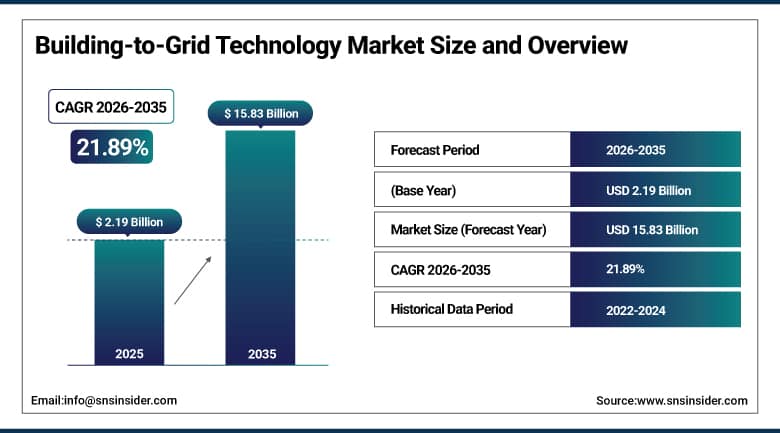
The Building-to-Grid Technology Market was valued at USD 2.19 Billion in 2025 and is projected to reach USD 15.83 Billion by 2035, registering a CAGR of 21.89% from 2026 to 2035.
Building-to-grid technology is a revolution that will transform how commercial, industrial, and residential buildings are connected to the electricity grid due to the emergence of smart metering, demand response technology, building energy management technology, and distributed energy generation from within the building. The Building-to-Grid Technology Market can be described as a trend that is witnessing more and more two-way communication between the building and the utility firm, the use of artificial intelligence software to balance the load, the installation of rooftop solar panels and batteries, and managing peak loads through demand response.
In August 2026, Trane Technologies, emphasized how AI-powered smart buildings help save energy, reduce emissions, and actively contribute to grid balancing through intelligent controls, thereby adding to the growing importance of buildings as energy resources.
To Get More Information On Building-to-Grid Technology Market - Request Free Sample Report
Building-to-Grid Technology Market Trends
-
Expanding two-way communication between smart meters and utility distribution management systems continues improving real-time load visibility.
-
Growing adoption of AI-driven building energy management software continues accelerating automated demand response participation.
-
Rising deployment of on-site solar and battery storage continues expanding buildings’ role as active grid balancing resources.
-
Increasing utility incentive programs for grid-interactive efficient buildings continue strengthening commercial and industrial enrollment rates.
-
Growing interoperability between building automation platforms and IoT ecosystems continues reducing integration costs for grid-edge deployments.
U.S. Building-to-Grid Technology Market Size Outlook
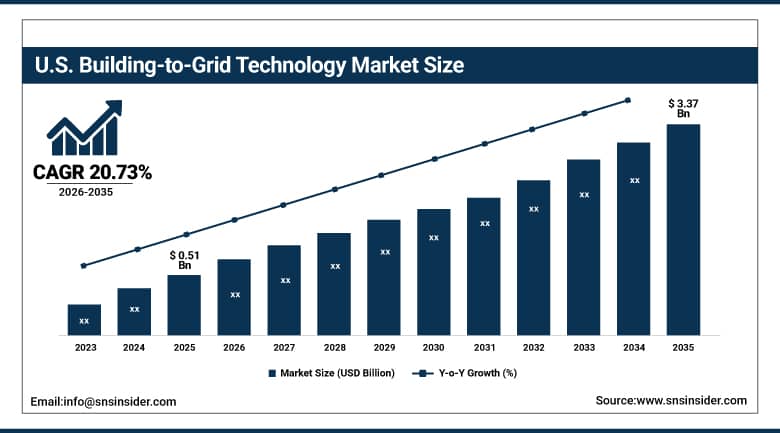
The U.S. Building-to-Grid Technology Market was valued at approximately USD 0.51 Billion in 2025 and is projected to reach approximately USD 3.37 Billion by 2035, registering a CAGR of approximately 20.73% from 2026 to 2035.
The demand in the U.S. was also driven due to huge investment made in grid-interactive efficient building programs, extensive utility rollout of automated demand response infrastructure, and high demand from commercial building owners for AI-driven load optimization platforms that reduce peak demand charges. Deployment of interoperable smart building platforms and adoption of on-site distributed energy resources across major commercial real estate portfolios played an important role in enhancing the status of the U.S. as the largest single-country market for building-to-grid technology. In addition to this, applications of this technology in peak load management, demand response participation, and utility incentive program enrollment were supporting the high domestic demand for this energy management technology.
In 2026, Johnson Controls maintained its support for U.S. establishments through an energy demand response program whereby participating buildings are able to cut down on electricity usage during times when there is high demand or when electricity prices are high.
Building-to-Grid Technology Market Segment Analysis
-
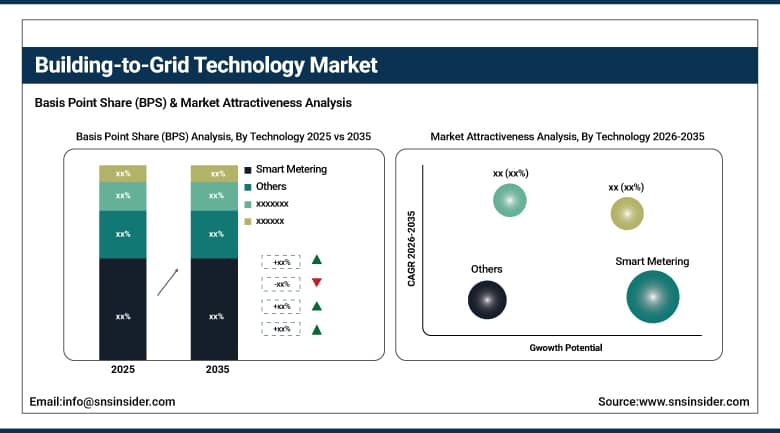
By Technology, Smart Metering segment dominated the Building-to-Grid Technology Market in 2025 with 34% share; Building Energy Management Systems segment is the fastest growing segment, registering a CAGR of 24.2% from 2026 to 2035.
-
By Component, Hardware segment dominated the market in 2025 with 58% share; Software segment is the fastest growing segment, registering a CAGR of 24.8% from 2026 to 2035.
-
By Connectivity, Wired segment dominated the market in 2025 with 54% share; Wireless segment is the fastest growing segment, registering a CAGR of 23.7% from 2026 to 2035.
-
By Application, Demand Response Participation segment dominated the market in 2025 with 41% share; On-Site Renewable Integration segment is the fastest growing segment, registering a CAGR of 24.5% from 2026 to 2035.
-
By End User, Commercial segment dominated the market in 2025 with 44% share; Industrial segment is the fastest growing segment, registering a CAGR of 23.9% from 2026 to 2035.
By Technology, Smart Metering Leads, Building Energy Management Systems Grow Fastest
Smart Metering dominated the Building-to-Grid Technology Market in 2025 due to its foundational role in enabling two-way communication between buildings and utility distribution management systems, a capability that every subsequent demand response or load optimization service depends upon. Utilities have relied on advanced metering infrastructure rollouts for the longest continuous body of deployment experience, making this technology category the most firmly established across grid-interactive building programs currently in place. Continuous advancements from manufacturers such as Itron and Landis+Gyr in terms of granular interval data, cybersecurity, and remote firmware upgrade capabilities have further cemented smart metering’s primacy among all other technology categories pursued by utilities and building owners worldwide.
Building Energy Management Systems are projected to experience the highest growth rate of all technologies within the Building-to-Grid Technology Market as building owners move from static automation schedules toward AI-driven, price- and carbon-responsive control. The joint smart building platform unveiled by ABB and Samsung Electronics in 2026, connecting Samsung’s SmartThings Pro enterprise IoT system with ABB’s Ability Building Pro automation suite, points to the continued growth of this technology category beyond conventional building automation. Growing demand from commercial real estate portfolios for unified energy, comfort, and grid-signal orchestration is spurring accelerated adoption of building energy management platforms.
By Component, Hardware Dominates, Software Grows Fastest
Hardware has contributed the maximum share in terms of component in the Building-to-Grid Technology Market in 2025 since smart meters, controllers, sensors, and communication gateways constitute the core capital expenditure that any building must install before software and services can be layered on top of it. The focus of utilities and building owners on procuring and installing metering and control hardware in their grid-interactivity retrofit projects is the key reason behind the dominance of this component in terms of revenues earned across the supply chain despite rapid advancements in the energy management software segment.
The Software component of the Building-to-Grid Technology Market is expected to record the highest growth rate over the forecast period as building owners move from standalone hardware installations to subscription-based analytics and automated demand response orchestration platforms. Siemens’ 2026 showcase of its Desigo CC and Building X AI-enabled applications at AHR Expo, integrating connected HVAC devices with cloud-based digital platforms, is one such example where the combination of AI and cloud software helps building operators manage grid interactivity as a single orchestrated system.
By Connectivity, Wired Leads, Wireless Grows Fastest
Wired connectivity dominated the Building-to-Grid Technology Market in 2025 owing to its established reliability, lower cybersecurity exposure, and compatibility with legacy building electrical and metering infrastructure already installed across commercial and industrial facilities. Utilities and system integrators have continued to favor wired backbones for mission-critical demand response signaling in large commercial and institutional buildings, and this continued preference for proven, low-latency communication links reflects the industry’s cautious approach toward retrofitting older building stock with new connectivity standards.
Wireless connectivity is anticipated to become the fastest-growing connectivity category within the Building-to-Grid Technology Market as building owners increasingly favor low-cost, easily scalable IoT sensor networks over expensive structured cabling retrofits. The growing use of wireless occupancy, temperature, and load sensors integrated through platforms such as Samsung’s SmartThings Pro has intensified interest in wireless-first building deployments, positioning this connectivity category for accelerated adoption as residential and light commercial grid-interactive programs scale.
By Application, Demand Response Participation Leads, On-Site Renewable Integration Grows Fastest
Demand Response Participation was the biggest application segment in the Building-to-Grid Technology Market in 2025, due to the extensive pipeline of utility incentive programs compensating commercial and industrial buildings for reducing or shifting electricity consumption during peak demand periods. This application segment is able to leverage already mature utility program infrastructure and established payment settlement models, making it the best funded application segment among building-to-grid technology providers worldwide.
The On-Site Renewable Integration application segment is the fastest-growing application segment of the Building-to-Grid Technology Market. It is experiencing increasing interest from building owners seeking to pair rooftop solar and battery storage systems with grid-interactive controls that can shift generation and consumption in response to price signals. This growing pairing of distributed generation with intelligent building controls shows just how essential the concept of on-site renewable integration has become to the commercial viability case for grid-interactive building deployments.
By End User, Commercial Dominates, Industrial Gains Fastest Traction
The commercial segment dominated the share of end-users of the Building-to-Grid Technology Market in 2025 owing to the fact that office towers, retail portfolios, and institutional campuses continue to represent the largest concentration of buildings enrolled in utility demand response and energy management programs. The large-scale adoption of building energy management platforms such as Johnson Controls’ OpenBlue and Siemens’ Building X across commercial real estate portfolios signifies that building owners are integrating grid-interactive technologies into their long-term operating cost and sustainability planning.
Industrial is likely to emerge as the fastest-growing end-user of the Building-to-Grid Technology Market owing to the fact that manufacturing facilities are increasingly deploying advanced metering infrastructure, energy management systems, and on-site renewable generation to reduce peak load charges and participate in demand response markets. The growing trend of industrial facilities pairing production scheduling with grid signal responsiveness is the reason why this end-user segment is growing faster than others.
Regional Analysis:
|
Region |
Major Country |
Share within Region, 2025 (%) |
|---|---|---|
|
North America |
United States |
85.40% |
|
Europe |
Germany |
24.70% |
|
Asia Pacific |
China |
38.60% |
|
Middle East and Africa |
UAE |
34.50% |
|
Latin America |
Brazil |
35.20% |
North America Building-to-Grid Technology Market Insights
North America maintained a sustainable market share in the worldwide revenue of the Building-to-Grid Technology Market due to mature utility demand response program infrastructure, strong presence of established building automation vendors, and continued federal and state-level support for grid-interactive efficient building initiatives. Increased utility investment in avoiding costly grid infrastructure upgrades by leveraging flexible building loads has also motivated developers in North America to invest in scalable metering and energy management platform solutions, helping the region secure its role as a mature demand response market.
The U.S. held major share of the total revenue of North America largely on account of strong presence and adoption of Johnson Controls’ OpenBlue, Honeywell’s Forge AI Agent, and Schneider Electric’s grid-edge platforms across commercial real estate portfolios. Expansion in utility-funded grid-interactive efficient building programs in Canada helped the region make substantial contributions towards North America’s position in the market.
Europe Building-to-Grid Technology Market Insights
Europe maintained a steady market share in the worldwide revenue of the Building-to-Grid Technology Market due to strict building energy performance regulations, ambitious national decarbonization strategies, and significant investments made in building automation and demand-side flexibility programs across the continent. Increased regulatory pressure through frameworks such as the EU Energy Performance of Buildings Directive has also motivated developers in Europe to invest in interoperable metering and control technology solutions, helping the region secure its role as a policy-driven grid-interactive building market.
Germany had the largest market demand among European countries due to considerable investments in building energy management infrastructure and the presence of Siemens’ Desigo and Building X platform development and testing facilities within its boundaries. The United Kingdom and France were other important countries making significant contributions to regional market demand through utility-led demand flexibility programs. Europe’s increasing demand for building-to-grid technology is expected to continue due to national net-zero building commitments across the region.
Asia Pacific Building-to-Grid Technology Market Insights
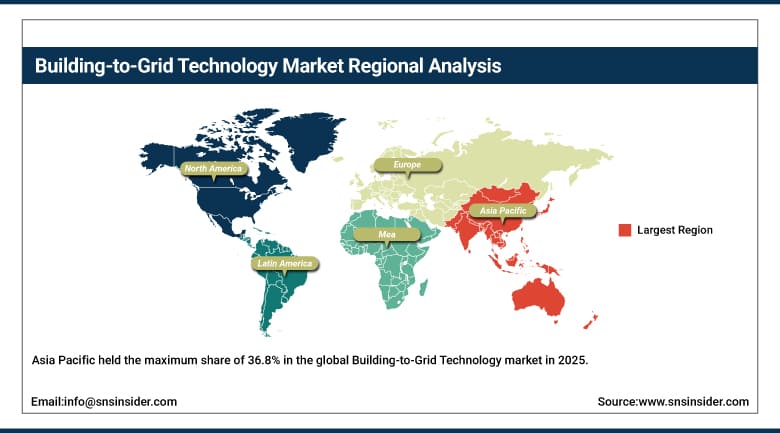
Asia Pacific held the maximum share of 36.8% in the global Building-to-Grid Technology market in 2025. The growth was driven by rapid smart city and smart metering rollouts, aggressive government mandates for grid modernization, and large-scale urbanization pushing utilities and building developers to adopt two-way grid-interactive infrastructure across newly constructed commercial and residential developments. The close collaboration between metering hardware manufacturers, building automation providers, and state-backed utility programs operating in the domestic environment also helped the region maintain its dominance in the market.
China held major share of the total revenue of Asia Pacific largely on account of strong presence and continued rollout of nationwide smart metering infrastructure and government-backed building energy efficiency mandates. Expansion of grid-interactive building pilot programs in Singapore and Japan, together with India’s growing utility digitalization initiatives, helped the region make substantial contributions towards the dominance of Asia Pacific in the market.
Get Customized Report as Per Your Business Requirement - Enquiry Now
MEA and Latin America Building-to-Grid Technology Market Insights
The Middle East and Africa region is witnessing the highest rate of growth among all other regions covered in the market, projected to register a CAGR of 15.4% during 2026 to 2035, due to large-scale smart city developments, sovereign investment in grid modernization, and rapid commercial construction activity requiring grid-interactive building infrastructure from the ground up. Latin America is also showing steady growth driven by growing utility interest in demand-side flexibility programs and expanding commercial real estate development across the region.
In ME&A, the UAE was the largest country market since it has an increasing advanced building technology investment plan tied to large-scale smart city developments and sovereign wealth-backed real estate projects. In LATAM, the largest revenue generating country was Brazil due to its large commercial real estate base and growing interest in utility demand response pilot programs.
Market Dynamics:
Growth Drivers: Rising Utility Demand Response Programs and Expanding Grid-Interactive Building Retrofits
The market is propelling due to the growing utility investment in demand response infrastructure to avoid costly grid capacity upgrades, greater deployment of AI-driven building energy management software, greater adoption of on-site solar and battery storage, and a growing range of use cases including peak load management, demand response participation, and grid balancing. With an increasing number of building owners enrolling in utility incentive programs, the demand for interoperable metering and control platforms will ensure that the capacity for deployments remains high across the supply chain.
The growing number of collaborations between building automation vendors and utilities, together with growing commitment from commercial real estate portfolios to reduce operating costs and meet sustainability disclosure requirements, provides further evidence in favor of this trend. Regulatory mandates requiring new construction to include grid-interactive readiness are also contributing to the increase in baseline deployment capabilities, and all those factors combine into constantly increasing demand throughout the forecast period.
Restraints: High Retrofit Costs and Interoperability Challenges Across Legacy Building Systems
High retrofit costs continue to be an actual constraint for the faster development of the market because older commercial and residential buildings require significant investment in metering, control, and communication infrastructure before grid-interactive capabilities can be enabled. Such a situation has resulted in the fastest adoption being concentrated among newly constructed buildings and large commercial portfolios with access to capital, leaving smaller building owners and older housing stock at a disadvantage in terms of participation in grid-interactive programs.
Interoperability challenges across legacy building automation systems, proprietary communication protocols, and varying utility program requirements continue to pose a problem as building owners must integrate multiple vendor platforms to achieve full grid-interactive functionality. The issue needs to be addressed through continued adoption of open standards such as OpenADR, and it is an evolving process that requires coordinated effort from technology vendors, utilities, and regulatory bodies.
Opportunities: AI-Driven Load Optimization and Data Center-Driven Grid Capacity Constraints
The rise in investments into AI-driven load optimization and digital twin technology becomes an important opportunity since building owners start committing to multiyear energy management partnerships where the whole system, consisting of metering data, HVAC control, and on-site generation, is orchestrated together. Those vendors who can secure large commercial portfolio contracts, such as ABB and Samsung’s joint smart building platform, will be able to occupy a significant market share as demand response programs scale from pilot projects to portfolio-wide deployments.
Another major opportunity lies in the rise of data center-driven grid capacity constraints, since utilities in power-constrained regions are increasingly turning to commercial and industrial building flexibility as a lower-cost alternative to new generation capacity. Building-to-grid technology vendors capable of demonstrating measurable peak load reduction will be able to obtain a significant share of new utility program contracts.
Recent Developments:
-
2026: ABB and Samsung Electronics unveiled a joint smart building platform connecting Samsung’s SmartThings Pro enterprise IoT system with ABB’s Ability Building Pro automation suite, with proof-of-concept trials launched at three European sites.
-
2026: Siemens showcased its Desigo CC V9, Desigo Optic V5.2, and AI-enabled Building X applications at AHR Expo 2026, integrating connected HVAC devices with cloud-based digital platforms for grid-interactive building operations.
-
2026: Automated Logic continued advancing intelligent building controls and predictive analytics that forecast energy-use patterns, supporting more efficient building operation and improved coordination between building loads and energy systems.
Building-to-Grid Technology Companies are:
-
Schneider Electric SE
-
Johnson Controls International plc
-
Honeywell International Inc.
-
ABB Ltd
-
Carrier Global Corporation (Automated Logic Corporation)
-
Emerson Electric Co.
-
Itron, Inc.
-
Landis+Gyr Group AG
-
Enel X North America, Inc.
-
Uplight, Inc.
-
Distech Controls Inc.
-
Tridium, Inc.
-
Buildings IOT, Inc.
-
Verdigris Technologies, Inc.
-
Voltus, Inc.
-
GridPoint, Inc.
-
Bidgely Inc.
-
Samsung Electronics Co., Ltd.
Building-to-Grid Technology Market Report Scope:
| Report Attributes | Details |
|---|---|
| Market Size in 2025 | USD 2.19 Billion |
| Market Size by 2035 | USD 15.83 Billion |
| CAGR | 21.89% from 2026 to 2035 |
| Base Year | 2025 |
| Forecast Period | 2026-2035 |
| Historical Data | 2022-2024 |
| Report Scope & Coverage | Market Size, Segments Analysis, Competitive Landscape, Regional Analysis, DROC & SWOT Analysis, Forecast Outlook |
| Key Segments |
• By Technology (Smart Metering, Building Energy Management Systems, Demand Response Systems, Distributed Energy Resource Integration, Others) • By Component (Hardware, Software, Service) • By Connectivity (Wired, Wireless) • By Application (Demand Response Participation, On-Site Renewable Integration, Peak Load Management, Energy Storage Optimization)
• By End User (Commercial, Industrial, Residential, Government & Institutional)
|
| Regional Analysis/Coverage | North America (US, Canada), Europe (Germany, UK, France, Italy, Spain, Russia, Poland, Rest of Europe), Asia Pacific (China, India, Japan, South Korea, Australia, ASEAN Countries, Rest of Asia Pacific), Middle East & Africa (UAE, Saudi Arabia, Qatar, South Africa, Rest of Middle East & Africa), Latin America (Brazil, Argentina, Mexico, Colombia, Rest of Latin America). |
| Company Profiles | Schneider Electric SE, Siemens AG, Johnson Controls International plc, Honeywell International Inc., ABB Ltd, Carrier Global Corporation (Automated Logic Corporation), Trane Technologies plc, Emerson Electric Co., Itron, Inc., Landis+Gyr Group AG, Enel X North America, Inc., Uplight, Inc., Distech Controls Inc., Tridium, Inc., Buildings IOT, Inc., Verdigris Technologies, Inc., Voltus, Inc., GridPoint, Inc., Bidgely Inc., Samsung Electronics Co., Ltd. |

Frequently Asked Questions
Key players include Schneider Electric SE, Siemens AG, Johnson Controls International plc, Honeywell International Inc., and ABB Ltd, among others.
Key opportunities include rising building electrification, increasing demand for demand-side flexibility, smart energy management adoption, distributed energy integration, and growing grid-interactive building deployments.
The major growth factor is rising utility demand response programs, expanding AI-driven building energy management software adoption, and growing deployment of on-site solar and battery storage integrated with grid-interactive building controls.
The Smart Metering segment dominated the Building-to-Grid Technology Market by technology, representing the largest share of revenue in 2025.
Asia Pacific dominated the building-to-Grid Technology Market in 2025, holding an estimated 36.8% share of total global market revenue.
